
What Owners and Buyers Should Know About GM’s 5.3-Liter Truck V8
Editorial note: Chevy Truck Expert is an independent enthusiast publication and is not affiliated with or endorsed by General Motors.
5.3L EcoTec3 at a glance: the short answer
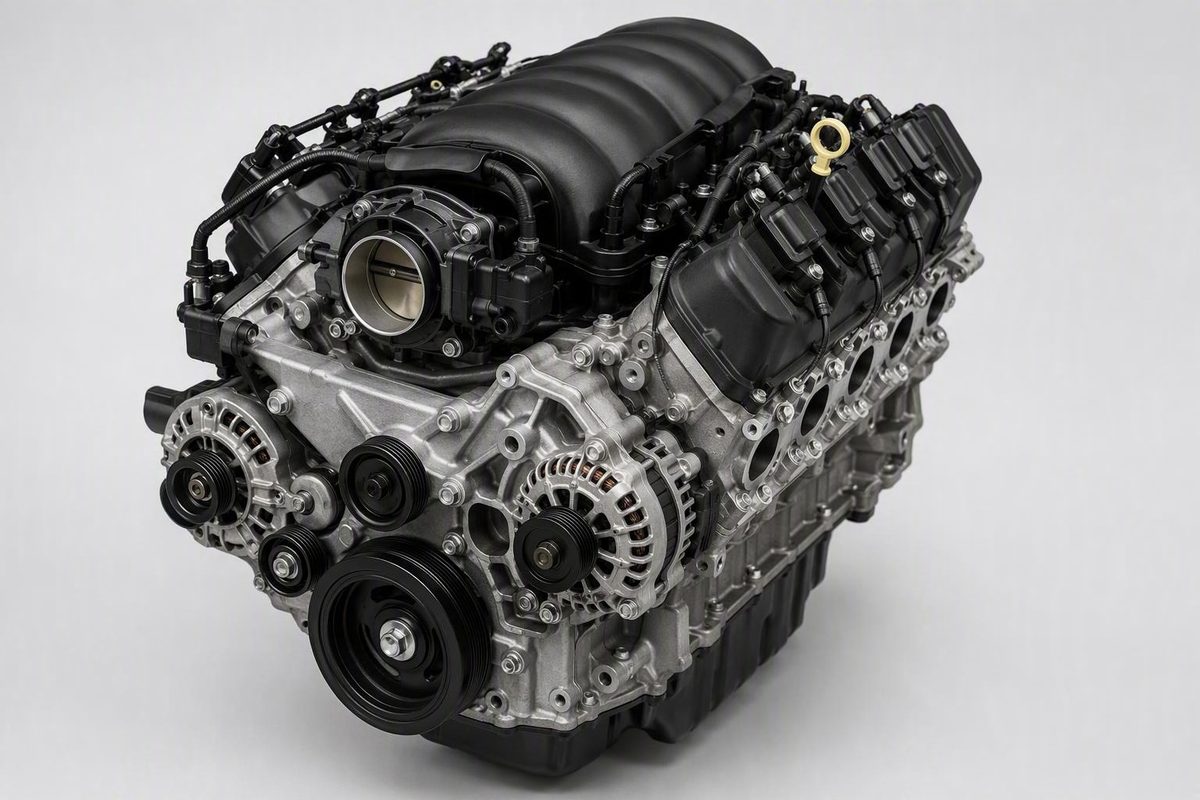
The GM 5.3L EcoTec3 is a family of naturally aspirated gasoline V8 engines used in selected Chevrolet and GMC pickups and full-size SUVs. Introduced for the 2014 model year as the successor to the Vortec truck-engine line, EcoTec3 is the truck-market name associated with GM’s Gen V small-block architecture.
Despite its modern fuel and control systems, the 5.3L EcoTec3 retains a traditional small-block layout. It is a cam-in-block, overhead-valve engine with pushrods and two valves per cylinder—not an overhead-cam V8.
The gasoline output most often associated with the family is 355 horsepower at 5,600 rpm and 383 lb-ft of torque at 4,100 rpm. Those figures appear in both launch-era L83 material and later 5.3L applications, but the engine code, fuel, model year, and vehicle calibration still need to be checked before treating them as definitive for a particular vehicle. The documented L83 specifications list the 355-hp and 383-lb-ft gasoline ratings.
Three technologies define the EcoTec3 approach:
- Direct injection: High-pressure injectors deliver gasoline directly into each combustion chamber.
- Variable valve timing: The engine changes camshaft position to alter valve timing as operating conditions change.
- Cylinder deactivation: Depending on the version, Active Fuel Management or Dynamic Fuel Management reduces the number of cylinders carrying out combustion under suitable light-load conditions.
Versions of the 5.3L EcoTec3 have appeared in selected:
- Chevrolet Silverado 1500
- Chevrolet Tahoe
- Chevrolet Suburban
- GMC Sierra 1500
- GMC Yukon
- GMC Yukon XL
That is a list of vehicle families, not universal fitment. A Silverado or Tahoe identified only by model year may have a different engine, cylinder-deactivation system, transmission, axle ratio, fuel calibration, or equipment package.
The distinction between engine and vehicle specifications is central to this guide. Displacement, architecture, horsepower, and torque can be discussed at engine level. Towing capacity, payload, transmission pairing, fuel economy, trim availability, and approved fuel belong to the complete vehicle configuration.
L83, L82, L84, and L8B: why the engine code matters
“5.3L EcoTec3” does not identify one unchanged engine. The name covers several variants whose hardware and control strategies should not be assumed to be interchangeable.
| Engine code | Broadly reported period or position | Cylinder deactivation | Distinguishing characteristic |
|---|---|---|---|
| L83 | Launch-era EcoTec3; commonly reported for 2014–2019 production | AFM | Principal early Gen V 5.3L EcoTec3 |
| L8B | Limited launch-era applications | AFM-based | Mild-hybrid eAssist derivative |
| L82 | Later variant in selected applications | AFM | Retains four-cylinder deactivation |
| L84 | Commonly reported from approximately 2019 onward in selected applications | DFM | Uses a broader range of active-cylinder patterns |
These periods are third-party, source-reported boundaries rather than a definitive GM fitment catalog. The underlying variant overview distinguishes the L83, L8B, L82, and L84, but changeovers did not necessarily occur at the same time in every pickup, SUV, drivetrain, market, or production configuration.
L83: the launch-era reference point
The L83 is the version most closely associated with the original EcoTec3 launch. It uses Active Fuel Management, or AFM, which deactivates four cylinders under suitable light-load conditions. In practical terms, the engine alternates between V8 and V4 operation rather than selecting among numerous active-cylinder combinations.
The commonly reported 2014–2019 production period is a useful research starting point, not an infallible fitment rule. Pickup and SUV schedules can differ, and production date, drivetrain, market, or fleet specification can complicate assumptions based on model year alone.
L8B: the eAssist derivative
The L8B is a mild-hybrid derivative that combined a 5.3L V8 with GM’s eAssist system in limited applications. It belongs in the variant map because the code may appear during used-vehicle research, but its battery, motor assistance, controls, and transmission integration make it more than an L83 with a different badge.
A buyer considering an L8B-equipped vehicle should assess the complete hybrid system, not just the gasoline engine. That includes the condition and service history of the electrical assistance hardware and its integration with the powertrain.
L82 and L84: later engines with different strategies
The L82 is a later 5.3L variant associated with AFM. The L84 is associated with Dynamic Fuel Management, or DFM. Unlike AFM’s conventional V8-to-V4 strategy, DFM can command a broader selection of active-cylinder patterns according to load and operating conditions.
Commercial engine-family tables generally place the L83 in the 2014–2019 period and the L84 from approximately 2019 onward, but those boundaries remain broad third-party guidance rather than vehicle-specific proof. A later model year does not by itself establish that a truck or SUV has an L84, and not every vehicle line changed engines simultaneously.
How to identify the engine accurately
Use the model year and vehicle family to narrow the possibilities, then confirm the installed engine through vehicle-specific records:
- Locate the original build sheet or equipment record.
- Request VIN-linked build information from a qualified Chevrolet, GMC, or GM parts or service department.
- Check vehicle-specific production or RPO documentation.
- Inspect applicable emissions and powertrain labels.
- Confirm the result through professional service information or a parts-catalog lookup.
An online VIN decoder can be a useful lead, but its result should agree with the build record and installed hardware. Avoid relying on an unsupported universal VIN-digit or RPO formula.
Do not automatically apply L83 information to an L84. Oil capacity, approved fuel, maintenance instructions, cylinder-deactivation operation, transmission pairing, diagnostic procedures, and service information may differ even when the engines share the familiar output rating.
Official GM fitment records, owner manuals, order guides, and service documents were not included in the evidence available for this article. Consequently, the broad periods above should be used to guide identification—not to order parts or choose service specifications without vehicle-specific confirmation.
Inside the engine: architecture and EcoTec3 technology
The L83 offers the clearest documented baseline for understanding the 5.3L EcoTec3 family. It displaces 5,328 cc, commonly rounded to 5.3 liters, or 325 cubic inches. Its bore is 3.78 inches, its stroke is 3.62 inches, and its compression ratio is 11.0:1, according to the published L83 specification reference.
Block, heads, and rotating assembly
The documented L83 design uses an aluminum cylinder block with cast-in iron cylinder liners and aluminum cylinder heads. Its construction includes a forged-steel crankshaft, aluminum pistons, hydraulic roller lifters, piston oil jets, and a variable-displacement oil pump.
The iron liners provide cylinder running surfaces within the aluminum block. Piston oil jets direct oil toward the undersides of the pistons for cooling and lubrication. The variable-displacement pump allows oil delivery to respond to operating conditions rather than remaining fixed.
These details describe the L83 baseline. They are not a complete interchange guide for every 5.3L EcoTec3 code.
Why it is a pushrod V8
A single camshaft sits in the block rather than above the cylinder heads. Its lobes act on lifters, which move pushrods. The pushrods operate rocker arms, and the rocker arms open the intake and exhaust valves.
The engine has two valves per cylinder—one intake and one exhaust—for 16 valves in total. These construction details are included in the independent L83 technical overview.
Direct injection and electronic controls modernize fuel delivery and operation, but they do not change the underlying pushrod layout.
Direct injection
A port-injected engine sprays fuel into an intake port upstream of the intake valve. The EcoTec3 direct-injection system instead uses a high-pressure injector to deliver fuel directly into the combustion chamber.
This gives the control system substantial authority over injection timing and fuel delivery. It also means gasoline does not routinely pass across the back of the intake valves, an important distinction when considering intake deposits later in the vehicle’s life.
The system involves both ordinary low-pressure fuel supply and high-pressure delivery to the injectors.
Variable valve timing
Variable valve timing changes the angular relationship between the camshaft and crankshaft.
Because this is a single-cam pushrod engine, the system phases that camshaft rather than controlling separate intake and exhaust camshafts as some overhead-cam engines do. It nevertheless gives the engine more flexibility than fixed valve timing.
Active Fuel Management
In the L83, AFM uses engine-oil pressure and electronic commands to deactivate selected lifters. When operating conditions permit, four cylinders stop carrying out normal combustion cycles and the engine enters V4 operation. When more torque is requested, the system restores V8 operation.
AFM does more than shut off fuel injectors. The system must also prevent the selected cylinders’ valves from following their normal lift events, which is why special lifters and oil control are integral to its operation.
Drivers may perceive transitions differently depending on calibration, exhaust configuration, road load, and vehicle condition. It is therefore inappropriate to promise that cylinder deactivation will be imperceptible in every vehicle.
Dynamic Fuel Management
DFM expands the cylinder-deactivation concept. In later L84 applications, the control system can select among more active-cylinder patterns rather than switching only between eight and four cylinders. Current-application descriptions state that DFM may operate with as few as two active cylinders under suitable light-load conditions (current L84 overview).
That does not mean the engine remains in two-cylinder operation whenever the vehicle cruises. The active pattern changes as torque demand and operating conditions change.
Vehicles, model years, fuel, and output
The L83 was used broadly in GM’s launch-era half-ton pickups and full-size SUVs. This application table is deliberately general because vehicle name and model year alone do not prove the installed engine.
| Vehicle family | Broad L83 association | Qualification |
|---|---|---|
| Chevrolet Silverado 1500 | Launch-era EcoTec3 pickups | Availability varied by year, trim, drivetrain, and market |
| GMC Sierra 1500 | Launch-era EcoTec3 pickups | The engine does not identify the transmission or axle ratio |
| Chevrolet Tahoe | Launch-era EcoTec3 SUVs | Later examples may use a different 5.3L code |
| Chevrolet Suburban | Launch-era EcoTec3 SUVs | Fuel and equipment specifications remain vehicle-specific |
| GMC Yukon | Launch-era EcoTec3 SUVs | Confirm the build record rather than relying on the model name |
| GMC Yukon XL | Launch-era EcoTec3 SUVs | Body style does not establish the engine code |
Third-party L83 application data commonly list 2014–2018 Silverado and Sierra pickups and 2015–2019 Tahoe, Suburban, Yukon, and Yukon XL SUVs. Those dates are useful for initial research but are not a substitute for VIN-linked confirmation or official parts data for the individual vehicle.
Later examples of the same nameplates may use L82 or L84 engines. Descriptions such as “2019 Silverado 5.3” or “2021 Tahoe 5.3” therefore provide too little information for parts ordering, maintenance specifications, transmission identification, or a meaningful reliability assessment.
Gasoline and E85 output
The recurring L83 gasoline rating is:
- 355 hp at 5,600 rpm
- 383 lb-ft at 4,100 rpm
E85 figures require more caution. One L83 reference lists 380 hp at 5,600 rpm and 416 lb-ft at 4,100 rpm, while another lists 376 hp at 5,600 rpm and 416 lb-ft at 4,000 rpm. The disagreement demonstrates why calibration-specific output should be verified rather than selecting the highest published figure.
Not every 5.3L EcoTec3 vehicle should be assumed to accept E85. Confirm fuel compatibility using the fuel-cap or fuel-door label, the exact owner’s manual, build information, and applicable manufacturer documentation. An engine is not necessarily flex-fuel capable merely because another vehicle with the same displacement is.
Regular unleaded is listed for the L83 and for some later 5.3L applications. The owner’s manual for the exact vehicle remains controlling because octane and fuel guidance can vary with calibration, market, and engine code.
EcoTec3 versus Vortec 5300
The EcoTec3 and the earlier 1999–2013 Vortec 5300 share GM small-block lineage, but they are not mechanically identical. The Gen V EcoTec3 introduced direct injection together with revised combustion, oiling, variable valve timing, and cylinder-deactivation controls.
Those differences matter when researching:
- Fuel injectors and fuel pressure
- Intake-valve deposits
- Oil specifications
- Lifters and camshafts
- Engine controls and wiring
- Transmission integration
- Replacement-engine compatibility
Enthusiasts sometimes use “LS” as shorthand for a wide range of GM small-block engines. That may be conversationally convenient, but calling every GM 5.3L an LS can conceal significant differences among Gen III, Gen IV Vortec, and Gen V EcoTec3 designs.
Towing, payload, transmission, and fuel economy depend on the truck
The engine’s power rating is only one component of towing capability. The complete truck determines the permitted trailer weight and payload.
Current dealer examples illustrate the danger of quoting one universal figure. One properly equipped Silverado configuration is listed at up to 11,100 pounds, with payload explicitly described as configuration-dependent (current Silverado 5.3L overview). A separate comparison tied to specific four-wheel-drive dealer inventory lists a 9,000-pound tow rating and 1,950-pound payload for the referenced 5.3L trucks (inventory-based comparison).
Both examples can be internally plausible because they describe different configurations. Neither figure should be transferred automatically to another 5.3L Silverado.
What changes a tow rating?
Relevant variables can include:
- Model year
- Cab configuration
- Bed length
- Two- or four-wheel drive
- Curb weight
- Axle ratio
- Transmission
- Suspension and cooling equipment
- Trailering package
- Trim and installed options
- Wheel and tire specification
- Powertrain calibration
A lineup maximum generally describes a carefully selected configuration with the required equipment.
For a specific truck, start with its trailering documentation, certification labels, equipment record, door-jamb payload label, and the ratings attached to its hitch, axles, and tires. If sources disagree, use the lower applicable limit until the configuration is verified through authoritative vehicle documentation.
Payload can become the limiting number
Trailer weight is only part of the calculation.
Plan around the loaded vehicle and trailer, not the trailer’s empty or advertised “dry” weight.
A practical comparison should account for:
- The trailer’s actual loaded weight.
- Measured or realistically estimated tongue weight.
- Every passenger.
- Cargo in the cab and bed.
- Hitch hardware.
- Dealer- and owner-installed accessories.
- The truck’s documented payload, axle, hitch, and tire limits.
This is a planning framework, not a replacement for the vehicle’s trailering instructions. If weights or ratings remain uncertain, have the complete combination checked by a qualified trailering professional before use.
Transmission pairings are not universal
Current commercial sources conflict over whether particular 5.3L trucks use an eight-speed or 10-speed automatic. That conflict should not be resolved by declaring either transmission universal.
Pairings vary by model year, vehicle, trim, drivetrain, market, and production configuration. Older L83 applications likewise used different transmissions according to application. If fluid service, towing behavior, diagnostics, or replacement compatibility matters, identify the transmission itself through build documentation or parts data rather than inferring it from “5.3L EcoTec3.”
Fuel economy is configuration-specific
Launch-era L83 material lists up to 23 mpg highway for selected two-wheel-drive applications. That figure does not describe every four-wheel-drive truck, crew cab, SUV, later DFM application, modified vehicle, or towing condition.
Newer dealer examples vary substantially. Differences can reflect drivetrain, transmission, tires, rating context, trim weight, and equipment. Actual consumption also changes with speed, temperature, elevation, traffic, idling, payload, trailer aerodynamics, and driving style.
Configuration verification checklist
Before comparing towing, payload, transmission, or fuel economy, record:
- Exact model year
- VIN-linked build configuration
- Confirmed engine code
- Two- or four-wheel drive
- Cab and bed combination
- Axle ratio
- Transmission
- Trailering package
- Door-jamb payload value
- Hitch, axle, and tire limits
- Loaded trailer weight
- Expected tongue weight
- Passenger, cargo, and accessory weight
Reported problems and the symptoms that deserve investigation
Available reporting supports discussion of several failure modes, but it does not establish population-level failure rates. It cannot show that every 5.3L EcoTec3 will develop these problems, identify a predictable failure mileage, or prove that a particular model-year range is categorically safe.
AFM and DFM lifter concerns
A frequently reported concern involves the special lifters used for cylinder deactivation. If a lifter fails to operate correctly, the affected valve may not follow its intended motion. Continued abnormal operation can be associated with misfires and camshaft wear.
Possible warning signs include:
- Persistent ticking or knocking
- Rough idle
- Misfires
- Reduced power
- A flashing or steady check-engine light
- Stored or pending misfire codes
Used-truck guidance from a Chevrolet dealership recommends checking for warm-engine ticking, prior lifter repairs, and stored fault codes. That is reasonable inspection guidance, but it does not mean ticking alone proves a failed lifter.
Ignition coils, spark plugs, injectors, wiring, fuel pressure, deposits, air-metering faults, vacuum leaks, compression loss, and other mechanical problems can produce overlapping symptoms. A misfire code identifies an observed combustion fault; it does not identify the failed component.
Oil consumption
Oil consumption is another reported concern. Observable clues can include:
- A falling dipstick level between services
- A low-oil warning
- Blue exhaust smoke
- Oil-fouled spark plugs
- Frequent need to add oil
Those signs do not establish one universal cause.
The dashboard oil-life display and the dipstick answer different questions. Checking the dipstick at appropriate intervals is therefore useful even when the display shows remaining oil life.
Intake-valve deposits
Direct injection places fuel in the combustion chamber rather than spraying it across the intake valves. Because the valves do not receive that routine fuel wash, oil vapor and other material entering through the intake tract can accumulate on them.
Reported symptoms associated with substantial deposits include rough idle and reduced performance. Those symptoms are nonspecific.
Cleaning should be based on evidence from inspection or testing, not automatically prescribed at a particular odometer reading.
Injectors and high-pressure fuel delivery
The direct-injection system depends on both low-pressure supply and high-pressure delivery. Reported concerns include injector faults and high-pressure fuel-system problems.
None independently proves that an injector or high-pressure pump has failed. Electrical testing, pressure data, cylinder-specific information, and mechanical testing may be needed.
How seriously should a tick be taken?
Apparent intensity also changes with engine covers, oil temperature, ambient temperature, an open hood, nearby walls, and recording equipment.
Concern increases when a new or worsening sound appears with:
- A misfire
- Rough running
- Reduced power
- A warning light
- Abnormal oil pressure
- Metallic debris
- Cylinder-specific fault data
Sound alone is insufficient for diagnosis. A persistent change accompanied by drivability symptoms or scan-data evidence deserves prompt professional inspection. Until the cause is known, avoid assigning heavy work to a vehicle showing an active warning, misfire, abnormal oil pressure, or substantial power loss.
Maintenance and used-vehicle inspection: what can be recommended responsibly
Maintenance advice must distinguish documented vehicle requirements from optional practices promoted by dealers, parts sellers, tuners, and rebuilders.
Use the exact owner’s manual for oil specifications
Third-party sources commonly list SAE 0W-20 Dexos oil for the L83, but even the basic refill quantities conflict. One reports eight quarts, while another reports 8.0 liters with the filter. Those quantities are not equivalent, so neither should be generalized across the entire EcoTec3 family.
Use the owner’s manual or verified service information for the exact year, model, engine code, and market to confirm:
- Oil viscosity
- Required oil specification
- Filter
- Refill capacity
- Oil-change interval
- Final oil-level checking procedure
After service, verify the level according to the vehicle-specific procedure.
Routine oil-level checks are particularly sensible when the vehicle has an unknown history, is used for towing, or appears to consume oil. Recording mileage and the amount added turns a vague statement such as “it uses some oil” into useful diagnostic information.
Used-vehicle inspection checklist
For a used Silverado, Sierra, Tahoe, Suburban, Yukon, or Yukon XL with a 5.3L EcoTec3:
- Confirm the engine code. Do not rely solely on the seller’s description.
- Review service records. Look for consistent oil service and documented powertrain work.
- Ask directly about oil consumption. Request the amount added and distance between additions.
- Check for previous lifter or camshaft repairs. Determine what was replaced and why.
- Inspect the oil level and condition. A low level deserves an explanation.
- Start the engine cold. Listen for startup noise and observe idle quality.
- Repeat the assessment fully warm. Some symptoms are easier to identify after warm-up.
- Scan relevant control modules. Check current, pending, and history codes where the equipment permits.
- Review misfire data. A cleared warning light does not prove that the underlying fault is gone.
- Road-test under varied load. Observe acceleration, shifting, idle quality, and warning messages.
- Inspect for leaks and prior disassembly. Fresh sealant or disturbed hardware may indicate previous work.
- Ask about towing use. Towing is not automatically harmful, but service and equipment documentation become more important.
A pre-purchase inspection by a technician familiar with GM direct-injected pushrod V8s is more useful than attempting to diagnose the engine from a parking-lot recording. The aim is to connect any sound with oil pressure, scan data, misfire counts, compression, fuel-system behavior, and service history.
Optional practices are not universal requirements
Commercial sources often promote some combination of:
- Shorter oil-change intervals
- Premium gasoline
- Fuel-injector additives
- Scheduled intake cleaning
- Oil catch cans
- Electronic AFM or DFM disabling
- Mechanical cylinder-deactivation deletion
The available evidence does not establish any of these as a universal preventive requirement for the 5.3L EcoTec3 family.
Before changing emissions-related hardware or powertrain software, owners should check the vehicle’s warranty terms, applicable local requirements, inspection rules, and the instructions supplied with the proposed calibration. The evidence available here does not establish the legal, warranty, or drivability outcome for a particular modification or jurisdiction, and no modification should be represented as a guaranteed way to prevent failure.
Generic coolant intervals, repair prices, and detailed service procedures should likewise not be applied across the whole family without vehicle-specific documentation.
5.3L versus TurboMax and 6.2L: choosing by workload
The 5.3L is best treated as a middle powertrain choice rather than a universal winner. Current commercial comparison material commonly lists the following baseline outputs:
| Engine | Configuration | Source-listed current-model output |
|---|---|---|
| TurboMax | Turbocharged four-cylinder | 310 hp, 430 lb-ft |
| 5.3L EcoTec3 | Naturally aspirated V8 | 355 hp, 383 lb-ft |
| 6.2L EcoTec3 | Naturally aspirated V8 | 420 hp, 460 lb-ft |
These are source-listed comparison figures, not specifications for every model year or configuration. A current GMC dealer comparison reports the 5.3L at 355 hp and 383 lb-ft and the 6.2L at 420 hp and 460 lb-ft (2026 Sierra engine comparison).
What the numbers do—and do not—show
The TurboMax’s listed 430 lb-ft exceeds the 5.3L’s listed 383 lb-ft, but peak torque alone does not identify the better towing vehicle. Gearing, transmission programming, cooling equipment, payload, axle ratio, and the specific truck’s ratings all matter.
The 5.3L supplies more listed horsepower than the TurboMax and offers the sound, response, and operating character of a naturally aspirated V8. It can suit buyers who want those qualities and regular towing capability without prioritizing the 6.2L’s higher peak output.
The 6.2L’s listed 420 hp and 460 lb-ft make it the higher-output choice. It may appeal to shoppers prioritizing acceleration or greater maximum towing potential, but a larger engine does not override payload, hitch, axle, tire, or configuration limits.
Scenario 1: primarily commuting
For commuting with little or no towing, compare fuel consumption, purchase price, drivetrain availability, and driving feel. The TurboMax may appeal to buyers who prefer its low-speed torque and accept a turbocharged four-cylinder. The 5.3L may appeal to those who specifically want naturally aspirated V8 operation.
Do not decide solely from cylinder count or peak torque. Compare the official specifications for the vehicles being considered and test-drive the actual configurations.
Scenario 2: mixed daily use and occasional towing
For a truck that commutes during the week and occasionally pulls a boat, utility trailer, or travel trailer, the 5.3L often occupies the middle of the available output range. That is a use-case judgment, not proof that it is objectively superior.
Before deciding, compare:
- Loaded trailer weight
- Expected tongue weight
- Passenger count
- Cargo and accessories
- Door-jamb payload
- Axle ratio
- Hitch rating
- Trailering package
- Terrain and towing frequency
If both candidate trucks meet those requirements with an appropriate margin, the decision can turn on price, response, engine character, and desired equipment.
Scenario 3: regular moderate towing
For repeated towing, the exact truck matters more than the engine badge. A correctly configured 5.3L may fit the trailer better than a higher-output truck whose payload or trailering equipment is unsuitable.
Use the trailer’s loaded condition, not its advertised empty weight.
Transmission behavior, cooling equipment, brake condition, tires, and hitch setup also become more important as towing changes from occasional to routine.
Scenario 4: frequent heavy towing near the truck’s limits
When towing frequently near a half-ton truck’s documented limits, compare the strongest applicable configurations rather than engines in isolation. The 6.2L’s additional output may provide more performance reserve, but the choice must still be based on loaded weights and the individual truck’s ratings.
If passengers, cargo, accessories, and tongue weight bring the combination close to payload, axle, hitch, or tire limits, a higher-rated truck class may be more appropriate than simply selecting a larger half-ton engine.
Frequently asked questions
Is the 5.3L EcoTec3 a reliable engine?
It can provide satisfactory service, but the available evidence does not establish a universal lifespan or population-level failure rate. Reported concerns include cylinder-deactivation lifter or camshaft trouble, oil consumption, intake-valve deposits, injectors, and high-pressure fuel-system faults.
A useful assessment considers engine code, maintenance records, oil-level history, prior repairs, scan data, and cold- and warm-engine behavior. Labels such as “bulletproof” or “categorically unreliable” are not supported.
What is the difference between the L83 and L84 5.3L engines?
The L83 is the principal launch-era EcoTec3 5.3L and uses Active Fuel Management, typically alternating between V8 and V4 operation. The later L84 uses Dynamic Fuel Management, which can select among more active-cylinder patterns.
They should not be treated as identical for maintenance, parts, diagnostics, transmission pairing, or model-year fitment. Confirm the code through vehicle-specific build information.
How much horsepower and torque does the 5.3L EcoTec3 produce?
The recurring gasoline rating is 355 hp at 5,600 rpm and 383 lb-ft at 4,100 rpm. Verify those figures against the exact engine code, model year, fuel, and application.
Some E85-capable L83 applications have higher published output, but the supplied references disagree on the precise horsepower figure. E85 compatibility is not universal across all 5.3L EcoTec3 vehicles.
Does a ticking 5.3L EcoTec3 mean the lifters are failing?
No. A persistent tick can be consistent with valvetrain trouble, particularly when accompanied by a misfire, rough running, power loss, or fault codes, but sound alone does not prove lifter failure.
Injectors, ignition components, fuel pressure, deposits, exhaust leaks, oil condition, and other mechanical faults can cause overlapping symptoms. Evaluate the sound cold and fully warm, review scan data, and perform appropriate mechanical tests before authorizing repairs.
How much can a 5.3L EcoTec3-equipped Silverado tow?
There is no single rating for every 5.3L Silverado. The supplied examples range from 9,000 pounds for specific dealer-inventory configurations to 11,100 pounds for a properly equipped maximum-tow configuration.
Use the exact truck’s trailering documentation, equipment record, door-jamb payload label, and applicable axle, hitch, and tire limits. Include passengers, cargo, accessories, hitch hardware, and tongue weight instead of applying a lineup maximum to an individual truck.
Configuration-first conclusion
A sound buying or ownership decision follows a configuration-first process:
- Identify the exact engine code.
- Verify oil, fuel, transmission, and maintenance requirements for that vehicle.
- Investigate symptoms through scan data and mechanical diagnosis.
- Review service history and prior repairs.
- Calculate towing from the truck’s labels, equipment, and loaded condition.
- Choose among TurboMax, 5.3L, and 6.2L according to workload and preferred driving characteristics.
The 5.3L EcoTec3 offers documented V8 output and broad use across GM trucks and SUVs. Its variants should not be conflated, however, and its long-term outlook cannot responsibly be reduced to either a mileage promise or a blanket warning.