
Identify Your Silverado’s Transmission Before You Drain a Drop
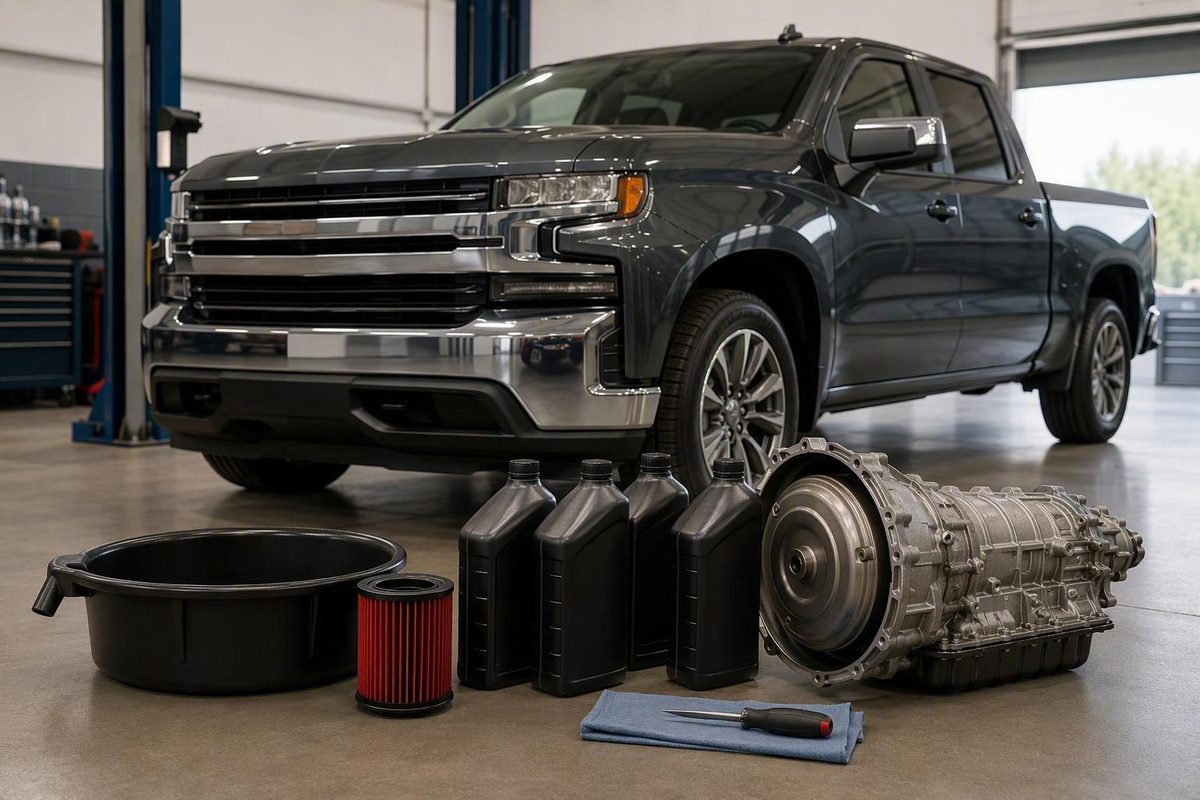
Identify the transmission before buying fluid. High mileage and unknown history call for inspection, not an automatic exchange or a decision to leave it untouched.
Changing transmission fluid in a Chevy Silverado is not one universal job.
The safest starting point is therefore identification—not loosening a drain plug. Confirm the transmission and obtain current Chevrolet or GM information for that exact configuration before choosing a drain-and-fill, pan-and-filter service, repeated partial changes, or a professional fluid exchange.
This is a configuration, preparation, and service-selection guide. It explains the general workflow and stop-work criteria, but it is not an executable replacement for the transmission-specific GM procedure.
Start With the Exact Truck and Transmission
Before buying fluid or parts, record:
- Model year
- Silverado series, such as 1500, 2500 HD, or 3500 HD
- Engine
- Two-wheel-drive or four-wheel-drive configuration
- Current mileage
- Towing and hauling use
- Typical operating conditions
- Known transmission-maintenance history
- Existing leaks, warning messages, or shifting symptoms
Do not infer the transmission from the Silverado badge or number of forward gears alone. Trucks carrying the same general model name may have different powertrains, and transmission offerings can vary by year, engine, series, and configuration.
Verify the installed transmission through one or more reliable identifiers:
- VIN and build information: Ask a Chevrolet dealer or qualified repair facility to identify the transmission from the vehicle’s build record.
- Build or RPO data: Use the truck’s actual build information rather than assuming an online application list covers every configuration.
- Owner’s manual: Consult the manual issued for the truck’s model year and configuration for its maintenance schedule and identified fluid requirements.
- Current GM service information: Obtain the transmission-specific instructions for draining, pan access, sealing, fastener tightening, refilling, and final level adjustment. A Chevrolet dealer or qualified repair facility with access to current GM service information can retrieve the applicable procedure.
- Physical identification: If the build data remain unclear, have a qualified technician identify the unit from its case, label, pan design, or other applicable identifiers.
Owner forums demonstrate why this matters: participants discussing recent Silverados report different fluid requirements and service-access problems for different transmissions. Those are unverified owner reports, not specifications you should apply without checking the truck’s build information and current GM documentation. The GM-Trucks discussion illustrates these configuration-dependent disagreements.
Build a pre-purchase specification sheet
Do not order fluid or open the transmission until you can complete this sheet:
| Item to verify | Why it matters |
|---|---|
| Installed transmission | Controls the applicable fluid, parts, access, and level procedure |
| Current approved fluid specification | Fluids with similar names or appearance may not be interchangeable |
| Routine service-fill quantity | Helps establish the initial purchase and refill amount |
| Filter design | Confirms whether a filter is serviceable during the intended operation |
| Gasket or sealing system | Determines which replacement seal or approved sealing method is required |
| Drain arrangement | Establishes whether there is a drain plug or an approved pan-draining method |
| Fill point | May be a tube, case opening, or other specified port |
| Level-check method | May involve a dipstick, level plug, or overflow arrangement |
| Required fluid-temperature range | Some level procedures are valid only within specified conditions |
| Engine and selector conditions | The final check may depend on engine state and selector position |
| Pan-fastener sequence and torque | Prevents reliance on generic forum values |
| Plug torque and seal requirements | Helps avoid damaged threads or leaks |
| Access instructions | Identifies configuration-specific obstructions and required preliminary work |
The available evidence does not support a complete year-by-year Silverado transmission lookup. It also does not establish universal capacities, fluid types, part numbers, torque values, temperature ranges, or access instructions. Those details must come from documentation matched to the VIN and installed transmission.
The Chevy Truck Expert About page describes the publication’s Chevrolet-truck focus and editorial practices. It does not make this article an official Chevrolet procedure.
Chevy Truck Expert is an independent enthusiast publication, not Chevrolet or General Motors, as its published terms expressly state. If this guide, a forum post, a parts listing, or a video conflicts with current GM information for the identified truck, the configuration-specific GM information should control.
Choose the Service You Actually Need
“Transmission fluid change” can refer to substantially different services. Compare what will actually be drained, inspected, replaced, and adjusted rather than choosing by name alone.
Drain-and-fill
Potential advantages include:
- Less disassembly
- Lower labor than pan removal
- Lower fluid use than an exchange
- A practical partial-replacement method when the design permits it
Limitations include:
- Only part of the old fluid is replaced
- The pan may not be inspected or cleaned
- A serviceable filter may remain unchanged
- The drained quantity varies by transmission and procedure
A drain-and-fill is not automatically inadequate. Its suitability depends on the transmission, service history, maintenance requirements, and current condition.
Pan-and-filter service
A pan-and-filter service generally involves draining the available fluid, removing and cleaning the pan, inspecting the residue, and replacing a serviceable filter and applicable gasket or seal.
Removing the pan may allow you or the technician to:
- Inspect residue and magnets
- Document unusual debris
- Clean the pan
- Replace a serviceable filter
- Renew the applicable sealing components
- Inspect the accessible area for evident concerns
The tradeoffs are greater labor, mess, and procedural risk. Pan access can be difficult on some configurations, and an incorrect sealing method or fastener procedure can cause leaks. Pan removal also does not necessarily remove all the fluid elsewhere in the system.
Machine fluid exchange
A machine exchange generally connects through the transmission’s cooling circuit and replaces a larger share of the old fluid while fluid circulates. Depending on the shop and process, it may replace fluid that would remain during a simple drain or pan service.
An exchange may not include:
- Pan removal or cleaning
- Inspection of magnets and residue
- Filter replacement
- Diagnosis of existing symptoms
A lubricant manufacturer’s comparison similarly distinguishes an exchange—which uses more fluid and replaces a larger share—from a pan drop, which may provide filter and gasket access. It also raises the possibility of disturbing debris in a neglected unit, but that possibility does not establish that every exchange is harmful. AMSOIL’s comparison explains these general scope differences.
Ask a shop what it means by “flush.” Do not assume every provider performs the same operation.
Repeated drain-and-fill cycles
Repeated drain-and-fill services can gradually replace more old fluid without one machine exchange.
This approach may be worth considering when:
- The transmission has a convenient service drain
- Pan removal is not due or is impractical
- The applicable procedure permits partial replacement
- Gradual replacement is preferred
- The maintenance plan accounts for the additional fluid and labor
Do not assume that one fixed number of cycles applies to every Silverado.
Total capacity is not the refill amount
Keep these quantities separate:
- Total or dry capacity: The volume associated with an empty system after an overhaul or another specified operation.
- Drain-and-fill quantity: The amount normally removed at the service drain point.
- Pan-service quantity: The amount lost when the pan and applicable filter are removed.
- Exchange quantity: The volume needed to replace a larger share of the existing fluid.
- Final adjusted quantity: The amount ultimately required after completing the prescribed level procedure.
Never add the total capacity merely because it is the easiest number to find online.
Match the method to the truck
Use these questions to narrow the choice:
- What does the applicable maintenance schedule require?
- Is the filter serviceable at this interval?
- Would pan inspection be valuable because the history is unknown?
- Is the transmission operating normally?
- Can the pan be accessed without work beyond your equipment and experience?
- Does the unit have an applicable drain point?
- How much existing fluid will the proposed method replace?
- Does a quoted exchange include filter service or pan inspection?
- Are there leaks, substantial debris, warning messages, or active symptoms?
If the truck has an unknown high-mileage history, slipping, delayed engagement, warning messages, unusual noises, contaminated fluid, or loss of drive, obtain an inspection before selecting an exchange or beginning routine DIY maintenance. The decision should follow the unit’s present condition and applicable procedure—not a blanket claim that old fluid must always remain or always be replaced.
Decide When the Fluid Is Due—Without Using a Universal Mileage Rule
There is no supported single service interval for every Silverado. Begin with the maintenance schedule for the exact model year and transmission, including its definitions of normal and severe service.
Third-party recommendations conflict:
- A dealership service manager recommends beginning around 30,000 miles for trucks used for towing, but presents that figure as a rule of thumb rather than a model-specific factory requirement. McFarland Chevrolet attributes the recommendation to its service manager.
- A dealership guide gives a broader general range of 45,000 to 60,000 miles, while still directing owners to vehicle-specific information. Cascade Chevrolet presents that range as general guidance.
- In an owner forum, a participant reports that an older truck’s manual specified 50,000 miles under severe conditions and 100,000 miles under normal conditions for that particular application. The SilveradoSierra thread contains that owner-reported older-manual example.
These figures illustrate why a universal Silverado interval is unreliable. None should be treated as the Chevrolet requirement for a different truck.
Check whether the applicable manual classifies any of the following as severe or otherwise demanding operation:
- Regular towing
- Heavy hauling
- Frequent high-load operation
- Extreme ambient heat
- Sustained stop-and-go driving
- Steep grades
- Rough or difficult terrain
- Commercial use
Towing, hauling, heat, and repeated high-load operation are reasons to examine the severe-use schedule—not reasons to substitute a third-party mileage rule for the truck’s manual.
Separate scheduled maintenance from diagnosis
Mileage- or time-based service is preventive maintenance for a transmission that is operating normally. It is different from investigating:
- Slipping
- Delayed engagement
- Harsh or erratic shifting
- Overheating
- Warning lights or transmission messages
- Limp mode
- Leaks
- Unusual noises
- Loss of drive
- Abnormal debris
Do not answer a serious symptom merely by accelerating a routine fluid-change schedule. Diagnose the concern first.
Keep a service record
After each service, record:
- Date and mileage
- Transmission identification
- Fluid specification
- Fluid brand and product
- Quantity purchased
- Approximate quantity installed
- Filter and sealing parts installed
- Service method
- Pan and magnet condition
- Unusual debris
- Final level-check conditions
- Shop invoice or parts receipts
A complete record reduces uncertainty at the next service and gives a technician useful context if a problem later appears.
Build a Configuration-Specific Parts, Tools, and Safety Checklist
Do not begin until the fluid, parts, access method, sealing instructions, fastener specifications, and final level procedure have been verified.
Fluid and parts
Confirm and obtain:
- The exact approved fluid specification
- Enough fluid for the selected method and final adjustment
- The correct serviceable filter, if applicable
- The specified filter seal or O-ring
- The correct pan gasket or approved sealing system
- Drain-, fill-, and level-plug seals where required
- Replacement fasteners or one-time-use components where specified
Do not use total capacity as the initial-refill figure without confirming how much the selected service normally removes. An exchange can require substantially more fluid than a drain-and-fill, while pan removal may release more than a plug-only service.
Verify the sealing method as well. The evidence does not establish a universal rule requiring or prohibiting sealant across all Silverado transmissions.
Access and fill arrangement
Confirm whether the identified transmission has:
- A drain plug
- A removable pan
- A serviceable internal or external filter
- A conventional dipstick
- A fill tube or case fill port
- An overflow or level plug
- A replaceable or reusable pan gasket
- A temperature-dependent level procedure
Review the exact pan-access instructions before assuming there is sufficient clearance. Owner reports describe interference involving exhaust routing, linkage, crossmembers, mounts, and four-wheel-drive hardware on some configurations, but they do not prove that any one component must be moved on every Silverado.
Universal equipment
The exact sockets and specialty tools vary, but a typical preparation list includes:
- A catch pan sized for the expected discharge
- A graduated container for measuring recovered fluid
- A funnel or transfer pump compatible with the verified fill point
- Appropriate hand tools
- A calibrated torque wrench covering the specified range
- An approved method of reading fluid temperature when required
- Gloves and eye protection
- Absorbent rags or pads
- Wheel chocks
- Lifting and support equipment if additional clearance is required
- Sealable containers for used fluid
A dealership guide lists gloves, eye protection, a drain pan, tools, rags, and optional lifting equipment among the basic supplies while directing owners to vehicle-specific information for the correct fluid and quantity. That list is useful for orientation, not as a complete transmission-specific tool schedule.
Set up the work area safely
Work on a clean, flat, level surface, set the parking brake, and secure the vehicle against movement. If additional clearance is required, do not proceed unless you have an appropriate lifting and support method for the truck. Wear gloves and eye protection, use caution around hot fluid, and ventilate the work area if the applicable procedure requires the engine to run. These basic precautions are reflected in the general dealership and forum service guides cited above.
Treat “warm” or “hot” as descriptions, not specifications. If the final level check requires a defined temperature range, use the specified measurement method and conditions rather than generic warm-up advice.
Establish a stop point before starting
Pause the job if:
- The transmission cannot be identified positively
- The approved fluid remains uncertain
- The service-fill quantity is unavailable
- The fill or level point cannot be located confidently
- The fastener torque or tightening sequence is missing
- The sealing method is unclear
- The pan cannot clear surrounding components
- A plug or fastener is damaged
- Moving exhaust, a mount, a crossmember, linkage, or drivetrain hardware appears necessary
- You do not have the procedure or equipment needed for the work that has become necessary
Do not expand the job by improvising around structural or drivetrain components. Obtain the applicable procedure and qualified help before continuing.
Follow a Safe High-Level Drain, Pan, and Filter Workflow
The following is an orientation workflow, not a model-specific procedure. The current procedure for the identified transmission determines which steps apply and how they must be performed.
1. Verify the procedure one final time
Confirm:
- Fluid specification
- Expected service quantity
- Drain and fill locations
- Pan-access method
- Filter serviceability
- Gasket or sealing method
- Fastener sequence and torque
- Fluid-temperature requirements
- Final level conditions
Compare the replacement filter, seal, and gasket with the verified parts information before opening the transmission.
2. Position and secure the truck
Place the truck on a clean, level surface and secure it against movement. If the procedure requires additional clearance, use the specified lifting and support method. Do not work beneath the truck if it is not stably supported.
Manage fluid temperature according to the applicable procedure. A generic instruction to drive or idle for a fixed period cannot substitute for transmission-specific requirements.
3. Position the catch pan
Place a catch pan beneath the specified drain area. Transmission fluid may spread across a pan flange or travel along nearby surfaces rather than falling straight down.
If the identified transmission has a service drain plug, use the prescribed removal method. If it lacks a drain plug and the procedure calls for controlled pan loosening, follow its bolt sequence and keep the pan controlled as fluid is released. General forum guidance warns that fluid can remain in the pan and may be hot, supporting the need for a suitably positioned catch pan and protective equipment.
4. Measure what drains
Transfer the recovered fluid into a graduated container and record the quantity. This provides an initial refill reference and may reveal a large difference from the expected service quantity.
It is not proof of the correct final level. The transmission may previously have been underfilled or overfilled, and some fluid may remain in the catch pan or on removed components.
5. Remove and inspect the pan if specified
Follow the exact access instructions. Do not force the pan around an obstruction or copy preliminary work from a video showing a different truck.
Lower the pan carefully and note the position of any magnets before removing them. Before cleaning, inspect and document:
- Fluid appearance and odor
- Sludge or fine residue
- Material on magnets
- Metal fragments
- Unexpected objects
- Evidence of another contaminant
- Damage to the pan or sealing surface
Photograph unusual findings before cleaning the pan.
6. Replace only serviceable components
Remove and replace a filter only when the procedure identifies it as serviceable during the selected operation. Use the verified filter and sealing parts.
Clean the pan, magnets, and mating surfaces using the method permitted by the applicable procedure. If the correct cleaning method is unavailable or the sealing surface is damaged, stop rather than improvising.
7. Reassemble to the verified specification
Install the correct gasket or approved sealing system. Start fasteners carefully and tighten them:
- In the specified sequence
- In the specified stages
- To the transmission-specific torque
- With a suitable calibrated torque wrench
Do not reuse generic forum torque values or assume one cross-pattern applies to every Silverado transmission, pan material, fastener, and seal design. The available evidence does not establish a universal value or sequence.
8. Pause if the job changes scope
An inaccessible fastener, obstructed pan, damaged sealing surface, missing torque value, unclear gasket method, or apparent need to move exhaust or drivetrain hardware is a reason to stop.
Obtaining the correct procedure or professional assistance is preferable to damaging the case, creating a leak, or leaving the truck disassembled without a verified way to complete the service.
Refill and Set the Level the Right Way
Refilling is not simply a matter of returning whatever quantity came out. The measured drain amount is an initial reference; the prescribed final level procedure is the controlling check.
Use only the verified fluid
Do not choose Dexron VI, Dexron HP, Dexron ULV, or another named fluid merely because someone used it in a similar-sounding truck. Verify the specification for the installed transmission and confirm that the product explicitly meets that requirement.
Do not identify fluid by color.
Begin with a conservative measured refill
Use the applicable service quantity and measured drain amount to establish a conservative initial refill. Add fluid through the prescribed fill point and keep a written tally of each measured addition.
Do not add the total system capacity after a partial drain.
Follow the correct level system
A dipstick-equipped unit may require specified conditions involving:
- Vehicle position
- Engine state
- Selector position
- Fluid temperature
- Dipstick reading method
A general process may involve:
- Adding an initial measured quantity.
- Starting the engine when instructed.
- Applying the brake.
- Moving the selector through specified positions.
- Returning it to the required position.
- Monitoring fluid temperature.
- Checking the designated dipstick or level point.
- Adding or allowing fluid to drain until the prescribed result is reached.
- Reinstalling the applicable plug with its specified seal and torque.
This sequence is only an outline. Gear order, timing, temperature, engine state, and interpretation of fluid flow must come from the exact procedure.
Why the conditions matter
A reading can therefore be misleading if taken:
- On an incline
- At the wrong temperature
- With the engine in the wrong state
- In the wrong selector position
- Before the required selector sequence
- Through the wrong plug or opening
Inspect for leaks
Under the conditions specified by the service procedure, inspect the areas disturbed during the work, including:
- Pan perimeter
- Drain plug
- Fill plug
- Level or overflow plug
- Cooler-line area
- Components moved for authorized access
Perform any post-service level or leak recheck required after the initial drive or heat cycle. Stop using the truck and investigate if a significant leak, warning message, loss of drive, or new unpredictable shifting behavior appears. A dealership overview likewise recommends professional inspection for leaks, warning lights, delayed shifting, unusual noises, or power loss. Applegate Chevrolet distinguishes these symptoms from routine maintenance concerns.
Read the Old Fluid and Pan Without Overdiagnosing
Old fluid and pan residue provide clues, not complete diagnoses. Interpret them with the truck’s mileage, service history, symptoms, diagnostic information, and transmission-specific guidance.
Dark fluid
Darkening may reflect age, heat exposure, or accumulated material. It can justify closer inspection, especially when the maintenance history is unknown, but color alone does not prove internal failure.
Lighting, container color, and the fluid formulation can alter its apparent color. If documenting the condition, use a clean, transparent container.
Burnt odor
A strong burnt odor can indicate that the fluid has experienced substantial heat or deterioration. It deserves attention when accompanied by slipping, delayed engagement, overheating, or debris.
Odor alone does not identify which component, if any, has failed.
Sludge and fine residue
Fine residue may accumulate during operation, while an unusual or substantial quantity can warrant further evaluation. The correct interpretation depends on the transmission, mileage, and service history.
Photograph the pan, magnets, and residue before cleaning so the evidence remains available for comparison or professional review.
Metal fragments or substantial debris
Visible fragments, sharp pieces, or substantial debris are reasons to stop routine maintenance and obtain professional assessment. Preserve photographs and representative material if practical.
Metal does not prove one specific failure merely because it is present. Its quantity, form, location, and other characteristics require informed interpretation.
Symptoms require diagnosis
Do not promise that fresh fluid will correct:
- Rough shifts
- Slipping
- Delayed engagement
- Overheating
- Warning lights
- Limp mode
- Unusual noises
- Loss of movement
Low, old, burnt, or incorrect fluid may contribute to operational problems, but the same symptoms may arise from electrical, software, hydraulic, cooling, or internal mechanical faults. If the truck already has active symptoms, diagnose them before treating a fluid change as the repair.
Know When This Is Not a DIY Job
A careful owner may be able to perform an appropriate drain-and-fill or pan service. The deciding issue is whether the job is identified, documented, accessible, and within the owner’s tools and experience.
Seek qualified help when:
- The transmission cannot be positively identified
- The approved fluid specification is uncertain
- The service-fill quantity cannot be verified
- The fill or level procedure is unavailable
- A required temperature cannot be monitored
- Filter, plug, pan, or sealing specifications are unclear
- Correct torque values and tightening instructions are unavailable
- Exhaust, linkage, mounts, crossmembers, or drivetrain hardware obstruct access
- A plug or fastener is seized, damaged, or rounded
- The pan or case sealing surface is damaged
- There is an active leak
- Warning lights or transmission messages are present
- The transmission slips or engages late
- The truck enters limp mode
- Unusual noises occur
- Substantial metal debris is present
A neglected high-mileage transmission with no service record calls for inspection and informed judgment. It does not prove that an exchange must be performed, that fresh fluid will cause a failure, or that the existing fluid should remain indefinitely.
Compare shop quotes by scope
Ask each shop the same questions:
- What exact service method will be performed?
- Is it a drain-and-fill, pan service, repeated partial change, or machine exchange?
- Which fluid specification and product will be used?
- How much fluid is included?
- Will the pan be removed and cleaned?
- Will a serviceable filter be replaced?
- Are the gasket and plug seals included?
- Is diagnostic work included?
- Is additional access labor expected?
- How will the final level be set?
- Will fluid temperature be monitored if required?
- Will the shop document the pan and magnet condition?
In one 2025 forum discussion, an owner reported paying just under $300 for a dealer exchange, while another reported approximately $690 for an independent-shop pan service performed in October 2024. These are unverified, dated local anecdotes involving different scopes—not market prices or estimates for your truck. The owner reports illustrate why service quotes must be compared line by line.
Ask the shop to document:
- Fluid specification and product
- Quantity billed
- Filter, gasket, seals, and other parts installed
- Pan and magnet condition
- Unusual debris
- Leak findings
- Diagnostic codes or test results
- Final level-setting method
- Additional access work
Frequently Asked Questions
Can I use one transmission-fluid type in every Chevy Silverado?
No. Silverado transmissions can require different approved fluids, and the requirement can vary by transmission, year, and application.
Do not choose fluid from the truck badge, number of gears, fluid color, or an owner’s forum post. Identify the installed transmission, verify its current specification, and confirm that the product explicitly meets that requirement.
Is a transmission flush better than a drain-and-fill or pan service?
Not universally.
A machine exchange can replace a larger share of the old fluid, but it may not include pan inspection or filter replacement. A drain-and-fill uses less fluid and requires less disassembly, but it replaces only what drains. A pan service can provide access for inspection and serviceable-filter replacement, yet it involves more labor and still may not remove all the existing fluid.
Choose according to the transmission design, maintenance schedule, service history, present condition, and work actually included. If the history is unknown or symptoms are active, arrange an inspection before authorizing an exchange.
How much transmission fluid will my Silverado need?
It depends on the installed transmission and selected service. A drain-and-fill, pan removal, filter service, repeated partial change, machine exchange, and dry refill can require different quantities.
Find the applicable service-fill quantity rather than relying on total capacity. Measure the drained amount as an initial reference, keep a tally while refilling, and complete the prescribed level-setting procedure. Do not assume the quantity removed proves the previous level was correct.
Should I change the fluid in a high-mileage Silverado with no service history?
Do not apply a blanket rule. High mileage and unknown history justify inspection, not an automatic decision either to exchange all the fluid or leave it untouched.
Identify the transmission and assess its operation, leaks, fluid condition, diagnostic information, and pan residue where appropriate. If it slips, engages late, makes unusual noises, enters limp mode, or contains substantial debris, obtain a professional diagnosis before choosing a service method.
Will changing transmission fluid fix rough shifting, slipping, or delayed engagement?
Not necessarily. An incorrect level, degraded fluid, or an unsuitable fluid may contribute to poor operation, but those symptoms can have other causes. Fluid replacement is maintenance, not a guaranteed repair.
If symptoms are already present, diagnose them before assuming fresh fluid will solve the problem. Stop using the truck and seek qualified assistance if it loses drive, develops a significant leak, displays a transmission warning, makes unusual noises, or behaves unpredictably.
Final action plan: Identify the installed transmission, retrieve the applicable Chevrolet or GM maintenance and service information, choose the service method according to the unit’s design, history, use, and condition, and buy only verified fluid and parts. Complete the prescribed temperature- and operating-condition-dependent level procedure rather than relying on the drained quantity alone.
If the specifications are complete, access is straightforward, the transmission operates normally, and the work matches your equipment and experience, an appropriate DIY drain or pan service may be reasonable. If specifications remain uncertain, access is obstructed, symptoms or leaks are active, or abnormal debris appears, stop and obtain professional diagnosis.