
Find the Right Fluid for Your Silverado’s Exact Transmission
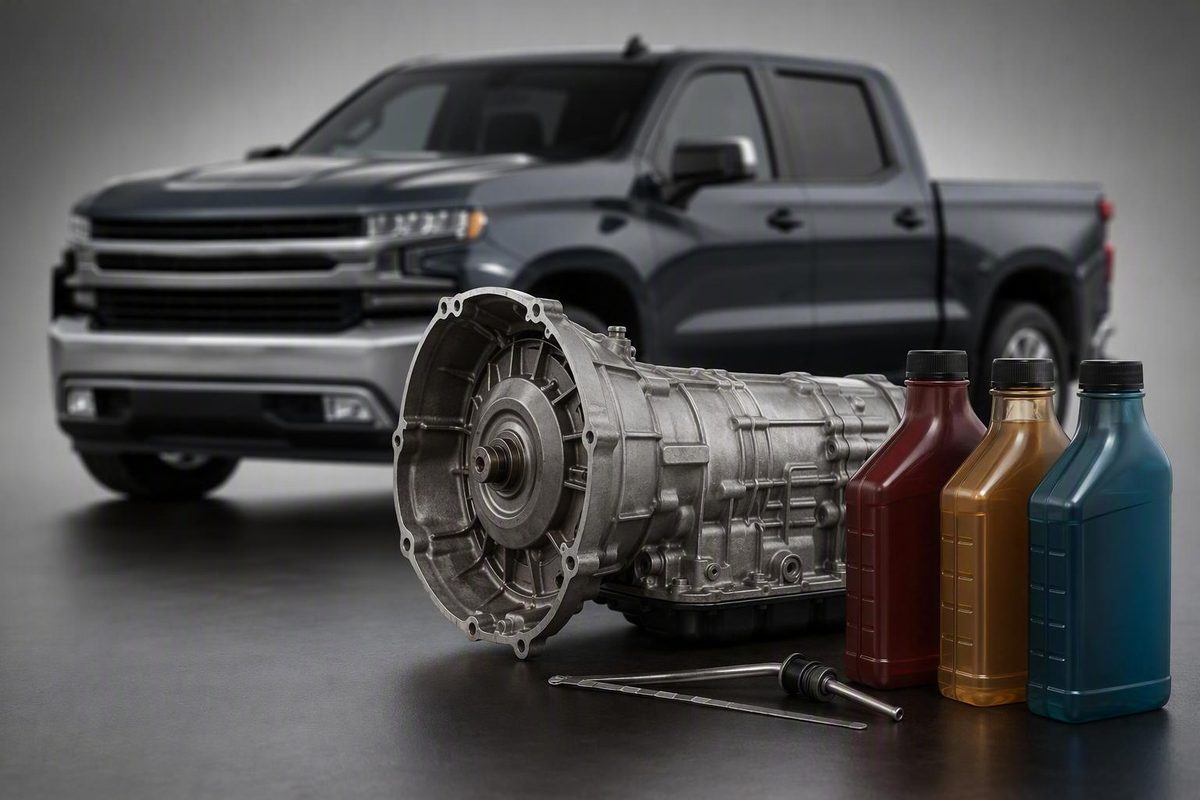
DEXRON VI, DEXRON HP and DEXRON ULV are not three steps on a simple good-better-best scale for a Silverado 1500.
The short answer: there is no universal Silverado 1500 transmission fluid
The correct transmission fluid for a Chevy Silverado 1500 depends on the truck’s model year and exact transmission. No single fluid can be recommended safely for every Silverado 1500.
Before buying fluid, topping off the transmission, or approving a service, verify:
- The transmission installed in the truck
- The fluid specification required for that transmission
- The quantity required for the intended service procedure
Do not buy transmission fluid based only on the Silverado 1500 name, the transmission’s speed count, a retailer fitment result, or a forum recommendation. “Six-speed,” “eight-speed,” or “ten-speed” may narrow the possibilities, but it does not identify the exact unit or establish its fluid requirement.
The safe decision path: Identify the transmission, verify its required specification in the owner’s manual or current Chevrolet/GM service or parts information, and obtain the refill quantity for the procedure being performed—not merely a published capacity number.
The available secondary evidence illustrates the general pattern, but it is not a complete application chart:
- A discussion involving a 2017 Silverado 1500 with a 5.3L engine, four-wheel drive, and a confirmed 6L80 supports DEXRON VI for that specific example.
- A retailer’s selected-vehicle results for a 2016 Silverado 1500 display DEXRON VI products and filters associated with the 6L80 family, but the page does not establish compatibility with every transmission offered in that model year.
- Forum participants associate some Silverado eight-speed applications with DEXRON HP and some ten-speed applications with DEXRON ULV. Those are research leads, not universal specifications.
This caution matters because the secondary sources conflict. One dealership article broadly claims that DEXRON VI applies to all Silverado 1500 automatic transmissions, while transmission-specific discussions distinguish among DEXRON VI, DEXRON HP, and DEXRON ULV. The dealership’s all-model statement is not supported there by cited GM documentation and should not be treated as a universal rule.
This article is therefore an identification and service-planning guide, not a complete year-by-year fluid lookup. The supplied evidence does not contain authoritative GM application and procedure data for every Silverado 1500 configuration. If the exact transmission, required specification, or refill procedure remains uncertain, pause before adding fluid.
Identify your transmission before selecting fluid
Start by recording the truck’s known configuration:
- Model year
- Engine
- Two-wheel drive or four-wheel drive
- Transmission designation or code, if known
- Number of forward speeds, if known
- Build or service information identifying the installed transmission
Two trucks sold under the Silverado 1500 name—even two trucks from the same model year—may not necessarily have the same transmission, fluid requirement, filter, pan design, or service procedure.
Check the owner’s manual, vehicle build information, transmission identification information, and existing service records. If those do not resolve the question, ask a Chevrolet/GM dealer or parts department to perform a vehicle-specific lookup. Avoid relying on an unsupported online VIN or build-code decoding rule unless the result can be confirmed against authoritative vehicle information.
The level of detail needed is illustrated by the available 6L80 example: 2017 Chevrolet Silverado 1500, 5.3L engine, four-wheel drive, confirmed 6L80 six-speed transmission. Participants discussing that exact configuration recommended DEXRON VI, and the owner ultimately chose ACDelco DEXRON VI. The discussion also included conflicting claims about a DEXRON HP-oriented product, demonstrating why the complete configuration matters more than an informal product recommendation (review the configuration-specific discussion).
By comparison, “2017 Silverado” or “Silverado six-speed” leaves too much unresolved. It can also lead to the wrong filter, gasket, pan hardware, or service kit.
A practical identification process
Use this sequence before shopping:
- Record the model year, engine, and drivetrain. Do not assume that a seller or repair shop has entered all three correctly.
- Identify the installed transmission. Use vehicle build information, service records, transmission identification information, or a vehicle-specific Chevrolet/GM lookup.
- Verify the required fluid specification separately. Knowing the transmission designation and knowing its fluid requirement are related but distinct tasks.
- Choose the intended service. A top-off, drain-and-fill, fluid exchange, pan service, and repair refill do not necessarily require the same quantity or parts.
- Read the current product label. Confirm that the exact container being purchased supports the specification required for the truck.
Retailer results can help screen products, but they should not make the final decision. For example, O’Reilly’s selected 2016 Silverado 1500 results include DEXRON VI products and 6L80-family filters while directing shoppers to check vehicle fit. The listing does not prove that every displayed product fits every 2016 Silverado configuration (see the selected-vehicle retailer listing).
If a repair shop identifies the transmission, ask it to place the transmission code or designation on the written estimate. Then compare that identification with the proposed fluid specification, product or part number, quantity, and service kit.
Stop point: If the exact transmission remains uncertain, do not add fluid or order a service kit. Resolve the identification through current Chevrolet/GM information or a qualified shop first.
DEXRON VI, DEXRON HP, and DEXRON ULV are different specifications
DEXRON denotes a GM transmission-fluid performance specification, not one fluid brand. Multiple companies may sell products carrying DEXRON-related wording, but the specifications should not be treated as interchangeable unless current documentation supports the application.
The correct shopping question is not:
Which transmission-fluid brand do I prefer?
It is:
Which specification does this transmission require, and does the current label on this exact product support that specification?
A fluid manufacturer’s explanation describes automatic-transmission-fluid specifications as performance standards established by vehicle manufacturers and advises owners to begin with the vehicle owner’s manual. The article is promotional rather than Silverado-specific, but its distinction between a specification and a brand is useful (read the explanation of ATF specifications).
DEXRON VI and the specific 6L80 example
The clearest example in the supplied evidence concerns the confirmed 6L80 in the 2017 Silverado described above. Forum participants recommended DEXRON VI, and the owner selected ACDelco DEXRON VI. The selected 2016 retailer page also displays DEXRON VI products alongside 6L80-family filters.
Together, those sources support DEXRON VI for the specifically discussed examples, subject to verification for the individual truck. They do not establish that:
- Every Silverado six-speed uses DEXRON VI
- Every 2016 or 2017 Silverado automatic uses DEXRON VI
- Every product mentioning DEXRON VI is appropriate for the application
- Every product returned by a retailer lookup fits every configuration
The transmission designation and current Chevrolet/GM requirement should control the decision.
DEXRON HP and eight-speed transmissions
Silverado owner discussions associate DEXRON HP with eight-speed applications. That pattern may be useful when checking a proposed product or shop invoice, but it does not establish that every Silverado eight-speed uses the same fluid.
Confirm the truck’s transmission designation and current specification before purchasing. A general statement such as “all eight-speeds use HP” is broader than the supplied evidence supports.
DEXRON ULV and ten-speed transmissions
Forum participants similarly associate DEXRON ULV with ten-speed applications. A manufacturer’s promotional article connects DEXRON ULV with newer ten-speed transmissions and states that ULV is not backward compatible with earlier DEXRON fluids. It does not identify the correct fluid for every Silverado year and transmission, so the information supports a no-substitution rule rather than a complete Silverado application chart (see the manufacturer’s compatibility explanation).
Do not assume that DEXRON ULV is simply a newer or better replacement for DEXRON VI. Likewise, do not assume that DEXRON VI can replace DEXRON HP or ULV merely because all three carry the DEXRON name.
These are specifications, not successive “grades”
DEXRON VI, DEXRON HP, and DEXRON ULV are not three steps on a simple good-better-best scale. A newer specification is not automatically an upgrade for an older transmission, and a familiar specification is not automatically suitable for a newer unit.
Use this conservative comparison:
- Required specification: What does current information for the truck and transmission require?
- Product claim: What specification does the current container say it meets or supports?
- Vehicle application: Does reliable vehicle-specific information connect that specification and product to the installed transmission?
This is a purchasing safeguard, not an official GM approval formula. A retailer fitment result or aftermarket suitability claim may provide additional information, but neither should override the documented requirement.
The disputed Mobil 1 Synthetic LV ATF HP example
The configuration-specific 6L80 discussion demonstrates the problem with informal substitution. Some participants supported Mobil 1 Synthetic LV ATF HP for the 6L80. Others reported that current bottles and Mobil’s website no longer claimed DEXRON VI compatibility. The original recommendation was also described as differing from GM’s recommended fluid.
Those conflicting statements do not establish compatibility. They establish that compatibility was disputed.
A forum recommendation should not override the required specification or the current product label. The same caution applies to:
- Multi-vehicle fluids
- Products carrying several manufacturer specifications
- A familiar brand recommended by a friend or rebuilder
- Automated retailer fitment results
- A shop’s verbal assurance without a written product or part number
If the label and application information do not clearly support the verified requirement, do not assume the fluid is an acceptable substitute.
Capacity is not the same as the amount needed for service
A published transmission capacity is not automatically the number of quarts to add after draining a Silverado 1500.
Several different quantities may be relevant:
- Routine drain-and-fill: Replaces only the fluid that exits through the applicable drain procedure.
- Pan service: Involves removing the pan and may allow filter and gasket replacement, depending on the transmission.
- Fluid exchange: Replaces more of the existing fluid than a simple drain, but does not automatically include pan removal or filter replacement.
- Overhaul refill: Applies after major disassembly or repair.
- Total or dry-fill capacity: Refers to a substantially emptied transmission and should not be treated as a routine-service refill quantity.
Use the quantity specified for the exact transmission and procedure.
Secondary-source capacity reference
Important: The following figures come from a dealership-published secondary source. The source does not fully map them to model year, engine, drivetrain, configuration, or refill procedure, and it does not clearly define every figure as dry fill or another capacity type. Do not use this table as instructions for how much fluid to add (review the dealership’s capacity compilation).
| Transmission | Reported capacity |
|---|---|
| 4L60-E automatic | 11.2 qt |
| 4L70-E automatic | 11.2 qt |
| 4L80-E automatic | 13.5 qt |
| 4L85-E automatic | 13.5 qt |
| 6L80 automatic | 12.2–12.4 qt |
| 8L90 automatic | 10.9–11.4 qt |
| 10L80 automatic | 11.5–12 qt |
| 2ML70 hybrid unit | 13 qt |
| NV3500 manual | 2.1 qt |
| NV4500 manual | 3.9 qt |
| MG5 GLS31 manual | 2.45 qt |
These are reported capacity figures, not verified drain-and-fill, pan-service, exchange, or overhaul-refill quantities for a particular truck.
Do not pour a tabled capacity into a transmission after a routine drain. Obtain the procedure-specific starting quantity and level-setting instructions for the exact transmission.
For example, the reported 6L80 range does not establish how much fluid will be removed during a drain-and-fill or pan service. Nor does it prove that every 6L80 configuration has the same applicable capacity.
Use the documented starting quantity and final checking procedure rather than assuming that the amount removed is automatically the correct amount to reinstall.
A cautious refill sequence is:
- Obtain the starting quantity for the exact procedure.
- Use only fluid meeting the verified specification.
- Follow the model- and transmission-specific level instructions.
- Add gradually as the final level is approached.
- Stop if the procedure or required quantity remains unclear.
Capacity is reference information; the selected service procedure determines the refill quantity.
Choose the service procedure, not just the fluid
A quote for “transmission service” is incomplete unless it explains what the shop will do. A drain-and-fill, fluid exchange, and pan service are not equivalent and may use different quantities of fluid, parts, and labor.
Drain-and-fill
Do not assume that the pan will be removed or the filter replaced unless the written estimate says so.
Fluid exchange
The term does not automatically mean that the pan will be removed, inspected, or fitted with a new filter and gasket.
Ask how the exchange will be performed, what quantity is expected to be used, and how the final level will be verified. Also ask whether the quoted fluid quantity includes fluid consumed during the process rather than retained as the final fill.
Pan service
A pan service involves removing the transmission pan. Depending on the transmission design and prescribed procedure, that may allow replacement of a serviceable filter and gasket and inspection of the pan.
A pan-service quantity should therefore not be confused with a published total capacity.
Filter replacement depends on the design and procedure
The supplied evidence does not support a universal rule that every fluid change requires a new filter. Filter replacement depends on:
- The installed transmission
- Whether its filter is serviceable
- Whether the pan is being removed
- The procedure being performed
- Applicable service instructions
A fluid exchange does not automatically include filter replacement. A drain-and-fill may not involve pan removal. A pan service may include a filter and gasket, but those parts should be confirmed for the exact transmission.
Compare quotes by scope, not headline price
Forum price reports show why headline prices can be misleading. One owner reported paying just under $300 for a dealer fluid exchange, while another reported paying about $690 in October 2024 for a private-shop eight-speed pan-drop service. These are non-comparable anecdotes involving potentially different locations, parts, fluid quantities, and labor—not expected or standard prices (review the owner-reported examples).
For each quote, request:
- Transmission code or designation
- Required fluid specification
- Fluid product name or part number
- Estimated quantity
- Drain-and-fill, exchange, or pan-removal description
- Filter replacement, if applicable
- Gasket, seal, or pan details
- Labor charges
- Fluid and parts charges
- Disposal or shop fees
- Final level-setting method
A higher quote may include pan removal, a filter, a gasket, more fluid, and additional labor. A lower quote may cover only an exchange. Neither is automatically the better service until the scope is clear.
Check the level differently on dipstick-equipped and sealed transmissions
First determine whether the truck has a conventional transmission dipstick. Not every Silverado 1500 does, and the model name alone does not establish the correct checking procedure.
Dipstick-equipped transmissions
For a dipstick-equipped truck, a dealership’s general secondary-source outline is:
- Park on level ground.
- Warm the truck as required by the model-specific instructions.
- Remove the transmission dipstick.
- Wipe it clean.
- Reinsert it completely.
- Remove it again and read the level.
The precise setup—including temperature, engine-running state, gear-selector sequence, and applicable dipstick marks—must come from instructions for the exact truck. The dealership guide also advises adding only the specified fluid, adding slowly, and checking repeatedly to avoid overfilling (see the general Silverado level-check overview).
Do not add an estimated quart simply because the first reading appears low. Confirm the checking conditions, add the verified fluid in small increments, and recheck.
Transmissions without a dipstick
Some Silverado configurations do not have a conventional dipstick and require a transmission-specific level-checking procedure. Depending on the truck, that procedure may require suitable lifting equipment, appropriate service tools, or a qualified technician.
Do not assume that every eight- or ten-speed Silverado has an identical setup. Confirm the procedure by model year and transmission, and do not open a fill or check point based solely on a generic video.
Color and odor are clues, not specifications or diagnoses
Severely dark fluid, a burnt smell, or foaming can indicate that inspection is warranted.
Use fluid condition as inspection information, not as a stand-alone diagnosis.
Use the truck’s maintenance schedule—and account for severe use
The supplied evidence does not support one universal transmission-fluid replacement interval for every Silverado 1500.
Use the maintenance schedule for the exact model year and configuration. If it distinguishes between normal and severe operation, choose the schedule that reflects how the truck is actually used.
Conditions that may justify more frequent service include:
- Regular towing
- Heavy payloads
- Off-road operation
- Repeated hard use
- Other operation classified as severe in the truck’s schedule
One forum participant reported a 45,000-mile severe-service interval, but that is an unverified owner report rather than a universal Chevrolet requirement (see the forum interval discussion).
A dealership article provides broad secondary guidance of 30,000–60,000 miles for manual transmissions and 60,000–100,000 miles for automatics. Those generalized ranges may not match a particular Silverado’s schedule and should not replace model-specific maintenance information (see the dealership’s generalized guidance).
Owners who regularly tow or haul should use the severe-duty provisions applicable to their truck rather than selecting an arbitrary internet interval. Keep records showing the date, mileage, fluid specification, product, quantity, and procedure performed.
Treat transmission, transfer-case, and differential service separately. They are different components and may require different lubricants and maintenance schedules.
Warning signs and a checklist before buying or authorizing service
Transmission-fluid maintenance is not a substitute for diagnosis. Arrange an inspection if the truck exhibits:
- Delayed engagement or shifting
- Rough, harsh, or inconsistent shifts
- Unusual transmission or driveline noises
- A transmission-related warning light or message
- A burning odor
- Severely dark or burnt-smelling fluid
- Foamy fluid
- Evidence of leakage or an unexplained low level
These signs do not prove that old, low, or incorrect fluid is the sole cause.
Pre-purchase checklist
Before buying fluid or a service kit, confirm:
- [ ] The exact transmission has been identified.
- [ ] The required fluid specification has been verified in the owner’s manual or current Chevrolet/GM information.
- [ ] The current product label supports that specification.
- [ ] The choice is not based solely on brand, bottle color, retailer fitment, or a forum post.
- [ ] The intended procedure—top-off, drain-and-fill, exchange, pan service, or repair refill—is known.
- [ ] A procedure-specific starting quantity has been obtained from appropriate documentation.
- [ ] Filter and gasket requirements have been confirmed.
- [ ] The correct level-setting instructions are available.
- [ ] Transmission fluid has not been confused with transfer-case or differential lubricant.
Shop estimate and invoice checklist
Ask the shop to document:
- [ ] Transmission code or designation
- [ ] Required fluid specification
- [ ] Fluid product name or part number
- [ ] Quantity installed
- [ ] Drain-and-fill, exchange, or pan-service description
- [ ] Filter replacement or why it was not included
- [ ] Gasket, seal, or pan details
- [ ] Labor, parts, and disposal charges
- [ ] Diagnostic findings or leaks
- [ ] Date and vehicle mileage
Invoice verification matters because fluid-selection questions are easier to resolve when the actual product is identified. In the cited forum discussion, an eight-speed service order reportedly listed a fluid that another participant alleged was incorrect for the transmission. The claim was unresolved and does not prove dealer error, but it illustrates why the invoice should be compared with the confirmed specification.
If you think the wrong fluid was added
Instead:
- Stop adding fluid.
- Retain the container, receipt, estimate, and invoice.
- Photograph the label and product or part number.
- Record the approximate quantity installed and the service performed.
- Note whether the truck was driven and whether symptoms appeared.
- Consult current GM service information or a qualified transmission specialist.
The appropriate response depends on the installed transmission, the fluids involved, the quantity added, and what occurred after the service. Improvising without those details can compound the uncertainty.
Frequently asked questions
Does a 2017 Silverado 1500 with a 6L80 use DEXRON VI?
The available configuration-specific evidence supports DEXRON VI for the discussed 2017 Silverado 1500 with a 5.3L engine, four-wheel drive, and a confirmed 6L80. Forum participants recommended DEXRON VI, and the owner selected ACDelco DEXRON VI (review the 6L80 discussion).
That is a narrow example, not a universal Silverado six-speed rule. Confirm that the truck actually has the 6L80 and verify its requirement in the owner’s manual or current GM information before purchasing.
Can DEXRON VI, DEXRON HP, and DEXRON ULV be mixed or substituted?
Do not assume that they can be mixed or substituted. They are different performance specifications, not successive universal grades.
The supplied sources do not provide a complete Silverado compatibility chart, and the fluid-manufacturer evidence specifically reports that DEXRON ULV is not backward compatible with earlier DEXRON specifications. If the required specification is uncertain, do not blend fluids to cover multiple possibilities.
Is 12.2–12.4 quarts the correct refill amount for a 6L80?
Not necessarily. That dealership-published range appears in the secondary-source capacity table above, but the source does not establish it as the correct quantity for a routine drain-and-fill, pan service, or every 6L80 configuration.
Use the refill quantity for the exact procedure and set the level according to transmission-specific instructions. Do not treat a reported capacity as an automatic service-fill quantity.
Does every Silverado 1500 have a transmission-fluid dipstick?
No. Some configurations have a conventional dipstick, while others require a different checking procedure.
Determine the setup from the truck’s owner’s manual and exact transmission. Do not apply generic dipstick instructions to a transmission that does not have one, and do not assume every eight- or ten-speed uses an identical procedure.
Should the transmission filter be replaced whenever the fluid is changed?
Not as a universal rule. Filter replacement depends on the transmission design, whether the filter is serviceable, the prescribed procedure, and whether the pan is removed.
A drain-and-fill or fluid exchange does not automatically include filter replacement. A pan service may permit replacement of a filter and gasket, but the applicable parts and instructions must be confirmed for the installed transmission.
Before buying fluid or authorizing service, identify the exact transmission, verify its required specification, and obtain the quantity for the intended procedure rather than relying on total capacity. Ask the shop to document the product, quantity, filter, gasket, and procedure on the invoice. If any detail remains uncertain—or the truck has shifting problems, warning lights, unusual noises, a burning odor, leakage, or severely degraded-looking fluid—pause the purchase or refill and consult a qualified transmission specialist.