
A Practical Guide to the 6L80’s Six-Speed Ratio Set
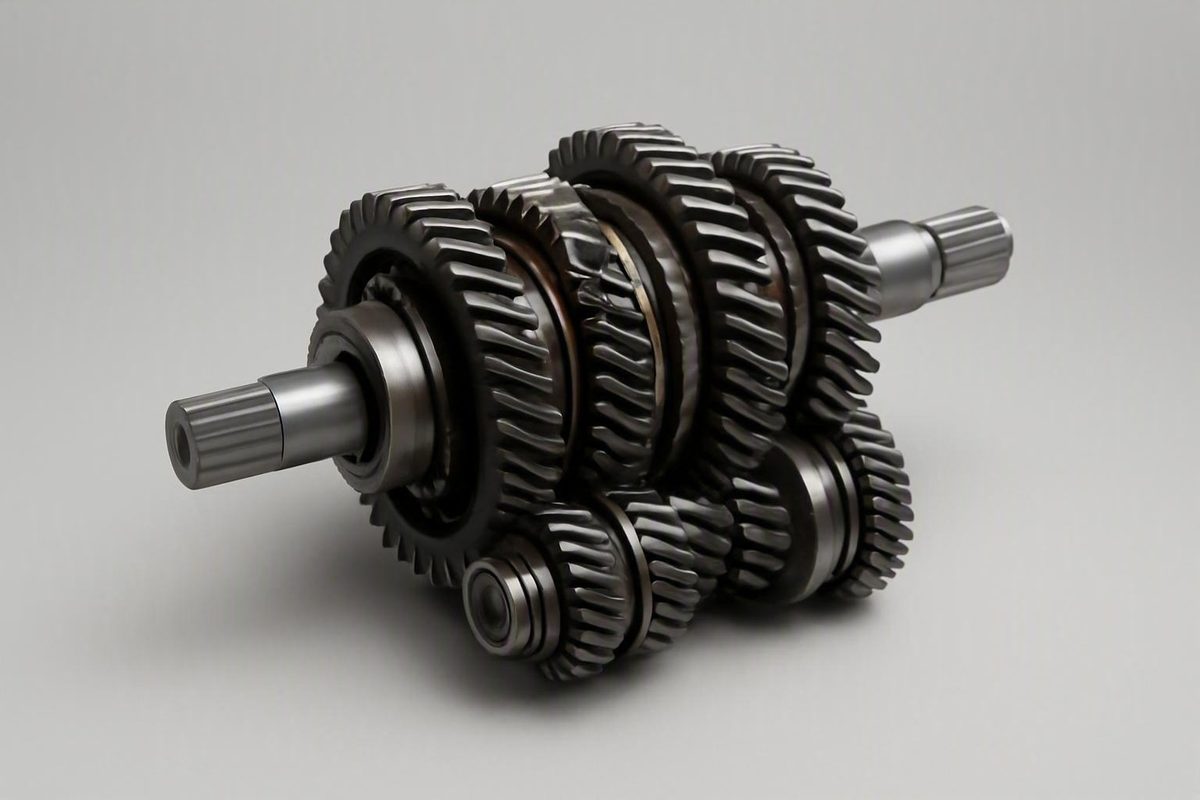
The normalized set is 4.027, 2.364, 1.532, 1.152, 0.852 and 0.667, plus 3.064 reverse. Fifth and sixth are overdrive. No forward gear is exactly 1.000:1.
By Dale Hutchins · Updated August 7, 2026
The commonly published 6L80 gear ratios extend from a 4.027:1 first gear to a 0.667:1 sixth gear. Fifth and sixth are overdrive ratios, while none of the six forward gears is exactly 1.000:1.
The figures below were cross-checked across several third-party references, with calculations repeated from the published ratios. They are a practical general reference, not an official GM specification: no primary GM service or engineering document is cited here. Application-specific service or parts information should take priority when identifying components, diagnosing a transmission, or planning a rebuild.
6L80 gear ratio chart: the immediate answer
| Gear | Precise published ratio | Commonly rounded ratio | Classification |
|---|---|---|---|
| 1st | 4.027:1 | 4.03:1 | Underdrive |
| 2nd | 2.364:1 | 2.36:1 | Underdrive |
| 3rd | 1.532:1 | 1.53:1 | Underdrive |
| 4th | 1.152:1 | 1.15:1 | Underdrive |
| 5th | 0.852:1 | 0.85:1 | Overdrive |
| 6th | 0.667:1 | 0.67:1 | Overdrive |
| Reverse | 3.064:1 magnitude | 3.06:1 | Reverse |
The precise values, including a reverse entry of −3.064 and a nominal forward span of 6.040, appear in a third-party GM 6L transmission reference. Commercial transmission charts also commonly publish the forward set in rounded form as 4.03, 2.36, 1.53, 1.15, 0.85, and 0.67.
A ratio greater than 1.000:1 is underdrive. The transmission input therefore turns more times than the output in first through fourth. A ratio below 1.000:1 is overdrive, making fifth and sixth the 6L80’s two overdrive gears.
Fourth deserves attention because it is sometimes casually called “direct” simply because it precedes the overdrive gears. Numerically, however, 1.152:1 remains an underdrive reduction. The normalized 6L80 ratio set has no exact 1.000:1 forward gear.
Reverse may be shown as either 3.064:1 or −3.064:1. It does not change the ratio’s magnitude, so basic reduction calculations use approximately 3.064:1.
For quick identification, the rounded figures are normally adequate:
6L80 ratios: 4.03, 2.36, 1.53, 1.15, 0.85, and 0.67; reverse 3.06.
Use the three-decimal values for ratio-spread, shift-drop, total-reduction, and cruising-RPM calculations.
Why some 6L80 ratio charts look different
Two charts can show slightly different numbers while describing the same normalized gear set.
First gear illustrates the distinction. Standard rounding of 4.027 to two decimal places produces 4.03. It should not be described as conventional rounding of 4.027, but the 0.01 difference alone is not evidence of a separate first-gear set.
The same precision issue appears throughout the chart:
- 2.364 is commonly displayed as 2.36.
- 1.532 is commonly displayed as 1.53.
- 1.152 is commonly displayed as 1.15.
- 0.852 is commonly displayed as 0.85.
- 0.667 is commonly displayed as 0.67.
- 3.064 reverse is commonly displayed as 3.06.
Use the precise values for calculations and the rounded values for quick lookup. Additional decimal places reduce accumulated rounding error when a transmission ratio is multiplied by an axle ratio and then used in an RPM estimate.
Resolving the 0.085 fifth-gear entry
One published chart requires special treatment. The Novak guide to the 6L80 and 6L90 prints fifth gear as 0.085, while also describing the transmission as having two overdrive gears and an overall spread of 6.04. The 0.085 entry is best treated as a likely typographical error rather than a valid alternate ratio.
Three points support using 0.852:1:
- The more precise combined 6L80/6L90 table publishes 0.852.
- Multiple commercial charts independently display the rounded value 0.85.
- A 0.852 ratio fits the normal progression from 1.152 fourth to 0.667 sixth.
The ratio-spread calculation also confirms that the chart is describing the familiar first-to-sixth set:
4.027 ÷ 0.667 ≈ 6.04
That calculation does not determine fifth gear directly, but it establishes the expected overall set. A 0.085 fifth ratio would be radically out of sequence: shifting from 0.085 fifth to 0.667 sixth at the same road speed would increase engine RPM rather than continue toward taller gearing.
The supportable fifth-gear value is therefore 0.852:1, commonly rounded to 0.85:1. Do not use 0.085:1 in drivetrain or RPM calculations.
A similar warning applies to sixth gear. The corroborated value is 0.667:1, not 0.0667:1. Moving the decimal one place creates a tenfold error and produces unusable cruising-RPM estimates.
Minor differences in displayed precision should not be used to infer model-year or application-specific internal changes. Establishing a genuine variation would require application documentation or another authoritative technical record, not merely a disagreement in the final decimal place.
Overdrive without a 1:1 direct gear
The basic classifications are numerical:
- Underdrive: greater than 1.000:1
- Direct drive: exactly 1.000:1
- Overdrive: less than 1.000:1
Underdrive means the input turns more than once for each output revolution. Overdrive means the output turns faster than the input side represented by the stated ratio. These labels do not, by themselves, establish vehicle speed, engine load, converter state, available power, or operating efficiency.
For the 6L80, first through fourth are underdrive:
- First: 4.027:1
- Second: 2.364:1
- Third: 1.532:1
- Fourth: 1.152:1
Fifth and sixth are overdrive:
- Fifth: 0.852:1
- Sixth: 0.667:1
The fourth-to-fifth shift crosses unity without stopping at an exact direct-drive ratio:
4th: 1.152:1 → unity at 1.000:1 → 5th: 0.852:1
A multi-speed transmission does not have to include a 1.000:1 gear between its reduction and overdrive ratios. In the 6L80 set, fourth remains a reduction gear and fifth is already overdrive.
Gear ratio is not converter lockup
A 1.000:1 mechanical gear ratio and torque-converter lockup are separate concepts.
The selected transmission ratio results from the internal gear and clutch arrangement. Converter lockup describes the operating state of the torque-converter clutch. Knowing that the transmission is in fourth, fifth, or sixth does not by itself establish whether that clutch is applied.
This distinction matters when comparing calculated RPM with a tachometer reading. A basic gearing calculation assumes a fixed mechanical relationship. If the converter is slipping, actual engine speed can be higher than the theoretical result.
Overdrive likewise does not guarantee a specific fuel-economy result.
What the 6.04 ratio spread and shift spacing mean
Forward ratio spread is the numerical distance between first gear and the highest forward gear. It is calculated by dividing first by sixth:
Forward spread = first-gear ratio ÷ sixth-gear ratio
               = 4.027 ÷ 0.667
               ≈ 6.04
In practical terms, 6.04 describes how far the ratio set extends from the deep first gear to the tall sixth gear.
Ratio spread is not a complete performance judgment. The figure alone does not prove how quickly a vehicle will accelerate, how much it can tow, what fuel economy it will return, or how durable its transmission will be. Those outcomes also involve engine output, axle gearing, tires, converter behavior, vehicle mass, cooling, controls, operating conditions, and component condition.
Calculating the RPM drop at each shift
If road speed remains unchanged during a shift and converter behavior remains comparable, post-shift engine speed is proportional to the new ratio. The percentage decrease is:
RPM drop = 1 − (next gear ratio ÷ current gear ratio)
Applying that formula to each adjacent shift produces:
| Shift | Calculation | Approximate RPM drop |
|---|---|---|
| 1st to 2nd | 1 − 2.364 ÷ 4.027 | 41.3% |
| 2nd to 3rd | 1 − 1.532 ÷ 2.364 | 35.2% |
| 3rd to 4th | 1 − 1.152 ÷ 1.532 | 24.8% |
| 4th to 5th | 1 − 0.852 ÷ 1.152 | 26.0% |
| 5th to 6th | 1 − 0.667 ÷ 0.852 | 21.7% |
For example, suppose the engine is turning 5,000 RPM immediately before a first-to-second upshift:
Post-shift RPM = 5,000 × (2.364 ÷ 4.027)
               ≈ 2,935 RPM
The calculated decrease is about 2,065 RPM, or 41.3%.
At 3,000 RPM immediately before a fifth-to-sixth shift:
Post-shift RPM = 3,000 × (0.667 ÷ 0.852)
               ≈ 2,349 RPM
That is a mathematical decrease of approximately 651 RPM, or 21.7%.
These are ratio-derived results, not road-test measurements from a particular Silverado, Tahoe, Suburban, or swap project. Tire dimensions and operating conditions also affect the tachometer reading.
The spacing still illustrates the set’s structure. The largest calculated drop is from first to second. Later ratios are generally closer together, although the progression is not perfectly uniform: the fourth-to-fifth percentage drop is slightly larger than the third-to-fourth drop.
Transmission ratio, axle ratio, and total reduction
The selected transmission gear is only one stage of the driveline. The axle ratio—also called the final-drive or ring-and-pinion ratio—adds another stage of reduction after the transmission.
The basic relationship is:
Transmission ratio × axle ratio = total mechanical reduction
This result applies before tire effects. If a four-wheel-drive vehicle is operating in low range, the engaged transfer-case ratio must also be included.
Example with a 3.42 axle
Using a 3.42:1 axle and the precise 6L80 ratios:
First gear
4.027 × 3.42 = 13.77234
The total mechanical reduction is approximately 13.77:1.
Sixth gear
0.667 × 3.42 = 2.28114
The high-gear relationship is approximately 2.28:1.
The complete first-through-sixth calculation is:
| Gear | Transmission ratio | Calculation with 3.42 axle | Total reduction |
|---|---|---|---|
| 1st | 4.027 | 4.027 × 3.42 | 13.77:1 |
| 2nd | 2.364 | 2.364 × 3.42 | 8.08:1 |
| 3rd | 1.532 | 1.532 × 3.42 | 5.24:1 |
| 4th | 1.152 | 1.152 × 3.42 | 3.94:1 |
| 5th | 0.852 | 0.852 × 3.42 | 2.91:1 |
| 6th | 0.667 | 0.667 × 3.42 | 2.28:1 |
These figures are not exact wheel-torque values.
For four-wheel-drive low range, the calculation becomes:
Transmission ratio × transfer-case low ratio × axle ratio
Use the documented ratio for the particular transfer case and application. A transfer-case ratio cannot be inferred merely from the vehicle having a 6L80.
This is why two vehicles with the same transmission can behave differently. A numerically higher axle ratio increases total reduction in every gear; a numerically lower axle ratio decreases it. Tire diameter then determines the distance traveled per wheel revolution. Converter selection, calibration, vehicle mass, load, and transfer-case configuration add further differences.
“Both vehicles have a 6L80” is therefore only the starting point. A useful comparison must account for selected gear, axle ratio, tire dimensions, and converter state.
How to estimate cruising RPM with a 6L80
A common road-speed estimate is:
RPM = mph × transmission ratio × axle ratio × 336 ÷ tire diameter
The inputs are:
- mph: vehicle speed in miles per hour
- Transmission ratio: the selected 6L80 gear ratio
- Axle ratio: the ring-and-pinion ratio
- 336: a conventional conversion constant for calculations using miles per hour, tire diameter in inches, and revolutions per minute
- Tire diameter: tire height in inches
Commercial drivetrain tools use the same basic inputs—vehicle speed, transmission ratio, ring-and-pinion ratio, and tire height—to estimate engine speed. The RANDYS Worldwide transmission RPM calculator also cautions that its calculated result is not guaranteed to match an exact reading.
Sixth-gear example: 70 mph, 3.42 axle, 33-inch tire
Use:
- Road speed: 70 mph
- Sixth gear: 0.667
- Axle ratio: 3.42
- Nominal tire diameter: 33 inches
Substitute those values:
RPM = 70 × 0.667 × 3.42 × 336 ÷ 33
    ≈ 1,626 RPM
The estimated engine speed is approximately 1,626 RPM.
This is a mathematical estimate, not a factory RPM specification for any Chevrolet model or configuration. A real tachometer reading can differ because of:
- Torque-converter slip or lockup state
- Actual loaded tire radius
- Differences between advertised and measured tire diameter
- Tire growth at speed
- Tire wear and inflation
- Instrument or calibration differences
- Small changes in actual road speed
Use measured operating diameter or loaded rolling information when available.
Estimating RPM in another gear
To estimate RPM in a lower gear, replace 0.667 with the appropriate ratio from the chart.
At the same 70 mph, with a 3.42 axle and nominal 33-inch tire, fifth gear gives:
RPM = 70 × 0.852 × 3.42 × 336 ÷ 33
    ≈ 2,077 RPM
Fourth gear gives:
RPM = 70 × 1.152 × 3.42 × 336 ÷ 33
    ≈ 2,809 RPM
These are mathematical comparisons, not claims that a particular vehicle will select or hold fifth or fourth at 70 mph.
The formula can also be rearranged to estimate an axle ratio when desired RPM, tire diameter, speed, and transmission ratio are known. That result remains a gearing estimate rather than a component recommendation; drivability and parts selection involve more than one cruise-speed target.
How the 6L80 gearing compares with the 4L80E
A numerical comparison shows how differently the two ratio sets are arranged. A third-party 6L80E and 4L80E comparison publishes the 4L80E ratios as 2.48:1, 1.48:1, 1.00:1, and 0.75:1, compared with the rounded 6L80 sequence of 4.03, 2.36, 1.53, 1.15, 0.85, and 0.67.
| Gear position | 6L80 | 4L80E |
|---|---|---|
| 1st | 4.027:1 | 2.48:1 |
| 2nd | 2.364:1 | 1.48:1 |
| 3rd | 1.532:1 | 1.00:1 |
| 4th | 1.152:1 | 0.75:1 |
| 5th | 0.852:1 | — |
| 6th | 0.667:1 | — |
The principal numerical differences are:
- The 6L80’s approximately 4.03:1 first gear is deeper than the 4L80E’s 2.48:1 first.
- The 6L80 has six forward ratios rather than four.
- The listed 4L80E set includes an exact 1.00:1 third gear.
- The 6L80 has no exact 1.00:1 forward gear.
- The 6L80’s 0.67:1 sixth is numerically lower than the 4L80E’s 0.75:1 fourth.
- The 6L80 has two overdrive ratios; the listed 4L80E set has one.
These differences do not establish that either transmission is categorically better. Internal ratios interact with axle gearing, so a 6L80 vehicle with one axle ratio may produce a different overall result from a 4L80E vehicle with another.
A responsible comparison also considers tire diameter, converter behavior, electronic controls, physical fit, output configuration, intended application, parts availability, calibration requirements, and other build details. Durability, towing performance, fuel use, cost, and shift quality cannot be determined from the ratio chart alone.
The useful conclusion is numerical: the 6L80 starts with a substantially deeper first gear, provides more intermediate steps, and finishes with a numerically lower top ratio. The 4L80E’s four-speed set includes a conventional direct third gear that the 6L80 set does not.
Identification limits and how to use the chart responsibly
Third-party technical references describe the 6L80 as a longitudinal, electronically controlled six-speed automatic using clutch-to-clutch shifting. They describe manufacture as beginning in 2005 for release in 2006-model-year GM vehicles, which explains why some summaries associate the transmission with 2005 while others identify a 2006 debut.
Aftermarket sources use both 6L80 and 6L80E. The references cited here do not establish a formal GM rule defining whether those names are universally interchangeable in service information, parts catalogs, or every technical context.
The ratio chart also has limits. Agreement among several third-party references supports the normalized 4.027-to-0.667 set, but it does not prove that every model year, regional version, vehicle application, or related 6L90 configuration has identical internal specifications. A table combining 6L80 and 6L90 data is useful corroboration, not proof that both transmissions share every specification.
Do not infer the following from the ratio chart:
- Torque-converter design or stall behavior
- Output-shaft configuration
- Fluid capacity
- Control-module compatibility
- Wiring or calibration requirements
- Transfer-case compatibility
- Case or mounting details
- Universal torque capacity
- Parts interchangeability
These details can vary independently of the nominal ratio set. Two units can share all six forward ratios yet differ in hardware, electronics, calibration, converter, output arrangement, or intended application.
For parts selection, diagnosis, rebuilding, or a swap, identify the exact transmission and vehicle application. Check the applicable service information, transmission identification, parts documentation, and build requirements before ordering components or treating a gearing calculation as diagnostic proof.
As a normalized reference, the usable set is:
1st 4.027, 2nd 2.364, 3rd 1.532, 4th 1.152, 5th 0.852, 6th 0.667, and reverse 3.064 in magnitude.
Fifth and sixth are overdrive gears, there is no exact 1.000:1 forward gear, and the forward spread is approximately 6.04. To apply the figures to a vehicle, combine the selected transmission ratio with axle ratio and tire diameter, adding transfer-case gearing where applicable.
Agreement among third-party sources makes this ratio set a useful general reference. The absence of a cited primary GM specification should remain clear, especially when the information will be used for diagnosis, rebuilding, a swap, or component selection.
Frequently asked questions
What is the 6L80 reverse gear ratio?
The commonly published reverse ratio is 3.064:1 in magnitude, usually rounded to 3.06:1. Some tables display it as −3.064; the negative sign indicates reverse rotational direction rather than a different magnitude, as shown in the published 6L80/6L90 ratio table.
For a basic reduction calculation with a 3.42 axle:
3.064 × 3.42 ≈ 10.48:1
That is mechanical reduction before tire effects or any engaged transfer-case gearing. It is not an exact wheel-torque figure.
Is fifth gear in the 6L80 0.852:1 or 0.085:1?
Use 0.852:1, commonly rounded to 0.85:1. Rounded 0.85 entries are corroborated by commercial ratio references such as the ATI 6L80E chart.
The isolated 0.085 entry is most likely a typographical error. It conflicts with the precise 0.852 figure, the commonly published 0.85 value, and the normal sequence from 1.152 fourth to 0.667 sixth. Do not use 0.085 in RPM or driveline calculations.
Does the 6L80 have a 1:1 direct-drive gear?
No. The commonly published set runs from fourth at 1.152:1 to fifth at 0.852:1, crossing unity without including an exact 1.000:1 gear. A third-party 6L80E ratio listing corroborates the rounded fourth- and fifth-gear values of 1.15 and 0.85.
Fourth remains underdrive, while fifth is overdrive. This numerical fact is separate from converter lockup and does not establish whether the converter clutch is applied at a particular moment.
Are 6L80 and 6L80E the same transmission?
Aftermarket references commonly use both names for the transmission discussed in this ratio chart. For example, commercial comparison material uses the 6L80E wording while publishing the familiar six-ratio set in its 6L80E overview.
The cited evidence does not establish an official GM rule stating that 6L80 and 6L80E are always interchangeable designations. For service work, controllers, parts, rebuilding, or swaps, use the identification tied to the exact transmission and vehicle application.
Do all 6L80 model years and vehicle applications use the same gear ratios?
The normalized ratio set is consistent across the third-party references reviewed here, including a commercial GM 6L80 transmission chart. That agreement does not prove that every model year, vehicle, region, or related configuration uses identical internal specifications.
Treat 4.027, 2.364, 1.532, 1.152, 0.852, and 0.667, plus 3.064 reverse, as a well-corroborated general reference. Confirm application-specific service or parts information before diagnosing a transmission, selecting internal components, planning a rebuild, or completing a drivetrain swap.