
NV4500 Gear Ratios: Identify the GM Version Before Using the Table
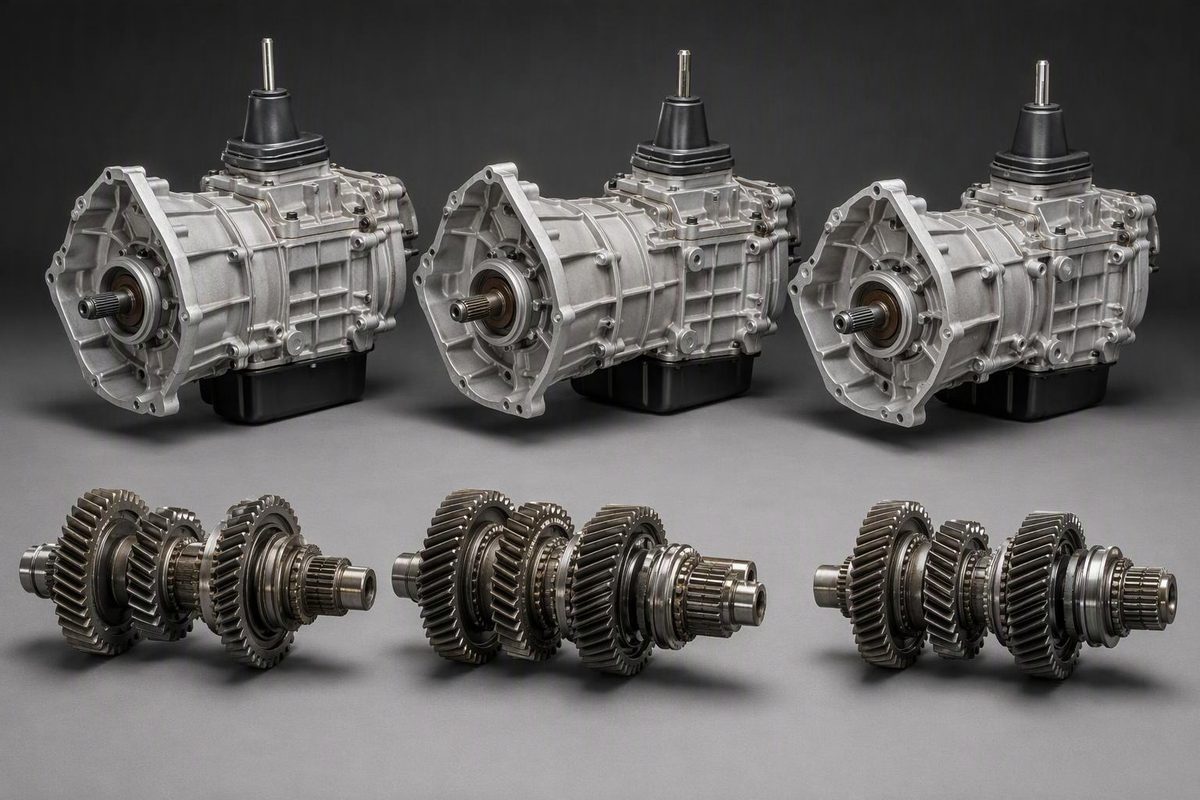
Compare GM NV4500 gear ratios by year, identify factory and swapped units, and calculate how the 6.34-to-5.61 first-gear change affects reduction.
The standard GM NV4500 ratio pattern is straightforward: 1992–1994 units have a 6.34:1 first gear, while 1995-and-later units have a 5.61:1 first gear. Reverse changed separately, from 5.61:1 to 5.04:1 for 1997.
Treat those years as a starting point, not final identification. A Chevrolet truck may have a replacement transmission, a mixed-parts rebuild or a Dodge donor. Advance Adapters also reports a rare 1995 GM hybrid with the early 6.34:1 low gear and later-style case pattern (NV4500 specifications).
Identify the NV4500 before using the table
1. Find and record its identification numbers
Clean the transmission and photograph every tag or decal before ordering parts. Advance Adapters places the identification tag on the shifter top cover and says it contains the model number, build date and part number. Torque King also directs owners to a build tag by the left PTO cover and decals on top, so inspect both areas (Advance Adapters identification guide; Torque King NV4500 FAQ).
Decode the numbers through a parts catalog or NV4500 specialist. A readable tag is more useful than the shift pattern, case appearance or a seller’s claimed donor year.
2. Use the truck’s RPO label only as factory-build evidence
Novak documents the NV4500’s GM introduction under RPO MT8 (Novak NV4500 guide). An RPO label can help establish how the truck left the factory, but it cannot establish that the transmission presently installed is original.
3. Check GM-versus-Dodge hardware on an untagged unit
Ratios alone cannot distinguish a later GM NV4500 from a Dodge version because both can use the 5.61/3.04/1.67/1.00 forward set. Useful checks on a removed, safely supported 4WD transmission include:
- GM input: about 6.625 inches long, 1-1/8-inch 10-spline, with a 0.590-inch pilot tip.
- Dodge input: about 7.5 inches long, with a 0.750-inch pilot tip. Gas and diesel/V10 versions use different spline diameters.
- GM 4WD output: 32 splines and an approximately 8.125-inch adapter housing.
- Dodge 4WD output: 23 or 29 splines and an approximately 6.25-inch adapter housing.
These dimensions come from the Advance Adapters specifications. They do not establish interchangeability: input and output shafts, retainers, bellhousing patterns and transfer-case interfaces differ among versions.
If a tagless transmission has been assembled from several donors, a rebuilder may need to identify its internal parts or verify the ratio by comparing input and output rotations in each gear.
GM NV4500 gear-ratio table
| Standard GM application | 1st | 2nd | 3rd | 4th | 5th* | Reverse |
|---|---|---|---|---|---|---|
| 1992–1994 wide-ratio | 6.34:1 | 3.44:1 | 1.71:1 | 1.00:1 | ≈0.73:1 | 6.34:1 |
| 1995–1996 medium-ratio | 5.61:1 | 3.04:1 | 1.67:1 | 1.00:1 | ≈0.73:1 | 5.61:1 |
| 1997–2007 medium-ratio | 5.61:1 | 3.04:1 | 1.67:1 | 1.00:1 | ≈0.73:1 | 5.04:1 |
The year and reverse splits are documented in Torque King’s production history. The same source says GM gained synchronized reverse for 1999; synchronization did not cause another ratio change (NV4500 production history).
New Venture parts documentation assigns the 6.34:1 hardware to 1992–1994 GM units and the 5.61:1 hardware to 1995-and-later units. It warns that converting a 6.34 transmission to 5.61 requires a matching countershaft, input shaft and third gear—not merely another first gear (New Venture 4500 parts guide).
*Specialist references publish fifth as 0.73, 0.74 or 0.75:1. Advance Adapters specifies 0.73:1, while Novak lists 0.73 for the early set and 0.74 for the later set. Use the documentation for the identified transmission or installed gearset when a calculation needs greater precision.
What 6.34 versus 5.61 means
A 6.34:1 first gear provides about 13% more reduction than 5.61:1. With a 4.10:1 axle ratio, transmission-and-axle reduction before transfer-case low range is:
- 6.34 × 4.10 = 25.99:1
- 5.61 × 4.10 = 23.00:1
The deeper 6.34 gear therefore produces about 13% more theoretical wheel-torque multiplication and about 13% lower road speed at the same engine rpm, axle ratio and tire diameter. The later set has a smaller first-to-second step. Fourth is direct at 1.00:1, and fifth is overdrive.
For a 4WD crawl ratio, multiply:
first gear × transfer-case low ratio × axle ratio
For approximate road-speed calculations in fifth:
Engine rpm = mph × transmission ratio × axle ratio × 336 ÷ loaded tire diameter in inches
Use the ratio tied to the transmission tag or verified internal gearset—not merely the Chevrolet model year.