
Which 4L60E Fits Your 5.3, and What Must Match
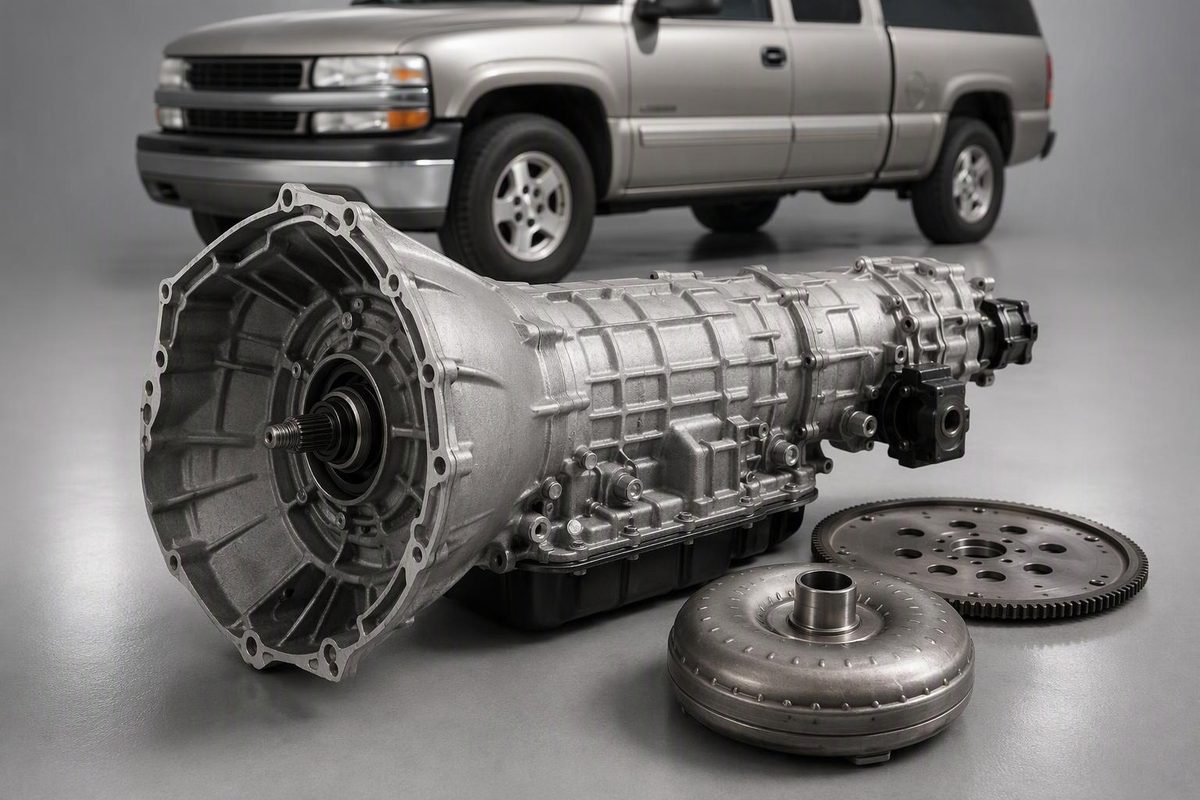
Identify which 4L60E fits your Chevy 5.3, then check bellhousing depth, converter spacing, flexplate compatibility and electronic controls before buying.
Yes—an LS-configured 4L60E can bolt to a Chevrolet truck or SUV’s Gen III or Gen IV 5.3L V8. An older Chevrolet-pattern 4L60E can also be adapted, but it is not automatically a bolt-in combination. The bellhousing, input-shaft/converter assembly, flexplate and electronic controls must match. A Gen V EcoTec3 5.3 needs a separate fitment plan. PSI’s transmission guide identifies LS-type units as the straightforward starting point and explains the additional parts needed for earlier transmissions.
This applies to longitudinal Chevrolet truck/SUV 5.3 engines—not the transverse, front-wheel-drive LS4.
Select your engine generation and transmission type to see the fitment verdict.
Select the identified configuration, not just the donor year. This tool covers longitudinal truck/SUV engines, not the LS4.
Fitment Verdict
Straightforward Mechanical Starting Point
An LS-configured 4L60E can bolt to a Gen III/IV truck 5.3. Verify the matched bellhousing, input/converter assembly, flexplate and crank-pilot support.
Not a complete bolt-in guarantee: confirm the actual connector, controller and calibration. Check the 2WD/4WD output arrangement separately.
Connector and Identification Caveats
| Typical Years | Pins | Check |
|---|---|---|
| 1996–2006 | 13 | Actual configuration |
| 2007–2008 | 15 | Input-speed sensor |
| 2009 onward | 17 | Controller support |
PSI lists typical populated-pin counts; applications overlap. Its Gen IV 58x advice concerns its GM-based swap controls, not every standalone controller. A removable bellhousing alone does not identify an LS unit.
Sources: PSI transmission guide, Novak 4L60E guide, US Shift compatibility notes and Michigan Motorsports Gen V flexplate listing, linked in the article.
Identify Your 4L60E Before Buying Parts
Use the donor vehicle, transmission identification code, bellhousing and electrical connector together. Model year is a starting point, not an interchange guarantee.
| Your 4L60E | Gen III/IV 5.3 Fitment | Main Checks |
|---|---|---|
| 1993–1995 Chevrolet-pattern | Adaptable, not automatically bolt-in | Converter spacing; early controls |
| 1996–1998 pre-LS truck | Usually needs adaptation parts | Short input arrangement; pilot support; flexplate |
| Typically 1999–2006 LS/Vortec V8 | Most straightforward starting point | LS bellhousing; converter; controls |
| 2007-and-later | May fit mechanically | Pin count; input-speed sensor; calibration |
The mechanical year guidance comes from PSI. Early electronic differences are documented by US Shift: 1995 added a pulse-width-modulated converter-clutch solenoid, and 1996 changed the 3–2 downshift solenoid. A 1993–1995 transmission is not electronically interchangeable with a later one simply because both are labeled 4L60E.
An LS Bellhousing Alone Does Not Complete the Conversion
A removable bellhousing does not prove that a transmission is configured for an LS engine. GM phased removable bellhousings into different applications during 1996–1998.
The LS-style arrangement uses a deeper bellhousing for the 300 mm converter. Novak identifies it as approximately 5/8 inch deeper, used in 1998-and-later Firebirds and 1999-and-later C/K trucks, with different turbine and stator shafts. Novak’s bellhousing identification guide illustrates the differences.
Installing an LS bellhousing on an older transmission is not, by itself, a complete conversion. Advance Adapters warns about interchanging bellhousings and converters because converter length, bolt pattern, stator and input-shaft arrangements vary.
If your transmission came from an S-10, Camaro or another nonmatching application, identify its bellhousing and internal arrangement rather than assuming every 4L60E has the same engine pattern.
Match the Converter, Flexplate and Crank Pilot
For an older 4L60E behind a Gen III/IV 5.3, you may need a compatible dished flexplate and crank-pilot adapter/spacer—or an application-specific conversion flexplate package. PSI describes these earlier-transmission options. The required arrangement depends on the converter and transmission you retain.
There are three separate interfaces to verify:
- Crankshaft to flexplate: Use a flexplate intended for that engine’s crank flange.
- Flexplate to converter: Confirm the converter bolt circle. LS-type 4L60E applications commonly use approximately 11.06 inches; earlier converter arrangements can differ. Speedway’s flexplate guide explains the patterns.
- Converter pilot and axial spacing: The converter nose must engage and be supported in the crank. With the converter fully seated in the transmission, its gap to the flexplate must meet the specification for that combination.
Never use the bellhousing bolts to pull a reluctant transmission against the engine. The case must sit flush before tightening, and the converter must be correctly seated. BTE’s installation instructions explicitly warn against drawing the assembly together with bolts.
Use the clearance specification supplied for your exact converter/transmission combination—not a universal spacer thickness. Chevrolet Performance’s Supermatic 4L65-E/4L70-E instructions likewise require checking that gap and rechecking seating or converter application when it is outside specification. Their dimensions apply to those assemblies, not every 4L60E swap.
There is no single converter-clearance figure established here for all 4L60E/5.3 combinations. Get that specification from the supplier of your matched parts before installation.
Electronic Compatibility Depends on the Actual Transmission
The 4L60E needs electronic control to shift automatically. A connector that plugs in is not enough.
PSI lists these typical populated-pin counts:
| Transmission Years | Populated Pins | Distinction |
|---|---|---|
| 1996–2006 | 13 | Earlier arrangement |
| 2007–2008 | 15 | Adds input-speed-sensor connections |
| 2009 onward | 17 | Later arrangement |
Application overlaps exist, so count the actual pins rather than ordering a harness by year alone.
For its GM-based swap-control arrangements, PSI recommends the later sensor-equipped versions for Gen IV 58x applications. Using an earlier 13-pin unit can require a custom operating system and calibration. That guidance does not establish a universal requirement for every standalone controller.
Before ordering a harness or standalone controller, give its supplier the engine code, engine controller identification, transmission code and connector details. Confirm support for that exact combination, including converter-clutch operation and speed signals.
On a 4WD truck, also account for transfer-case low range and where vehicle speed is measured. Advance Adapters explains why low-range compensation matters when the speed sensor is downstream of the transfer case. Mechanical engine fit does not resolve those control requirements.
A Gen V EcoTec3 5.3 Needs a Separate Plan
Treat an L83, L84 or other Gen V 5.3 as a different conversion—not simply another LS donor. Gen V uses direct injection and different engine management, as described by PSI’s harness guide.
Mechanical adaptation options exist. Michigan Motorsports lists an eight-bolt Gen V flexplate supporting a 4L60E when paired with a compatible dished-flexplate converter.
That product establishes a mechanical option, not compatibility with your factory electronics or every converter. Confirm the complete flexplate, converter, pilot-support and controller/harness arrangement before purchasing parts. Use our 5.3L EcoTec3 engine guide for engine-identification context.
Engine Fit Does Not Guarantee Truck Fit
Two-wheel-drive and four-wheel-drive 4L60Es have different output arrangements, as Novak documents. Even when the transmission fits the engine, the output arrangement, transfer-case adapter, transmission mount and driveshaft fit still need to match the truck.
Before committing money, record the engine’s donor year and RPO code, transmission identification, bellhousing type, converter identification and connector pin count. Those details let a parts or controller supplier verify the actual combination instead of quoting a generic “LS swap” package.
Bolt-up compatibility also does not establish whether a used transmission is suitable for your towing or power goals.
If you are buying both components, a matched 5.3/4L60E donor package with its converter, flexplate, wiring and controls is the simplest starting point. If you are keeping an older 4L60E, identify it first and price the complete adaptation—not just a bellhousing.