
How to Identify Your GM 10-Bolt Before Buying Parts
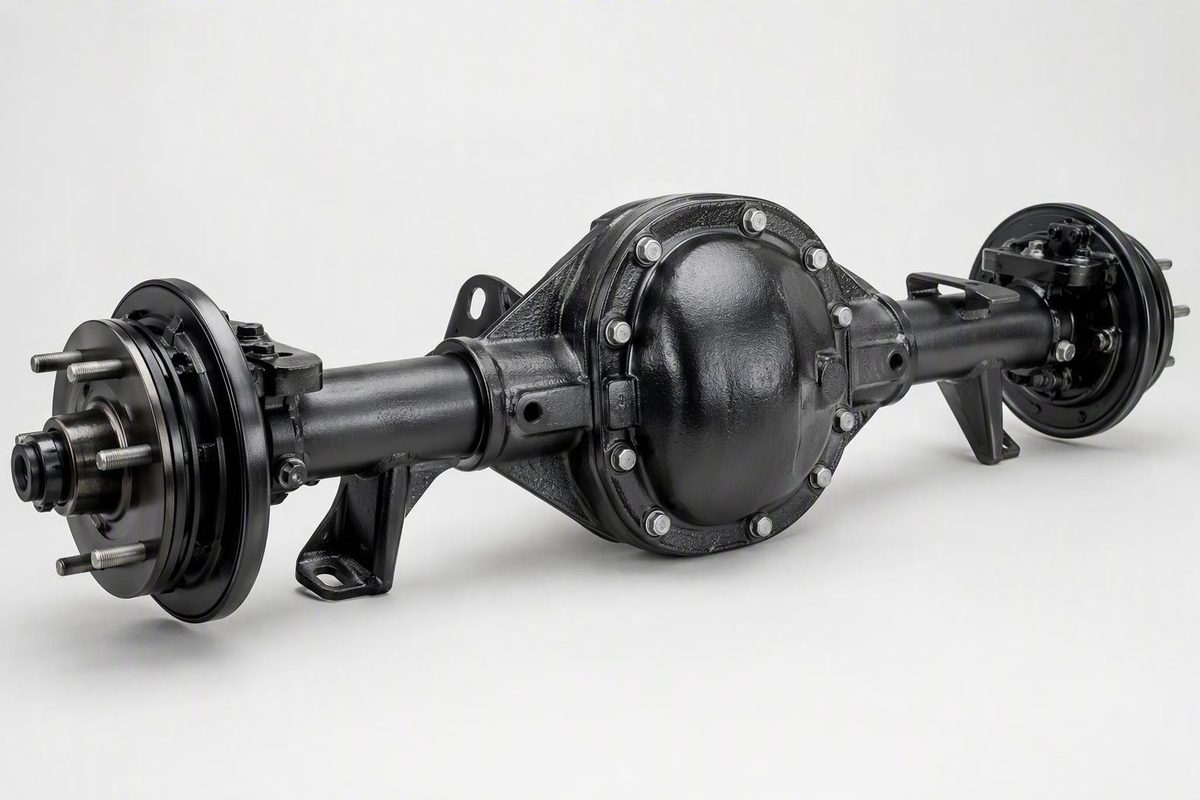
A Chevrolet 10-bolt rear end is not one standardized axle. The name covers several GM axle families that differ in ring-gear diameter, carrier design, spline count, axle retention, bearings, seals, gears, brakes, and installation dimensions.
That makes “I have a GM 10-bolt” the beginning of an identification—not enough information to order parts.
The safest approach is progressive:
- Confirm the cover-bolt count.
- compare multiple housing features.
- uncover and record the axle-tube stamp.
- distinguish the axle’s original identity from its current configuration.
- inspect the internal components before buying expensive parts.
What “10-bolt” tells you—and what it does not
“10-bolt” commonly refers to the number of bolts securing the differential cover and ring gear. It does not establish:
- Ring-gear diameter
- Axle spline count
- Axle-retention method
- Gear ratio
- Carrier ratio range
- Bearing or seal dimensions
- Brake configuration
- Housing width or mounting points
- Parts interchangeability
The principal families covered here are the 7.5/7.625-inch axle, Chevrolet 8.2-inch axle, Buick-Oldsmobile-Pontiac—or BOP—8.2-inch axle, and corporate 8.5/8.6-inch axle. Retailers place these designs in separate product categories, reinforcing why buyers cannot safely shop using only the phrase “GM 10-bolt.” Quick Performance’s catalog, for example, separates several GM 10-bolt families.
| Family | Common external clues | Typical axle retention | Distinguishing internal details | Identification cautions |
|---|---|---|---|---|
| 7.5/7.625-inch | Compact oval cover; small lower lugs near 5 and 7 o’clock; approximately 3.25 inches from the lower center cover bolt to either adjacent bolt | Commonly C-clips | Smaller ring gear; configuration varies by application | The lower lugs can resemble those on an 8.5, so lug shape alone is insufficient. These commonly cited dimensions are summarized in Speedway Motors’ multi-family identification guide. |
| Chevrolet 8.2-inch | Mostly smooth, rounded lower housing; approximately 1.125-inch original-equipment pinion nut | Commonly C-clips | Chevrolet-specific gears, pinion, and carrier design | A replacement pinion nut can defeat the visual rule. Do not confuse it with a BOP 8.2. Chevy Hardcore documents these Chevrolet 8.2 identifiers. |
| BOP 8.2-inch | External appearance varies by division and application | Commonly outer retainer plates | Internally different from the Chevrolet 8.2; gears do not interchange | The shared “8.2” label does not imply shared gears or retention parts. |
| Corporate 8.5/8.6-inch | Large square lower lugs; approximately 3.75-inch lower-bolt spacing; approximately 1.25-inch original-equipment pinion nut | Most use C-clips, with retained or bolt-in exceptions | Roughly 1.625-inch pinion shaft; multiple axle and pinion spline configurations | These external clues usually identify only the combined 8.5/8.6 family. Brake type and model year are not conclusive separators. |
Historical references disagree about some transition dates. Some describe the corporate 8.5-inch axle as appearing in 1970, while another places its introduction in 1971. The conflict is visible in the published histories rather than something that can be resolved from a model year alone. Hemmings gives the 1970 date.
A separate identification account places the corporate axle’s arrival in 1971. OnAllCylinders documents that alternate date.
Retailer categories also differ on whether the truck transition to the 8.6-inch designation began in 1999 or 2000. One catalog begins its 8.6-inch truck category in 1999, while other editorial guidance uses 2000. Rigid Axle’s categories illustrate the 1999 classification.
These conflicts should not be “solved” by treating a vehicle’s model year as a decisive identifier. Inspect and measure the physical axle.
Chevrolet 10-bolt identification decision tree
Use the following decision tree to identify a likely family. Require at least two matching external clues before assigning even a provisional identity. If the planned purchase includes gears, axle shafts, a differential, or other expensive components, proceed to internal verification.
| Step | Observation | Branch or provisional result |
|---|---|---|
| 1 | Cover does not have 10 bolts | Stop. This is outside the GM 10-bolt families covered here. |
| 1 | Cover has 10 bolts | Continue to cover profile and lower-housing inspection. |
| 2 | Small oval cover and small lower lugs | Measure the lower cover-bolt spacing. Approximately 3.25 inches supports 7.5/7.625. |
| 2 | Smooth, rounded lower housing without prominent square lugs | Inspect the pinion hardware and retention design. An original-style approximately 1.125-inch pinion nut and C-clips support Chevrolet 8.2. |
| 2 | Large square lugs near 5 and 7 o’clock | Measure the lower cover-bolt spacing. Approximately 3.75 inches and an original-style approximately 1.25-inch pinion nut support the 8.5/8.6 family. |
| 2 | Housing resembles an 8.2 but uses outer retainer plates | Investigate a possible BOP 8.2; do not order Chevrolet 8.2 gears or retention parts. |
| 3 | External clues conflict | Treat the axle as unidentified. Record stamps and castings, then inspect internally. |
| 3 | Two or more clues agree | Record a likely family, but verify spline count, retention, ratio, and component dimensions before ordering. |
| 4 | External clues indicate 8.5/8.6 | Do not force an 8.5-versus-8.6 conclusion from brakes or model year. Use application-specific castings, internal measurements, spline details, and the component manufacturer’s fitment data. |
Identification confidence
- Low confidence: Cover-bolt count or vehicle application only
- Moderate confidence: Two matching external housing measurements or features
- High confidence: Matching housing evidence plus stamp or casting research and internal verification
- Parts-ordering confidence: Exact family, ratio, carrier, spline count, retention method, bearings, seals, brakes, and critical dimensions have all been verified
Schematic identification map—not to scale
REAR VIEW                                   FRONT / PINION VIEW

                  [A] 12 o’clock
                         |
            9 o’clock [ COVER ] 3 o’clock
/ \
[B] lug / lug [B]
                 7 o’clock       5 o’clock
                         |
                    [C] 6 o’clock

[A] Cover profile and bolt count
[B] Lower-lug size and shape
[C] Lower center cover bolt

Measure lower-bolt spacing center-to-center:

             adjacent bolt ●
                           /
                          /  [D]
                         /
        lower bolt      ●

[D] Center of lower bolt to center of either adjacent bolt
SIDE / FORWARD-FACING AXLE-TUBE VIEW

 wheel end                                                center section
    |                                                           |
====|================ [E] stamp area ========================[F]====>
                                                            casting pads

[E] Search around the axle tube near the center housing
[F] Record raised casting number and casting date separately

PINION AREA

                 driveshaft side
                       |
                    [ yoke ]
                       |
                 [G] pinion nut
                       |
                center housing

[G] Pinion-nut size is a clue only; replacement hardware may differ
1. Confirm ten cover bolts
Clean enough of the cover perimeter to count every fastener. Do not assume that all ten-bolt covers share the same dimensions or gasket shape.
2. Compare the cover profile
Look at the overall proportions, side bulges, ridges, and lower contour:
- A relatively small oval cover points toward the 7.5/7.625 family.
- A Chevrolet 8.2 commonly has a smoother lower case and may have a smooth or ridged cover.
- An 8.5 commonly has a larger, rounder cover, often with a side bulge.
3. Inspect the lower housing
A likely 7.5/7.625 has relatively small cast lugs around the 5 and 7 o’clock positions. A likely 8.5/8.6 has larger, squarer lugs in approximately the same region. A Chevrolet 8.2 generally has a smoother, rounded lower case without the prominent square protrusions.
Do not stop at lug shape. A 7.5 can resemble an 8.5 in this area.
4. Measure the lower cover-bolt spacing
Measure from the center of the bottom cover bolt to the center of either adjacent bolt. Do not measure from bolt edge to bolt edge.
- Approximately 3.25 inches supports a 7.5/7.625 identification.
- Approximately 3.75 inches supports an 8.5/8.6 identification.
- The commonly cited 7.5/7.625 cover measures approximately 8 5/16 by 10 9/16 inches. These measurements are documented together in the GM 10-bolt identification guide from Speedway Motors.
5. Inspect the pinion area
If original-style hardware remains:
- An approximately 1.125-inch pinion nut supports a Chevrolet 8.2 identification.
- An approximately 1.25-inch pinion nut supports an 8.5/8.6 identification.
- The 8.5 is commonly described as having a roughly 1.625-inch pinion shaft. Chevy Hardcore gives these comparative dimensions.
Pinion-nut size is not conclusive. A replacement nut, aftermarket yoke, previous rebuild, or damaged hardware can invalidate the comparison.
6. Investigate axle retention
Depending on the assembly, retention may involve:
- C-clips inside the differential
- Outer retainer plates
- Retained bearings or another bolt-in arrangement
A Chevrolet 8.2 commonly uses C-clips, while a BOP 8.2 commonly uses outer retainer plates. Most 8.5 units are described as C-clip designs, but retained and bolt-in exceptions exist. Do not order axle shafts simply because the center housing resembles a common C-clip version.
7. Record stamp and casting areas
Photograph the axle-tube stamp, raised center-section casting number, and casting date separately. These markings serve different purposes and should not be combined into one identification string.
8. Verify internally when the purchase depends on the answer
Removing the cover usually permits inspection of:
- Ring-gear markings and approximate diameter
- Carrier type
- Ring-gear fasteners
- C-clips or other visible retention hardware
- Gear condition
- Tooth counts, when accessible
Some questions require more than removing the cover. Directly counting pinion teeth can also require additional access, so readable ring-gear markings or professional inspection may be more practical.
A useful identification photo set should include labeled views of:
- Complete rear cover
- Lower lugs at 5 and 7 o’clock
- Lower-bolt measurement endpoints
- Pinion nut and yoke
- Axle-tube stamp area
- Center-section casting number and date
- Housing ends and backing-plate mounts
- Carrier and visible retention hardware
Do not use drum-versus-disc brakes as a conclusive 8.5-versus-8.6 test. Factory variation, replacement housing ends, and brake conversions can defeat that shortcut.
Find the axle code, then verify what is actually inside
The axle identification stamp is commonly found on an axle tube near the center housing, often on a forward-facing surface. The side, exact position, and code format vary by vehicle and model year.
Remove paint, rust, and grime carefully. A hand wire brush, degreaser, directional light, and chalk or marking powder may help reveal a shallow stamp. Avoid grinding or aggressive abrasion that could remove the characters.
Depending on the application, an axle code may identify some combination of:
- Original axle ratio
- Assembly plant
- Assembly or build date
- Work shift
- Differential type
- Positraction source or equipment
Code formats changed, and similar characters can mean different things in different model years. Consult the correct GM service manual, assembly reference, or model-specific code source rather than a universal online list.
Keep three kinds of markings separate:
- Axle-tube stamp: Usually relates to the assembly’s identity or original configuration.
- Center-section casting number: Identifies a casting or housing family, not necessarily its current gearing.
- Casting date: Indicates when the cast component was produced, not when every internal part was installed.
A code or RPO label describes an original configuration. It cannot prove that the original gears, carrier, axle shafts, brakes, or even the complete housing remain in the vehicle.
When the history is unknown, inspect the gears. Calculate the ratio by dividing the ring-gear tooth count by the pinion-gear tooth count:
Axle ratio = ring-gear teeth ÷ pinion teeth
For example:
40 ÷ 13 = 3.0769
That rounds to approximately 3.08:1. The calculation and the 40-to-13 example are documented in published GM 10-bolt identification guidance.
Some ring gears carry tooth-count and date markings. Photograph those markings before aggressive cleaning. If the markings are readable, they may be more practical than trying to count pinion teeth through the cover opening.
While the cover is off, inspect the tooth faces, carrier, ring-gear fasteners, cross pin, and visible retention hardware. Treat chipped teeth, pitting, unusual wear patterns, loose components, or metal debris as reasons for further professional inspection.
Parts compatibility: the checks to make before ordering
Before buying any product labeled for a “Chevrolet 10-bolt,” record:
- Exact axle family
- Ring-gear diameter
- Current ratio
- Desired ratio
- Carrier compatibility with the desired ratio
- Current differential type
- Axle spline count
- Pinion spline count, where relevant
- Axle-retention method
- Axle-shaft length and critical dimensions
- Bearing part numbers or measured dimensions
- Seal dimensions
- Housing-end design
- Brake type and size
- Brake offset
- Wheel bolt pattern
- Wheel pilot diameter
- Pinion-yoke dimensions
- U-joint series or measured cap and span dimensions
- Suspension brackets or spring-perch dimensions
Never assume the Chevrolet 8.2 and BOP 8.2 share internal components. They are materially different designs, and published identification guidance says their gears do not interchange. Chevrolet 8.2 units commonly use C-clips, while BOP 8.2 designs commonly use outer retainer plates. Exact application still must be verified.
Most 8.5-inch units are C-clip designs, but uncommon Buick, Oldsmobile, Pontiac, and selected Chevrolet applications used retained or bolt-in axles. Commonly cited 8.5 internal identifiers include a 28- or 30-spline pinion, ten left-hand-thread ring-gear bolts, and 28-spline axles in many original units. These are identification clues, not universal specifications for every housing.
A 28-to-30-spline 8.5 conversion generally requires both matching 30-spline axle shafts and a compatible 30-spline differential.
Do not copy a shopping list from another vehicle merely because both assemblies are called 8.5-inch 10-bolts.
Carrier compatibility depends on axle family and ratio range. A carrier break quoted for an 8.5 does not automatically apply to a Chevrolet 8.2, BOP 8.2, or 7.5/7.625. Match the exact axle, intended ratio, carrier, and gear manufacturer’s application data.
Likewise, do not assume that a thick gear, spacer, or other special arrangement is acceptable. Use only configurations approved by the manufacturers of the installed carrier and gearset.
Printable parts worksheet
| Item | What to record |
|---|---|
| Vehicle | Year, model, drivetrain, transmission |
| Claimed axle origin | Seller’s or previous owner’s description |
| Cover | Bolt count, shape, dimensions |
| Lower housing | Lug shape and location |
| Lower-bolt spacing | Center-to-center measurement |
| Pinion area | Nut, yoke, spline, and seal details |
| Axle-tube stamp | Full code, character spacing, orientation, and location |
| Center casting | Casting number and date |
| Axle family | 7.5/7.625, Chevrolet 8.2, BOP 8.2, 8.5, 8.6, or unresolved 8.5/8.6 |
| Current ratio | Ring teeth divided by pinion teeth |
| Desired ratio | Intended final ratio |
| Carrier | Open, limited slip, locker, spool, or unknown |
| Carrier compatibility | Manufacturer-approved ratio range |
| Axles | Spline count, length, bearing seat, flange dimensions |
| Retention | C-clip, outer retainer, retained bearing, or unknown |
| Bearings and seals | Part numbers and measured dimensions |
| Housing ends | Type, pattern, dimensions, and condition |
| Brakes | Drum/disc, diameter, width, offset, and completeness |
| Wheels | Bolt pattern, pilot, and required offset |
| Driveline | Yoke, U-joint, driveshaft, and slip-yoke requirements |
| Installation | Parts, labor, setup, inspection, and fabrication estimates |
Treat every blank as an unanswered fitment question—not permission to assume the most common configuration.
Open differential, limited slip, locker, or spool?
Both open and Positraction versions of the 8.5-inch axle were produced.
A wheel-rotation observation is sometimes used as a preliminary clue: wheels tending to turn in the same direction may suggest limited-slip operation, while opposite rotation may suggest an open differential. It is not a conclusive identification method.
Results can be affected by wear, resistance at the brakes or bearings, differential design, prior modification, and automatic locking mechanisms. A worn limited-slip unit may not behave as expected, and a modified or damaged carrier can make the result meaningless.
This guide does not provide a vehicle-lifting procedure for that test. Do not raise or work beneath a vehicle without following the vehicle manufacturer’s service instructions and the lift, jack, or support-equipment manufacturer’s procedures. If a purchasing or service decision depends on differential type, removing the cover and identifying the carrier directly is the better approach.
The basic differential categories are:
These are functional categories, not universal statements about handling, noise, service life, or suitability. Product design, setup, vehicle use, and manufacturer instructions all matter.
Street-oriented vehicles generally require predictable cornering behavior and controlled differentiation. Competition vehicles may prioritize consistent axle coupling. One commercial listing offers a custom 8.5-inch assembly with a full spool and multiple housing-end and brake choices, but it does not establish that the spool is appropriate for public-road use. Those options apply only to that seller’s custom assembly.
Do not use a burnout to identify a differential. It adds vehicle-control and mechanical risk without producing a dependable diagnosis.
Confirm all of them from the correct service documentation and the instructions supplied with the installed components. There is no responsible universal fluid prescription for every GM 10-bolt.
Strength, weak points, and sensible upgrade paths
There is no defensible universal horsepower ceiling for a Chevrolet 10-bolt rear end. Engine horsepower alone does not describe the load delivered to the axle.
Durability depends on:
- Engine torque and how it is delivered
- Converter multiplication
- Transmission first-gear ratio
- Axle ratio
- Vehicle weight
- Tire traction
- Suspension behavior
- Wheel hop
- Launch shock
- Gear and bearing condition
- Axle material and spline count
- Housing alignment
- Ring-and-pinion setup
- Street, towing, autocross, off-road, or drag-strip use
A vehicle that spins ordinary street tires can impose less peak load on an axle than the same vehicle fitted with tires that hook abruptly.
That is why anecdotal statements such as “this axle survives a certain horsepower” transfer poorly between vehicles.
Technical publications generally characterize the 8.5/8.6 family as stronger and better supported for performance use than the 7.5/7.625 and 8.2 families. That does not make every used 8.5 healthy or every smaller axle unsuitable. Housing condition, internal components, setup quality, traction, and intended use remain decisive.
For an 8.5-inch build, a sensible sequence is:
- Inspect the housing for cracks, bent tubes, damaged ends, poor welds, and bearing-seat wear.
- Verify the current spline count and retention design.
- Select a compatible limited-slip differential or locker for the intended use.
- Choose gearing around the transmission, tire diameter, cruising needs, and carrier compatibility.
- Replace bearings and seals as condition and component instructions require.
- Consider matching 30-spline axle shafts and a 30-spline differential where the application supports them.
- Have housing alignment checked if the assembly has experienced hard launches, collision damage, extensive welding, or suspected tube movement.
Axle tubes and axle bearings are frequently cited as inspection points on an 8.5 assembly. Hemmings identifies those areas while documenting the axle’s broad use and the production of both open and Positraction versions in its 8.5-inch differential overview.
For an 8.2-inch street build, possible improvements include:
- Stronger replacement axle shafts
- A compatible limited-slip differential
- New bearings and seals
- Suitable wheel studs
- Professional ring-and-pinion setup
That approach may be reasonable for a traction-limited cruiser whose existing housing fits correctly and is in excellent condition. A heavily modified 8.2, however, may not be the most economical starting point.
Compare its complete installed cost with a correctly sized 8.5, passenger-car 12-bolt, or aftermarket assembly before committing.
The passenger-car 12-bolt has a larger ring gear than the 8.5. The two are commonly cited as having similar pinion-shaft diameters, but that does not make them equal in strength. The passenger-car 12-bolt uses an 8.875-inch ring gear, while a cited comparison gives its pinion shaft as approximately 1.625 inches and emphasizes the remaining structural differences. OnAllCylinders provides the dimensional comparison.
Avoid recommendation charts based on horsepower alone:
| Situation | Sensible direction |
|---|---|
| Healthy stock axle, normal tires, quiet street use | Inspect it, address leaks or wear, and retain the existing gearing if suitable |
| Sound 8.5 housing, added traction or performance use | Use a compatible differential, appropriate gears, required bearings, and a supported spline upgrade |
| Sound 8.2 in a traction-limited cruiser | Consider a selective rebuild after comparing complete installed cost |
| Wheel hop, sticky tires, or repeated hard launches | Correct suspension behavior and evaluate whether a stronger assembly is warranted |
| Bent tubes, damaged bearing seats, cracks, or poor modifications | Replace the housing or have it evaluated by a qualified axle shop |
| Unknown axle sold only by application or horsepower claim | Identify and inspect it before assigning value |
Choosing gearing and checking swap fit
A numerically higher axle ratio generally increases torque multiplication and acceleration while raising engine speed at a given road speed. A numerically lower ratio generally reduces cruise rpm but also reduces torque multiplication.
Choose a ratio as part of the complete drivetrain. Consider:
- Transmission top-gear or overdrive ratio
- Transmission first-gear ratio
- Tire diameter
- Target highway speed
- Engine operating range
- Converter characteristics
- Towing load
- Desired acceleration
- Noise and fuel-use priorities
- Current carrier compatibility
Published “highway,” “street,” or “street/strip” ratio bands are broad editorial guidance, not universal prescriptions. A deep axle gear may work well with substantial overdrive and a tall tire but be unpleasant with a non-overdrive transmission and short tire.
Calculate cruise rpm using the actual transmission ratio, tire diameter, and intended road speed before buying gears.
Swapping an entire housing creates a separate set of fitment questions. Verify:
- Wheel-mounting-surface to wheel-mounting-surface width
- Housing-end to housing-end width, when relevant
- Spring-perch center-to-center distance
- Control-arm bracket locations and angles
- Shock mounts
- Pinion offset
- Pinion angle
- Brake type, size, offset, and line connections
- Parking-brake cable arrangement
- Wheel bolt pattern and pilot
- Pinion yoke
- U-joint dimensions
- Driveshaft length and slip-yoke engagement
- Wheel offset
- Inner-fender, frame, brake, and tire clearance
Name the measurement endpoints every time. These measurements are not interchangeable:
- Flange-to-flange
- Backing-plate-to-backing-plate
- Housing-end-to-housing-end
- Wheel-mounting-surface to wheel-mounting-surface
Two sellers can report different widths for the same housing simply because they measured between different points.
Camaro and Nova axles illustrate the application problem. A 42 7/16-inch spring-perch measurement has been cited for both an early Camaro 8.2 housing and a later Nova 8.5 housing. The measurement therefore cannot establish ring-gear size or direct interchange by itself. The overlap is documented in an OnAllCylinders identification example.
Application lists can narrow the search, but they cannot prove that an axle remains original or will fit another vehicle. Verify the physical assembly rather than relying on claims that it “came out of a Camaro,” “fits a C10,” or “is a Chevelle rear.”
Rebuild, upgrade, or replace: a pre-purchase framework
There are three practical paths.
1. Retain and service a healthy stock axle
Choose this path when the verified axle family suits the intended use, the housing is straight and undamaged, the ratio is acceptable, and the bearings, seals, gears, and differential are serviceable.
Address leaks, wear, brake problems, and lubricant requirements without replacing components merely for the sake of modification.
2. Upgrade a suitable housing
Choose this path when the housing fits correctly, has adequate parts support, and can accept the required gearing, differential, axle shafts, retention arrangement, and brakes.
A sound 8.5 is often an attractive upgrade candidate. A verified 8.2 may also justify a restrained street rebuild if the vehicle is traction-limited and the complete cost remains sensible.
3. Replace an unsuitable or damaged assembly
Replacement becomes more compelling when the housing is:
- Bent or cracked
- Badly modified
- Difficult to support with correct parts
- Incompatible with the desired spline count or differential
- Expensive to adapt
- Unsuitable for the vehicle’s traction or intended use
Compare options by complete installed cost, not purchase price alone. Include:
- Housing or complete assembly
- Ring-and-pinion set
- Differential
- Axle shafts
- Bearings, races, and seals
- Installation kit
- Brakes and brake hardware
- Hydraulic lines and hoses
- Parking-brake cables and brackets
- Yoke or U-joint changes
- Driveshaft shortening, lengthening, or replacement
- Suspension brackets and fabrication
- Wheel or tire changes
- Lubricant and any manufacturer-required additive
- Housing inspection
- Professional ring-and-pinion setup
A used assembly should be inspected for:
- Visibly bent, dented, cracked, or heavily rust-damaged tubes
- Damaged housing ends or bearing surfaces
- Leaking axle or pinion seals
- Rough or noisy bearings
- Broken, chipped, scored, or pitted gear teeth
- Excessive or irregular play
- Damaged differential components
- Worn yoke surfaces or loose pinion condition
- Incomplete or mismatched brakes
- Bent spring perches or damaged control-arm mounts
- Cracked or suspicious weld repairs
- Missing fasteners, clips, retainers, lines, or cables
- Evidence of narrowed tubes, changed ends, welded carriers, or other modification
Do not turn isolated historical prices or individual seller listings into a current market average. Price depends on location, completeness, condition, rarity, brakes, ratio, differential, fabrication, and whether the axle requires a total rebuild.
Complete custom 8.5-inch assemblies are commercially available in multiple configurations. Any advertised base price, spool, brake options, housing ends, lead time, or shipping charge applies only to that seller and selected configuration—not to the broader axle market.
Safety before inspection
This article does not replace the vehicle service manual or the instructions supplied with lifting equipment. Perform under-vehicle work only on stable, level ground using correctly rated equipment and manufacturer-approved support points. Never rely solely on a hydraulic jack. Keep the engine off, chock the wheels that remain on the ground, prevent uncontrolled wheel or driveshaft movement, allow hot lubricant and components to cool, and wear eye protection when cleaning stamps or opening the housing. If the proper procedure or support points are uncertain, stop and use a qualified repair facility.
Ring-and-pinion installation is a sensible professional-service boundary for many owners. It requires axle- and component-specific procedures for:
- Pinion depth
- Bearing preload
- Backlash
- Tooth-contact pattern
- Fastener torque
- Lubricant
- Break-in
Frequently asked questions
How do I know if my Chevrolet rear end is an 8.2 or 8.5-inch 10-bolt?
Start with the lower housing. A Chevrolet 8.2 commonly has a mostly smooth, rounded lower case, while an 8.5 commonly has large square lugs near the 5 and 7 o’clock positions.
Then corroborate the housing observation with lower cover-bolt spacing, original-style pinion hardware, axle retention, tube stamps, and internal details. Use at least two external clues because replacement hardware and similar-looking housings can mislead. Confirm internally before purchasing gears, axle shafts, or a carrier.
Where is the identification code on a GM 10-bolt rear end?
It is commonly stamped into an axle tube close to the center housing, often on a forward-facing surface. The side, exact position, orientation, and code format vary by vehicle and model year.
Clean the tube carefully and inspect around its circumference under directional light. Do not confuse the stamped axle-tube code with raised center-section casting numbers or casting dates. Decode the stamp using the correct model-year service or assembly reference.
How do I verify the current gear ratio if the axle may have been rebuilt?
Inspect the gearset and divide the ring-gear tooth count by the pinion-gear tooth count. For example, 40 ring teeth divided by 13 pinion teeth produces a ratio of approximately 3.08:1.
Readable ring-gear markings may provide the tooth counts. A factory axle code or RPO label describes the original configuration and cannot prove which gears are installed now.
Can a Chevrolet 10-bolt be upgraded to 30-spline axles?
Some 8.5-inch applications can be converted from 28- to 30-spline axles, but the conversion generally requires matching axle shafts and a compatible 30-spline differential.
Axle length, housing ends, bearing surfaces, retention method, brake offset, wheel pattern, and other dimensions must also match. Do not assume the same conversion applies to a Chevrolet 8.2, BOP 8.2, or 7.5/7.625.
Is an 8.5-inch 10-bolt as strong as a 12-bolt?
Do not treat them as equal. The corporate 8.5 is generally regarded as the strongest and best-supported GM 10-bolt family, and its commonly cited pinion-shaft diameter is similar to that of the passenger-car 12-bolt. The passenger-car 12-bolt still has a larger ring gear and other structural differences.
The durability of either assembly depends on its condition, axle shafts, differential, setup, tire traction, vehicle weight, wheel hop, launch shock, and use. Compare specific builds rather than relying on the “10-bolt” and “12-bolt” names.
The final verification sequence is short:
- Count the cover bolts.
- Identify at least two matching housing features.
- Uncover and record the axle-tube stamp.
- Separate the axle’s original identity from its current configuration.
- Inspect the internals before ordering costly parts.
The correct rebuild or replacement follows from the verified axle family, spline and retention details, housing condition, intended use, traction, fitment requirements, and complete installed cost—not simply from the words “10-bolt” or a claimed horsepower limit.