
2016 Chevrolet Silverado 1500: Engines, Cab-and-Bed Sizes and Used-Buying Checks
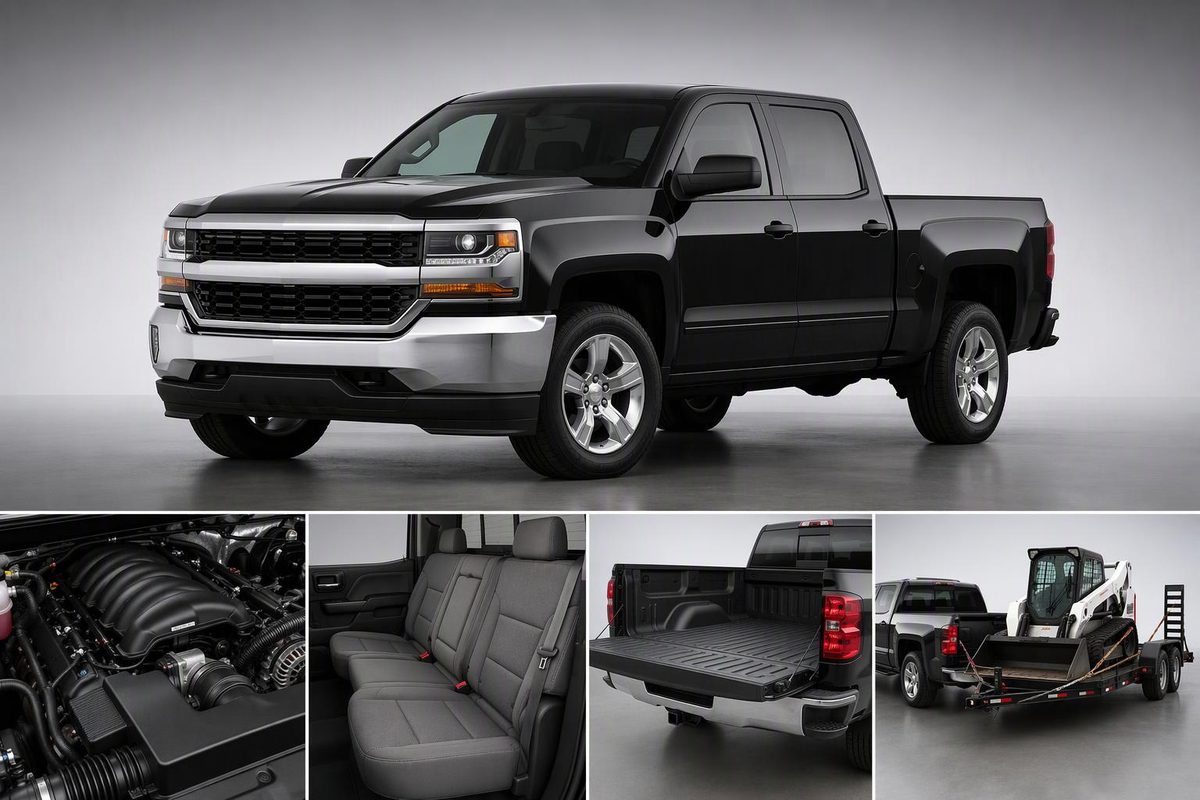
Compare 2016 Silverado 1500 engines, transmissions, cab and bed dimensions, towing limits and key checks before buying a used truck.
The 2016 Chevrolet Silverado 1500 offers three main gasoline engines, three cab styles and bed-floor lengths of 69.3, 78.9 or 97.8 inches. Its advertised maximum towing capacity is 12,000 lb, but that requires a specific 6.2L V8 configuration with the Max Trailering Package—not simply any V8 Silverado. Chevrolet’s 2016 brochure and dimension tables establish those choices.
For a used buyer, the important split is the 5.3L transmission: a 2016 truck can have either a six-speed or an eight-speed automatic. Identify that equipment before comparing towing capability or service records.
Engines and transmissions
These are the main U.S.-market EcoTec3 powertrains; output figures below are for gasoline.
| Engine | Horsepower | Torque | Automatic transmission | Advertised maximum towing* |
|---|---|---|---|---|
| 4.3L V6 | 285 hp | 305 lb-ft | Six-speed | 7,600 lb |
| 5.3L V8 | 355 hp | 383 lb-ft | Six- or eight-speed, depending on build | 11,100 lb |
| 6.2L V8 | 420 hp | 460 lb-ft | Eight-speed | 12,000 lb |
*Engine maximums apply only to qualifying configurations. The V6 maximum requires a Regular Cab Standard Box 4WD with a 3.42 axle. Chevrolet’s advertised V8 maximums require qualifying Double Cab Standard Box or Crew Cab Short Box 2WD trucks with Max Trailering equipment; the 6.2L brochure footnote specifies LTZ. Sources: 2016 Chevrolet Silverado brochure and owner’s manual trailering tables.
The 5.3L is the middle choice for mixed driving and hauling, but engine size alone does not establish capability. Chevrolet’s 2016 brochure lists the eight-speed as standard on selected 5.3L builds, including LTZ Z71 and High Country Crew Cabs and LTZ Crew Cabs with Max Trailering. An LTZ badge alone does not guarantee an eight-speed. Chevrolet’s powertrain and equipment listings show the configuration differences.
The 6.2L provides the highest output and was offered on LTZ, LTZ Z71 and High Country. Choose it for its performance or a verified towing requirement, rather than assuming it automatically carries more payload.
Cab, bed and overall dimensions
The bed names are nominal sizes; use the measured floor length when checking cargo fit.
| Cab and bed | Bed length at floor | Cargo volume | Wheelbase | Overall length |
|---|---|---|---|---|
| Regular Cab Standard Box, nominal 6 ft 6 in | 78.9 in | 61.0 cu ft | 119.0 in | 205.6 in |
| Regular Cab Long Box, nominal 8 ft | 97.8 in | 76.3 cu ft | 133.0 in | 224.4 in |
| Double Cab Standard Box, nominal 6 ft 6 in | 78.9 in | 61.0 cu ft | 143.5 in | 230.0 in |
| Crew Cab Short Box, nominal 5 ft 8 in | 69.3 in | 53.4 cu ft | 143.5 in | 230.0 in |
| Crew Cab Standard Box, nominal 6 ft 6 in | 78.9 in | 61.0 cu ft | 153.0 in | 239.6 in |
Source: Chevrolet’s Canadian-market 2016 Silverado dimension tables. These list 51.0 inches between the wheelhousings, 64.6 inches of inside width at the floor and 21.1 inches of inside bed height across the five configurations.
What those measurements mean:
- For 4-by-8-foot sheet goods: the 48-inch width fits between the wheelhousings. Only the Long Box has enough floor length for a 96-inch sheet with the tailgate closed, based on the published dimensions. Measure usable clearance if a liner or toolbox is installed.
- For rear passengers: Crew Cab rear legroom is 40.9 inches versus 34.6 inches in the Double Cab. Try your actual child seats or usual seating positions before buying.
- For parking: the Double Cab Standard Box and Crew Cab Short Box are both 230.0 inches long. The Crew Cab Standard Box adds 9.6 inches to the truck and bed. Allow extra garage space for hitch hardware and access—not just the published length.
Towing: match the axle and package, not just the engine
A 5.3L Crew Cab Short Box 4WD illustrates why a listing’s generic tow rating can be misleading:
| 2016 configuration | Maximum trailer weight in owner’s manual |
|---|---|
| 5.3L, 3.08 axle | 6,100 lb |
| 5.3L, 3.42 axle, without the enhanced-towing specification below | 9,100 lb |
| 5.3L, eight-speed, 3.42 axle, Enhanced Towing Package | 10,800 lb |
Source: 2016 Silverado owner’s manual, pages 336–337.
Before choosing a trailer, verify the engine, transmission, axle ratio and factory trailering package against the appropriate manual row. Then check the truck’s Tire and Loading Information label, GVWR, axle limits, GCWR and hitch ratings. Passengers, accessories, bed cargo and trailer tongue weight all consume carrying capacity.
Chevrolet advertised up to 2,260 lb of payload, but specifically warns buyers to use the individual truck’s door-jamb label. Its manual recommends conventional trailer tongue weight of 10–15% of loaded trailer weight. A 7,000-lb trailer therefore puts roughly 700–1,050 lb on the truck before accounting for people or other cargo. The manual also limits Silverado 1500 tongue weight to 800 lb with a weight-carrying hitch or 1,200 lb with a weight-distributing hitch; lower equipment or vehicle limits still apply. Brochure payload guidance; owner’s manual, pages 343–344.
Trims and checks before buying used
The 2016 lineup includes WT, LS, Custom, LT, LT Z71, LTZ, LTZ Z71 and High Country. WT emphasizes utility; Custom adds body-color styling and 20-inch wheels; LT adds equipment such as the 8-inch MyLink display and EZ Lift & Lower tailgate. LTZ adds leather-appointed heated front seating, dual-zone climate control and LED headlamps. High Country adds heated and ventilated front bucket seats, Bose audio and other upscale equipment. Z71 versions add off-road equipment; Z71 is not the Max Trailering Package. Chevrolet’s trim and package listings.
Prioritize these checks over appearance packages:
- Confirm the build. Photograph the Service Parts Identification label inside the glove box and obtain a VIN-specific equipment record. The label lists production options and special equipment. Owner’s manual, page 477.
- Test the transmission warm. GM bulletin 18-NA-355 covers specified 2015–2018 eight-speed Silverado applications with light-throttle shake or shudder at steady speeds between 25 and 80 mph, when the transmission is not actively shifting. A rumble-strip sensation warrants professional diagnosis; the bulletin does not establish that every vibration needs a replacement transmission. Ask for repair invoices if the seller reports a fluid exchange or torque-converter repair. GM service bulletin, March 2019. For service planning, see our Silverado transmission-fluid guide.
- Verify brake-recall work. Recall 19V-645 / N192268490 includes certain 2014–2018 Silverado light-duty trucks whose vacuum-pump output can decline, causing increased pedal effort and potentially longer stopping distances. The recall remedy is brake-control-module reprogramming—not automatic vacuum-pump replacement. GM safety filing and repair bulletin. Check all open recalls through NHTSA’s VIN lookup and request completed-repair records: the lookup does not display recalls already repaired. A hard pedal still needs diagnosis even if recall work is complete.
- Review maintenance and inspect underneath. Arrange a cold start, diagnostic scan and independent inspection for leaks, corrosion, collision repairs and driveline condition. For an oil-service reference, the third-printing manual lists approximate capacities with a filter change of 6 US quarts and dexos1 5W-30 for the 4.3L, or 8 US quarts and dexos1 0W-20 for the 5.3L and 6.2L. Recheck the level on level ground after allowing several minutes for oil to drain back following shutdown. Owner’s manual, pages 370–371 and 478–479.