
What You Actually Get With the Entry-Level 2026 Suburban
Two commonly published starting amounts differ by $2,795, and the evidence does not conclusively explain why. VIN-specific documents settle payload and towing.
By Dale Hutchins | Last reviewed August 8, 2026
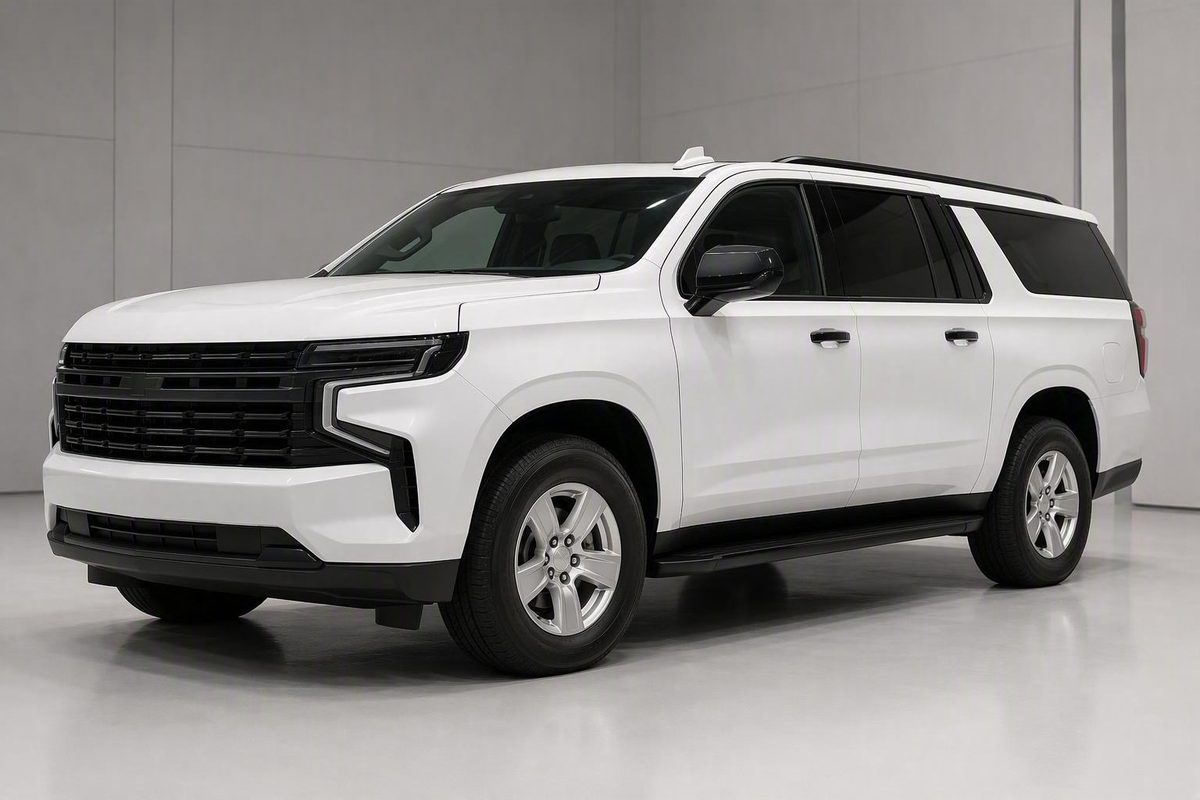
The 2026 Chevrolet Suburban LS is the utility-first version of Chevrolet’s largest three-row SUV. It combines a standard V8, substantial passenger and cargo room, modern dashboard displays, and an unusual option for nine seats. What it does not provide is one simple price, payload, or towing number that applies to every vehicle.
Published starting prices differ by nearly $3,000. Towing and payload figures also vary by source and configuration, while some driver-assistance features may depend on packages or production details. The current configurator, VIN-specific window sticker, door-jamb labels, and trailering information therefore matter more than any generic specification table.
For the right household, fleet, or towing job, the LS delivers most of what makes a Suburban useful without requiring an LT or higher trim. Its value, however, depends on the exact drivetrain, seating layout, trailering equipment, safety technology, destination charge, and dealer-installed options being purchased.
This guide was reviewed by separating Chevrolet’s model-level information from independent evaluations, third-party specification databases, and dealer trim guides. Pricing and equipment can change after publication, so volatile details should be rechecked before signing.
2026 Suburban LS at a glance
The Suburban is Chevrolet’s large, three-row SUV, and major third-party trim guides identify the LS as the entry-level model. It is aimed at shoppers who prioritize seating, cargo flexibility, V8 capability, and essential technology over premium cabin features.
The following figures are third-party reported because the supplied Chevrolet material does not provide a complete LS-specific specification sheet. Configuration-sensitive entries are labeled accordingly.
| Specification | Reported 2026 Suburban LS figure | Configuration or source context |
|---|---|---|
| Engine | Naturally aspirated 5.3-liter EcoTec3 gasoline V8 | LS |
| Output | 355 hp at 5,600 rpm | LS |
| Torque | 383 lb-ft at 4,100 rpm | LS |
| Transmission | 10-speed automatic | LS |
| Standard drivetrain | Rear-wheel drive | LS |
| Optional drivetrain | Four-wheel drive | LS |
| Standard seating | Eight | LS |
| Maximum seating | Nine with optional front bench | LS |
| Fuel economy | 15 mpg city/20 highway/17 combined | 5.3-liter RWD |
| Cargo behind third row | 41.5 cu. ft. | All three rows available |
| Cargo behind second row | 93.8 cu. ft. | Third row folded |
| Maximum cargo volume | Approximately 144.5 cu. ft. | Both rear rows folded |
| Length | 226.3 in. | Reported 4x2 LS |
| Wheelbase | 134.1 in. | Reported 4x2 LS |
| Fuel tank | 28 gal. | Reported 4x2 LS |
| Published towing figures | 7,700 to 8,200 lb. | Rating and equipment vary |
Edmunds supports the reported LS engine, transmission, standard rear-wheel drive, available four-wheel drive, eight-seat layout, optional nine-seat configuration, and 15/20/17-mpg RWD ratings in its 2026 Suburban trim comparison. Those economy figures should not be assigned to a four-wheel-drive LS without configuration-specific confirmation.
A third-party 4x2 LS specification page reports the 41.5-, 93.8-, and 144.5-cubic-foot cargo figures, along with a 226.3-inch length, 81-inch width, 75.6-inch height, 134.1-inch wheelbase, and 28-gallon tank. It also lists a 7,700-pound base tow figure and an 8,200-pound maximum, subject to equipment and loading conditions in its detailed 2026 Suburban LS specifications.
The central buying proposition is straightforward: the LS preserves the Suburban’s defining utility. It has three usable rows, considerable cargo space, a standard V8, large displays, smartphone integration, and potential towing capability. The tradeoff is that heated seats, leather upholstery, a panoramic roof, and certain higher-end technologies may require moving to the LT or beyond.
Price: why shoppers see both $63,700 and $66,495
Chevrolet’s U.S. Suburban page displays a model-level starting figure of $63,700, but the available page text does not explicitly identify it as the LS price or show the qualification attached to the asterisk on the 2026 Suburban product page.
Multiple dealer trim guides assign that same $63,700 figure to the LS. Other major automotive publications show a higher amount. Car and Driver, for example, lists $66,495 for its selected 2026 Suburban 2WD LS configuration on its LS features and specifications page.
Kelley Blue Book and Edmunds also list $66,495 in their respective pricing contexts. These figures do not establish a universal national transaction price, and the supplied evidence does not conclusively explain the $2,795 difference between the two commonly published starting amounts.
It is tempting to assume destination accounts for the entire discrepancy. That explanation is plausible because one documented test vehicle carried a $2,795 destination charge, but it is not proven by the available material. Publication timing, regional data, price updates, and different conventions for displaying destination-inclusive MSRP may also contribute.
A real vehicle illustrates how quickly an LS can move beyond the headline figure. Cars.com evaluated a four-wheel-drive LS priced at $71,840 as tested. That amount included a $2,720 LS Custom Edition package after a $1,600 discount, 22-inch wheels, dark exterior accents, four-wheel drive, and a $2,795 destination charge, according to its hands-on Suburban LS review. It was an optioned media vehicle, not a representative price for every LS or every four-wheel-drive LS.
Shoppers should distinguish five numbers:
- Advertised starting price: The lowest headline figure associated with the model or trim, subject to stated qualifications.
- Destination-inclusive MSRP: Base MSRP plus destination, when destination is not already included in the displayed figure.
- Optioned sticker price: MSRP after drivetrain, factory packages, paint, wheels, accessories, and destination are added.
- Transaction price: The negotiated selling price after applicable discounts or incentives.
- Out-the-door price: The transaction price plus taxes, title, registration, documentation charges, and other applicable fees.
A practical calculation is:
Current base MSRP + destination charge + four-wheel-drive charge + factory packages + accessories or dealer-installed equipment + dealer and documentation fees + sales or use tax + title and registration − applicable incentives − negotiated discount = estimated out-the-door price
Do not insert a presumed four-wheel-drive surcharge or destination fee unless it appears on the current configuration or sticker. The evidence does not establish one universal 4WD charge.
Build the desired vehicle with Chevrolet’s 2026 Suburban configurator, then compare the result with a VIN-specific window sticker and written buyer’s order. Ask the seller to identify every factory option, accessory, discount, and dealer-installed item.
Powertrain, rear-wheel drive, and four-wheel drive
Third-party LS specifications consistently identify the powertrain as a naturally aspirated 5.3-liter EcoTec3 gasoline V8 producing 355 horsepower at 5,600 rpm and 383 lb-ft of torque at 4,100 rpm, paired with a 10-speed automatic transmission.
Rear-wheel drive is reported as standard, with four-wheel drive available. RWD is the simpler starting point for shoppers who do not need driven front wheels, but the appropriate choice depends on climate, road conditions, launch-ramp use, job-site access, and intended use—not merely the lowest advertised price.
For the documented 5.3-liter RWD configuration, published fuel economy is 15 mpg city, 20 mpg highway, and 17 mpg combined. Car and Driver also lists a 28-gallon tank and a theoretical EPA-based highway range of 560 miles for its selected 2WD LS configuration. Those numbers should not be generalized to 4WD vehicles or real-world towing conditions.
The stronger trim comparisons do not present either alternative Suburban engine as an LS option. The 3.0-liter Duramax turbo-diesel is reported as unavailable on LS, while the 6.2-liter gasoline V8 is associated with higher trims. Buyers should not use diesel economy, diesel range, or 6.2-liter output when estimating LS performance or operating costs.
This restriction matters in two ways. First, the least expensive Suburban cannot necessarily be combined with the lineup’s most powerful or most fuel-efficient engine choice. Second, moving to an LT becomes part of the cost calculation if access to the diesel is important.
When comparing RWD and 4WD vehicles, request the following for each exact configuration:
- Final MSRP and drivetrain charge
- Applicable fuel-economy listing
- Curb weight and gross vehicle weight rating
- Door-sticker payload
- Axle ratio
- Vehicle-specific trailer rating
- Hitch and tongue-weight limits
- Required trailering equipment
- Tire and wheel specifications
Four-wheel drive can be valuable, but it should be evaluated as a complete configuration rather than priced as an isolated feature. The source material does not establish a universal 4WD surcharge or a complete set of 4WD LS economy, payload, and towing specifications.
Eight or nine seats, cargo capacity, and everyday size
The normal Suburban LS layout seats eight across three rows. Its distinctive advantage is an available front bench that raises maximum capacity to nine—an increasingly uncommon arrangement in a modern full-size SUV.
Nine seats are not standard on every LS. Buyers should sit in the center front position and inspect the cabin rather than assuming it functions like the conventional two-seat front row with a full center console.
Cars.com evaluated a bench-equipped vehicle with three rows of benches and reported that it could accommodate nine adults. Its reviewer also found that taller adults fit in the second and third rows and noted useful climate coverage from ceiling-mounted rear vents. Those are hands-on observations from one vehicle, not a guarantee that every passenger will find every seating position equally comfortable.
Cargo capacity changes substantially with seat position:
- 41.5 cubic feet behind the third row: The relevant figure while all three rows remain available.
- 93.8 cubic feet behind the second row: Available after the third row is folded.
- Approximately 144.5 cubic feet behind the first row: The maximum with both rear passenger rows folded.
The maximum figure should not be interpreted as luggage space available while carrying eight or nine people. For family travel with every row occupied, 41.5 cubic feet is the more relevant starting point.
Cargo volume does not show whether an item can pass through the liftgate or turn into place. The ItemFits Suburban tool offers a geometric planning check for the 2021+ generation, using all seats upright or the third row folded with the second row upright. It does not model both rear rows folded together or the complete loading maneuver. ItemFits uses researched dimensions for this generation; some dimensions are approximate and should be verified against the actual vehicle. Check seat positions, packaging and obstructions as well. Keep physical fit separate from payload limits and securing the load. Our free Suburban cargo-fit measurement record keeps those measurements, the tool’s inputs, and the unresolved restrictions on one printable sheet.
The reported 4x2 exterior measurements are 226.3 inches long, approximately 81 inches wide without mirrors, 75.6 inches high, and 134.1 inches between the axles. Those dimensions make the Suburban just under 18 feet 11 inches long.
That size can affect ownership every day. Measure the usable garage rather than relying on its nominal designation. Account for shelving, steps, water heaters, door hardware, and enough clearance to walk around the vehicle. Leave room behind it for the liftgate to open without contacting a wall or garage door.
A useful fit test should include:
- Garage depth with the door fully closed
- Actual entrance height
- Mirror clearance at the opening
- Space to open the front and rear doors
- Liftgate opening clearance
- The turn into the driveway
- School, office, and grocery-store parking spaces
- Parking-garage height and ramp width
A short drive on broad roads will not reveal all of this. During the test drive, park between two vehicles, reverse into a marked space, make a tight U-turn, and operate every available camera or parking aid.
The reported 28-gallon fuel tank multiplied by the published 20-mpg highway rating produces a theoretical 560-mile highway figure:
28 gallons × 20 mpg = 560 miles
That is arithmetic, not a promise of usable range. Reserve fuel, speed, traffic, terrain, weather, idling, cargo, and towing will reduce the practical distance between fuel stops.
Infotainment, comfort, and safety equipment
Third-party trim guides repeatedly list a 17.7-inch center touchscreen and an 11-inch digital driver display for the LS, along with Google Built-In compatibility and wireless Apple CarPlay and Android Auto.
Commonly listed convenience equipment includes:
- Remote start
- Keyless entry and ignition
- Power-adjustable front seats
- Premium cloth upholstery
- Three-zone automatic climate control
- Rear climate vents
- 18-inch wheels
- Multiple power or charging connections
These items are strong additions for routine family use. Large displays, wireless smartphone integration, rear climate coverage, and power front-seat adjustment may affect every trip more than cosmetic upgrades. Nevertheless, standard-versus-optional status should be checked on the window sticker because third-party equipment lists can blend base features with package-dependent items.
Cars.com’s evaluator found the interface easy to use and the ceiling-mounted vents helpful for distributing air to rear passengers. Those findings reflect one evaluated vehicle and the reviewer’s experience; screen preferences and climate performance should still be judged in person.
Dealer trim guides attribute the core Chevrolet Safety Assist group to the LS. The commonly listed functions are:
- Forward-collision warning
- Automatic emergency braking
- Front pedestrian braking
- Lane-keeping assistance with lane-departure warning
- Following-distance indicator
- Automatic high beams
A dealer’s 2026 Suburban trim overview lists that six-feature group with the LS’s displays and smartphone integration. These systems have operating limitations and do not replace attentive driving.
Equipment requiring VIN-specific verification
The supplied sources do not consistently establish whether the following features are standard on every LS, package-dependent, or merely available:
- Adaptive Cruise Control
- HD Surround Vision
- Automated parking
- Blind-spot monitoring or intervention
- Front and rear parking sensors
- Rear cross-traffic alert or braking
- Power rather than manual liftgate
Confirm each item on the window sticker and operate it during the test drive. Do not rely on a generic dealer advertisement or model-wide feature list.
Super Cruise is reported as unavailable on the LS. Heated seats and a panoramic sunroof are also reported as unavailable rather than optional LS upgrades.
Safety ratings require similar care. KBB displays an overall 5.0 NHTSA result but separately shows a 3.0 rollover component on its LS page. The evidence also includes dealer predictions and material that may draw on prior model years. That mixture does not support an unqualified claim that every 2026 Suburban LS has a confirmed perfect or five-star result.
Before buying, locate the controls for cruise assistance, lane support, parking sensors, camera views, and collision alerts in the exact vehicle. Check whether settings persist after restarting and whether any connected function includes only a trial period before requiring a subscription.
Towing, payload, and fuel use without the headline-number trap
Published towing numbers should remain source- and configuration-specific. Cars.com reports 7,700 pounds for the LS it discusses. Car and Driver separately lists an 8,200-pound maximum towing capacity and a 7,700-pound weight-distributing-hitch trailer limit for its selected 2WD LS specification. The supplied evidence does not fully reconcile those figures or establish the exact drivetrain, axle, package, and equipment required for the higher rating.
A dealership FAQ also reports an 8,200-pound properly equipped maximum while warning that the exact rating depends on engine, drivetrain, trailering equipment, passenger weight, cargo, and configuration in its 2026 Suburban towing guidance.
Payload is even less settled. Several third-party sources report 1,750 pounds, while Car and Driver lists 2,070 pounds for its 2WD LS data. A 320-pound difference is significant when passengers, luggage, accessories, and trailer tongue weight must all fit within the vehicle’s carrying capacity.
Neither payload number should be treated as universal. Use the Tire and Loading Information label on the exact SUV. Drivetrain equipment, wheels, packages, and other installed components can change the remaining capacity for people and cargo.
A practical payload worksheet is:
Door-sticker payload − driver and passengers − luggage and cabin cargo − cargo carried behind the seats − aftermarket accessories − trailer tongue weight = remaining payload margin
Consider an illustrative—not vehicle-specific—example. If a door sticker allowed 1,750 pounds and the SUV carried 900 pounds of occupants, 200 pounds of luggage, and 700 pounds of trailer tongue weight, the total load would be 1,800 pounds. That combination would exceed the assumed payload by 50 pounds before adding other accessories or cargo, even if the trailer remained below the advertised tow rating.
Tongue weight is part of the load carried by the tow vehicle. Buyers must therefore respect every applicable limit, not merely the largest number in a brochure:
- Vehicle-specific trailer rating
- Receiver and hitch rating
- Tongue-weight limit
- Payload
- Gross vehicle weight rating
- Gross combined weight rating
- Front and rear axle ratings
- Tire load limits
- Trailer rating and cargo capacity
The Max Trailering package is reported as available on LS. Availability does not prove that every LS fitted with the package reaches the same maximum. Confirm the factory option code, package contents, and vehicle-specific trailering information.
Fuel use is likewise configuration-dependent. The cited RWD LS rating is 15 mpg city, 20 highway, and 17 combined; verified LS-specific 4WD economy is not established by the supplied evidence.
At 12,000 miles per year and 17 mpg, the simple calculation is:
12,000 ÷ 17 = approximately 706 gallons per year
Actual consumption may be higher with towing, short trips, idling, winter weather, hills, congestion, or frequent acceleration. Multiply expected gallons by a realistic local fuel price, and run a separate towing scenario if a trailer will be used regularly.
A towing buyer should not sign until the following have been located and interpreted:
- Payload sticker
- VIN-specific trailering label or rating
- Window sticker
- Hitch and receiver markings
- Axle and tire information
- Max Trailering package contents
- Owner’s manual trailering section
If a generic online listing conflicts with labels or documentation attached to the exact vehicle, stop and resolve the discrepancy before towing.
LS versus LT: pay for comfort or keep the extra seat?
The LS-versus-LT decision should be framed around intended use. The LS is not automatically the better value because it is the entry trim, and the LT is not automatically worth its premium because it includes more equipment.
The LS already provides the core Suburban experience:
- 5.3-liter V8 and 10-speed automatic
- Three passenger rows
- Large cargo area
- 17.7-inch center screen
- 11-inch driver display
- Wireless smartphone integration
- Available four-wheel drive
- Reported availability of Max Trailering equipment
- Optional nine-passenger layout
That final feature is especially important. Edmunds reports that the optional front bench is exclusive to the LS. If nine seating positions are a firm requirement, the entry trim may be the only suitable Suburban configuration regardless of the LT’s comfort upgrades.
Trim comparisons generally associate the LT with leather upholstery, heated front seats, wireless charging, and a power liftgate. The LT also provides access to the diesel engine, according to a dealer’s 2026 Suburban LS-versus-LT comparison. Heated seats, a panoramic sunroof, and Super Cruise are reported as unavailable on the LS, although every desired feature should still be checked in the current configuration.
Edmunds lists $66,495 for the LS and $69,495 for the LT, a $3,000 difference in that publication’s comparison. Those amounts illustrate one reported trim step rather than settled national pricing; destination treatment, options, incentives, and dealer charges can alter the actual gap.
A practical decision rule is:
Choose the LS when:
- Nine seats are required
- Cloth upholstery is acceptable
- Heated front seats are unnecessary
- Passenger and cargo utility matter more than luxury
- The configured LS remains meaningfully less expensive
- The exact vehicle has the required towing and safety equipment
Price an LT when:
- Leather and heated seats are non-negotiable
- A factory power liftgate is important
- Wireless charging matters
- The diesel engine is under serious consideration
- Aftermarket workarounds would erase the LS savings
- Actual LS and LT inventory prices are already close
Compare window stickers line by line rather than comparing trim names. A heavily optioned LS can overlap a more comfortably equipped LT, while a basic LS may preserve a worthwhile price advantage.
Cars.com also argues that shoppers who do not need truck-based towing capability should compare a minivan. That comparison should include purchase price, fuel use, passenger access, floor height, cargo flexibility, and ease of parking. The Suburban’s strengths are most persuasive when its towing potential, four-wheel-drive availability, passenger capacity, or combination of three-row seating and cargo room will actually be used.
Warranty, ownership costs, and the final pre-purchase checklist
Third-party references commonly list three years or 36,000 miles of basic coverage and five years or 60,000 miles of powertrain coverage for the 2026 Suburban LS. Those terms appear in KBB’s 2026 Suburban LS specifications and ownership data, but coverage remains subject to Chevrolet’s current warranty documents, exclusions, in-service date, and maintenance requirements.
The purchase price is only one part of owning a full-size V8 SUV. KBB estimates a five-year cost to own of $95,833 for its selected location and assumptions. That estimate consists of $32,877 in depreciation and $62,956 in projected out-of-pocket expenses.
KBB divides those projected out-of-pocket costs as follows:
| Category | Five-year estimate |
|---|---|
| Fuel | $18,688 |
| Insurance | $16,785 |
| Financing | $7,967 |
| State fees | $12,801 |
| Maintenance | $4,768 |
| Repairs | $1,947 |
| Total out-of-pocket | $62,956 |
These figures are not a guaranteed ownership bill. Insurance can vary substantially by driver and ZIP code. Financing depends on the loan amount, rate, term, down payment, and credit profile. Fuel spending changes with annual mileage, local prices, congestion, and towing. Options can affect purchase price and depreciation, while future resale conditions cannot be known.
Build a personal ownership estimate using:
- Annual mileage
- Expected city, highway, and towing mix
- Local fuel price
- Insurance quotes for the exact VIN
- Loan amount, rate, and term
- Registration and property-tax rules
- Tire replacement cost for the selected wheel size
- Maintenance plans or included service
- Parking or storage expenses
- Expected ownership period
There is not enough long-term 2026 owner evidence to make a robust reliability claim. Statements that the 2026 LS is proven reliable or unreliable should be treated cautiously.
Before ordering or signing, complete this checklist:
- [ ] Confirm the displayed base MSRP and whether destination is included.
- [ ] Obtain a VIN-specific window sticker.
- [ ] Verify rear-wheel drive or four-wheel drive.
- [ ] Confirm the eight- or nine-seat interior layout.
- [ ] Sit in the optional front bench if selected.
- [ ] Identify every factory package and dealer-installed accessory.
- [ ] Verify Max Trailering equipment and factory option codes.
- [ ] Read the Tire and Loading Information label.
- [ ] Locate the vehicle-specific towing information.
- [ ] Confirm receiver, hitch, and tongue-weight limits.
- [ ] Check wheel and tire size.
- [ ] Verify manual or power liftgate operation.
- [ ] Confirm every desired safety and parking feature.
- [ ] Identify connected-service trials and future subscription costs.
- [ ] Review basic, powertrain, roadside, and corrosion warranty terms.
- [ ] Itemize documentation and dealer fees.
- [ ] Confirm taxes, title, and registration.
- [ ] List incentives and eligibility requirements in writing.
- [ ] Compare the buyer’s order with the agreed vehicle and price.
The test drive should include more than acceleration and highway cruising. Enter the second and third rows, test representative child seats if applicable, check front-bench comfort, operate every camera view, and try low-speed parking. If possible, verify garage and driveway fit before the purchase becomes final.
Frequently asked questions
Does the 2026 Chevrolet Suburban LS start at $63,700 or $66,495?
Both figures appear in published listings. Chevrolet displays a model-level starting price of $63,700, and several dealer guides identify that amount as the LS starting MSRP. KBB, Edmunds, and Car and Driver list $66,495 in their respective pricing contexts.
The supplied evidence does not conclusively establish whether destination treatment, publication timing, price updates, or different data conventions explain the entire discrepancy. Use the current configurator and a VIN-specific window sticker to determine the applicable price.
Can the 2026 Suburban LS seat nine people?
Yes, when equipped with the available front bench. The normal LS configuration seats eight, while the bench adds a center front seating position and raises maximum capacity to nine.
Because the option changes the front-row seating and storage arrangement, inspect the exact layout before ordering. Nine-passenger capacity should not be interpreted as standard on every LS.
Can the Suburban LS be ordered with the diesel engine, 6.2-liter V8, or Super Cruise?
Third-party trim comparisons report that the 3.0-liter Duramax diesel, 6.2-liter gasoline V8, and Super Cruise are unavailable on the LS. The LS is consistently listed with the 5.3-liter V8.
Equipment rules can change, so the current configuration should still be checked. Diesel economy, diesel range, and 6.2-liter output should not be used as LS specifications.
How much can a 2026 Chevrolet Suburban LS tow?
Published figures range from 7,700 pounds to a properly equipped maximum of 8,200 pounds. The available evidence does not establish one rating that applies to every LS or fully reconcile the different published figures.
The actual limit depends on the drivetrain, trailering equipment, hitch, axle, passengers, cargo, and the individual vehicle’s payload. Use the VIN-specific towing information and door-jamb payload sticker rather than assuming every LS can tow 8,200 pounds.
Is four-wheel drive available on the 2026 Suburban LS?
Yes. Third-party trim guides consistently report rear-wheel drive as standard and four-wheel drive as available.
The exact 4WD surcharge and configuration-specific fuel economy, payload, curb weight, and towing figures are not established by the supplied evidence. Confirm those details for the vehicle being considered.
The 2026 Chevrolet Suburban LS is most compelling for buyers who will use what makes a Suburban different: three-row passenger room, substantial cargo capacity, V8 power, towing potential, or the unusual nine-passenger option. It is harder to justify if those strengths will go unused or if required comfort features push the configured price close to an LT.
Ultimately, the LS should be evaluated as an exact vehicle—not merely a trim name or advertised starting figure. Compare LS and LT window stickers, then verify destination, drivetrain, seating, packages, payload, trailering labels, safety equipment, subscriptions, accessories, and dealer fees before deciding which configuration represents the better value.