
A Chevrolet Suburban Is Nearly 19 Feet Long—Here’s What That Means
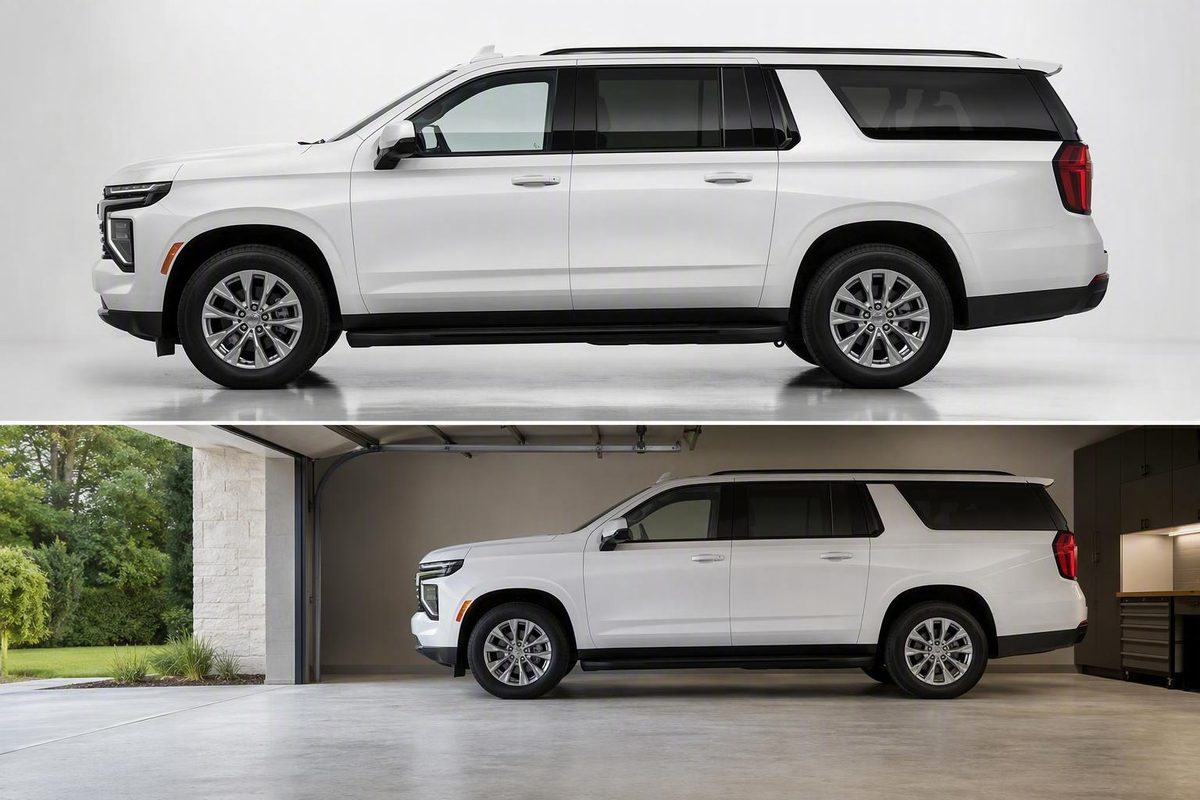
Recent listings put a Suburban at about 18 feet 10 inches. A garage advertised as 20 feet deep may not provide 240 clear inches where it will sit.
The short answer: how long is a Chevrolet Suburban?
A recent Chevrolet Suburban is about 226 inches—or 18 feet 10 inches—long. More precisely, Car and Driver lists the 2026 Chevrolet Suburban LS 2WD at 226.3 inches from end to end.
Here is that measurement in three common units:
- Inches: 226.3 inches
- Feet and inches: 18 feet 10.3 inches
- Meters: approximately 5.75 meters
For preliminary garage and parking calculations, treat a current Suburban as approximately 19 feet long before adding clearance. This shorthand reduces the risk of underestimating the required space, but it does not account for accessories, garage obstructions, storage, liftgate operation, or room to walk around the SUV.
The 226.3-inch figure describes overall exterior length—the vehicle’s end-to-end footprint. It is not the length of the passenger compartment, cargo floor, or wheelbase. Those measurements answer different questions and should not replace overall length when checking garage depth or parking-space length.
No single exact measurement applies to every Chevrolet Suburban ever made. Overall dimensions vary by generation and model year, while third-party listings for recent models sometimes differ by several tenths of an inch. If a fit depends on that fraction, verify the specifications and installed equipment for the exact vehicle rather than relying on the general “about 19 feet” answer.
Suburban length by model year: 2021, 2025, and 2026
Recent Suburbans are closely grouped in overall length, although published figures are not perfectly uniform. The following table covers only the model years supported by the available evidence; it is not a complete historical chart for every Suburban generation.
| Model year | Listed overall length | Feet-and-inches conversion | Source configuration | Qualification |
|---|---|---|---|---|
| 2021 | 225.7 inches | 18 feet 9.7 inches | Configuration not identified | Allen Turner Chevrolet lists 225.70 inches; another source rounds it to 226 inches |
| 2025 | 225.7 inches | 18 feet 9.7 inches | Configuration not identified | Cable Dahmer lists 225.7 inches |
| 2025 | 226.3 inches | 18 feet 10.3 inches | Premier 4WD | Edmunds lists 226.3 inches for the selected configuration |
| 2026 | 226.3 inches | 18 feet 10.3 inches | LS 2WD | A 2026 specification listing reports 226.3 inches |
For 2021, Allen Turner Chevrolet reports 225.70 inches, while OnMilwaukee reports the length as 226 inches. The 0.3-inch difference may be no more than rounding: 225.7 becomes 226 when expressed as a whole number. It is not evidence by itself that the sources describe meaningfully different bodies.
The 2025 discrepancy is slightly larger. One dealership lists 225.7 inches, while Edmunds lists 226.3 inches for a selected Premier 4WD. The difference could reflect the configuration, the source data, or the measurement convention, but the supplied evidence does not establish a definitive cause.
For 2026, the strongest configuration-specific measurement in the evidence is 226.3 inches for the LS 2WD. Other third-party pages report 225.7 inches or round the vehicle to 226 inches. In practical terms, all of those figures describe an SUV just under 19 feet long.
Across the supported 2021–2026 listings, overall length falls within a narrow 225.7-to-226.3-inch range, or approximately 18 feet 9.7 inches to 18 feet 10.3 inches. A 0.6-inch difference is unlikely to matter in an open driveway, but it can matter when the garage door, front wall, shelving, or another fixed object leaves almost no margin.
Used-vehicle shoppers should not automatically apply these current-generation measurements to an older Suburban. The nameplate spans numerous generations, and dimensions have changed over time. Check the exact model year and, where possible, the trim, drivetrain, and exterior equipment fitted to the vehicle under consideration.
Overall length, wheelbase, width, and height explained
Vehicle specification sheets place several exterior measurements together, but each describes a different part of the SUV’s footprint.
Overall length is the end-to-end exterior measurement. It is the first number to use when comparing a Suburban with a garage’s usable depth, a driveway, a parallel-parking space, or a parking bay.
Wheelbase is the distance between the centers of the front and rear axles. It affects the vehicle’s proportions, but it excludes the body extending ahead of the front axle and behind the rear axle. A Suburban with a 134.1-inch wheelbase is therefore not only 134.1 inches long.
The principal dimensions for the selected 2026 Suburban 2WD LS are:
| Measurement | Listed dimension | Approximate feet-and-inches equivalent |
|---|---|---|
| Overall length | 226.3 inches | 18 feet 10.3 inches |
| Wheelbase | 134.1 inches | 11 feet 2.1 inches |
| Body width without mirrors | 81 inches | 6 feet 9 inches |
| Height | 75.6 inches | 6 feet 3.6 inches |
These are configuration-specific figures for the 2026 Suburban 2WD LS, not universal dimensions for every trim and drivetrain.
The difference between the listed overall length and wheelbase is 92.2 inches. That remaining distance is distributed across the body ahead of and behind the axle centers. This is why wheelbase cannot determine whether a garage door will close behind the vehicle.
Width requires similar care. The listed 81-inch body width excludes the exterior mirrors. It is useful for an initial comparison with the garage interior, but it cannot confirm whether the SUV will pass safely through a narrow door opening. For a close fit, obtain verified unfolded and folded mirror widths for the exact vehicle.
Height can also vary among selected configurations and third-party listings. For example, Edmunds reports 76.5 inches for its selected 2025 Premier 4WD, compared with 75.6 inches for the cited 2026 LS 2WD. When a low opening, garage-door track, beam, light, or storage rack makes fractions of an inch important, check the exact vehicle rather than assuming one listing applies universally.
Roof rails, crossbars, cargo boxes, antennas, and other installed equipment can increase the practical height requirement. Equipment mounted at the front or rear can likewise increase the space needed to park the vehicle. Measure the Suburban as it will actually be used instead of assuming that a base specification includes every accessory.
Turning measurements are not used here because the cited sources apply different figures and labels. More importantly, a published turning value cannot determine whether a particular driveway approach, gate, pillar, retaining wall, or neighboring vehicle allows a comfortable path into the garage.
Will a Suburban fit in a 20-foot garage?
A 226.3-inch Suburban can fit on paper in a garage that provides a full 20 feet of usable interior depth. The calculation is:
20 feet × 12 inches = 240 inches
240 inches − 226.3 inches = 13.7 inches
Using the reported 226.3-inch vehicle length, that leaves 13.7 inches of combined front-and-rear clearance—not 13.7 inches at each end. If the SUV were centered perfectly, the nominal result would be:
13.7 inches ÷ 2 = 6.85 inches per end
The calculation is based on the cited 226.3-inch overall length. Approximately 6.85 inches at each end is a narrow margin, and even a small parking error could consume much of it.
This illustrates the difference between physical fit and practical daily use. The door might close behind the Suburban, yet the garage could still leave too little space to:
- Walk between the bumper and wall
- Reach cabinets or storage
- Load or unload cargo
- Operate the rear liftgate
- Access steps or an interior house door
- Position the vehicle consistently every day
A garage advertised as 20 feet deep does not necessarily provide 240 clear inches where the SUV will sit. Exterior building dimensions, wall thickness, the closed garage door, door hardware, storage, and structural features can reduce the usable parking envelope.
Measure with the garage door closed and inspect the full parking area for:
- Steps and raised foundations
- Shelves and storage racks
- Cabinets, workbenches, and freezers
- Structural posts and pillars
- Baseboards, curbs, and wall guards
- Garage-door tracks and open-door hardware
- Handles or braces projecting from the closed door
- Wall-mounted tools, hoses, or charging equipment
- Heating equipment, pipes, lights, and low beams
- Trailer hitches and other exterior vehicle equipment
- Roof accessories and overhead storage
- Items that may hang or shift into the parking envelope
Garage-fit guidance also identifies pillars, steps, shelves, door clearance, and liftgate movement as separate checks. These objects can prevent a practical fit even when the nominal wall-to-wall measurement appears sufficient.
The rear liftgate needs its own test. A Suburban may fit with the liftgate closed but lack enough room behind or above it to open safely. If routine loading matters, measure both the vehicle’s parked footprint and the liftgate’s operating envelope.
Mark Allen Chevrolet says many 20-foot garages may accommodate a 2026 Suburban with careful positioning, but that should be treated as conditional guidance rather than a guarantee. Actual usable depth, fixed obstructions, roof accessories, and the room required for doors and loading still determine whether a particular garage works.
The practical answer is:
- Can it fit by length? Potentially, if the bay truly provides 240 unobstructed inches.
- Will it be comfortable to use? Not necessarily.
- Is a “20-foot garage” label enough to decide? No. Measure the usable interior.
How to measure your garage or parking area before buying
A reliable fit check starts with the exact vehicle and ends with the actual usable parking envelope. Perform the calculations in inches so decimals and small differences are not lost during conversion.
1. Identify the exact Suburban
Record the model year, trim, and drivetrain. If evaluating a particular vehicle, also note equipment that could change its exterior envelope:
- Trailer-hitch components
- Front-mounted equipment
- Running boards
- Roof rails and crossbars
- Cargo boxes or racks
- Aftermarket wheels or tires
- Suspension modifications
Do not assume that a generic search result for “Chevrolet Suburban dimensions” describes the SUV you intend to buy.
2. Record the relevant vehicle dimensions
At minimum, obtain:
- Overall length
- Body width without mirrors
- Verified width including mirrors
- Folded-mirror width, if applicable
- Height as equipped
- Any additional accessory projection
The commonly quoted width of approximately 81 inches excludes the mirrors. That body-width measurement is insufficient for a close garage-door calculation, even if you expect to fold the mirrors, because the vehicle must still pass through the opening in its actual operating configuration.
Use the exact vehicle’s documentation or dealer build information when fractions of an inch determine the result. The dimensions in this article were compiled from third-party listings and were not independently measured.
3. Measure usable garage depth
Close the garage door. Measure from its nearest interior point to the closest permanent obstruction at the front of the bay.
Do not automatically measure wall to wall if any of the following intrudes into the space:
- The garage door or its handle
- Door braces or hardware
- Shelving
- A step or raised foundation
- Cabinets or equipment
- Wall-mounted storage
Measure along the line where the SUV will actually sit. An obstruction positioned to one side may not affect the bumper, while a central step or cabinet can substantially reduce usable depth.
Use this worksheet:
Usable interior depth:        ______ inches
Verified vehicle length:    − ______ inches
Nominal total clearance:     = ______ inches
For a 240-inch usable bay and a 226.3-inch vehicle, the nominal result is 13.7 inches. Decide deliberately how to divide that clearance. You may need more room behind the vehicle for the garage door or liftgate, or more room in front for steps, storage, or a walkway.
4. Measure the entrance and interior width
Measure the narrowest point of the garage-door opening, not merely the nominal door size. Account for:
- Trim
- Tracks
- Weather seals
- Posts
- Hardware projecting into the opening
Then measure the narrowest point inside the bay. Shelving, cabinets, or a structural pillar may leave less width than the entrance.
Use separate calculations:
Narrowest entrance width − mirror-inclusive vehicle width = entrance clearance
Narrowest interior width − vehicle body width = interior clearance
Any resulting clearance must be allocated between both sides. A 10-inch difference does not mean 10 inches beside the driver’s door; if the vehicle is centered, it means approximately 5 inches per side.
Passing through the opening is only one part of the test. The parked vehicle must also leave enough room to open the driver’s door, reach child seats, and use frequently occupied passenger doors.
5. Measure the lowest overhead point
Do not rely on ceiling height alone. Measure the lowest object above the vehicle’s approach and final parking position, including:
- The garage door when open
- Door tracks and supports
- Lights and ceiling fans
- Beams, ducts, and pipes
- Overhead storage
- Hanging tools or sports equipment
Compare that clearance with the Suburban’s actual height as equipped. A cargo box or crossbar may become the limiting factor even if the unmodified vehicle would clear the opening.
6. Check passenger-door and liftgate operation
A static rectangle representing the vehicle does not capture all the space required for everyday use. Test or estimate the separate operating areas needed for:
- The driver’s door
- Frequently used passenger doors
- Access to child seats
- The rear liftgate
- Loading and unloading cargo
- Walking to an interior door
- Reaching shelves, switches, or charging equipment
If possible, arrange a test fit with the actual vehicle before buying. Park it in the intended position, close the garage door, and test the required passenger doors. Operate the liftgate only after confirming that it cannot contact the garage door, ceiling, wall, or another obstruction.
7. Evaluate the approach
A bay can be large enough internally but difficult to enter because of a narrow driveway, sharp turn, post, gate, retaining wall, or another parked vehicle. Inspect the entire route into the garage rather than checking only the final parking rectangle.
Apply the same principle to outdoor spaces. Measure the actual location and consider curbs, wheel stops, landscaping, traffic lanes, gates, and passenger-loading room. Labels such as “standard parking space,” “one-car garage,” and “full-size SUV bay” do not establish usable dimensions.
The basic worksheet is:
Usable space dimension − verified vehicle dimension = nominal clearance
Run the calculation separately for length, width, and height. Then decide whether the remaining space supports the way you intend to use the SUV—not merely whether each answer is greater than zero.
How much longer is a Suburban than a Tahoe?
In a matched 2026 comparison, the Chevrolet Suburban is 15 inches longer than the Chevrolet Tahoe. That equals 1 foot 3 inches.
The comparison is most useful when the model year and configuration match. Car and Driver’s selected 2026 comparison pairs the Suburban 2WD LS with the Tahoe 2WD LS and lists the Suburban at 226.3 inches, with a 15-inch difference between the two vehicles.
That does not mean every Suburban is exactly 15 inches longer than every Tahoe. A broader historical summary describes the difference as approximately 15 to 20 inches, reflecting changes across model years rather than a universal relationship. Mixing an older Suburban measurement with a newer Tahoe measurement can produce a misleading comparison.
In practical terms, 15 inches can materially affect parking:
- The Tahoe requires less longitudinal space.
- It can leave more room between the bumpers and garage boundaries.
- It may fit more easily in a short driveway or crowded parking area.
The additional exterior length should not be interpreted as an inch-for-inch increase in cargo-floor length. Interior packaging, seat position, trim, and measurement conventions also affect usable space.
For buyers, the choice is straightforward: the Tahoe is the shorter full-size Chevrolet SUV, while the Suburban is the extended alternative. If a garage leaves only a few inches around a Suburban, the Tahoe’s shorter body could substantially improve daily usability.
What the Suburban’s exterior size provides inside
The Suburban’s nearly 19-foot body supports three rows of seating while preserving considerable cargo space behind the third row.
For the selected 2026 Suburban LS 2WD, passenger capacity is listed at eight, with the following cargo volumes:
- Behind the third row: 41.5 cubic feet
- Behind the second row: 93.8 cubic feet
- Behind the front row: 144.5 cubic feet
Those are configuration-specific passenger and cargo figures. They show why buyers may accept the Suburban’s large exterior footprint: the cited configuration combines three-row seating with 41.5 cubic feet of cargo volume behind the third row.
Seating arrangements and cargo figures can depend on configuration and measurement convention. Cubic volume also does not describe every useful interior measurement. The shape of the opening, cargo-floor length, width between interior trim, and seat-folding arrangement may matter more when carrying a particular object.
The buying decision ultimately depends on whether the interior-space benefit justifies the exterior footprint in the places you use most often. Compare the cabin and cargo space with the realities of your garage, driveway, workplace parking, school pickup area, and other regular destinations.
The bottom line
A recent Chevrolet Suburban is about 226 inches, or 18 feet 10 inches, long. The cited 2026 LS 2WD measurement is 226.3 inches, but buyers should verify the exact model year and configuration before making a close-clearance decision.
Compare the vehicle’s overall length, mirror-inclusive width, equipped height, and liftgate operating space with direct measurements of the usable parking area. Do not rely only on an advertised garage size or generic vehicle category.
For a 226.3-inch Suburban, a genuinely unobstructed 20-foot garage leaves only 13.7 inches of combined length clearance. Fitting on paper is not the same as being easy to park, load, and use every day.
Frequently asked questions
How long is a Chevrolet Suburban in feet?
A recent Chevrolet Suburban is approximately 18 feet 10 inches long. Depending on the cited model year and configuration, recent listings generally place it around 226 inches. For initial planning, treat it as approximately 19 feet long before adding clearance.
Will a Chevrolet Suburban fit in a 20-foot garage?
Potentially. A 20-foot bay equals 240 inches, so a 226.3-inch Suburban leaves 13.7 inches of combined front-and-rear clearance, or approximately 6.85 inches at each end if perfectly centered.
The garage must provide a full 240 usable inches without interference from the closed door, steps, shelves, cabinets, or other obstructions. Passenger-door access and liftgate operation require separate checks.
Is wheelbase the same as overall vehicle length?
No. Wheelbase is the distance between the centers of the front and rear axles. Overall length measures the complete vehicle from end to end.
Recent cited listings give the Suburban a wheelbase of approximately 134.1 inches and an overall length of about 226 inches. Use overall length—not wheelbase—to evaluate garage depth or parking-space length.
How much longer is a Suburban than a Tahoe?
In Car and Driver’s matched comparison of 2026 2WD LS models, the Suburban is 15 inches, or 1 foot 3 inches, longer than the Tahoe. Historical comparisons place the difference at approximately 15 to 20 inches, so the exact answer depends on the model years and configurations being compared.
Are all Chevrolet Suburbans the same length?
No. Dimensions vary by generation and model year, and third-party listings can differ slightly by configuration or measurement convention. Supported recent-model listings range from approximately 225.7 to 226.3 inches, but that range should not be applied to every older Suburban.
When clearance is tight, verify the exact vehicle’s documentation and measure any installed exterior equipment that could change its practical footprint.