
Which Silverado Bed Fits Your Cab, Cargo, and Garage?
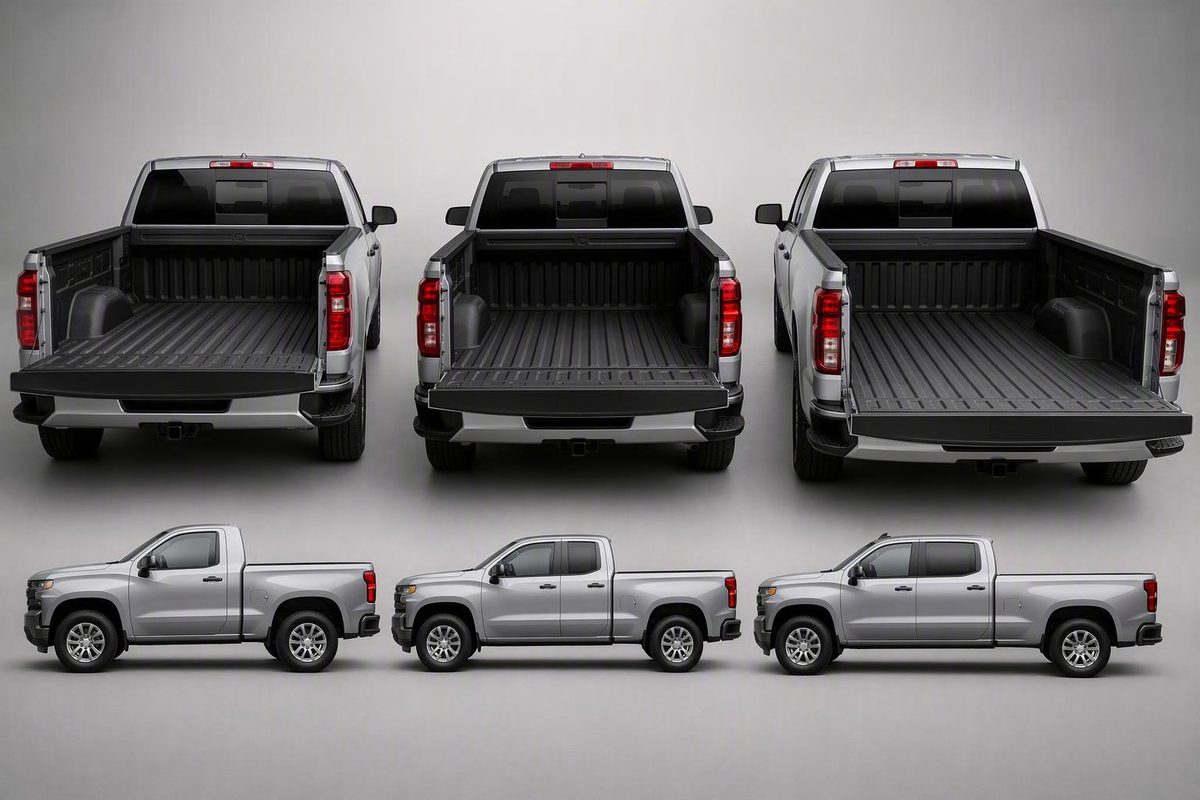
The Silverado 1500 standard bed measures 79.44 inches versus 82.25 inches for HD. Model year, cab pairing and measurement point change the answer.
Silverado bed labels—short, standard, and long—are useful starting points, but they are not precise dimensions. The correct truck bed size depends on the Silverado series, model year, cab, trim, drivetrain, measurement point, and equipment already installed in the box.
That distinction matters whether you are comparing a Silverado 1500 with a 2500HD, checking whether plywood will fit, or ordering a tonneau cover. Even a “standard bed” is not the same length across the recent 1500 and HD lines.
The current-model figures below come from dealership and accessory-industry guides rather than a Chevrolet order guide. Treat the tables as model-year-specific shopping references, then confirm availability and dimensions for the exact truck.
Silverado bed sizes at a glance
For the 2026 Silverado 1500, dealership-published figures list floor lengths of approximately 5 feet 10 inches, 6 feet 7 inches, and 8 feet 2 inches. The exact reported lengths, floor widths, depths, and cargo volumes in the table come from a 2026 Silverado 1500 dimensions guide. The exact 50.63-inch wheelhousing figure is corroborated by recent-model dealership specifications; a 2026 accessory-industry chart rounds it to 50.6 inches.
| 2026 Silverado 1500 bed | Floor length | Approximate label | Floor width | Between wheelhousings | Depth | Cargo volume |
|---|---|---|---|---|---|---|
| Short | 69.92 in. | 5 ft. 10 in. | 71.4 in. | 50.63 in. | 22.4 in. | 62.9 cu. ft. |
| Standard | 79.44 in. | 6 ft. 7 in. | 71.4 in. | 50.63 in. | 22.4 in. | 71.7 cu. ft. |
| Long | 98.18 in. | 8 ft. 2 in. | 71.4 in. | 50.63 in. | 22.4 in. | 89.1 cu. ft. |
For long cargo, the most useful number is normally the interior floor length, not an exterior sheet-metal measurement. For wide objects that must sit directly on the floor, the more restrictive dimension is often the 50.63-inch spacing between the wheelhousings, rather than the full 71.4-inch floor width. Recent dealership tables report those recurring measurements across multiple model years, including 2025, but that does not make them universal for every Silverado generation.
“Short,” “standard,” and “long” are nominal categories rather than precision measurements. Publishers may round the same physical length differently: 69.92 inches, for example, is approximately 5 feet 10 inches, although some shopping guides describe it with a different nominal label.
An accessory-industry 2026 truck-bed chart rounds the three Silverado 1500 lengths to 69.9, 79.4, and 98.2 inches. That agreement is useful for orientation, but older generations and HD trucks still require separate checks.
Silverado 1500 versus 2500HD and 3500HD bed dimensions
Silverado 1500 and Silverado HD beds should not be combined into one generic chart. Recent Silverado 1500 guides report short, standard, and long options, while recent 2500HD and 3500HD guides generally report standard and long beds.
The confusing word is standard. In the cited 2025 tables, the Silverado 1500 standard bed measures 79.44 inches, while the HD standard bed measures 82.25 inches.
The following figures are dealership-published 2025 specifications, not a manufacturer order guide. They should remain attached to that model year and should not be treated as a universal fitment chart. The dimensions and cargo volumes come from a 2025 Silverado 1500, 2500HD, and 3500HD bed guide.
2025 Silverado 1500 dimensions
| Bed | Floor length | Floor width | Between wheelhousings | Depth | Cargo volume |
|---|---|---|---|---|---|
| Short | 69.92 in. | 71.4 in. | 50.63 in. | 22.4 in. | 62.9 cu. ft. |
| Standard | 79.44 in. | 71.4 in. | 50.63 in. | 22.4 in. | 71.7 cu. ft. |
| Long | 98.18 in. | 71.4 in. | 50.63 in. | 22.4 in. | 89.1 cu. ft. |
2025 Silverado 2500HD and 3500HD dimensions
| Bed | Floor length | Floor width | Between wheelhousings | Depth | Reported 2025 cargo volume |
|---|---|---|---|---|---|
| Standard | 82.25 in. | 71.4 in. | 51.85 in. | 21 in. | 69.5 cu. ft. |
| Long | 98.18 in. | 71.4 in. | 51.85 in. | 21 in. | 89.1 cu. ft. |
Based on those reported dimensions, the HD standard bed is approximately 2.81 inches longer than the 1500 standard bed: 82.25 − 79.44 = 2.81 inches. The HD box also has approximately 1.22 inches more total clearance between the wheelhousings: 51.85 − 50.63 = 1.22 inches. That is total clearance across the box, not 1.22 inches on each side.
At the same time, the cited HD bed is 1.4 inches shallower: 22.4 − 21.0 = 1.4 inches. Those differences help explain why cargo volume cannot be inferred from length alone.
Cargo-volume figures must stay tied to a stated model year. The table uses 69.5 cubic feet for the cited 2025 HD standard bed and 89.1 cubic feet for the long bed. A broadly labeled dealership overview instead reports 83.5 cubic feet for an HD long bed, demonstrating why one secondary figure should not be generalized across every year and configuration; see the conflicting HD bed summary.
The practical rule is simple: do not shop by “standard bed” or “long bed” alone. Match the exact series and model year first, then compare actual interior measurements.
Which bed fits each Regular, Double, or Crew Cab?
Cab-and-bed availability changes by model year and configuration. A combination shown in a general chart may be limited to a particular trim, drivetrain, market, or equipment package.
For the cited 2026 Silverado 1500, a dealership configuration guide reports the following pairings. These are summarized availability claims, not an authoritative order matrix for every possible build.
| 2026 Silverado 1500 cab | Short bed | Standard bed | Long bed |
|---|---|---|---|
| Regular Cab | — | Yes | Yes |
| Double Cab | — | Yes | — |
| Crew Cab | Yes | Yes | — |
The same 2026 configuration overview reports the short bed with Crew Cab, the standard bed with Regular, Double, and Crew Cabs, and the long bed with Regular Cab. Verify those pairings against the specific vehicle or current ordering information before treating them as buildable.
A dealership’s 2023 summary reports the same high-level matrix:
| 2023 Silverado 1500 cab | Short bed | Standard bed | Long bed |
|---|---|---|---|
| Regular Cab | — | Yes | Yes |
| Double Cab | — | Yes | — |
| Crew Cab | Yes | Yes | — |
The 2023 summary says Regular Cab could be paired with standard or long beds, Double Cab used the standard bed, and Crew Cab could use short or standard beds. It also includes configuration qualifications, showing why identical-looking matrices can conceal trim-level or ordering restrictions.
The disagreement among 2025 dealership summaries is more instructive. Preston Hood Chevrolet reports the 1500 standard bed with Regular, Double, and Crew Cabs, while Chevrolet of Fairbanks lists it only with Double and Crew Cabs. The latter pairing appears in its 2025 Silverado bed-size guide. The discrepancy may reflect trim, drivetrain, market, ordering, or editorial differences; neither summary establishes a universal rule.
Trim and drivetrain can therefore restrict a pairing that appears nominally available. Inventory listings create another complication because they may use rounded labels without stating the actual floor length.
The Crew Cab long-bed question also requires separating the 1500 and HD series. The recent Silverado 1500 evidence reviewed here pairs Crew Cab with short or standard beds, not the long bed. The cited 2025 HD guide, by contrast, lists long-bed Crew Cab configurations for the 2500HD and 3500HD.
Before treating any combination as available, verify it using:
- Model-year-specific configuration information for the correct Silverado series.
- The detailed build information for the actual vehicle.
- The window sticker or equivalent equipment record.
- The listing’s cab, wheelbase, and bed details.
- A physical measurement when accessory fit is the concern.
A cab-and-bed matrix narrows the search. It does not replace configuration-specific confirmation.
What each bed measurement actually means
Truck-bed dimensions can appear inconsistent because two people may be measuring different parts of the same box. Floor, rail, exterior, and rounded sales measurements are not interchangeable.
Interior floor length is the usable distance along the floor from the front bulkhead—the wall behind the cab—to the inside edge of the closed tailgate. An accessory manufacturer’s truck-bed length guide uses this definition and also recommends checking width, depth, and wheel-well intrusion.
Other common measurements include:
- Rail-level length: The interior length measured where a tonneau cover or topper interfaces with the bed rails.
- Floor width: The broad interior width of the cargo-box floor.
- Width between wheelhousings: The narrowest clear floor width between the wheel-well intrusions.
- Bed depth: The vertical distance from the tallest point of the floor to the top edge of the bedside.
- Exterior box size: A body measurement taken outside the cargo box. It may matter for body panels or repairs but does not describe usable interior space.
- Cargo volume: A calculated three-dimensional capacity. It does not establish whether a long, wide, or rigid object will fit.
An advertised “6.5-foot bed” may therefore differ from a tape measurement taken along the top rail or outside sheet metal. Always compare measurements taken from the same reference points.
How to measure the bed
Use a tape measure that can remain straight and record the reference points for every dimension.
- Measure floor length. Place the tape against the front bulkhead at floor level and extend it to the inside edge of the closed tailgate.
- Measure rail length. Repeat the measurement at the top of the rails, where a cover or topper would mount.
- Measure interior width. Check the box at the location relevant to the cargo or accessory.
- Measure between the wheelhousings. Record the shortest clear distance between the inward-projecting wheel wells.
- Measure depth. Measure vertically from the tallest point of the bed floor to the top edge of the bedside.
- Repeat critical measurements. Check both sides and multiple points if the bed has a liner, cap, or unusual contour.
Rail-level measurements are normally relevant to accessories that mount on or between the rails. The accessory manufacturer’s instructions should determine which points matter for a particular product.
RealTruck recommends physically measuring the truck before ordering a tightly fitted accessory and says accuracy within approximately one-quarter inch is ideal for many applications. Its bed-measuring instructions distinguish rail measurements for covers and toppers from floor-level measurements for liners and mats.
Installed equipment can change usable space or the mounting surface. Inspect the truck for:
- Drop-in or spray-in liners
- Bed-rail caps
- Toolboxes
- Cargo-management rails
- Racks and topper clamps
- Fifth-wheel or gooseneck hardware
- Internal storage systems
- Repairs or body modifications
Before ordering a fitted accessory, record:
- Model year
- Silverado series: 1500, 2500HD, or 3500HD
- Cab type
- Nominal bed label
- Interior floor length
- Rail-level length and width
- Width between wheelhousings
- Bed depth, when relevant
- Installed liner, caps, toolbox, or cargo equipment
- Accessory manufacturer’s exact fitment listing
The nominal bed name is useful for searching a catalog. Physical measurements and the accessory manufacturer’s fitment data should make the final decision.
What fits in each Silverado bed?
A cargo box can be long enough but too narrow, wide enough but too short, or large in volume while still being unsuitable for a rigid object. Check cargo in three dimensions rather than relying on volume alone.
Plywood and other 4-by-8-foot sheet goods
A nominal 4-by-8-foot sheet is 48 inches wide and 96 inches long. Compared with the recent Silverado 1500’s reported 50.63-inch wheelhousing spacing, that leaves approximately 2.63 inches of total nominal width clearance: 50.63 − 48 = 2.63 inches, or about 1.315 inches per side when perfectly centered. The underlying dimensions are reported in recent-model Silverado 1500 cargo-box specifications.
Width clearance does not mean the sheet fits entirely inside every Silverado bed with the tailgate closed. The reported 98.18-inch long bed exceeds a 96-inch sheet by approximately 2.18 inches. Subject to the actual truck, liner, tailgate position, and cargo placement, it has enough stated floor length for the sheet.
The 69.92-inch short bed and 79.44-inch standard bed are both shorter than 96 inches. An eight-foot sheet carried lengthwise in either bed must extend beyond the floor with the tailgate open or use another arrangement appropriate to the cargo and truck.
The site’s prior Silverado bed generation guide estimates that a lowered tailgate adds roughly 21 inches of supported length. Treat that as an approximate editorial estimate, not a universal tailgate specification. Tailgate design, load position, support, and the actual truck still matter.
Lumber
For lumber, the key measurement is the length of the longest pieces carried regularly. Eight-foot boards present the same basic length issue as plywood: the reported long-bed floor exceeds eight feet, while short and standard beds require the load to extend beyond the closed box.
Longer boards can extend beyond any Silverado bed. Bed dimensions alone cannot establish whether a particular arrangement is appropriate. Consult the vehicle documentation and the rules that apply where the truck will be operated before carrying an extended load.
Furniture and appliances
Furniture and appliances rarely behave like flat sheet goods. Measure the object’s:
- Longest dimension
- Widest rigid section
- Height
- Base or foot spacing
- Ability to rotate through the loading opening
- Sensitivity to tilting or stacking
Packaging and protective padding add size. A high cargo-volume figure also does not guarantee that a rigid cabinet, appliance, or sofa can pass between the wheelhousings or through a topper opening.
Volume differences among recent 1500 beds
Using the reported recent Silverado 1500 figures, the standard bed adds 8.8 cubic feet over the short bed: 71.7 − 62.9. The long bed adds 17.4 cubic feet over the standard bed: 89.1 − 71.7. Overall, the long bed provides 26.2 cubic feet more than the short bed.
Those differences matter for bulky or irregular cargo, but they do not replace length and width checks. Cargo-box dimensions also do not establish payload capacity or an appropriate securement method. Follow the documentation for the exact vehicle and any applicable operating requirements.
How Silverado bed sizes changed across generations
Current Silverado measurements should not be extrapolated backward across every generation. Body structures, interior dimensions, cab pairings, and nominal labels have changed.
The following overview combines the site’s generation-level summary with selected third-party historical measurements. It is an orientation guide, not an official year-by-year fitment chart.
| Silverado 1500 generation | Reported bed-length overview |
|---|---|
| 2019 and newer T1XX | 69.9 in. short, 79.4 in. standard, 98.2 in. long |
| 2014–2018 K2XX | Nominally 5 ft. 8 in., 6 ft. 6 in., and 8 ft. 1 in. |
| 2007–2013 GMT900 | Approximately the same three nominal lengths as 2014–2018, within about 1 in. |
| 1999–2006 GMT800 | 6 ft. 6 in. and 8 ft., with a later 5-ft.-8-in. Crew Cab bed |
The current-generation figures recur in recent-model sources, while the older nominal descriptions come from the site’s prior generation guide. They should not be interpreted as proof that every trim and model year within a generation used an identical box.
A separate historical chart reports selected interior lengths:
| Model-year range | Short inside length | Standard inside length | Long inside length |
|---|---|---|---|
| 2014–2018 | 69.3 in. | 78.7 in. | 97.8 in. |
| 2007–2013 | 68.5 in. | 77 in. | 96.625 in. |
Those selected older measurements come from Raybuck’s pickup truck bed-dimension chart, which distinguishes inside dimensions from exterior box measurements. Its coverage is incomplete, and its 79.4-inch entry for a purported 2019–2024 long bed appears inconsistent with the recurring modern long-bed figure. That entry should not be used as a reliable current long-bed specification.
For an older Silverado, verify all of the following before ordering a liner, cover, topper, toolbox, or body part:
- Exact model year
- Silverado 1500, 2500HD, or 3500HD series
- Body generation
- Cab configuration
- Nominal bed category
- Interior floor and rail measurements
- Existing body or bed modifications
A part described only as fitting a “Silverado standard bed” is not sufficiently specific when multiple generations and series are involved.
Choosing the right Silverado bed for your use
There is no universally best Silverado bed. The right choice depends on passenger-space requirements, recurring cargo, parking conditions, garage depth, and accessory plans.
Choose the short bed when cab space and maneuverability come first
The recent 1500 short bed is the compact cargo-box option and is reported with Crew Cab configurations. It may suit buyers who prioritize rear-seat space and want a shorter truck than a comparable longer-bed configuration.
Its tradeoff is the lowest listed recent 1500 cargo volume—62.9 cubic feet—and a 69.92-inch floor. Eight-foot materials must extend beyond the closed bed. Do not assume that every short-bed Silverado will fit a particular parking space; cab, wheelbase, and the rest of the configuration determine overall vehicle size.
Choose the standard bed for a middle position
The recent 1500 standard bed provides approximately 9.52 inches more floor length than the short bed: 79.44 − 69.92 = 9.52 inches. It also adds 8.8 cubic feet of listed volume but remains shorter and lower in volume than the long bed.
Its main advantage is configuration flexibility. In the cited recent summaries, it appears with multiple cab types, although exact availability varies by model year and build.
The standard bed is a practical middle option when six-to-seven-foot cargo appears frequently but carrying eight-foot material entirely inside the closed box is not essential. Accessory placement still matters because an in-bed toolbox or other installed equipment can reduce usable floor length.
Choose the long bed for maximum listed box space
The recent 1500 long bed has the greatest reported cargo volume at 89.1 cubic feet and a 98.18-inch floor. That stated floor length exceeds a nominal 96-inch sheet, subject to physical verification and cargo placement.
The tradeoff is the truck around the box. Cab choice can be restricted, and the resulting configuration may be less convenient in confined parking or work areas. A long bed that satisfies every cargo requirement is not useful if the complete truck cannot fit the owner’s garage.
Check the entire truck, not just the box
Garage planning requires overall vehicle dimensions, not bed length alone. The site’s generation overview reports 231.7 inches as one T1XX Crew Cab standard-bed example. That is an illustrative configuration, not a universal overall length for every Crew Cab standard-bed Silverado.
Measure usable garage depth from the closed door to the nearest obstruction. Include shelving, steps, workbenches, fixed equipment, hitch hardware, and the space needed to move around the truck. Width, mirrors, height, and overhead clearance may also matter.
Accessory requirements can influence the decision as much as cargo length. A toolbox, cover mechanism, rack, topper, or in-bed hitch may change usable space, but the exact effect depends on the product design. Confirm measurements and fitment with the accessory manufacturer.
Bed size must also remain separate from payload and towing capacity. Confirm the ratings for the actual truck rather than assuming that a longer bed carries or tows more.
Use this five-step process:
- Identify the model year and series. Start with Silverado 1500, 2500HD, or 3500HD and the exact year.
- Choose the required cab. Passenger-space needs may eliminate some bed options before cargo preference enters the decision.
- Determine the longest recurring cargo. Measure what you carry regularly rather than designing the truck around an unlikely one-time load.
- Measure garage and parking constraints. Consider the complete vehicle, access space, and turning room.
- Verify the exact truck and accessories. Review vehicle-specific information and physically measure the box before ordering fitted equipment.
Silverado bed size FAQ
How long are the Silverado short, standard, and long beds?
For the cited 2026 Silverado 1500, the reported floor lengths are 69.92 inches for the short bed, 79.44 inches for the standard bed, and 98.18 inches for the long bed. Those equal approximately 5 feet 10 inches, 6 feet 7 inches, and 8 feet 2 inches. A separate recent-model Silverado bed-dimension table reports the same exact measurements, but they should not be applied to every generation or HD model.
Can a 4-by-8 sheet of plywood fit in a Silverado bed?
A 48-inch-wide sheet is nominally narrower than the recent Silverado 1500’s reported 50.63-inch wheelhousing spacing, leaving approximately 2.63 inches of total width clearance.
Only the approximately 98.18-inch long bed has enough stated floor length to contain a 96-inch sheet lengthwise with the tailgate closed. Short and standard beds require the sheet to extend beyond the closed box. Measure the actual truck and account for liners, cargo position, and the arrangement used to carry the load.
Can you get a Silverado Crew Cab with a long bed?
It depends on the series and model year. The recent Silverado 1500 summaries reviewed here pair Crew Cab with short or standard beds, not the long bed. The cited 2025 HD summary lists Crew Cab long-bed combinations for both the 2500HD and 3500HD.
Verify the exact model year, trim, drivetrain, and vehicle listing. A generic compatibility chart does not guarantee that every nominal pairing is buildable.
What is the difference between the Silverado 1500 and HD standard beds?
The cited recent Silverado 1500 standard bed measures 79.44 inches, while the cited 2025 HD standard bed measures 82.25 inches. The HD version is therefore approximately 2.81 inches longer.
The same 2025 model-specific specifications report 51.85 inches between the HD wheelhousings versus 50.63 inches in the 1500, a total difference of 1.22 inches. The cited HD bed is also 21 inches deep versus 22.4 inches for the 1500. Do not assume that accessories for one “standard bed” fit the other.
How should I measure a Silverado bed for a tonneau cover, liner, or toolbox?
For a tonneau cover or topper, measure the interior length and width at the rails where the accessory mounts. For a liner or mat, measure along the floor from the bulkhead to the inside of the closed tailgate, then record the floor width, wheelhousing spacing, and relevant contours.
For any tightly fitted product, account for rail caps, liners, cargo-management hardware, and other installed equipment. Aim for approximately one-quarter-inch accuracy and compare the measurements with the manufacturer’s fitment listing.
The bottom line
Identify the exact Silverado year and series first, narrow the choices by cab availability, and compare your longest recurring cargo with the actual floor length and wheelhousing clearance. Recent 1500 beds cluster around 5 feet 10 inches, 6 feet 7 inches, and 8 feet 2 inches, while recent HD trucks use a longer standard bed. No generic label replaces vehicle-specific configuration information or a physical measurement before buying a fitted accessory.