
The 5.3L Silverado’s Tow Rating Depends on More Than Its Engine
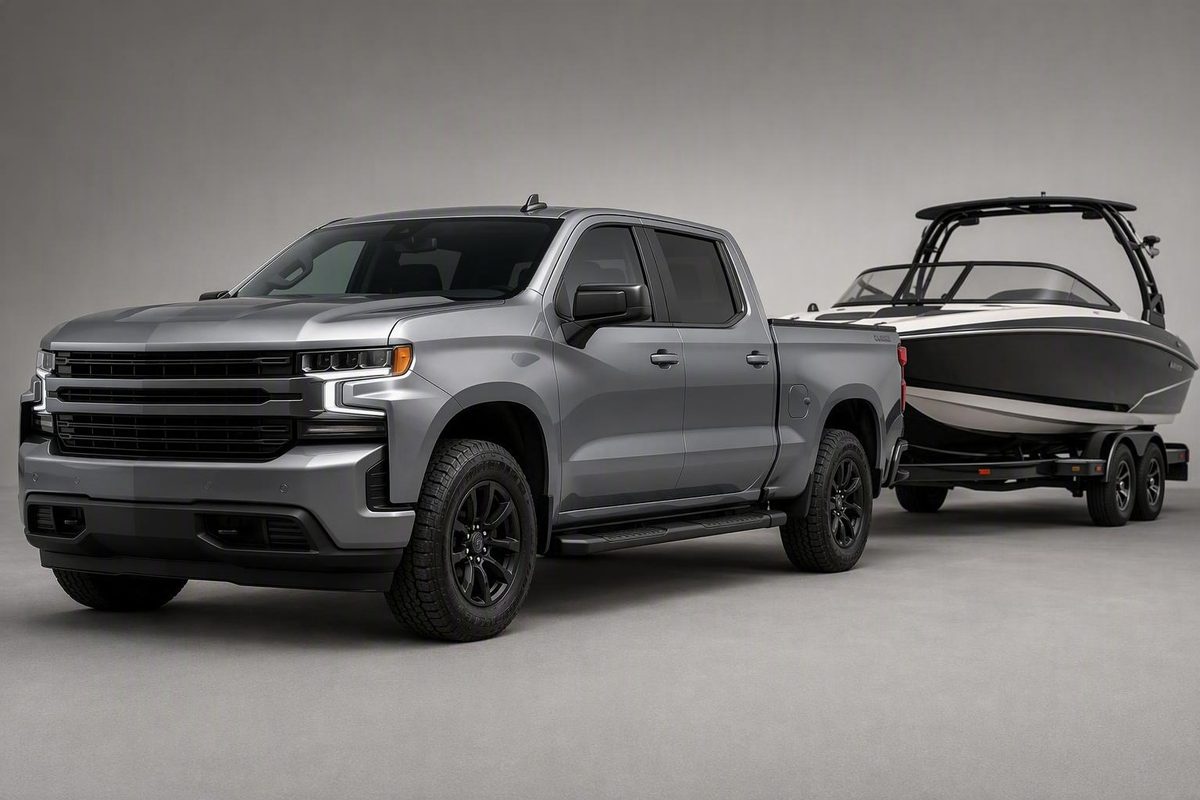
For 2026, listed 5.3L configurations range from about 9,600 to 11,300 pounds for conventional towing, showing why the engine alone cannot set the rating.
The short answer: up to 11,300 pounds, but not in every 5.3L truck
A recent Chevrolet Silverado 1500 with the 5.3L EcoTec3 V8 can tow up to 11,300 pounds with a conventional hitch when properly equipped. That is a dealer-published, best-case figure—not the capacity of every Silverado carrying the 5.3L engine. For 2026, listed conventional ratings for specific 5.3L configurations range from approximately 9,600 to 11,300 pounds. McGee Chevrolet of Middlebury publishes the underlying 2026 configuration figures.
The rating changes with the complete truck configuration, including:
- Model year
- Cab and bed combination
- 2WD or 4WD
- Axle ratio
- Wheel and tire package
- Conventional, fifth-wheel, or gooseneck hitch
- Factory trailering equipment
- Payload and installed options
- Passengers, accessories, and cargo
That is why “How much can a Chevy 1500 5.3 tow?” has two answers. The quick answer is up to 11,300 pounds conventionally. The useful answer is the rating assigned to the individual truck.
Do not confuse the 5.3L maximum with the Silverado 1500 lineup maximum. Recent dealer guides cite 13,300 pounds for selected 3.0L Duramax diesel configurations, not for the 5.3L V8. Cox Chevrolet’s model breakdown attributes the lineup maximum to the diesel.
These figures come from dealership towing guides rather than a complete set of first-party Chevrolet specifications supplied for every configuration and model year. Treat them as planning figures. Before choosing a camper, boat, utility trailer, or work trailer, verify the limits on the truck’s labels and in the correct model-year owner’s manual and Chevrolet trailering documentation.
5.3L Silverado 1500 towing capacity by model year
Dealer-reported headline maxima changed only modestly from 2022 through 2026. The headline number does not, however, reveal every required cab, bed, drivetrain, axle, wheel, or trailering-package detail.
| Model year | Dealer-reported maximum conventional towing capacity | Important qualification |
|---|---|---|
| 2022 | Up to 11,000 lb, or 11,200 lb with Dynamic Fuel Management | The source does not identify the complete configuration required for either maximum. |
| 2023 | Up to 11,000 lb, or 11,200 lb with Dynamic Fuel Management | These are engine-level headline figures; individual configurations can be substantially lower. |
| 2024 | Up to 11,300 lb | One source ties the maximum to a Double Cab or Crew Cab 2WD with the Max Trailering Package and lists up to 11,000 lb for 4WD. |
| 2025 | Up to 11,300 lb | This is an engine-specific dealer figure, not an inference from trim tables combining several engines. |
| 2026 | Up to 11,300 lb | Applies to qualifying conventional-towing configurations when properly equipped. |
The 2022–2025 entries are supported by Cox Chevrolet’s model-year breakdown, which also warns that configuration and equipment affect the result.
For 2026, a separate dealer comparison lists an engine-level maximum of 11,300 pounds with rear-wheel drive and 11,100 pounds with four-wheel drive. Those are maximums for qualifying configurations, not universal ratings for every truck using the corresponding drivetrain. Ed Morse Chevrolet publishes the 2026 engine-and-drivetrain comparison.
For 2024, another dealership guide reports 11,300 pounds with 2WD and 11,000 pounds with 4WD. Its stated top configuration requires a Double Cab or Crew Cab, 2WD, and the Max Trailering Package. New Port Richey Chevrolet details the reported 2024 ratings and required equipment.
The 2025 entry requires particular care. Some dealer tables show a trim’s maximum towing capacity while listing several available engines. A trim-level maximum cannot automatically be assigned to the 5.3L merely because that engine is offered on the trim. One 2025 guide, for example, attributes the Silverado’s overall 13,300-pound maximum to selected diesel 2WD configurations, illustrating why engine-specific and multi-engine trim figures must remain separate. Bomnin Chevrolet’s guide distinguishes its diesel lineup maximum from its multi-engine trim listings.
The table compares model-year headline maxima; it does not guarantee that any truck from a listed year can tow that amount. A 2023 Crew Cab Short Bed, for example, can have a rating well below the model-year maximum depending on drivetrain, hitch, and equipment.
The table also stops at 2022 intentionally. The available evidence does not establish sufficiently clear 5.3L figures for earlier years. Owners of older trucks should use documentation for the exact model year rather than carrying a 2022–2026 figure backward.
Why two 5.3L Silverados can have different tow ratings
The “5.3L” designation identifies the engine. It does not identify the complete towing configuration.
Changing one element can change the assigned rating even when the engine remains the same.
Cab and bed combinations affect the complete truck
They therefore help determine which towing ratings and packages are offered.
On current-generation Silverado 1500 models, Crew Cab trucks use short or standard beds, Double Cab trucks use the standard bed, and Regular Cab trucks use the long bed. The internal Silverado bed-size and cab-pairing guide covers those combinations in more detail. Bed dimensions alone do not determine towing capacity; the pairing is only one part of the truck’s complete specification.
The difference is visible in this dealer-published 2026 comparison:
| 2026 5.3L configuration | 2WD conventional rating | 4WD conventional rating |
|---|---|---|
| Double Cab Standard Bed | 11,300 lb | 11,100 lb |
| Crew Cab Short Bed | 11,300 lb | 11,000 lb |
| Crew Cab Standard Bed | 11,200 lb | 11,000 lb |
| Regular Cab Long Bed | 9,900 lb | 9,600 lb |
Source: McGee Chevrolet of Middlebury’s 2026 cab, bed, drivetrain, and hitch table.
The table shows a 1,700-pound spread between the highest and lowest listed conventional ratings even though every truck uses the 5.3L engine.
2WD and 4WD are not interchangeable
Comparable 2WD configurations often receive slightly higher published tow ratings than their 4WD counterparts. Four-wheel-drive hardware generally adds weight to the truck, which can reduce the capacity available within other assigned weight limits.
The difference is not a fixed amount. In the 2026 table, the Double Cab Standard Bed declines by 200 pounds when moving from 2WD to 4WD, while the Crew Cab Short Bed and Regular Cab Long Bed each decline by 300 pounds.
This means that “a 5.3L 4WD can tow 11,100 pounds” is still too broad. That is the reported maximum for a qualifying 4WD configuration. Other listed 4WD trucks are rated at 11,000 pounds, and the Regular Cab Long Bed 4WD is listed below 10,000 pounds.
Axle, wheels, hitch, and packages still matter
The drivetrain and body style are only the visible parts of the answer. Cooling, suspension, rear-axle hardware, and brake-control equipment can also differ by package.
Trim name is not enough. One trim may offer several engines, drivetrains, beds, wheels, and trailering packages. Two visually similar LT, RST, or High Country trucks can therefore have different ratings.
Use the engine to narrow the search, then use the complete configuration and truck-specific documentation to finish it.
What the Max Trailering Package changes
The highest cited 5.3L towing ratings are associated with qualifying configurations equipped for maximum trailering. Selecting the Max Trailering Package does not automatically turn every 5.3L Silverado into an 11,300-pound tow vehicle.
Dealer descriptions vary by model year and configuration, but reported package equipment may include:
- Enhanced engine or transmission cooling
- Heavier-duty rear springs or rear-axle hardware
- Revised or specifically tuned suspension components
- An automatic locking rear differential
- A trailer-brake controller
- Equipment intended to increase the truck’s assigned combined-weight capability
For 2024, one dealer reports that reaching the stated 11,300-pound 5.3L maximum requires a Double Cab or Crew Cab, 2WD, and the Max Trailering Package. Its package description includes an enhanced radiator, heavier rear hardware, tuned shocks, an automatic locking differential, and an integrated trailer-brake controller. New Port Richey Chevrolet provides the configuration requirement and package description.
The package matters because towing is a whole-vehicle task. Factory equipment can support those demands and qualify particular configurations for higher ratings.
Even so, the package operates only within the limits assigned to the complete factory configuration. It cannot erase differences created by cab, bed, drivetrain, axle ratio, wheels, hitch type, or model year. It also cannot override the truck’s payload, tire, rear-axle, hitch, or tongue-weight limits.
Those features alone do not prove that every component of a maximum-trailering configuration was installed at the factory.
Verify the equipment through truck-specific records and documentation, such as the original window sticker, build or equipment record, applicable labels, owner’s manual, and model-year trailering guide. The supplied evidence does not establish one definitive VIN or RPO-code lookup process that works for every owner, so an unsupported online decoder should not be treated as the sole authority.
Conventional towing versus fifth-wheel or gooseneck towing
Conventional, fifth-wheel, and gooseneck ratings must be treated separately.
For the 2026 5.3L Silverado, one dealer guide reports:
- Up to 11,300 pounds with a conventional hitch
- Up to 10,300 pounds with a fifth-wheel or gooseneck hitch
- Approximately 9,600 to 10,300 pounds across its listed 5.3L fifth-wheel or gooseneck configurations
The same guide describes conventional tongue weight as generally 10%–15% of loaded trailer weight and fifth-wheel or gooseneck pin weight as generally 15%–25%. These are broad planning ranges, not truck-specific vertical-load limits. Miller Chevrolet publishes the hitch-type maxima and planning percentages.
In this comparison, the best conventional rating is higher than the best bed-mounted-hitch rating. A fifth-wheel or gooseneck hitch therefore cannot be used as evidence that the truck inherits or exceeds the 11,300-pound conventional maximum.
A 2023 Crew Cab Short Bed example shows the same distinction. With the 5.3L engine, the cited conventional ratings are 9,500 pounds for 2WD and 9,300 pounds for 4WD. The cited gooseneck ratings are 9,300 pounds for 2WD and 8,600 pounds for 4WD. Spruce Pine Chevrolet publishes those configuration-specific 2023 examples.
Pin weight can become the limiting load
A conventional trailer applies tongue weight through the rear receiver. A fifth-wheel or gooseneck applies pin weight through a bed-mounted hitch. Both consume carrying capacity, but pin weight is commonly planned as a larger share of the trailer’s loaded weight.
For illustration, applying the cited planning ranges to a hypothetical 10,000-pound loaded trailer produces:
- About 1,000–1,500 pounds of conventional tongue weight
- About 1,500–2,500 pounds of fifth-wheel or gooseneck pin weight
Those calculations do not mean a particular Silverado can carry the resulting load. The truck’s actual payload, rear gross axle weight rating, tires, hitch, and maximum tongue or pin-weight rating still control. A bed-mounted hitch also has weight of its own and consumes payload before the trailer is connected.
This is why a half-ton truck can remain below its fifth-wheel trailer-weight rating yet exceed payload or rear-axle capacity. Always use the published rating for the intended hitch type; never substitute the higher conventional figure for a fifth-wheel or gooseneck rating.
Payload may set the real limit before towing capacity does
Tow rating is only one limit in a group of interdependent ratings. A trailer may weigh less than the truck’s maximum trailer-weight rating while the truck is overloaded elsewhere.
The principal terms are:
- Trailer-weight or tow rating: The maximum trailer weight assigned to a particular truck and hitch configuration.
-
Payload: The weight the truck can carry, including occupants, cargo, accessories, hitch hardware, and trailer tongue or pin weight.
-
GCWR: Gross Combined Weight Rating—the manufacturer-rated maximum combined weight of the loaded truck and loaded trailer.
Payload is not limited to cargo placed in the bed. The driver, passengers, tools, coolers, bed covers, steps, auxiliary equipment, hitch hardware, and trailer tongue or pin load all consume it.
Why dry trailer weight is inadequate
A trailer’s brochure “dry” or “shipping” weight generally does not represent its travel-ready weight.
Compatibility calculations should therefore use the trailer’s expected or measured loaded weight. Tongue or pin weight should likewise reflect the loaded trailer and its actual road-going load distribution.
Hypothetical example: an 11,000-pound conventional trailer
Suppose a conventional trailer weighs 11,000 pounds when loaded. Applying the general 10%–15% planning range gives an estimated tongue load of:
- 1,100 pounds at 10%
- 1,375 pounds at 12.5%
- 1,650 pounds at 15%
Those figures arrive before adding the driver, passengers, bed cargo, accessories, or hitch hardware. They are illustrative calculations, not specifications for a particular Silverado and not a conclusion that the trailer is compatible.
Now suppose, again purely for illustration, that a truck has 1,900 pounds of available payload. If people and cargo consume 600 pounds, approximately 1,300 pounds remains for receiver hardware and loaded trailer tongue weight.
Under those assumptions:
- A 1,100-pound tongue load may fit within the remaining payload before hitch-hardware weight is counted.
- A 1,375-pound tongue load already exceeds the 1,300 pounds remaining.
- A 1,650-pound tongue load exceeds it by an even larger amount.
Changing the passenger count, cargo, accessories, trailer loading, or actual truck payload changes the result. The rear axle, receiver, tires, GVWR, GCWR, and maximum tongue-weight rating also require separate checks.
Being below the advertised tow maximum does not make another exceeded rating acceptable. A trailer that is 300 pounds below the tow rating is still an invalid combination if its tongue load causes the truck to exceed payload, rear GAWR, tire capacity, hitch rating, or GVWR. Conversely, satisfying payload does not permit the combination to exceed GCWR or the trailer-weight rating.
Generic arithmetic can explain the process, but it cannot certify a specific truck-and-trailer combination as safe or legal.
How to find the exact rating for your truck
Begin by identifying the truck precisely. Do not start with the engine and stop there.
1. Record the complete configuration
Collect:
- Model year
- Confirmation of the 5.3L engine
- 2WD or 4WD
- Cab style
- Bed length
- Axle ratio
- Wheel and tire package
- Conventional, fifth-wheel, or gooseneck hitch
- Factory Trailering or Max Trailering Package
- Other installed options and accessories
If an item is uncertain, record it as unknown rather than inferring it from appearance or trim name.
2. Inspect the driver-side labels
Dealer guidance reports that the Trailering Information Label may show values including GVWR, GCWR, rear GAWR, maximum payload, maximum tongue weight, and curb weight. The same guidance describes subtracting actual loaded truck weight from GCWR when estimating remaining combined allowance. Ed Morse Chevrolet explains the label location and combined-weight method.
Label formats and displayed values can vary. Use the figures printed on the truck rather than assuming that a sample label or another owner’s Silverado is identical.
3. Consult the correct model-year documents
Compare the labels with:
- The trailering section of the owner’s manual
- The correct model-year Chevrolet trailering guide
- Truck-specific build or equipment documentation
Make sure the selected table row matches the engine, cab, bed, drivetrain, axle, wheels, equipment, and hitch type. Read all applicable footnotes because they may identify required packages or restrictions not obvious from the headline number.
4. Check every applicable rating
Record and compare:
- Maximum trailer weight
- Maximum payload
- Maximum tongue or pin weight
- GVWR
- GCWR
- Front and rear GAWR
- Receiver or bed-mounted hitch rating
- Ball mount and hitch-ball ratings, where applicable
- Tire and wheel load limits
- Trailer, trailer-axle, and trailer-tire ratings
An 11,300-pound trailer rating cannot override a lower receiver rating, and an adequate hitch cannot override payload or rear GAWR.
5. Determine the trailer’s loaded values
Collect or estimate:
- Travel-ready loaded weight
- Loaded tongue or pin weight
- Cargo capacity
- Water, fuel, battery, propane, equipment, and accessory weight
- Trailer axle and tire ratings
Do not substitute brochure dry weight for expected loaded weight. If the trailer has not been purchased, create a realistic loading estimate rather than assuming it will remain empty.
6. Determine the truck’s loaded weight
Prepare the truck as it will travel:
- Driver and passengers aboard
- Normal cab and bed cargo included
- Accessories installed
- Hitch hardware installed
- Fuel and other carried items accounted for
When exact calculations matter, weigh the truck in that condition.
7. Apply GCWR without ignoring other limits
Subtracting the actual loaded truck weight from GCWR estimates how much combined allowance remains for the loaded trailer.
For example, if a hypothetical truck had a 16,000-pound GCWR and weighed 6,000 pounds in travel condition, the calculation would leave 10,000 pounds of combined allowance. It would not automatically create a 10,000-pound trailer rating. The trailer must still stay within the truck-specific trailer rating, and the combination must satisfy payload, GVWR, rear GAWR, hitch, tongue or pin-weight, tire, and wheel limits.
No single calculation replaces all the other ratings. A VIN, build sheet, or equipment record may help identify the configuration, but the available sources do not establish one definitive VIN or RPO-code lookup method for every Silverado.
A pre-tow compatibility checklist
Before connecting a trailer to a 5.3L Silverado 1500, work through the combination in this order:
- [ ] Confirm the truck-specific trailer-weight rating. Match the model year, engine, cab, bed, drivetrain, axle, wheels, hitch type, and trailering equipment.
- [ ] Determine loaded trailer weight. Include cargo, fluids, batteries, propane, accessories, and installed equipment.
- [ ] Estimate or measure loaded tongue or pin weight. Use the trailer’s travel-ready condition.
- [ ] Confirm remaining payload. Account for occupants, cargo, accessories, and hitch hardware.
- [ ] Check maximum tongue or pin weight. Remaining payload alone does not establish the allowable vertical hitch load.
- [ ] Check GVWR. The fully loaded truck must remain within its assigned rating.
- [ ] Check GCWR. The loaded truck and trailer together must remain within the assigned combined rating.
- [ ] Check rear GAWR. Tongue or pin load can add substantial weight to the rear axle.
- [ ] Check hitch hardware. Verify the receiver, ball mount, hitch ball, fifth-wheel hitch, or gooseneck system and installation.
- [ ] Check tires and wheels. Use the ratings for the equipment actually installed.
- [ ] Use the correct hitch-type rating. A fifth-wheel or gooseneck setup cannot inherit the conventional maximum.
- [ ] Verify required factory equipment. The advertised maximum may require the Max Trailering Package and a narrow configuration.
- [ ] Confirm trailer-braking requirements. Check the owner’s manual and the laws applying where the combination will be operated.
One dealer guide reports that Chevrolet requires trailer brakes when trailer weight exceeds 2,000 pounds, while also noting that state laws vary. Because this is a safety- and jurisdiction-dependent requirement, verify it in the owner’s manual and comply with all applicable laws. Miller Chevrolet reports the 2,000-pound threshold and the need to consider state requirements.
Plan the load so ordinary changes in passengers, cargo, fluids, or trailer loading do not cause a rating to be exceeded. The available evidence does not establish a universal percentage margin, so an arbitrary margin should not replace actual weights and truck-specific limits.
The reported top answer remains 11,300 pounds conventionally for a properly equipped recent 5.3L Silverado 1500. It is not universal. Move from that headline to the driver-side labels, correct model-year documentation, loaded trailer weight, payload, hitch rating, rear-axle load, GVWR, and GCWR.
A generic capacity article cannot certify a particular truck-and-trailer combination as safe or legal.
Frequently asked questions
How much can a 2026 Chevy Silverado 1500 5.3L tow?
Dealer guides report up to 11,300 pounds with a conventional hitch for a properly equipped 2026 Silverado 1500 with the 5.3L V8. The configuration table above shows listed conventional ratings from approximately 9,600 to 11,300 pounds. Select fifth-wheel or gooseneck configurations are reported at up to 10,300 pounds.
The exact rating depends on cab, bed, drivetrain, axle, wheels, trailering equipment, and hitch type. Use the truck’s labels and model-year documentation rather than applying the maximum to every 5.3L Silverado.
How much can a 5.3L Silverado tow with 4WD?
It depends on the model year and complete configuration. For 2026, dealer-published figures in the table above range from 9,600 pounds to 11,100 pounds for the listed 4WD configurations. For 2024, one dealer reports a 5.3L 4WD maximum of 11,000 pounds.
A drivetrain-wide maximum is not the rating of every 4WD truck. Cab, bed, axle, wheels, hitch, and factory equipment still need to be matched to the individual Silverado.
Does the Max Trailering Package make every 5.3L Silverado capable of towing 11,300 pounds?
No. The package is associated with the highest cited 5.3L ratings, but the final rating still depends on the complete factory configuration.
Cab, bed, drivetrain, axle ratio, wheels, hitch type, model year, and other equipment remain relevant. The package cannot override the payload, axle, hitch, tire, or combined-weight limits assigned to the truck.
Can a 5.3L Silverado tow an 11,000-pound camper?
Some properly equipped 5.3L Silverado 1500 configurations have trailer-weight ratings of 11,000 pounds or more, but that alone does not establish compatibility with a particular camper.
Use the camper’s loaded weight and loaded tongue or pin weight—not its dry weight. Then check those values against the exact truck’s payload, GVWR, GCWR, rear GAWR, hitch, tire, and vertical-load limits. Occupants, cargo, accessories, and hitch hardware must also be included.
Where is the Silverado Trailering Information Label?
Look in the driver-side door-jamb area. Depending on model year and label format, it may provide truck-specific values such as GVWR, GCWR, rear GAWR, maximum payload, maximum tongue weight, and curb weight.
Read it with the vehicle certification and tire-loading labels, then compare the figures with the trailering section of the owner’s manual and the correct model-year Chevrolet trailering guide.