
How Much Can a Suburban Really Tow? Ratings, Limits, and Load Math
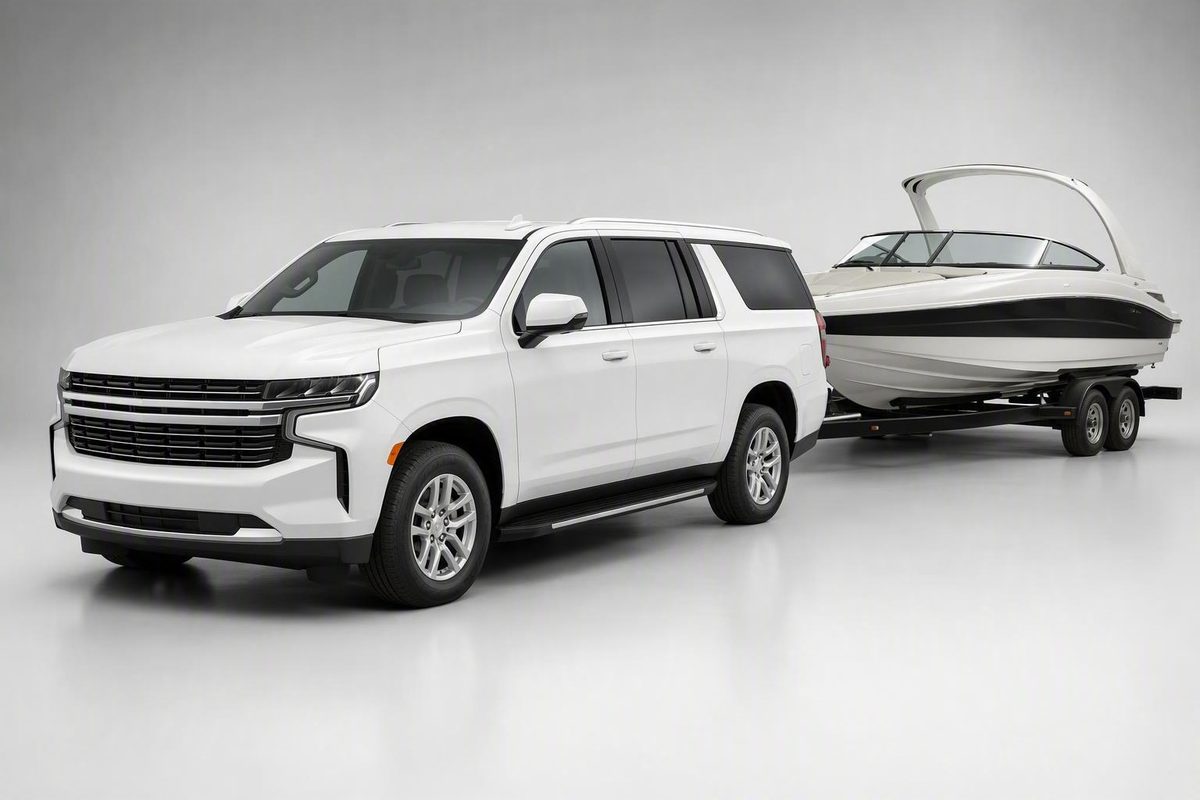
Reported maxima reach 8,300 lb, with a configuration table plus payload, tongue-weight, label and scale checks to find your usable limit.
By Dale Hutchins · Independently published; not affiliated with or endorsed by General Motors
A recent Chevy Suburban can tow a trailer in the low-8,000-pound range when properly equipped, but that headline figure is only a model-line maximum. It is not the towing capacity of every Suburban, and it does not account for the people, luggage, accessories, hitch equipment, and tongue weight carried by a specific vehicle.
To find a usable towing limit, match the exact model year, engine, drivetrain, and trailering equipment. Then check the vehicle-specific trailer rating, carrying capacity, gross vehicle weight rating, gross combination weight rating, rear-axle rating, hitch limits, and tongue-weight limit. Whichever limit is reached first controls the answer.
Chevy Suburban towing capacity at a glance
Chevrolet lists a maximum trailer weight rating of 8,300 pounds for a properly equipped 2023 Suburban. Secondary sources report the same maximum for 2024, while newer reporting puts the maximum at 8,200 pounds for 2025 and 2026.
None of those figures applies automatically to every Suburban.
| Model year | Reported maximum trailer weight | Source and qualification |
|---|---|---|
| 2023 | 8,300 lb | Official Chevrolet model-line maximum when properly equipped; see the 2023 Chevrolet Trailering Guide |
| 2024 | 8,300 lb | Secondary-source maximum reported by Rick Hendrick Chevrolet |
| 2025 | 8,200 lb | Third-party configuration report from GM Authority |
| 2026 | 8,200 lb | Maximum reported by Carl Black Chevrolet; the supplied official Chevrolet product page does not state a towing specification |
The 2023 Chevrolet guide provides the strongest first-party figure in the available evidence. It also explains why the advertised maximum may not be usable in practice: the actual allowance depends on the vehicle, equipment, occupants, cargo, tongue load, and applicable gross-weight limits.
For 2024, dealership reporting gives the 5.3L V8 an 8,300-pound maximum. That reporting does not fully map each engine figure to drivetrain, trim, axle ratio, and required equipment, so it should be treated as an initial reference rather than proof of an individual vehicle’s rating.
For 2025, GM Authority reports that the maximum belongs to a Suburban with the 5.3L V8, 2WD, and Max Trailering Package. Its configuration table places the other combinations between 7,400 and 8,100 pounds.
For 2026, the 8,200-pound figure remains a dealership-reported maximum. Because the supplied Chevrolet product-page material contains no towing specification, it should not be presented as an independently verified Chevrolet rating.
The practical conclusion is simple: 8,200 or 8,300 pounds is a starting point for research, not permission to attach a trailer of that weight to any recent Suburban.
2025 Suburban towing capacity by engine, drivetrain, and package
The 2025 model has the clearest configuration-level breakdown in the available evidence. The following matrix reproduces GM Authority’s reporting; it is not an official Chevrolet-verified towing table.
| 2025 configuration | 5.3L V8 | 6.2L V8 | 3.0L Duramax diesel |
|---|---|---|---|
| 2WD, without Max Trailering | 7,700 lb | 7,500 lb | 8,100 lb |
| 2WD, with Max Trailering | 8,200 lb | 8,000 lb | 8,100 lb |
| 4WD, without Max Trailering | 7,500 lb | 7,400 lb | 7,800 lb |
| 4WD, with Max Trailering | 8,000 lb | 7,900 lb | 7,800 lb |
All configurations in the source’s table use a 3.23 axle ratio. These figures and package designations come from GM Authority’s 2025 Suburban towing report.
The matrix shows several useful patterns:
- The highest reported 2025 rating is 8,200 pounds, with the 5.3L V8, 2WD, and Max Trailering Package.
- Without Max Trailering, the 2WD diesel has the highest figure in its row.
- The 6.2L V8 does not lead any row despite being the larger gasoline engine.
- Max Trailering raises each gasoline-engine figure by 500 pounds.
- The diesel figures do not change with the package.
- Every 2WD figure is higher than its comparable 4WD figure, although the difference varies from 100 to 300 pounds.
Do not carry this table forward to 2026. Model years can differ in powertrains, equipment combinations, option restrictions, vehicle weight, and certified ratings. An official 2026 configuration guide—or documentation tied to the exact vehicle—is needed before assuming that any 2025 figure still applies.
Trim should not be used as a shortcut either. Two Suburbans with similar badges can differ in engine, drivetrain, factory equipment, options, carrying capacity, and vehicle-specific ratings. A package shown as available for a trim is not necessarily installed on the vehicle being inspected.
What engine, 2WD or 4WD, and Max Trailering change
There is no universally “best” Suburban towing engine without first defining the drivetrain, package, intended trailer, passenger load, and operating conditions. Engine choice matters, but it does not determine the rating by itself.
The 5.3L V8 reaches the reported 2025 maximum
The 2025 matrix shows how drivetrain and equipment change the 5.3L V8’s rating:
- 2WD without Max Trailering: 7,700 pounds
- 2WD with Max Trailering: 8,200 pounds
- 4WD without Max Trailering: 7,500 pounds
- 4WD with Max Trailering: 8,000 pounds
Within these reported configurations, Max Trailering adds 500 pounds and the comparable 4WD versions rate 200 pounds below the 2WD versions. Those relationships are specific to this 2025 matrix; they are not formulas that can be applied to other model years.
For a buyer pursuing the highest reported 2025 rating, the 5.3L V8 with 2WD and Max Trailering is the leading configuration. A buyer towing a lighter trailer may care more about traction, equipment availability, operating conditions, or remaining carrying capacity than the final 200 pounds of trailer rating.
The 6.2L V8 is not automatically the towing leader
A larger engine does not guarantee a higher trailer rating. The reported 2025 figures for the 6.2L V8 range from 7,400 to 8,000 pounds, depending on drivetrain and package status. In each row, either the 5.3L V8 or diesel has a higher rating.
That does not make the 6.2L unsuitable for towing. It means only that the certified limit applies to the complete vehicle configuration, not to engine displacement alone.
The diesel leads in some configurations
The reported diesel ratings are 8,100 pounds with 2WD and 7,800 pounds with 4WD, regardless of Max Trailering Package status.
The diesel therefore leads the 2WD row without Max Trailering. It also exceeds the 6.2L in both 4WD rows and ties or exceeds it in the 2WD rows. It does not hold the overall maximum because the 5.3L V8, 2WD, Max Trailering configuration reaches 8,200 pounds.
Broad claims such as “the diesel tows the most” or “the biggest V8 is best” are therefore unreliable. The answer changes with the rest of the configuration.
Max Trailering does not increase every rating
The package raises the reported 2025 gasoline ratings by 500 pounds, but it does not change either diesel figure. Paying for the package may still add useful trailering hardware or technology, even when the published trailer rating for a particular engine and drivetrain stays the same.
The package cannot be evaluated in isolation. The vehicle must have the engine, drivetrain, and other equipment required for the applicable configuration. A visible brake controller, receiver, or camera feature does not by itself establish the certified rating.
2WD generally rates higher, but 4WD can still be the better fit
In the supplied recent-year tables, comparable 2WD configurations generally have higher trailer ratings than 4WD versions. The difference is not constant, so there is no defensible fixed “4WD penalty” to subtract from every Suburban.
A lower published rating also does not make 4WD the wrong choice. Four-wheel drive may matter when using slippery boat ramps or traveling on snow, mud, loose gravel, or unpaved access roads. The decision should balance verified capacity against the traction conditions likely to be encountered.
If an 8,000-pound rating is sufficient after all load calculations, a 4WD configuration with that rating may be more useful than a 2WD version rated 200 pounds higher. If suitability depends on using nearly every pound of the maximum, the proposed combination deserves especially careful review.
The 2024 diesel figure remains unresolved
The supplied secondary sources conflict on the 2024 diesel. Rick Hendrick Chevrolet reports an 8,100-pound engine-level maximum, while an aftermarket manufacturer lists 8,000 pounds for 2WD and 7,800 pounds for 4WD with Max Trailering in its 2023–2024 Suburban configuration tables.
Because neither source is the applicable Chevrolet trailering guide and the figures conflict, there is no sound basis here for declaring a definitive 2024 diesel rating. Use the correct Chevrolet documentation and vehicle labels for the specific Suburban.
Why the advertised maximum is not your usable towing capacity
Tow rating is only one part of the load calculation. A Suburban can remain below its trailer-weight rating and still exceed carrying capacity, rear-axle capacity, hitch limits, or gross vehicle limits.
The key terms are:
- Maximum trailer weight rating: The greatest loaded trailer weight allowed for a specified vehicle configuration under the manufacturer’s stated assumptions and limits.
- Payload or carrying capacity: The combined occupant and cargo weight that the individual vehicle can carry. People, luggage, accessories, hitch hardware, and tongue weight all use this allowance.
- GVWR—Gross Vehicle Weight Rating: The maximum permitted weight of the loaded Suburban.
- GCWR—Gross Combination Weight Rating: The maximum permitted combined weight of the loaded tow vehicle and loaded trailer.
- RGAWR—Rear Gross Axle Weight Rating: The maximum permitted load on the rear axle.
- Hitch rating: The trailer-weight and tongue-weight limit of the receiver and other hitch components. The lowest component rating controls.
- Tongue weight: The downward load a conventional trailer places on the hitch. It is carried by the Suburban and cannot be ignored as “trailer weight.”
Chevrolet calculates maximum trailer weight by subtracting tow-vehicle curb weight from GCWR and assumes a base vehicle carrying a 150-pound driver and a 150-pound front passenger. Additional passengers, options, equipment, and cargo reduce the available allowance. Chevrolet also says hitch weight must not cause the vehicle to exceed GVWR or RGAWR.
For a conventional trailer, Chevrolet recommends tongue weight of approximately 10% to 15% of loaded trailer weight. It also recommends placing about 60% of the trailer’s cargo in the front half, balancing the load side to side, and crossing safety chains beneath the tongue with enough slack for turns but without allowing them to drag. Chevrolet says trailer brakes are required above 2,000 pounds for the Suburban while noting that state laws may differ. These figures and instructions come from the 2023 Chevrolet Trailering Guide.
How tongue weight consumes carrying capacity
Consider an 8,000-pound loaded conventional trailer:
- At 10%, estimated tongue weight is 800 pounds
- At 12%, estimated tongue weight is 960 pounds
- At 15%, estimated tongue weight is 1,200 pounds
That load exists before counting the driver, passengers, luggage, tools, accessories, or hitch hardware.
Suppose the Suburban carries:
- 800 pounds of loaded tongue weight
- 75 pounds of hitch equipment
- 600 pounds of occupants
- 200 pounds of luggage and accessories
The total load carried by or imposed on the vehicle is 1,675 pounds. Whether it fits depends on the carrying-capacity label and the resulting loaded vehicle and axle weights. Increasing tongue weight toward 15% would add several hundred pounds.
This is why carrying capacity can become the practical constraint for a three-row SUV. A lightly occupied Suburban may have room for a substantial tongue load; the same vehicle carrying a family and vacation cargo may not.
Dry trailer weight is not the planning number
Dry weight can help compare trailers, but it does not represent the actual departure-day load.
For initial screening, use either:
- A realistic estimate of the fully loaded trailer weight, or
- The trailer’s GVWR as a conservative upper planning figure.
Then estimate the loaded tongue weight rather than relying only on an empty-hitch figure.
The same principle applies to boats and utility trailers. Fuel, water, anchors, coolers, tools, spare tires, and cargo change both total trailer weight and tongue weight.
Every applicable limit must pass
A workable combination must remain within:
- Vehicle-specific maximum trailer weight
- Suburban carrying capacity
- GVWR
- GCWR
- Front and rear axle ratings
- Receiver and hitch-component ratings
- Maximum permitted tongue load
- Trailer GVWR and axle ratings
- Equipment and hitch requirements in the Owner’s Manual
The lowest applicable limit governs. A trailer does not become suitable merely because its total weight is below a model-line maximum.
Calculations are useful for screening, but a loaded scale check provides stronger confirmation. Axle-level measurements can reveal a rear-axle overload that a single combined-weight figure would not show.
How to verify the towing capacity of your exact Suburban
Start with the labels attached to the vehicle and Chevrolet documentation for the correct model year. Treat online tables, dealer pages, and aftermarket articles as research aids rather than substitutes.
1. Identify the exact configuration
Record the:
- Model year
- Engine
- 2WD or 4WD drivetrain
- Trim
- Factory trailering package, if installed
- Relevant hitch and cooling equipment
- Major factory options and aftermarket equipment
Do not infer the rating from a trim name, engine badge, receiver, brake controller, or camera feature alone. Similar-looking vehicles can have different equipment and certified limits.
2. Inspect the Trailering Information Label
Open the driver’s door and inspect the doorframe area. Chevrolet’s 2023 guide says the Suburban’s vehicle-specific maximum trailer weight rating and GCWR appear on its Trailering Information Label.
Write down those values. If the label states less than a model-line advertisement, use the vehicle-specific figure for planning.
3. Inspect the carrying-capacity label
Find the tire-and-loading or carrying-capacity label. It identifies how much combined occupant and cargo weight that individual vehicle can carry.
Against that allowance, count:
- Everyone riding in the Suburban
- Luggage and cabin cargo
- Tools, coolers, and other equipment
- Permanently installed accessories
- Hitch and weight-distribution hardware
- Loaded trailer tongue weight
Do not substitute a generic payload figure from an online listing. Options and equipment can change the carrying capacity of individual vehicles.
4. Consult the correct Owner’s Manual and trailering guide
Use documents for the exact model year. Review the sections covering trailer towing, loading, GCWR, tongue weight, brakes, hitch selection, tire pressure, and equipment-specific instructions.
Model-year discipline matters. A detailed 2025 table is not proof of a 2026 rating, even when the body style and engine names appear unchanged.
5. Confirm the installed hitch and components
Record the ratings of the:
- Receiver
- Ball mount
- Hitch ball
- Weight-distributing equipment, when applicable
- Pin and retaining hardware
- Trailer coupler
A high vehicle rating cannot override a lower hitch-component rating. Follow the component manufacturers’ instructions for compatibility and use.
6. Confirm the trailer’s limits and loaded condition
Record the trailer’s:
- GVWR
- Gross axle weight ratings
- Expected or measured loaded weight
- Loaded tongue weight
- Brake equipment
- Coupler and safety-chain ratings
The trailer must comply with its own ratings as well as the Suburban’s.
7. Compare every limit on one worksheet
| Check | Rated limit | Expected or measured load | Pass? |
|---|---|---|---|
| Maximum trailer weight | |||
| Suburban carrying capacity | |||
| GVWR | |||
| GCWR | |||
| RGAWR | |||
| Hitch trailer-weight rating | |||
| Hitch tongue-weight rating | |||
| Trailer GVWR | |||
| Trailer axle ratings |
Passing the trailer-weight row does not compensate for exceeding another limit.
8. Obtain exact-vehicle documentation when necessary
When shopping for a used Suburban, request documentation tied to the exact VIN and installed equipment. If a label is missing, damaged, or unclear, contact a Chevrolet dealer or Chevrolet support before towing.
Do not rely solely on a seller’s statement that the vehicle “has the tow package.” Confirm which equipment is installed and which rating applies.
9. Weigh the loaded combination
Load the Suburban and trailer as they will travel, including occupants, luggage, fuel, water, hitch hardware, and trailer cargo. Obtain combined and axle-level measurements where available.
Compare the scale results with the vehicle labels and documentation. This turns an estimate into evidence about the actual loaded combination.
What trailering packages and equipment actually do
Trailering packages may combine mechanical hardware with convenience and driver-assistance technology. Contents vary by model year, trim, drivetrain, and option availability, so no single package description should be assumed to cover every recent Suburban.
Features repeatedly attributed to the Max Trailering Package include:
- Enhanced radiator cooling
- Integrated trailer-brake controller
- Hitch View or hitch-guidance technology
- An in-vehicle trailering system
These features do different jobs.
Capacity-supporting hardware, such as enhanced cooling, can help a configuration meet the manufacturer’s requirements for a higher rating.
Driver-assistance and monitoring technology can make hitching or trailer management more convenient.
The 2025 matrix shows the distinction clearly:
| Configuration | Without Max Trailering | With Max Trailering | Reported change |
|---|---|---|---|
| 5.3L V8, 2WD | 7,700 lb | 8,200 lb | +500 lb |
| 6.2L V8, 2WD | 7,500 lb | 8,000 lb | +500 lb |
| 5.3L V8, 4WD | 7,500 lb | 8,000 lb | +500 lb |
| 6.2L V8, 4WD | 7,400 lb | 7,900 lb | +500 lb |
| 3.0L diesel, 2WD | 8,100 lb | 8,100 lb | No reported change |
| 3.0L diesel, 4WD | 7,800 lb | 7,800 lb | No reported change |
The package raises some reported ratings, not all of them. It may still provide useful equipment when the trailer-weight rating remains unchanged.
Do not conflate the Advanced Trailering Package with the Max Trailering Package. Package names, availability, and contents can change. Confirm the description for the exact model year and trim rather than assuming that the terms are interchangeable.
Rick Hendrick Chevrolet’s 2024 package description attributes Hitch Guidance with Hitch View, a trailer-brake controller, an in-vehicle Advanced Trailering System, and enhanced radiator cooling to Max Trailering. That dealer description may help buyers identify questions to ask, but it does not replace vehicle-specific build documentation.
Suspension helpers do not rewrite the ratings
Aftermarket air springs, rubber springs, and other suspension helpers may reduce visible rear sag or alter how a loaded vehicle feels. They do not create additional certified carrying or towing capacity.
The aftermarket vendor in the supplied evidence explicitly states that its suspension enhancement system does not increase payload capacity. That provides no basis for increasing the Suburban’s trailer rating, GVWR, GCWR, RGAWR, or axle ratings.
A level stance is not proof that the combination is within limits. Suspension aids must be used without exceeding any original vehicle, axle, tire, hitch, or combination rating.
Pre-tow checklist for a camper, boat, or utility trailer
A camper advertised at 6,500 pounds dry, a boat package listed at 7,000 pounds, or an enclosed trailer rated for 8,000 pounds may appear to fit beneath a Suburban’s headline maximum. Those figures are only screening inputs; none proves compatibility by itself.
Trailer and load calculations
- [ ] Identify the trailer’s GVWR and axle ratings.
- [ ] Estimate its actual loaded weight rather than relying only on dry weight.
- [ ] Include batteries, propane, water, fuel, options, tools, food, and recreational cargo.
- [ ] For a conventional trailer, estimate loaded tongue weight using Chevrolet’s cited 10%–15% range.
- [ ] Add tongue weight and hitch hardware to occupants, luggage, accessories, and cargo carried by the Suburban.
- [ ] Compare that total with the vehicle’s carrying-capacity label.
- [ ] Confirm the loaded trailer does not exceed the vehicle-specific trailer rating.
- [ ] Confirm the combination remains within GVWR, GCWR, RGAWR, hitch limits, and tongue-load limits.
For an 8,000-pound loaded conventional trailer, that means planning for approximately 800 to 1,200 pounds of tongue weight before counting people, luggage, accessories, or hitch hardware.
Hitch and connection
- [ ] Verify the ratings and compatibility of the receiver, ball mount, hitch ball, coupler, and related components.
- [ ] Use weight-distributing equipment if required by the applicable vehicle, hitch, or trailer instructions.
- [ ] Confirm the coupler is engaged and secured according to its instructions.
- [ ] Cross the safety chains beneath the trailer tongue.
- [ ] Leave enough chain slack for turns without allowing the chains to drag.
Too little slack can interfere with turning, while excessive slack can allow the chains to contact the road.
Brakes and electrical equipment
- [ ] Confirm that the trailer has the brakes required by Chevrolet guidance, current model-year instructions, and applicable law.
- [ ] Follow the instructions for the installed brake controller.
- [ ] Confirm that the trailer-lighting and brake connection functions as specified.
- [ ] Consult the trailer and brake-equipment manuals for their inspection and operating procedures.
Chevrolet’s 2023 guidance requires trailer brakes above 2,000 pounds for the Suburban, but legal requirements vary by state. Check the correct model-year documentation and the law where the combination will be operated.
Tires and mechanical condition
- [ ] Follow the Suburban’s tire-pressure and loading instructions.
- [ ] Follow the trailer and tire manufacturers’ load and inflation requirements.
- [ ] Confirm that the tow vehicle, trailer, hitch, and braking equipment are in serviceable condition under their applicable manuals.
- [ ] Secure cargo against movement.
Remaining below a numerical trailer rating does not override a component’s instructions or load limit.
Load placement
For a conventional trailer, apply Chevrolet’s guidance to place approximately 60% of the cargo in the front half and balance it side to side. Then measure or verify the resulting tongue weight and keep it within the trailer, hitch, axle, and vehicle limits.
Do not move heavy cargo to the extreme rear merely to force tongue weight downward. If correct loading produces too much tongue weight for the Suburban, reduce or reconfigure the load or select a more capable tow vehicle.
Final walk-around
Before moving:
- Confirm the coupler and hitch connection are secured according to their instructions.
- Verify that the safety chains cross beneath the tongue and have suitable slack.
- Confirm the trailer’s lighting and braking connections function as specified.
- Make sure cargo and trailer openings are secured.
- Confirm that the loaded vehicle and trailer remain within all applicable ratings.
Finish with a loaded scale check. Calculations can identify an unsuitable combination, but axle-level weights provide the strongest confirmation that the actual Suburban and trailer remain within the relevant vehicle, axle, hitch, trailer, and combination limits.
Chevy Suburban towing capacity FAQ
Can a Chevy Suburban tow 8,200 pounds?
Some can. The reported 2025 matrix gives an 8,200-pound maximum to the 5.3L V8, 2WD configuration with Max Trailering. A Chevrolet dealer also reports an 8,200-pound model-line maximum for 2026, although the available official Chevrolet product-page material does not independently verify that figure.
Even when a vehicle-specific label permits 8,200 pounds, carrying capacity, occupants, cargo, tongue weight, hitch hardware, axle ratings, and GCWR may require a lighter trailer.
Does a 2WD Suburban tow more than a 4WD Suburban?
Usually, in the supplied recent-year configuration tables. In the reported 2025 matrix, comparable 2WD ratings are 100 to 300 pounds higher than 4WD ratings, depending on engine and package status.
That is not a universal fixed penalty. Four-wheel drive may be useful on snow, mud, loose surfaces, unpaved access roads, or slippery ramps. Choose between 2WD and 4WD based on both verified capacity and expected operating conditions.
Is the 5.3L V8, 6.2L V8, or 3.0L Duramax best for towing?
For the highest reported 2025 trailer rating, the answer is the 5.3L V8 with 2WD and Max Trailering, at 8,200 pounds. The diesel leads some other configurations, including the 2WD row without Max Trailering.
The 6.2L V8 is not the trailer-rating leader in the reported 2025 matrix. The best choice depends on the complete configuration and intended use, not engine displacement alone.
Is the 80% towing rule required by Chevrolet?
No. The so-called 80% rule is a voluntary planning guideline under which an owner aims to use no more than 80% of the vehicle’s trailer rating. It is not a Chevrolet-certified limit, as the Carl Black Chevrolet guide also acknowledges.
Using only 80% of the headline rating can still overload carrying capacity, the rear axle, or the hitch. Conversely, the manufacturer’s certified limits do not automatically change to 80%. Evaluate the vehicle-specific trailer rating, carrying capacity, GVWR, GCWR, RGAWR, tongue weight, and hitch limits.
Do suspension helpers increase Suburban towing or payload ratings?
No. The cited suspension-product vendor explicitly says its system does not increase payload capacity.
A recent Suburban’s 8,200- or 8,300-pound headline maximum is therefore only a starting point. The responsible answer comes from the exact vehicle’s Trailering Information Label, carrying-capacity label, model-year documentation, installed equipment, loaded trailer weight, tongue weight, and scale results. Reject any universal rating until every relevant vehicle, axle, hitch, payload, trailer, and combination limit passes.