
Where to Lift the Front of a 2004 Avalanche—Without Guessing at the Crossmember
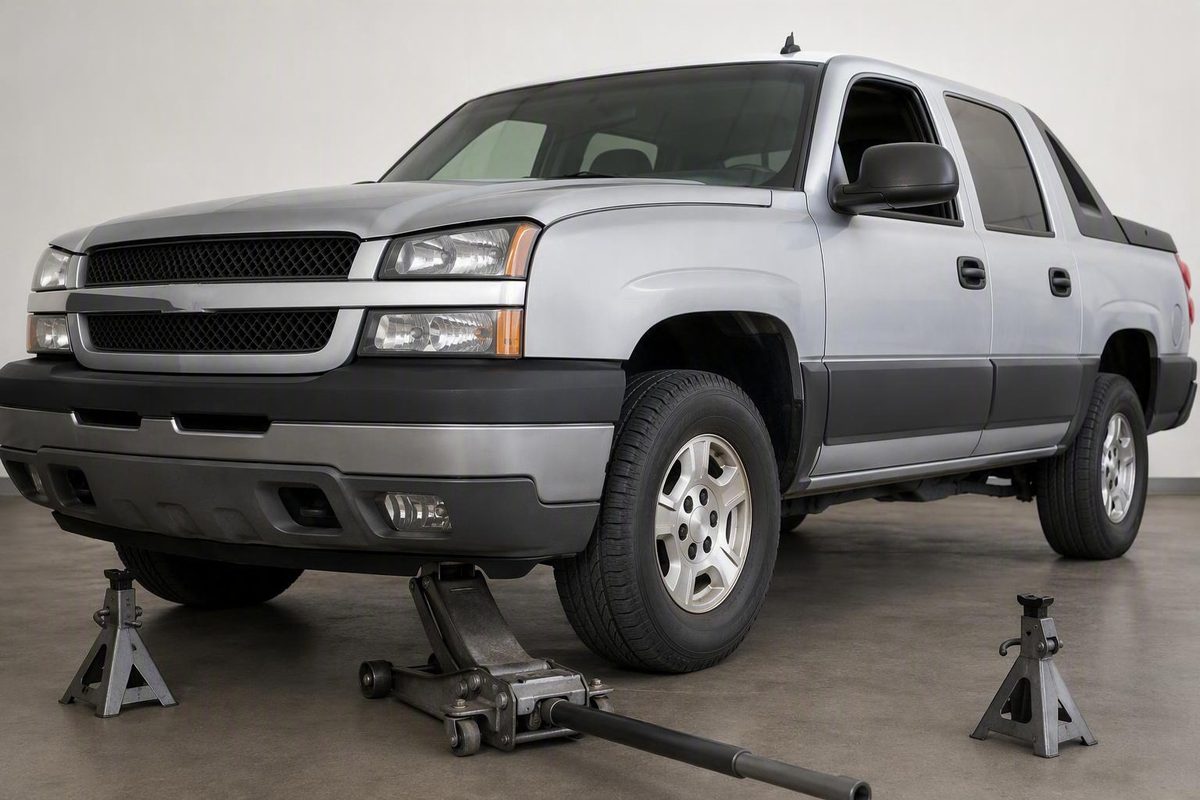
The Short Answer: The Exact Avalanche Jack Point Is Not Confirmed Here
The sources reviewed do not identify an exact Chevrolet-approved front jack point for a 2004 Chevy Avalanche. Because lifting a vehicle incorrectly can cause instability or damage, this article cannot responsibly name a specific underside component as the correct point.
The limited third-party evidence suggests two areas to investigate in factory documentation:
- For raising both front wheels, a substantial front frame or suspension crossmember.
- For lifting one front corner, a designated frame area behind the corresponding front tire.
Neither description is precise enough to begin lifting. The evidence consists of a Silverado guide and an anecdotal forum discussion in which the terminology changes between “engine crossmember,” “front suspension crossmember,” and a member farther forward. One contributor even questions his original identification, demonstrating why “use the front crossmember” is not an adequate instruction. The CK5 forum discussion should be treated as anecdotal, not as a Chevrolet procedure.
A third-party guide for the Silverado distinguishes between a front frame crossmember for raising both front wheels and a point behind the front tire for removing one wheel. It does not establish that those instructions apply to a 2004 Avalanche.
Before placing a jack, check the 2004 Avalanche owner’s manual for the supplied tire-changing jack location and warnings. For a central floor-jack lift or jack-stand placement, use authenticated GM service information that covers the vehicle’s drivetrain and equipment. If you cannot positively match the documented point to the actual vehicle, do not lift it there.
| Intended task | Area suggested by third-party sources | What is not confirmed |
|---|---|---|
| Lift one front corner | Designated area behind the corresponding front tire | The precise reinforced location on a 2004 Avalanche |
| Raise both front wheels | Substantial front frame or suspension crossmember | The exact member and whether GM authorizes a central lift |
| Support the raised vehicle | Appropriate support locations | The factory stand points for a 2004 Avalanche |
| Lift from a lower control arm | Disputed in the forum discussion | Whether GM authorizes it for any applicable configuration |
These are leads for locating the correct factory diagram—not lifting instructions.
One Front Corner and the Entire Front End Require Different Decisions
Decide what you need to raise before choosing equipment or looking for a contact point. Removing one front wheel and raising the whole front end are different operations, and evidence for one location does not establish the other.
If you need to lift one front wheel
The third-party Silverado guide recommends a designated location behind the corresponding front tire for one-wheel removal. That suggests a region to compare with the Avalanche owner’s-manual diagram, but it does not prove that any visible portion of the Avalanche frame behind the tire is suitable.
The manual may illustrate a location intended specifically for the vehicle’s supplied tire-changing jack.
Do not select an arbitrary flat or convenient section of frame. “Behind the front tire” describes a region, not a sufficiently precise contact point.
If you need to raise both front wheels
The Silverado guide recommends a front frame crossmember when both front wheels must be raised. The forum thread also contains reports of lifting an Avalanche or a 2005 vehicle from a front crossmember. However, the forum does not clearly identify the component, and neither source confirms a central floor-jack procedure for the 2004 Avalanche. The Silverado lifting guide is useful only for understanding the distinction between a one-wheel lift and a whole-front lift; it is not Avalanche-specific authority.
Before considering a central lift, determine:
- Whether authenticated GM information authorizes it for the vehicle.
- Which exact structural member and contact face the jack must engage.
- Whether the instructions apply to a floor jack rather than the supplied jack or a shop lift.
- Where the stands will go after the vehicle is raised.
- Whether drivetrain, suspension, skid plates, or other equipment change access or the approved procedure.
If those questions are unresolved, do not test a likely-looking crossmember. Obtain model-specific information or have a qualified repair facility lift the vehicle.
How to Interpret the Phrase “Front Crossmember”
The forum descriptions are especially ambiguous. One contributor first refers to an “engine crossmember,” then questions that identification and suggests a member farther forward. Another reports using a “front suspension crossmember.” Because the exact Avalanche model year, drivetrain, and component are not established, those comments cannot identify a safe jack-saddle contact surface.
Several components may look plausible from underneath:
- A heavy, frame-connected member.
- A skid plate or protective shield.
- A thin brace.
- A steering or suspension component.
- A body or radiator/core-support component.
- The oil pan or another powertrain surface.
- An unidentified transverse member.
Do not infer that any of these is a jack point from its width, apparent strength, central position, or accessibility. The forum’s uncertain reference to a forward or core-support-area member is particularly important: it does not establish that a core-support component is suitable for lifting.
That description can help distinguish the general idea from an oil pan or shield, but it is not approval to use a component.
A reliable factory diagram should identify:
- The exact structural member.
- The specific face or surface contacted by the jack.
- The type of lifting equipment covered.
- Whether the location raises one corner or both front wheels.
- Any nearby surfaces that must not be loaded.
- Separate stand-support locations.
- Relevant drivetrain, suspension, or underbody-equipment notes.
Do not use an unlabeled underside photograph as proof. Any published image marking the jack point should first be verified against factory information and should label nearby look-alikes clearly enough to prevent confusion.
If you cannot confidently match the factory illustration to the vehicle, stop rather than choosing the widest or strongest-looking component.
The Frame Area Behind the Front Tire
The frame region behind the front tire appears in both sources, but only as third-party guidance. In the forum, a contributor using the name Blue85 reports lifting a 2005 vehicle from either the front suspension crossmember or the frame behind the front tire. The Silverado guide recommends a designated point behind the front tire when removing one front wheel.
That overlap makes the area worth checking in the 2004 Avalanche owner’s manual. It does not verify the exact reinforced contact point on the Avalanche.
Within the region behind the tire, there may be frame surfaces, brackets, body mounts, fasteners, lines, suspension attachments, or accessories. Do not assume that any convenient frame edge or flat-looking area is suitable.
Match the manual’s diagram to the vehicle, paying attention to:
- Its position relative to the wheel opening.
- Whether the arrow identifies the frame rail or another reinforced feature.
- The face that contacts the jack.
- The type of jack shown.
- Whether the location is for lifting, supporting, or both.
The reviewed sources do not determine whether this area may be used only to lift the corner, only to support it, or for both purposes. A lifting location should not automatically be treated as a stand point.
Before relying on any documented area, check whether corrosion, deformation, collision damage, or installed equipment prevents the illustrated contact. The sources do not provide an Avalanche-specific inspection standard, so uncertainty about the condition or accessibility of the point should be referred to a qualified professional rather than resolved by improvisation.
Accessories and modifications may also obstruct the illustrated location. If the factory diagram and physical vehicle do not agree, do not place the saddle partly on a bracket and partly on the frame to approximate the position.
Why the Lower Control Arm Is a Disputed Choice
The reviewed evidence does not support recommending the lower control arm as a safe or preferred front jack point for this Avalanche.
The forum participants disagree. One considers lower-control-arm lifting possible but recommends supporting the vehicle by the frame before working underneath it. Another avoids the control arms because of concern about bending or otherwise damaging them. The discussion also warns that the angle of a lower control arm may allow a jack or stand to slide.
These comments do not prove that every lower control arm will bend, and they do not establish that all control-arm lifting is prohibited. They show that the proposed method is unresolved and lacks a verified, model-specific procedure.
Before any suspension component could be considered, authenticated Chevrolet information would need to establish:
- That the component is an authorized lifting point.
- The precise contact area.
- The permitted lifting equipment and saddle or adapter.
- Whether the procedure is for temporary lifting or continued support.
- Any drivetrain or suspension-package differences.
A component used temporarily for lifting is not automatically suitable for a jack stand.
Unless a factory procedure for the exact Avalanche configuration expressly authorizes lower-control-arm lifting and identifies the required contact method, do not substitute the control arm for an inaccessible or unidentified factory point.
Lifting Points and Jack-Stand Points Are Not Automatically the Same
A lifting point is where the jack applies force while raising the vehicle. A stand point is where the vehicle remains supported during the work. Those locations may coincide in a particular procedure, but that cannot be assumed.
A central jack point also does not reveal where to support the left and right sides. Likewise, a corner point illustrated for the supplied tire-changing jack may not have the correct geometry for a stand saddle.
The Silverado guide calls for jack stands after lifting and warns against working beneath a vehicle held only by a jack. Its stand-location language is imprecise, however: it mentions the appropriate axle for a single-wheel lift and elsewhere refers generally to previously mentioned points. It does not establish any factory stand location for a 2004 Avalanche.
Before lifting, the support plan must identify:
- The documented lifting point.
- Every documented stand-support location needed for the task.
- Whether the stands can be positioned without interference.
- Whether each saddle can make full contact as the applicable procedure requires.
- Whether the jack can be lowered without contacting or displacing a stand.
Do not place stands under unidentified suspension, body, drivetrain, or protective components. Only use support locations confirmed for the applicable vehicle and procedure.
After lowering the vehicle fully onto verified stands, check the setup cautiously from a safe position before beginning work. Do not reach beneath the vehicle to reposition a loaded stand. Most importantly, never put any part of your body under a vehicle supported only by a hydraulic or portable jack; the third-party Silverado guide specifically calls for transferring the load to jack stands before under-vehicle work.
The exact Avalanche stand locations are not given here because neither reviewed source verifies them.
What to Check Before the Jack Touches the Vehicle
Because the model-specific lift and support points remain unverified, the following checks do not form a complete lifting procedure. They identify conditions that must be resolved before work begins.
Confirm the vehicle and its configuration
Determine whether the Avalanche is 2WD or 4WD and whether it has Z71 equipment, skid plates, suspension modifications, collision repairs, or other changes affecting the underside. The reviewed sources do not establish whether these configurations use different points.
Do not assume that a nearby aftermarket plate or bracket can carry the load merely because it covers or obstructs a documented location.
Confirm the task and support plan
Decide whether you are changing one wheel, raising both front wheels, or creating access underneath. Identify the documented lifting location and every required support location before starting.
If anyone will reach beneath the vehicle, the load must first be transferred to suitable stands. Do not begin a central lift and plan to search for stand locations afterward; the Silverado guide requires jack stands for under-vehicle work.
Check the working surface
The Silverado guide instructs users to place the jack on solid ground where it will not tilt as the load increases. It also says to keep people away from the jack and vehicle while lifting.
Do not proceed on a surface where the jack or stands cannot remain stable. Because the evidence pack does not contain authenticated Avalanche instructions for transmission selection, parking-brake application, or wheel chocking, consult the model-specific manual for the complete movement-control procedure rather than treating this checklist as sufficient.
Inspect the equipment
Use a jack and stands suitable for the vehicle, contact point, and intended task. No minimum capacity, reach, or lift height is stated here because the reviewed evidence does not establish those specifications.
Follow the equipment manufacturer’s instructions. Do not use visibly damaged or incomplete lifting equipment. The available evidence does not support prescribing a homemade extension, pad, or adapter.
Inspect the proposed contact area
Before applying a load, make sure the documented location can be positively identified and is not visibly deformed, heavily corroded, damaged, obstructed, or contaminated in a way that prevents the intended contact. These are general screening precautions, not Chevrolet specifications for this model.
If a shield, dirt, damage, or installed equipment prevents a confident match to the factory illustration, stop. Do not proceed from memory or from the outline of a nearby component.
Keep people clear
Keep everyone away from the jack and vehicle while it is being raised, as the Silverado guide instructs. Never work under the Avalanche while it is supported only by the jack.
If the structural member or support locations remain uncertain, obtain authenticated model-specific documentation or use a qualified repair facility.
How to Verify the Point for Your Exact 2004 Avalanche
The correct answer is a point tied to the vehicle and lifting method by Chevrolet documentation—not a location inferred from a related Silverado or an online discussion.
Start with the 2004 Avalanche owner’s manual and find the tire-changing section, jack-location diagram, and associated warnings. Confirm that the manual matches the model year and vehicle. Do not substitute an image from another year solely because the underside looks similar.
The owner’s manual may answer only where to place the supplied jack for an emergency wheel change. It may not establish:
- A central floor-jack point for raising both front wheels.
- Front jack-stand support locations.
- Hoist or shop-lift contact points.
- Any suspension-component lifting procedure.
For those questions, consult authenticated GM service information and locate the lifting-and-jacking procedure applicable to the vehicle. The useful document is one that identifies the exact member and jack-pad contact face, not merely a text instruction to use “the crossmember.”
Compare the procedure with the vehicle’s:
- Drivetrain.
- Suspension or off-road package.
- Skid plates and underbody protection.
- Factory and aftermarket equipment.
- Suspension modifications.
- Collision or structural repairs.
If service information is organized by VIN, drivetrain, or equipment code, use the information corresponding to the actual vehicle.
Before treating a location as confirmed, the documentation must answer five questions:
- Which exact front member or corner feature is the authorized contact point?
- Does Chevrolet authorize raising both front wheels from a central floor-jack point?
- Where are the separate front jack-stand support locations?
- Do drivetrain, suspension, or skid-plate configurations change the procedure?
- Is lower-control-arm lifting authorized under any specific procedure?
Until authenticated Chevrolet information resolves them, the evidence supports only these limited conclusions:
- A substantial front crossmember is a tentative lead for investigating a central lift, not a confirmed 2004 Avalanche jack point.
- The frame region behind the front tire is a tentative lead for investigating a one-corner lift, not permission to use any nearby frame surface.
- The lower control arm is a disputed option, not a recommended substitute.
- A jack point is not automatically a jack-stand point.
Do not guess among the visible crossmembers. Verify the exact lifting and support locations in documentation for the 2004 Avalanche, use suitable equipment on solid ground, and never work beneath the vehicle while it is held only by a jack.
Can I jack up both front wheels of a 2004 Chevy Avalanche from the center?
That is not confirmed by the reviewed evidence. Third-party sources mention a substantial front frame or suspension crossmember, but they neither establish that Chevrolet authorizes a central lift on the 2004 Avalanche nor identify the exact member. Verify the procedure in authenticated GM service information before lifting.
Is the frame behind the front tire a verified Avalanche jack point?
No. A forum contributor reports using that region on a 2005 vehicle, and a Silverado guide recommends a designated point behind the front tire for one-wheel removal. Neither verifies the precise reinforced point on a 2004 Avalanche. Match the vehicle to its owner’s-manual diagram before applying a load.
Can I use the lower control arm as a front jack point?
Do not use it based on the evidence reviewed here. Forum opinions conflict, and reported concerns include damage and sliding from an angled surface. Consider it only if an explicit factory procedure for the exact vehicle configuration authorizes the component and specifies the equipment and contact method.
Can I leave the Avalanche supported by the floor jack while working underneath it?
No. As a general lifting-safety rule, do not work beneath a vehicle supported only by a floor or portable jack. Transfer the load to suitable stands at verified support locations first, consistent with the cited Silverado guide’s warning.
Are Silverado and Avalanche front jack points the same?
The reviewed evidence does not establish that they are. Silverado guidance can illustrate why a one-corner lift and a whole-front lift require different decisions, but it cannot replace documentation for the 2004 Avalanche’s model year, configuration, and lifting method.