
Your Silverado’s Cab, Drivetrain, and Model Year Determine Its Weight
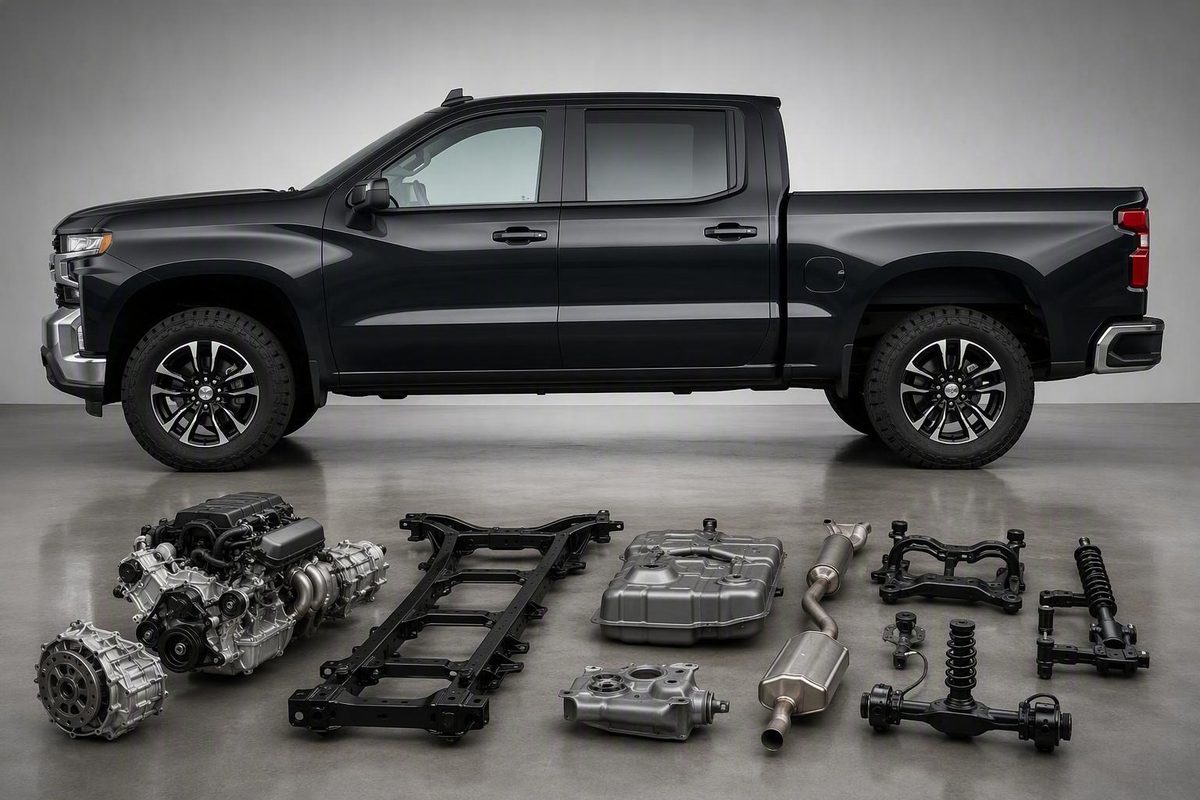
For 2021, the dealership table places its listed trucks between 4,520 and 5,150 pounds of base curb weight, depending on build.
The short answer: Silverado 1500 weight varies by year and build
There is no single answer to “How much does a Silverado 1500 weigh?” Model year, cab, bed, engine, drivetrain, trim, factory packages, options, and installed equipment can all change the result.
Curb weight is not the same as gross vehicle weight rating (GVWR), payload, towing capacity, axle ratings, or the truck’s current weight on a scale.
For the selected model years covered here:
- 2021: A dealership configuration table lists 4,520–5,150 pounds of base curb weight for the trucks it includes. This is not necessarily the full range for every possible 2021 build. See the dealer’s 2021 Silverado weight table.
- 2023: Dealer sources report 4,400–5,620 pounds. The upper endpoint is supported by a detailed ZR2 example, but the supplied evidence does not identify a complete configuration that verifies the commonly repeated 4,400-pound lower endpoint. Review the dealer-reported 2023 starting weights.
- 2025: One dealership estimates 4,500–5,800 pounds, but its page contains conflicting configuration counts and unclear descriptions. Treat the figure as a rough dealer estimate, not an official Chevrolet specification. Read the dealership’s 2025 estimate.
These figures come from dealership articles rather than Chevrolet or General Motors specification guides. They should remain separated by model year and should not be blended into one universal Silverado 1500 range.
To find a figure that applies to a particular truck, identify its:
- Model year
- Regular, Double, or Crew Cab
- Bed length
- Engine
- 2WD/RWD or 4WD drivetrain
- Trim
- Factory packages and options
- Permanently installed accessories or modifications
If the decision depends on what the truck weighs today, a published curb-weight figure may not be enough. Its present weight can also reflect fuel, equipment, modifications, occupants, and cargo.
Silverado 1500 curb weight by model year
The available evidence covers selected model years rather than every Silverado 1500 year. Each row also comes with different limitations.
| Model year | Reported curb-weight range | Source type | Important limitation |
|---|---|---|---|
| 2021 | 4,520–5,150 lb | Rusty Wallace Chevrolet configuration table | Covers the configurations listed by the dealership, not necessarily every possible 2021 build |
| 2023 | 4,400–5,620 lb | Dealer-reported range and starting trim figures | The 5,620-pound endpoint has a detailed ZR2 example; the 4,400-pound endpoint lacks a fully described configuration |
| 2025 | 4,500–5,800 lb | DELLA Chevrolet estimate | The page is internally inconsistent and is not an official Chevrolet specification sheet |
For 2021, the dealership table places its listed trucks between 4,520 and 5,150 pounds of base curb weight. It separately reports 6,800–7,300-pound GVWR values, demonstrating why curb weight and GVWR cannot be treated as the same measurement.
For 2023, dealer pages report a broad 4,400–5,620-pound span. One supplies starting weights by trim, while another provides several configuration-specific examples. The detailed evidence supports a 5,620-pound ZR2 Crew Cab at the upper end, but no supplied configuration identifies the cab, bed, engine, and drivetrain associated with the 4,400-pound lower figure. See the configuration-specific 2023 examples.
The 2025 estimate deserves the most caution. Although the dealership says weight varies by cab, drivetrain, trim, and configuration, the same page gives conflicting totals for the number of available setups and uses unclear measurements in its bed discussion. Its 4,500–5,800-pound range is therefore best understood as an estimate from that dealer page rather than a verified factory range.
Combining the three rows into a single 4,400–5,800-pound specification would be misleading because:
- Each row refers to a different model year.
- The sources provide different levels of configuration detail.
- None is an official Chevrolet specification matrix covering every build.
- The broadest 2025 estimate comes from the least consistent source.
If your truck is a 2020, 2022, 2024, or another year not covered here, do not borrow a nearby year’s number. Look for documentation corresponding to the truck’s own model year and configuration.
What the 2021 configuration examples show
The 2021 dealership table is useful because it identifies multiple cab, bed, drivetrain, and package combinations instead of publishing only one broad range.
Its lightest listed truck is a Regular Cab, 2WD, long-box Silverado 1500 at 4,520 pounds of base curb weight. The comparable listed Regular Cab, 4WD, long-box truck weighs 4,730 pounds.
The same table reports:
- Double Cab configurations: 4,720–5,100 pounds
- Crew Cab configurations: 4,720–5,150 pounds
- Heaviest listed configuration: Crew Cab Trail Boss with a standard box at 5,150 pounds
These are dealer-published 2021 figures, not manufacturer documentation or a complete matrix of every factory build. The dealership’s configuration table attributes the differences to variables including cab, drivetrain, engine, bed, Trail Boss equipment, and another listed package.
| Listed 2021 example | Base curb weight |
|---|---|
| Regular Cab, 2WD, long box | 4,520 lb |
| Regular Cab, 4WD, long box | 4,730 lb |
| Double Cab configurations | 4,720–5,100 lb |
| Crew Cab configurations | 4,720–5,150 lb |
| Crew Cab Trail Boss, standard box | 5,150 lb |
The two Regular Cab long-box examples differ by 210 pounds. Because their descriptions are closely matched, the comparison illustrates how drivetrain can affect weight. It does not prove that 4WD always adds exactly 210 pounds.
The lightest and heaviest listed trucks differ by 630 pounds, but several characteristics change at once: cab, drivetrain, bed combination, and equipment. That total difference cannot be assigned exclusively to the Crew Cab, Trail Boss package, or any other single feature.
The Double Cab and Crew Cab ranges also overlap. That matters because cab style does not create one fixed weight. The responsible approach is to match all available build details rather than choosing a figure based only on the cab badge.
These 2021 examples should remain separate from 2023 and 2025 figures.
What the 2023 trim and drivetrain examples show
The reported 2023 figures fall into two categories:
- Starting curb weights associated with trim names
- More detailed examples identifying the bed, engine, drivetrain, and sometimes cab
A starting trim weight does not mean every truck wearing that trim badge has the same curb weight.
One Chevrolet dealership reports these starting figures:
| 2023 trim | Dealer-reported starting curb weight |
|---|---|
| Work Truck | 4,400 lb |
| Custom | 4,720 lb |
| LT | 4,720 lb |
| RST | 4,860 lb |
| LTZ | 4,860 lb |
| High Country | 4,860 lb |
| Custom Trail Boss | 5,080 lb |
| LT Trail Boss | 5,080 lb |
| ZR2 | 5,620 lb |
These are dealer-reported starting values. Cab, bed, engine, drivetrain, factory options, and installed equipment can change the result. The source does not give a complete configuration for the 4,400-pound Work Truck, so that value should be treated as a reported starting point rather than a conclusively established minimum. See the complete dealer-published trim list.
A second dealership gives more specific 2023 examples:
- High Country, 5.8-foot bed, 5.3-liter V8, RWD: 4,860 pounds
- High Country, 5.8-foot bed, 5.3-liter V8, 4WD: 5,000 pounds
- LT, 5.8-foot bed, 2.7-liter turbo, RWD: 4,740 pounds
- ZR2 Crew Cab, 5.8-foot bed, 6.2-liter V8, 4WD: 5,620 pounds
The two High Country examples show a 140-pound RWD-to-4WD difference in that particular comparison. The detailed ZR2 example also supports the reported 5,620-pound upper endpoint. Review the dealership’s detailed 2023 configuration examples.
The lower endpoint is less certain. Two dealer pages repeat 4,400 pounds as either a starting weight or range boundary, but repetition does not replace a complete configuration description. The supplied evidence does not connect that number to a specific cab, bed, engine, and drivetrain.
The examples also show why trim rankings are not enough. The LT is listed at a 4,720-pound starting weight on one page, while a more detailed LT turbo RWD example is listed at 4,740 pounds on another. Configuration, source methodology, or rounding may explain the difference, but the evidence does not establish which factor is responsible.
For comparisons, preserve the complete description. “2023 High Country” leaves important variables unanswered. “2023 High Country, 5.8-foot bed, 5.3-liter V8, RWD” is much more useful.
Why two Silverado 1500 trucks can weigh differently
A Silverado 1500’s weight reflects its structure and equipment. The variables supported by the available examples include:
- Model year: Construction, standard equipment, available engines, trims, and packages can change.
- Cab style: Regular, Double, and Crew Cabs use different body configurations.
- Bed length: Cab-and-bed pairings change the truck’s body and frame configuration.
- Engine: Different powertrains use different components and supporting equipment.
- Drivetrain: A 4WD system adds hardware not used by a 2WD/RWD configuration.
- Trim: Trims may include different interior, suspension, exterior, and convenience equipment.
- Factory packages and options: Off-road, trailering, technology, seating, and other packages alter the build.
- Installed equipment: Permanent accessories and modifications change the truck’s present weight.
Across the cited examples, Regular Cab and 2WD trucks generally appear toward the lighter end. Crew Cab, 4WD, Trail Boss, and ZR2 trucks tend to appear toward the heavier end. That is a directional pattern, not a formula.
Four-wheel drive does not have one fixed weight penalty
The clearest supplied comparison is the 2023 High Country with a 5.8-foot bed and 5.3-liter V8. The reported RWD truck weighs 4,860 pounds, while the corresponding 4WD description weighs 5,000 pounds—a 140-pound difference in that example.
Other dealer pages give broader estimates. The inconsistent 2025 page says 4WD generally adds 200–300 pounds, while an undated guide estimates 300–400 pounds across configurations. The undated dealership guide presents its figures as approximate.
Those estimates disagree and are not based on one common, fully matched truck. Neither should be used as a universal 4WD allowance.
Compare two listings only when they share the same model year, cab, bed, engine, trim, and major packages. If several characteristics change, the total difference cannot be attributed to drivetrain alone.
Cab and bed must be considered together
Cab style and bed length are often linked rather than independently selectable. For 2019-and-newer Silverado 1500 models, the site’s Silverado bed-size chart lists these pairings:
- Crew Cab with a short or standard bed
- Double Cab with a standard bed
- Regular Cab with a long bed
That chart can help identify the body configuration, but it does not provide vehicle weights. After identifying the cab and bed, you still need model-year-specific information covering the powertrain, drivetrain, trim, and equipment.
Trim and packages complicate comparisons
Trail Boss and ZR2 examples appear near the heavier end of the cited data, but the available evidence does not establish a fixed weight addition for either nameplate.
A trim badge therefore identifies only part of the build.
Starting weights require the same caution. They are reference points for a particular base arrangement within a trim, not a promise that every truck in that trim weighs the listed amount.
Current equipment changes actual weight
Tools and supplies that remain aboard will also be included when the truck is weighed.
Do not try to correct a published curb weight by guessing the weight of each accessory. If present weight matters, weigh the equipped truck and record what was aboard.
Curb weight, GVWR, payload, and towing capacity are not interchangeable
Choosing the correct number depends on the question being asked. Comparing trucks, selecting service equipment, arranging transport, calculating payload, and evaluating a towing setup do not necessarily require the same measurement.
| Term | What it answers | What it does not answer | Where it may appear |
|---|---|---|---|
| Base curb weight | What a standard-equipped truck weighs without loaded passengers or items | Current loaded weight or maximum allowable weight | Configuration specifications or build information |
| GVWR | The maximum rated total vehicle weight, including the truck and its load | Empty truck weight or trailer capacity | Certification label and vehicle documentation |
| Payload | How much allowable load may be carried in or on the truck under the applicable rating | Curb weight or tow rating | Vehicle-specific occupant-and-cargo information |
| GAWR | The maximum rated load for an individual axle | Total curb weight or trailer limit | Certification information |
| Towing capacity | A trailer limit for a specified configuration and operating conditions | The truck’s curb weight, payload, or GVWR | Applicable towing and configuration documentation |
| Actual scale weight | What the truck weighs in its present condition | The manufacturer’s allowable ratings | Vehicle scale |
Base curb weight
The 2021 dealership source defines base curb weight as vehicle weight with standard equipment and without loaded passengers or items. That makes it a useful comparison figure for different configurations.
Third-party sources are not consistent about fuel and operating fluids. Because the supplied evidence does not establish Chevrolet’s model-year-specific methodology, do not assume that every dealer table uses the term identically. Check the documentation attached to the figure when that distinction matters.
GVWR
GVWR is the maximum rated total weight of the vehicle and its load, not the empty weight of the truck.
The cited 2021 dealer table lists base curb weights of 4,520–5,150 pounds and separate GVWR values of 6,800–7,300 pounds for the included configurations. A truck with a 7,000-pound GVWR does not therefore have a 7,000-pound curb weight.
Use the rating that applies to the specific truck. A broad online range is not a substitute for the vehicle’s own certification information and applicable manufacturer documentation.
Payload
Payload is an allowable-load concept rather than the truck’s own weight. Occupants, cargo, and carried or installed equipment contribute to the load placed on the vehicle.
Do not use another configuration’s advertised payload as a vehicle-specific limit. The supplied evidence also does not justify treating a generic GVWR minus a generic curb-weight estimate as an official payload calculation for a particular truck.
GAWR
Gross axle weight rating, or GAWR, is the rated limit for an individual axle. It is distinct from both GVWR and curb weight.
Total vehicle weight alone does not describe how weight is distributed between the front and rear axles. For any practical load assessment, use the ratings and instructions applicable to the specific truck rather than generalized figures from an online article.
Towing capacity
Towing capacity describes a trailer limit under specified conditions. It is not another expression of curb weight, payload, or GVWR.
Those determinations require the documentation and limits for the particular truck and equipment.
Actual scale weight
Actual scale weight is what the truck weighs under the conditions present when it is measured. It may reflect:
- Fuel level
- Driver and passengers
- Cargo
- Tools
- Bed equipment
- Accessories
- Modifications
- Trailer-related load in the measured condition
A scale reading and a published curb-weight figure answer different questions. A scale shows present weight; vehicle documentation supplies the applicable ratings and published specifications.
How to find the weight of your exact Silverado 1500
Document the truck before searching for a number:
- Model year
- Regular, Double, or Crew Cab
- Short, standard, or long bed
- Engine
- 2WD/RWD or 4WD
- Trim
- Factory packages and options
- Permanent accessories and modifications
A result that omits several of these details is a starting point or estimate, not a vehicle-specific answer.
For a published specification, look for model-year Chevrolet documentation, original build records, or verified vehicle-specific information available through Chevrolet or a dealer. The supplied evidence does not establish one definitive online VIN lookup that always returns exact curb weight, and an owner’s manual may explain ratings without listing a configuration-specific curb weight.
The driver-door area can still provide important information, but read each label according to its stated purpose. An owner-forum discussion describes the certification label as displaying GVWR and front and rear GAWR, while the yellow label displays maximum combined occupant-and-cargo weight. Because that evidence is user-generated rather than authoritative manufacturer guidance, verify the labels on the truck and consult the applicable vehicle documentation. See the forum discussion and its vehicle-specific cautions.
Do not assume that a door label displays exact curb weight. Depending on the label, it may provide ratings and load limits instead.
Use this framework:
- Need a published comparison figure? Find a model-year- and configuration-specific specification or build record.
- Need GVWR or axle ratings? Read the truck’s certification information and applicable documentation.
- Need the occupant-and-cargo limit? Check the vehicle-specific label intended for that purpose.
- Need the truck’s present weight? Obtain a scale reading under the loading condition relevant to the decision.
- Need to evaluate towing or hauling? Use the specific truck’s documentation and all applicable component ratings; do not rely on curb weight alone.
When recording an online figure, preserve its complete description:
2023 Silverado 1500 High Country, 5.8-foot bed, 5.3-liter V8, 4WD — dealer-reported curb weight: 5,000 pounds.
That is safer and more useful than writing only “High Country: 5,000 pounds.”
How to weigh the truck for hauling, towing, transport, or service
This may include transport, service equipment, lift selection, hauling preparation, or checking the effect of installed accessories.
A scale does not convert its reading into official curb weight. It reports the truck’s weight in the condition presented.
1. Minimally loaded measurement
For a consistent baseline:
- Remove passengers.
- Remove removable cargo and personal items.
- Record the fuel level.
- Note permanent accessories and modifications that remain installed.
- Keep the scale ticket with the date and truck description.
Describe this as a minimally loaded scale weight, not official curb weight. The conditions may not match the methodology used for a published factory figure.
2. Normal daily-use measurement
For a real-world daily figure, leave aboard the equipment that normally remains with the truck. That might include a bed cover, toolbox, steps, racks, emergency equipment, tools, or work supplies.
Record what was present. Otherwise, the scale ticket may be difficult to interpret after equipment is added or removed.
This condition may be more relevant than a stripped measurement when evaluating equipment or services that will encounter the truck as normally used.
3. Trip-ready measurement
For a trip-ready measurement, present the truck in the intended operating condition, including:
- Intended occupants
- Planned fuel level
- Cab and bed cargo
- Tools and travel equipment
- Permanently installed accessories
- Trailer-related equipment, if relevant to the measurement
A scale may provide total vehicle weight and separate axle weights. It does not establish the allowable limits. Compare the readings only with the ratings and instructions that apply to the particular truck, tires, hitch, trailer, and operating setup.
Why a scale reading may not match an online table
In one owner-forum anecdote, a participant reported that a mostly stock 2012 Silverado 1500 Crew Cab with a 5.3-liter engine and 4WD weighed about 5,600 pounds, including approximately 3,300 pounds on the front axle and 2,300 pounds on the rear. The participant acknowledged that unspecified items remained in the cab. This is an unverified report about one older truck, not a general Silverado specification. Read the original scale account and its limitations.
The anecdote illustrates why “empty” in ordinary conversation may not match a published curb-weight definition. Fuel, tools, cab contents, accessories, and measurement conditions can all affect a scale reading.
Record enough information to reuse the result
A useful scale record includes:
- Date
- Model year and configuration
- Fuel level
- Occupants
- Cargo
- Installed equipment
- Whether a trailer was connected
- Total weight
- Front and rear axle readings, if supplied
If you obtain multiple measurements, label each one clearly as minimally loaded, daily-use, or trip-ready.
Never infer payload, towing capacity, axle capacity, tire capacity, or hitch capacity from curb weight alone. Those are separate ratings that must come from documentation applicable to the specific vehicle and equipment.
Frequently asked questions
How much does a 2023 Silverado 1500 weigh?
Dealer sources report 4,400–5,620 pounds for the 2023 Silverado 1500, but the lower figure is not tied to a fully described configuration in the supplied evidence.
The upper endpoint is supported by a dealer-reported 5,620-pound ZR2 Crew Cab with a 5.8-foot bed, 6.2-liter V8, and 4WD. Other reported examples include a 4,740-pound LT turbo RWD truck and High Country examples at 4,860 pounds with RWD and 5,000 pounds with 4WD.
Use the figure matching the full cab, bed, engine, drivetrain, trim, and equipment description rather than treating the broad range as a specification for every 2023 truck.
How much does a 2021 Silverado 1500 weigh?
The cited dealership table lists 4,520–5,150 pounds of base curb weight for the 2021 configurations it covers.
Its lightest example is a Regular Cab 2WD long-box truck at 4,520 pounds. Its heaviest is a Crew Cab Trail Boss standard-box truck at 5,150 pounds. Those endpoints describe the dealer’s table, not necessarily every 2021 Silverado 1500 build.
Does four-wheel drive make a Silverado 1500 heavier?
The available comparisons generally show 4WD trucks weighing more, but they do not establish one universal increase.
In the closely described 2023 High Country examples, the RWD truck is reported at 4,860 pounds and the 4WD truck at 5,000 pounds—a 140-pound difference for that build. Other dealer estimates are higher, which is why adding a generic “4WD penalty” to an unrelated curb-weight figure is unreliable.
Is a Silverado 1500’s curb weight shown on the driver-door label?
Not necessarily. The door area may contain certification and occupant-and-cargo information, but the supplied evidence does not establish that every Silverado label displays exact curb weight.
Read the labels on the specific truck and use the applicable Chevrolet documentation to interpret them. For present weight, obtain a scale reading under the relevant loading condition.
What is the difference between Silverado curb weight and GVWR?
Curb weight describes the truck itself under the definition used by the applicable specification. GVWR is the maximum rated total weight of the truck and its load.
The cited 2021 dealer table, for example, separates its 4,520–5,150-pound base curb weights from 6,800–7,300-pound GVWR values. A 7,000-pound GVWR is a maximum loaded-vehicle rating, not a statement that the empty truck weighs 7,000 pounds.
The correct Silverado 1500 weight is therefore configuration-specific. Use dealer figures only as qualified comparison data, identify the full build before relying on a published number, and obtain an actual scale reading whenever a practical decision depends on the truck’s present weight.