
Is the Tahoe or the Suburban the Better Fit for Your Family?
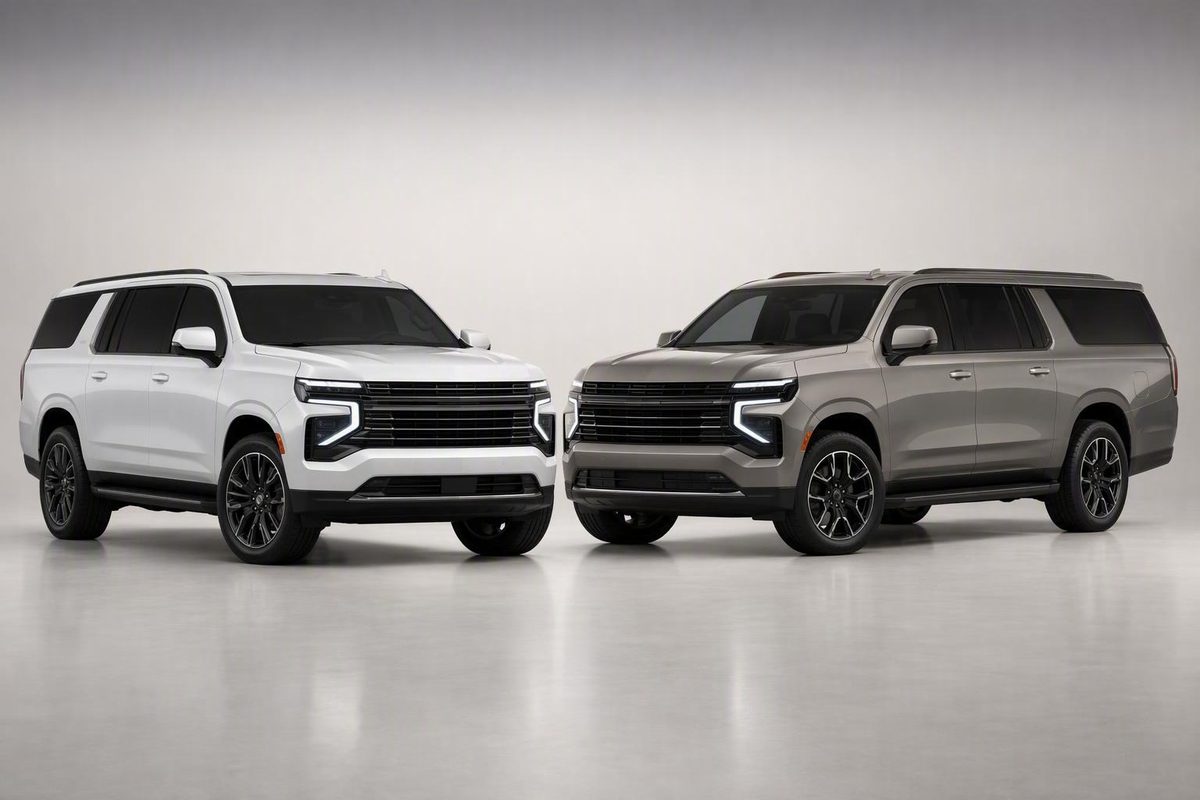
With all three rows in use, the Suburban adds roughly 16 cu. ft. of cargo room. The Tahoe's shorter body may matter more in a tight garage or daily parking.
The 2026 Chevrolet Tahoe is the better fit when a shorter footprint, easier garage accommodation, and a lower selected-trim price matter most. The 2026 Chevrolet Suburban is the stronger choice when the third row is regularly occupied and luggage, strollers, sports equipment, or work gear still needs to fit behind it. In Car and Driver’s selected 2WD LS comparison, the Tahoe is 15 inches shorter and costs $3,000 less. See Car and Driver’s selected 2026 comparison.
These SUVs share their listed core engine choices, 10-speed automatic transmission, and much of their available equipment. The meaningful Chevrolet Tahoe vs. Chevrolet Suburban decision therefore comes down mainly to usable space versus exterior size.
This guide uses selected published comparisons rather than Chevrolet ordering guides, owner manuals, EPA records, or an instrumented side-by-side test. Some supporting sources are dealership comparisons, and several specifications—most notably the Suburban’s maximum towing figure—conflict. Treat the figures below as comparison data to help narrow your choice, then verify dimensions, prices, seating, equipment, payload, and trailering limits for the exact vehicle before buying.
2026 Tahoe vs. Suburban at a Glance
The Tahoe preserves three-row utility in a shorter body. The Suburban uses its added length to provide more cargo space in every seating configuration and modestly more listed third-row legroom.
The table primarily reflects Car and Driver’s selected 2026 2WD LS listings. Cargo volume behind the third row is shown as a range because the supplied sources round it differently. Fuel economy applies only to the selected trims, while acceleration figures discussed later come from separately tested 6.2-liter vehicles. Specifications can vary by trim, drivetrain, seating arrangement, and equipment.
| Specification | 2026 Chevrolet Tahoe | 2026 Chevrolet Suburban |
|---|---|---|
| Overall length | 211.3 in. | 226.3 in. |
| Wheelbase | 120.9 in. | 134.1 in. |
| Cargo behind third row | Approx. 25.5–26 cu. ft. | Approx. 41.5–42 cu. ft. |
| Cargo behind second row | 72.5 cu. ft. | 93.8 cu. ft. |
| Maximum cargo behind first row | 122.7 cu. ft. | 144.5 cu. ft. |
| Third-row legroom | 34.9 in. | 36.7 in. |
| Selected 2026 2WD LS price | $63,495 | $66,495 |
| Selected 2WD LS fuel economy | 15 city/20 highway/17 combined mpg | 15 city/20 highway/17 combined mpg |
| Fuel-tank capacity | 24 gal. | 28 gal. |
| Engine choices listed | 355-hp 5.3L V8; 420-hp 6.2L V8; 305-hp 3.0L diesel inline-six | 355-hp 5.3L V8; 420-hp 6.2L V8; 305-hp 3.0L diesel inline-six |
| Transmission | 10-speed automatic | 10-speed automatic |
| Third-party published maximum towing | Up to 8,400 lb when properly equipped | Reported as 8,200–approximately 8,300 lb when properly equipped |
Car and Driver supports the selected-trim dimensions, staged cargo volumes, third-row legroom, prices, fuel economy, fuel capacities, engines, and transmission shown above. Its comparison is internally inconsistent about the Suburban’s towing maximum, citing 8,200 pounds in its table and 8,300 pounds in its summary. Those towing numbers remain unverified without current configuration-specific Chevrolet documentation. Review the comparison data and its configuration context.
The quick decision is straightforward:
- Choose the Tahoe if garage depth, parking-space length, or the lower selected-trim price matters more than maximum cargo capacity.
- Choose the Suburban if people routinely occupy all three rows while their belongings must remain behind them.
- Do not choose solely from the headline tow rating. The reported difference is small, the Suburban number conflicts across sources, and the exact vehicle’s payload and trailering configuration matter more than a nameplate-level maximum.
The 15-Inch Question: Exterior Size, Garage Fit, and Parking
A 2026 dealer comparison reports an overall length of 211.3 inches for the Tahoe and 226.3 inches for the Suburban, matching the selected independent comparison. That makes the Suburban 15 inches longer. The selected comparison also lists wheelbases of 120.9 and 134.1 inches, respectively. Review the reported 2026 dimensions.
Those measurements make the Tahoe potentially easier to accommodate, but overall length does not prove that either SUV will fit a particular garage or feel manageable in a particular parking lot. The supplied evidence does not include comparable turning-circle measurements or controlled maneuverability testing, so it cannot establish that the Tahoe objectively handles better.
Measure the usable garage, not just the floor
A garage’s advertised depth is not necessarily its usable vehicle space. Shelving, steps, a water heater, wall-mounted equipment, bumpers, and the inside face of the closed door can all reduce clearance.
Before buying either SUV:
- Close the garage door and measure from its nearest interior surface to the closest fixed obstruction.
- Subtract the space needed to walk in front of and behind the vehicle.
- Check whether the liftgate can open without contacting the door, ceiling, opener, shelving, or another vehicle.
- Measure the available width with every household vehicle parked as it would be in daily use.
- Allow room to open passenger doors, especially where an adult must help a child into a restraint.
- Include accessories that change the effective dimensions, such as a hitch-mounted step or cargo carrier.
The difference may seem modest on a specification sheet, but garage fit can be decided by the final few inches. A vehicle can technically fit between a wall and closed door yet remain inconvenient if nobody can walk around it or open the liftgate.
Parking consequences extend beyond fitting between the lines
The Suburban’s added length may matter when:
- A parking space is short enough to create front or rear overhang.
- A tight driveway requires repeated directional changes.
- A parking structure has narrow ramps, pillars, or close walls.
- Parallel parking is part of the regular routine.
- A garage or driveway must accommodate another vehicle.
- The rear hatch needs to open near a wall or parked car.
- Passengers need room around wide doors in a crowded lot.
The Tahoe may reduce some of those conflicts simply because it occupies less space front to rear. That does not make it a small vehicle; it remains a full-size, three-row SUV.
The best evaluation is a real-space test. With permission, take the exact configuration home and park it in the garage. Close the door, open the liftgate, walk around the vehicle, load passengers, and repeat the normal driveway approach. If a home test is unavailable, mark the published dimensions on the floor and account for mirrors, accessories, door movement, and liftgate clearance.
Cargo Space With Every Row Up or Folded
Maximum cargo volume makes an impressive headline, but space behind an occupied third row is usually the more revealing family measurement. If every seat is needed, the maximum seats-folded figure is unavailable in practice.
Published comparisons place the Tahoe at approximately 25.5 to 26 cubic feet behind the third row and the Suburban at approximately 41.5 to 42 cubic feet. The longer SUV therefore adds roughly 16 cubic feet in the configuration that matters most when passengers occupy all three rows. Compare the reported staged cargo capacities.
That difference can provide more flexibility for suitcases, a stroller, groceries, sports bags, coolers, tools, or work equipment. Cubic-foot volume cannot establish an exact item count, however. Usability also depends on floor length and width, wheel-well intrusion, hatch angle, interior trim, and the dimensions of the objects being loaded.
Cargo volume by seating position
| Seating and cargo configuration | Tahoe | Suburban | Reported Suburban advantage |
|---|---|---|---|
| All three rows in use | Approx. 25.5–26 cu. ft. | Approx. 41.5–42 cu. ft. | Roughly 16 cu. ft. |
| Third row folded | 72.5 cu. ft. | 93.8 cu. ft. | 21.3 cu. ft. |
| Second and third rows folded | 122.7 cu. ft. | 144.5 cu. ft. | 21.8 cu. ft. |
The strongest supplied independent comparison lists 72.5 versus 93.8 cubic feet behind the second row and 122.7 versus 144.5 cubic feet behind the first row. Some dealer comparisons instead report 72.6 cubic feet for the Tahoe behind the second row or 144.7 cubic feet as the Suburban maximum. Those small differences appear to result from source or rounding variation and should be confirmed against current documentation for the vehicle being considered.
When the Tahoe may provide enough room
The Tahoe can be the more sensible compromise when:
- The third row is used only occasionally.
- One or both rear rows are normally folded for bulky cargo.
- Most trips involve fewer passengers.
- Garage and parking constraints are more pressing than cargo volume.
- Infrequent high-volume trips can be managed without exceeding any roof, hitch, payload, or towing limit.
Buyers who seldom combine a full passenger load with bulky luggage may never benefit from the Suburban’s additional capacity. The key question is not whether the Tahoe has less space, but whether it has enough space for the household’s recurring load.
When the Suburban’s advantage becomes decisive
The Suburban makes its clearest case when the third row cannot be folded. A full-family road trip, airport run, sports tournament, camping weekend, or work assignment may require passenger seating and cargo room simultaneously.
The additional volume can also create more packing options. It may reduce the need to stack belongings high or place them in the passenger area, although all cargo still needs to be positioned and secured appropriately.
Do not inspect these SUVs with an empty cargo area alone. Bring the stroller, largest suitcase, sports bag, mobility equipment, pet crate, or work case that most often creates a problem. Put every required seat in its occupied position and test the actual load.
Passenger Space, Seating Layouts, and Family Use
Both models are three-row SUVs, but passenger capacity is not universal across trims and seating layouts. Bench seats, captain’s chairs, and any available front-row configuration can change the number of seating positions.
Car and Driver’s selected 2026 2WD LS comparison lists eight seats in both SUVs. Dealership sources describe other configurations with higher capacities, but the supplied evidence does not include a Chevrolet ordering guide that resolves exactly which 2026 versions provide each layout. The seating-capacity label, seat belts, and documentation for the exact vehicle should control.
Third-row room
Published measurements list 34.9 inches of third-row legroom in the Tahoe and 36.7 inches in the Suburban, giving the longer SUV a reported 1.8-inch advantage. A separate 2026 dealer comparison rounds the Tahoe measurement to approximately 35 inches while also listing 36.7 inches for the Suburban. See the reported passenger-space comparison.
That supports the limited conclusion that the Suburban has somewhat more measured third-row legroom. It does not establish universal adult comfort. Seat-bottom height, cushion shape, foot room, headroom, backrest angle, door opening, floor height, and the positions of the seats ahead can all affect comfort.
Bench seats, captain’s chairs, and access
A second-row bench can maximize nominal seating capacity, while captain’s chairs can create a more open route to the third row. Neither arrangement is automatically better for every family.
Ask:
- Must multiple child restraints fit across one row?
- Does a caregiver need to sit beside a child?
- Can someone reach the third row without removing an installed restraint?
- Will adults, children, or both use the rearmost seats?
- Does every intended passenger have a suitable seat belt and head restraint?
- Does the chosen seating layout preserve enough cargo room?
A family-focused review describes lower LATCH anchors and top tethers at all Tahoe second-row positions, top tethers at the third-row positions, and no third-row lower anchors in the vehicles discussed. It also reports fold-and-flip third-row access and an absent third-row center head restraint. Those are attributed observations—not verified specifications for every 2026 Tahoe or Suburban—because the review discusses multiple model years and configurations. Read the family-use and child-seat observations.
Follow the vehicle and restraint manufacturers’ instructions, and test the intended access route with the family’s own restraints. If reaching the third row requires disturbing an installed seat, that arrangement may prove impractical in daily use.
Conduct a family-use audit before buying
Bring every person and restraint that regularly travels in the vehicle. Then check:
- Whether each restraint installs correctly in its intended position.
- Whether the required lower anchors and top tethers are present.
- Whether the third row remains accessible with the restraints installed.
- Whether every occupied position has a suitable belt and head restraint.
- Whether airflow reaches rear passengers.
- Whether passengers can enter and exit without awkward climbing.
- Whether required luggage still fits with every occupied seat in position.
- Whether the selected bench or captain’s-chair layout matches the household’s actual needs.
For safety-related details, inspect the exact vehicle and consult its current owner documentation. Historical or dealer observations should not replace model-year-specific instructions.
Engines, Acceleration, and Fuel Economy
The supplied 2026 comparisons list the same core engine menu for both SUVs: a 355-horsepower 5.3-liter V8, a 420-horsepower 6.2-liter V8, and a 305-horsepower 3.0-liter diesel inline-six, each paired with a 10-speed automatic transmission. Availability can still differ by trim and configuration.
Because the listed engine families overlap, body size, cargo demand, seating layout, drivetrain, and required trailering equipment may be more decisive than headline horsepower for many buyers.
Acceleration depends on the tested configuration
Car and Driver reports a 5.8-second zero-to-60-mph result for a Tahoe equipped with the 6.2-liter V8 and 6.0 seconds for a Suburban with that engine. These are results for specific tested vehicles, not universal claims about every 2026 Tahoe and Suburban.
A two-tenths-of-a-second difference between two test vehicles does not prove that every Tahoe will be quicker than every Suburban.
Compare like with like on fuel economy
For the selected 2026 2WD LS trims, the published comparison lists the same economy figures for both SUVs: 15 mpg city, 20 mpg highway, and 17 mpg combined. It also lists a 24-gallon tank for the Tahoe and a 28-gallon tank for the Suburban.
Those figures do not establish equal fuel economy across every engine, drivetrain, wheel-and-tire package, and trim. A diesel Tahoe should not be compared with a gasoline Suburban, and a rear-wheel-drive model should not be casually compared with a four-wheel-drive version. Mixing model years can introduce further errors.
A larger fuel tank may reduce the frequency of stops under similar operating conditions, but it does not prove a particular range.
Before buying, compare the fuel-economy information and equipment shown for the exact vehicles under consideration. The model names alone are not specific enough.
Towing and Payload: Why the Headline Rating Is Not the Whole Answer
Third-party published maximums consistently place the Tahoe at up to 8,400 pounds when properly equipped. The Suburban figure remains unresolved in the supplied evidence: different comparisons report 8,200 or approximately 8,300 pounds, and the strongest independent comparison contains both numbers.
Olson Chevrolet reports 8,400 pounds for the Tahoe and 8,200 pounds for the Suburban while warning that configuration and vehicle loading affect capability. Other dealer comparisons use approximately 8,300 pounds for the Suburban. These are not substitutes for a current Chevrolet trailering guide tied to the exact vehicle. See the towing figures and configuration qualifications.
The reported 100- to 200-pound difference should not drive the purchase. It is far smaller than the SUVs’ differences in exterior length and occupied-third-row cargo space, and no published maximum automatically applies to every vehicle on a dealer lot.
Maximum towing is configuration-specific
The applicable limit can depend on:
- Engine
- Two- or four-wheel drive
- Axle and related mechanical configuration
- Trailering package
- Installed options
- Vehicle payload rating
- Hitch and towing hardware
- Trailer type and setup
- Passenger and cargo load
Two visually similar SUVs can have different payload labels and trailering limits. A model advertised with a particular maximum does not necessarily provide that capacity in every configuration.
Payload can become the binding constraint
The correct calculation must use actual loads and the exact vehicle’s ratings. Do not assume an SUV can tow its published maximum while also carrying a full passenger and cargo load.
Before towing:
- Find the payload information on the exact vehicle’s door-jamb label.
- Confirm its configuration-specific trailer limit in current documentation.
- Account for every occupant, all cargo, installed accessories, and hitch equipment.
- Use the trailer’s loaded weight rather than only its empty or dry weight.
- Determine loaded tongue weight.
- Verify hitch, tire, axle, and combined-weight limits where applicable.
- Remain within every relevant manufacturer rating.
If towing is central to the purchase, ask the seller to identify the engine, drivetrain, axle configuration, trailering equipment, payload label, and applicable trailer limit for the actual inventory unit. A general statement that a Tahoe can tow up to 8,400 pounds is not enough.
Price, Shared Features, and What the Extra Money Buys
In Car and Driver’s matched selected 2026 2WD LS listings, the Tahoe costs $63,495 and the Suburban costs $66,495. The $3,000 difference applies to that comparison; it is not a guarantee that every matched pair will have the same gap.
Within the cited comparison, the Suburban premium primarily corresponds to:
- Additional overall length and wheelbase
- More cargo volume behind every seating row
- Modestly greater listed third-row legroom
- A larger listed fuel tank
It does not provide access to a fundamentally separate engine family. Both vehicles are listed with the same three core engine choices and 10-speed automatic transmission.
Shared cabin technology
The selected comparison lists both models with:
- An 11.0-inch digital driver display
- A 17.7-inch infotainment touchscreen
- Apple CarPlay
- Android Auto
It also lists common driver-assistance categories including blind-spot monitoring, front and rear collision mitigation, and lane-departure warning. Those categories should not be interpreted as proof that every related feature is standard or implemented identically throughout both lineups.
Premium equipment such as Super Cruise, Bose audio, rear-seat entertainment, wireless charging, enhanced camera views, and parking aids should be treated as available or trim-dependent unless the exact vehicle’s equipment list says otherwise. A 2026 dealer comparison presents several of these systems as available on both models rather than universally standard. Review the trim-dependent technology comparison.
Is the larger SUV the better value?
The answer depends on whether the added space solves a recurring problem.
The Suburban may represent good value if the alternative is leaving luggage behind, placing belongings in the passenger area, adding an external carrier, or taking a second vehicle. The Tahoe may be the better value if its cargo area is already sufficient and the longer body would make garage storage or parking more difficult.
A proper comparison should match:
- Trim
- Engine
- Drivetrain
- Seating layout
- Trailering equipment
- Driver-assistance options
- Infotainment and audio equipment
- Wheels and tires
- Dealer-installed accessories
- Destination charges and other listed fees
The supplied evidence does not support a complete trim-by-trim ownership-cost analysis. It does not establish which model costs less to insure, maintain, repair, or resell. Compare actual vehicles and written quotes rather than assuming the selected LS price difference remains unchanged across every trim.
Which Should You Buy? A Scenario-Based Decision Guide
Neither SUV is universally better. The right choice depends on which limitation would be more disruptive: the Tahoe’s smaller cargo area or the Suburban’s longer footprint and higher selected-trim price.
Choose the Tahoe if:
- Garage depth is limited.
- Crowded parking is part of the daily routine.
- You prefer the lower price in the matched selected-trim comparison.
- The third row is used occasionally rather than constantly.
- One rear row is normally available to fold for cargo.
- You want three-row capacity without the Suburban’s added length.
- A properly equipped Tahoe provides sufficient trailer capacity and payload for your actual load.
The Tahoe is not a compact alternative. It is simply the shorter of two full-size SUVs. Measure it rather than assuming it will fit wherever a midsize vehicle fits.
Choose the Suburban if:
- All three rows are regularly occupied.
- Luggage must fit behind those occupied seats.
- A stroller, sports equipment, groceries, tools, or bulky gear travels with the full passenger load.
- Third-row passengers benefit from the additional listed legroom.
- Maximum cargo flexibility matters more than minimizing exterior length.
- The measured garage, driveway, and parking routine can accommodate the longer body.
For road trips with a full passenger load, the Suburban’s approximately 16-cubic-foot reported advantage behind the third row is more relevant than maximum cargo volume with the seats folded. See the reported behind-third-row comparison.
If you tow
Do not choose the Tahoe merely because its third-party headline maximum is reported as slightly higher. Choose the exact configuration that provides enough trailer capacity, payload, and equipment for the loaded trailer and everything carried in the SUV.
The Suburban’s additional physical cargo room may be useful on towing trips, but cargo weight still consumes payload. More space does not increase the vehicle’s rated capacities.
If you use child seats
Do not decide from nominal seat count alone. Test the exact bench or captain’s-chair arrangement with the family’s own restraints. Confirm anchor and tether locations, third-row access, head restraints, seat-belt fit, airflow, and remaining cargo volume using the exact vehicle and its current documentation.
A configuration that technically has enough seating positions may still be impractical if reaching the third row requires disturbing an installed restraint.
Five questions that usually settle the decision
-
How often is the third row occupied? Occasional use strengthens the Tahoe’s case; routine use makes the Suburban’s cargo advantage more valuable.
-
How much cargo remains when the third row is occupied? Test the actual gear rather than relying only on maximum volume.
-
What is the measured usable garage depth? Include the closed door, liftgate clearance, walking room, and accessories.
-
What trailer and loaded tongue weight must be accommodated? Compare those loads with the exact vehicle’s towing and payload limits.
-
Does the added space justify the selected-comparison price difference? If it solves a weekly packing problem, the Suburban may earn its premium. If it solves only a hypothetical problem, the Tahoe may be the better fit.
For the final evaluation, drive both SUVs over the same route. Use representative parking spaces and, if possible, the driveway and garage that matter in daily life. Load regular passengers, install the family’s child restraints, place typical gear behind the third row, open the liftgate, and compare the exact window stickers, equipment lists, payload labels, and trailering documentation.
The Tahoe is the stronger choice when the shorter footprint and lower matched-trim price solve real constraints. The Suburban earns its larger body when passengers and cargo must travel together. Your measurements, loads, and exact configuration—not the model names alone—should determine the winner.
Frequently Asked Questions
What is the main difference between a Chevrolet Tahoe and a Chevrolet Suburban?
The principal difference is size and the cargo capacity created by that added length. The Suburban is longer and provides substantially more cargo room, especially behind an occupied third row. The Tahoe costs less in the selected 2WD LS comparison and may be easier to accommodate in garages and shorter parking spaces.
How much more cargo space does the Suburban have behind the third row?
The supplied comparisons indicate an advantage of roughly 16 cubic feet. Sources report approximately 25.5 to 26 cubic feet behind the Tahoe’s third row and approximately 41.5 to 42 cubic feet behind the Suburban’s. The decimals vary by source and rounding, but the practical conclusion is consistent: the Suburban provides considerably more room while all three rows remain usable.
Which can tow more, the Tahoe or the Suburban?
Third-party published maximums slightly favor the Tahoe, which is listed at up to 8,400 pounds when properly equipped. The Suburban is variously reported at 8,200 or approximately 8,300 pounds, so its maximum remains unresolved in the supplied evidence. For either SUV, verify the exact configuration, payload label, trailering equipment, loaded trailer weight, and tongue weight before towing.
Can the Tahoe and Suburban seat nine passengers?
Some dealer sources describe higher-capacity configurations, while the selected 2026 2WD LS comparison lists eight seats in both SUVs. Another dealer guide says capacity varies with seating configuration. See the seating-layout qualification. Verify the exact trim, seat arrangement, installed seat belts, and seating-capacity label before assuming either vehicle seats nine.
Is the Suburban worth approximately $3,000 more than the Tahoe?
It can be when all three rows are frequently occupied and substantial cargo must travel behind them. In the selected comparison, the additional cost accompanies a longer body, more cargo room in every seating configuration, a larger listed fuel tank, and modestly more third-row legroom.
If the third row is used infrequently, the Tahoe’s cargo area is sufficient, or the Suburban would create garage and parking problems, the Tahoe is likely the better value. Compare matched configurations because trim, engine, drivetrain, seating, options, fees, and dealer pricing can change the actual difference.