
How Much Can Your Colorado Actually Tow?
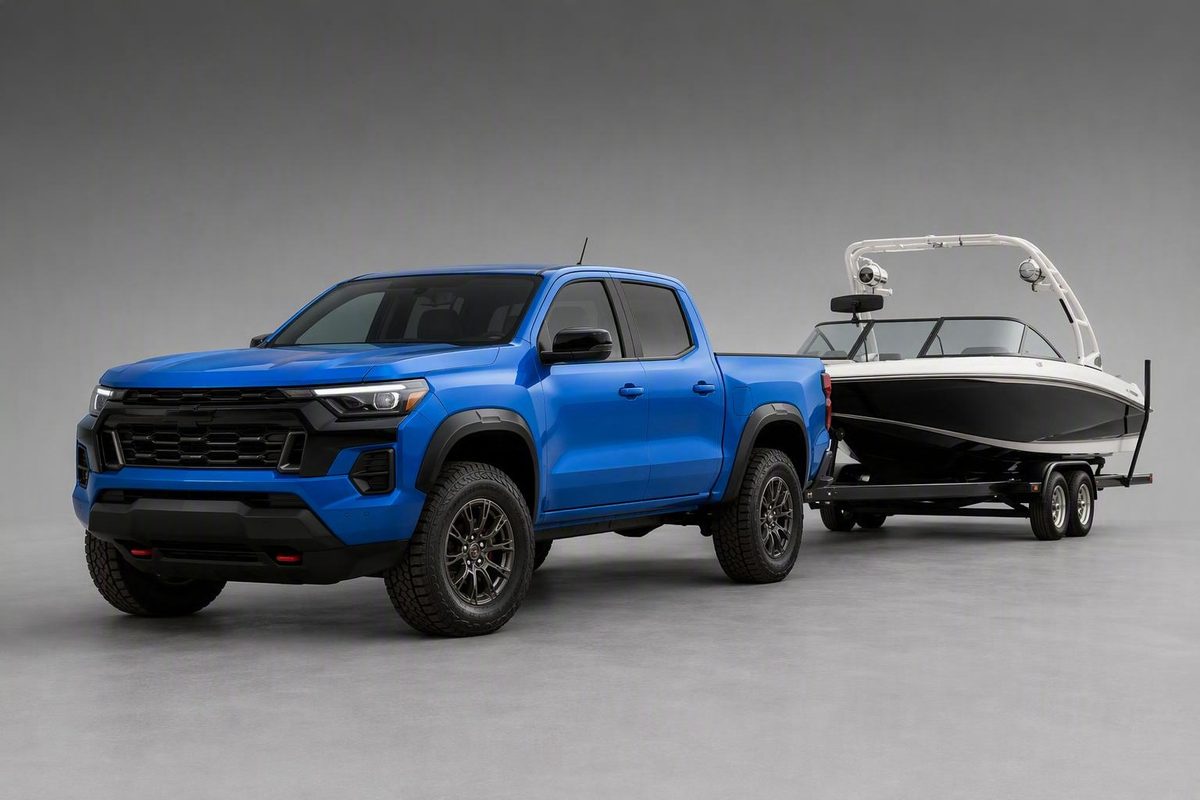
Quick answer: the headline rating is 7,700 pounds, with important limits
Dealer sources repeatedly report that a properly equipped Chevrolet Colorado can tow up to 7,700 pounds. That rating does not apply to every model year, trim, engine, drivetrain, or equipment combination.
Because the available evidence consists of dealership towing pages—not Chevrolet trailering guides or Owner’s Manuals—this article treats 7,700 pounds as a dealer-reported advertised maximum, not a verified specification for any individual truck. The first fact to establish is the Colorado’s model year; never transfer a rating from one year to another.
The exceptions are significant. Some configurations are reported at 3,500 pounds, while a detailed 2026 dealership guide lists 6,000 pounds for the ZR2 and 5,500 pounds for the ZR2 Bison. It also reports that eligible 2026 mainstream trims require the Advanced Trailering Package to increase their rating from 3,500 to 7,700 pounds. See the dealer’s detailed 2026 configuration guide.
Even a Colorado with a 7,700-pound trailer rating may reach another limit first. Payload, tongue weight, Gross Vehicle Weight Rating (GVWR), Gross Combined Weight Rating (GCWR), axle ratings, receiver limits, and the trailer’s ratings all matter. The lowest applicable limit governs the combination.
Colorado tow ratings by model year
Colorado ratings must be compared one model year at a time. Engines, trims, packages, and configuration rules can change, so the broad statement that “a Colorado can tow 7,700 pounds” is not enough to guide a purchase or towing decision.
| Model year | Dealer-reported tow rating | Qualifications and unresolved points |
|---|---|---|
| 2023 | 3,500 lb with the base 2.7L Turbo; up to 7,700 lb with the 2.7L Turbo Plus or Turbo High-Output | The cited dealer says maximum towing requires the trailering package. The supplied evidence is insufficient to establish a definitive 2023 ZR2 rating. |
| 2024 | Up to 7,700 lb | Reported with the available 2.7L TurboMax engine and Advanced Trailering Package. The evidence does not include a trim-by-trim configuration table. |
| 2025 | Up to 7,700 lb | Reported with the Advanced Trailering Package. A separate dealer reports 6,000 lb for ZR2, but its page contains internal inconsistencies, making that value provisional. |
| 2026 | Up to 7,700 lb on eligible WT, LT, Trail Boss, and Z71 configurations; 6,000 lb for ZR2; 5,500 lb for ZR2 Bison | The detailed dealer guide reports that eligible mainstream trims require the Advanced Trailering Package to reach 7,700 lb and are rated at 3,500 lb without it. |
Table sources: the dealer-reported figures for 2023, 2024, 2025, and 2026 come from dealership articles rather than primary Chevrolet documentation.
For 2023, Bennett Chevrolet lists the base 2.7L Turbo at 3,500 pounds and the Turbo Plus and High-Output engines at up to 7,700 pounds, subject to the required trailering equipment. The supplied evidence is not sufficient to resolve the 2023 ZR2 rating, so this guide does not assign that configuration a definitive number.
For 2024, Boland Chevrolet advertises up to 7,700 pounds with the available 2.7L TurboMax engine and Advanced Trailering Package. Its article does not provide enough configuration detail to conclude that every trim or drivetrain with that engine receives the same rating.
For 2025, Galleria Chevrolet advertises up to 7,700 pounds with the Advanced Trailering Package and advises consulting the Owner’s Manual because passengers, cargo, and added equipment affect the applicable limit. DELLA Chevrolet separately reports a 6,000-pound ZR2 maximum, but that page contradicts itself about engines and rating coverage. Its ZR2 value should therefore be treated as provisional.
For 2026, the available evidence is more detailed, but it remains dealer-produced. It separates a 3,500-pound standard rating for eligible mainstream trims from their package-equipped 7,700-pound maximum, while listing lower maximums for ZR2 and ZR2 Bison.
Verification note: These figures are useful for screening configurations, not certifying an individual truck. Confirm the applicable rating using the correct model-year Chevrolet trailering guide, Owner’s Manual, factory build sheet, certification labels, tire-and-loading placard, receiver label, and equipment installed on the truck.
2026 Colorado tow rating by trim and equipment
The following table summarizes the detailed dealer-reported 2026 ratings. “Up to” is essential: eligibility for a maximum does not mean every truck wearing that trim badge receives it.
| 2026 trim and drivetrain | Reported rating without Advanced Trailering Package | Dealer-reported maximum when properly equipped |
|---|---|---|
| WT 2WD | 3,500 lb | 7,700 lb with Advanced Trailering Package |
| WT 4WD | 3,500 lb | 7,700 lb with Advanced Trailering Package |
| LT 2WD | 3,500 lb | 7,700 lb with Advanced Trailering Package |
| LT 4WD | 3,500 lb | 7,700 lb with Advanced Trailering Package |
| Trail Boss 4WD | 3,500 lb | 7,700 lb with Advanced Trailering Package |
| Z71 4WD | 3,500 lb | 7,700 lb with Advanced Trailering Package |
| ZR2 4WD | Not presented as a 3,500/7,700-lb package choice | 6,000 lb |
| ZR2 Bison 4WD | Not presented as a 3,500/7,700-lb package choice | 5,500 lb |
Source: Arnie Bauer Chevrolet’s dealer-reported 2026 towing table. Confirm all values in Chevrolet documentation for the individual truck.
That guide identifies the Advanced Trailering Package as RPO ZL6 for eligible WT, LT, Trail Boss, and Z71 configurations. Cab specification, drivetrain, installed options, and other build details can still affect an individual vehicle, so use the table to narrow the search—not to establish a rating from the trim badge alone.
Reported 2026 combined-weight and tongue-weight limits
| 2026 trim family | Dealer-reported maximum GCWR | Dealer-reported maximum tongue weight |
|---|---|---|
| WT / LT / Trail Boss / Z71 with Advanced Trailering Package | 13,250 lb | 770 lb |
| ZR2 | 11,600 lb | 600 lb |
| ZR2 Bison | 11,600 lb | 550 lb |
Source: Arnie Bauer Chevrolet’s 2026 towing guide cited above. These are dealer-reported maximums, not substitutes for vehicle-specific documentation.
These figures show why trailer weight cannot stand alone. A 7,700-pound trailer that places more than the applicable maximum on the hitch would not fit the reported limits. Likewise, a loaded truck and trailer exceeding GCWR would be over the combined rating even if the trailer remained below the nominal tow rating.
Dealership material attributes the ZR2’s lower rating to its off-road suspension and trail equipment. Cumming Chevrolet offers the same explanation while listing a 6,000-pound ZR2 maximum. Treat that as a dealer explanation of a towing-versus-off-road tradeoff, not as an independently established engineering conclusion.
Do not use a generic maximum-payload headline for 2026. The supplied dealership pages conflict, reporting maximums of 1,710 pounds and 2,046 pounds. Starling Chevrolet publishes the higher conflicting claim, while the detailed Arnie Bauer table reports the lower maximum. Payload also changes with installed equipment, making the driver-door-jamb tire-and-loading placard the relevant number for the truck being evaluated.
What the Advanced Trailering Package changes
For 2026, Arnie Bauer Chevrolet associates the 7,700-pound rating on eligible WT, LT, Trail Boss, and Z71 configurations with the Advanced Trailering Package, RPO ZL6. Its guide reports these package components:
- 2-inch receiver
- Integrated trailer-brake controller
- Upgraded cooling
- Trailer-lighting wiring
- Camera wiring and trailer connections
The dealer associates this equipment package with the higher rating; the evidence does not independently establish the engineering contribution of each component. Package contents must also be checked for the truck’s model year and build.
That distinction matters when comparing years. For 2023, Bennett Chevrolet describes a trailering package with an automatic locking rear differential, a 2-inch receiver, four-pin and seven-pin connectors, and associated wiring. That list is not identical to the reported 2026 package, so one year’s package contents should not be projected onto every Colorado.
Trailering equipment falls into two broad groups:
- Equipment associated with the applicable rating or towing setup. Depending on the model year and configuration, this may include the specified receiver, wiring, brake controller, cooling provisions, differential equipment, and factory package.
- Driver-assistance and information features. Hitch Guidance, Hitch View, camera views, Tow/Haul mode, trailering apps, and monitoring functions can help with connecting or operating the combination.
The second group does not independently raise the truck’s published tow rating. A camera system, trailering app, or Tow/Haul mode does not turn a configuration reported at 3,500 pounds into one rated at 7,700 pounds.
The same caution applies to used trucks. A visible receiver proves only that a receiver is present. It does not establish that the truck left the factory with a complete trailering package, that the receiver has the necessary rating, or that the vehicle qualifies for the advertised maximum. An aftermarket receiver supplies a connection point; the evidence does not support treating it as an increase in the vehicle’s published ratings.
Before buying or towing with a used Colorado, inspect and document:
- Factory RPO list or build sheet
- Receiver and its rating label
- Four-pin and seven-pin electrical connectors, as applicable
- Integrated brake-controller installation
- Cooling equipment specified for the configuration
- Trailer-lighting and camera wiring
- Owner’s Manual instructions for conventional towing
- Tire-and-loading placard and certification labels
- Vehicle tow, payload, GVWR, GCWR, axle, hitch, and tongue-weight limits
If any item is unclear, treat the higher rating as unconfirmed until the factory equipment and vehicle-specific limits are established.
Tow rating is only one of several limits
A tow rating answers a narrow question: the maximum trailer weight published for a particular truck configuration, subject to required equipment and other ratings. It is not a model-wide promise, nor does it show how much payload remains after people and cargo are added.
The main limits work together:
-
Tow rating: Maximum approved trailer weight for the specific vehicle configuration.
-
GVWR: Gross Vehicle Weight Rating—the maximum allowed loaded weight of the truck.
- GCWR: Gross Combined Weight Rating—the maximum allowed combined weight of the loaded truck and loaded trailer.
- GAWR: Gross Axle Weight Rating—the maximum load permitted on an axle. Tongue weight adds load through the rear of the truck, making the rear-axle figure relevant.
The governing rule is straightforward: use the lowest applicable vehicle, axle, payload, hitch, tongue-weight, combined-weight, or trailer limit. Remaining below one figure does not cancel another.
Payload is often the practical constraint. Start with the individual truck’s tire-and-loading placard, not a brochure maximum. Subtract occupants, personal items, tools, bed cargo, accessories added after manufacture, hitch hardware, and expected tongue weight. The result is the remaining payload, provided no axle or GVWR limit is reached first.
This is why the conflicting 1,710- and 2,046-pound dealer payload claims should not be resolved by choosing the more convenient number. Neither replaces the door label on a specific truck. Even trucks with the same trim and drivetrain may have different available payload because installed equipment affects vehicle weight.
Four-wheel drive can affect configuration weight and therefore payload. It can also be part of a trim’s required configuration. Its presence alone, however, does not establish a higher tow rating or prove that the truck has the Advanced Trailering Package.
Calculate a practical trailer limit from payload and tongue weight
Use the trailer’s loaded weight, not only its dry, empty, or shipping weight. Water, propane, batteries, food, tools, camping equipment, boat equipment, spare parts, and dealer- or owner-installed accessories can raise the actual trailer weight.
A dealership article citing Chevrolet guidance gives a general conventional-trailer tongue-weight range of 10% to 15% of loaded trailer weight. The applicable Owner’s Manual, trailer instructions, and hitch documentation govern the actual setup; this general range does not override a different requirement. Vince’s GM Center explains the relationship between loaded trailer weight, payload, and tongue weight.
The basic estimate is:
Expected tongue weight = loaded trailer weight × expected tongue-weight percentage
Example: 5,000-pound loaded trailer
Using the dealer-reported general range, a loaded 5,000-pound conventional trailer would place approximately:
- 500 pounds on the hitch at 10%
- 625 pounds at 12.5%
- 750 pounds at 15%
That tongue weight counts against truck payload. It must also fit within the vehicle’s, receiver’s, hitch equipment’s, and trailer coupler’s applicable limits.
Example: 6,000-pound loaded trailer
At the same general range, a 6,000-pound loaded trailer would produce approximately:
- 600 pounds at 10%
- 750 pounds at 12.5%
- 900 pounds at 15%
The upper result of 900 pounds exceeds the detailed dealer-reported 770-pound maximum tongue weight for package-equipped 2026 WT, LT, Trail Boss, and Z71 configurations. It also exceeds the reported 600-pound ZR2 and 550-pound ZR2 Bison tongue limits. A 6,000-pound trailer therefore cannot be evaluated merely by comparing 6,000 with the 7,700-pound headline.
Payload worksheet
Use the payload number on the individual truck’s tire-and-loading label:
| Item | Weight |
|---|---|
| Door-label payload | ______ lb |
| Minus driver and passengers | − ______ lb |
| Minus cab cargo | − ______ lb |
| Minus bed cargo | − ______ lb |
| Minus added accessories | − ______ lb |
| Minus hitch hardware | − ______ lb |
| Minus expected trailer tongue weight | − ______ lb |
| Remaining payload | ______ lb |
A positive result is only one checkpoint. The truck must still remain within its GVWR, axle ratings, GCWR, tow rating, receiver and hitch limits, while the trailer remains within its ratings.
Hypothetical calculation
Suppose—not assume—that a particular door label shows 1,710 pounds of payload. The truck carries:
- 400 pounds of occupants
- 200 pounds of cab and bed cargo
- 100 pounds of hitch hardware
Before tongue weight:
1,710 − 400 − 200 − 100 = 1,010 pounds
That leaves 1,010 pounds of payload before the trailer is connected. If expected tongue weight is 750 pounds, the arithmetic leaves 260 pounds. The setup is not automatically approved: a lower receiver, tongue-weight, rear-axle, GVWR, GCWR, trailer, or tow limit may still govern.
Do not convert this worksheet into a universal percentage-based “safety margin.” The supplied evidence does not establish one margin for every Colorado, trailer, route, or loading condition. Calculate actual loading and remain within every published limit.
Can a Colorado tow your camper, boat, or work trailer?
Trailer type alone cannot establish compatibility. Campers of similar length can have different loaded and tongue weights. Boats vary with hull, engine, fuel, batteries, equipment, and trailer. Utility and equipment trailers vary with construction, axles, cargo placement, attachments, and load.
Use this decision sequence:
- Identify the truck exactly. Record model year, trim, drivetrain, engine where applicable, factory package, and relevant build information.
- Determine loaded trailer weight. Use a realistic traveling weight, not only advertised dry weight.
- Determine loaded tongue weight. Use actual measurements where available and follow the vehicle, trailer, and hitch instructions.
- Record door-label payload. Do not substitute a model-level maximum.
- Total truck-carried weight. Include occupants, cab and bed cargo, accessories, hitch hardware, and tongue weight.
- Check the truck’s limits. Verify tow rating, payload, GVWR, GCWR, tongue-weight limits, and front- and rear-axle ratings.
- Check the connection equipment. Verify the receiver, ball mount, ball, coupler, safety equipment, and any other equipment specified for the setup.
- Check the trailer. Confirm its GVWR, axle ratings, tire limits, coupler rating, brake system, and loading instructions.
- Use the lowest remaining limit. If any applicable rating is exceeded or unknown, suitability has not been established.
A camper advertised at 5,500 pounds dry cannot be approved from that figure alone. Its traveling weight can increase with water, propane, batteries, food, clothing, tools, outdoor equipment, and installed options. Its tongue weight can also change with cargo placement.
Likewise, a Colorado rated at 3,500 pounds cannot use the 7,700-pound headline merely because it has Hitch Guidance, camera views, Tow/Haul mode, a trailering app, or an aftermarket receiver. Driver aids and connection hardware do not replace the rating assigned to the truck’s configuration.
A scale result is a verification input, not permission to exceed a published vehicle, component, tire, or trailer rating.
No named camper, boat, utility trailer, or equipment trailer should be declared compatible without the individual truck’s ratings and the trailer’s loaded data. Follow the vehicle, hitch, tire, and trailer manufacturers’ operating instructions for the conditions in which the combination will be used.
Verify the tow rating of a specific Colorado before towing
Before buying a Colorado for towing—or connecting a trailer to one you own—work through this final checklist.
Truck identity and build
- Confirm the model year
- Confirm the trim
- Confirm 2WD or 4WD
- Confirm the engine or output specification, especially in years with multiple versions
- Record relevant axle and build information
- Verify the factory trailering package and RPO codes
- Obtain the build sheet or factory equipment record where available
Truck labels and limits
- Read the driver-door-jamb tire-and-loading placard
- Read the vehicle certification labels
- Record available payload for the individual truck
- Verify GVWR
- Verify front and rear GAWR
- Verify GCWR
- Verify maximum trailer and tongue-weight ratings
The tire-and-loading placard provides vehicle-specific payload information. The supplied dealer guidance also recommends checking the build sheet to establish whether the relevant factory equipment was installed.
Hitch and electrical equipment
- Inspect the receiver and its rating label
- Confirm the ball mount and ball are correctly rated
- Verify the trailer coupler rating
- Confirm the specified electrical connectors
- Confirm brake-controller installation and operation
- Check the specified cooling and trailering hardware
- Verify that added equipment follows the Owner’s Manual
Documentation
- Read the applicable Owner’s Manual
- Obtain the correct model-year Chevrolet trailering guide
- Follow the hitch and trailer manufacturers’ instructions
- Ask a Chevrolet dealer for VIN-specific factory equipment records
A VIN-specific inquiry may help identify the factory build, but do not assume one lookup will present every towing, tongue, axle, payload, and combined-weight limit. Reconcile the build record with the labels, Owner’s Manual, trailering guide, receiver rating, and installed equipment.
Check the brake, lighting, hitch, registration, and licensing rules that apply where the combination will operate. This article does not establish a universal legal threshold; use the relevant jurisdiction’s official requirements and the applicable manuals.
Arnie Bauer Chevrolet’s 2026 guide reports instructions to complete 500 miles of normal driving before first towing and remain below 50 mph during the first 500 towing miles. Treat those figures only as dealer-reported 2026 guidance and verify them in the Owner’s Manual for the applicable truck before use.
The bottom line is that 7,700 pounds is a best-case, properly equipped maximum—not a universal Chevy Colorado tow rating. Match the model year, trim, drivetrain, engine where applicable, and factory trailering equipment. Then compare the loaded trailer and tongue weights with the truck’s remaining door-label payload, GVWR, GCWR, axle ratings, hitch limits, and every other applicable rating before connecting the trailer.
Chevy Truck Expert describes itself as an independent publication and is not affiliated with or endorsed by General Motors. Its material is general information rather than a substitute for vehicle documentation, as stated in its independence and informational-use terms.
Frequently asked questions
Can every Chevy Colorado tow 7,700 pounds?
No. 7,700 pounds is a dealer-reported maximum for properly equipped configurations. Some Colorados are reported at 3,500 pounds, while off-road-oriented configurations can have lower maximums. Model year, trim, engine, drivetrain, factory package, installed equipment, and vehicle-specific limits all matter.
Check the truck’s build information, labels, Owner’s Manual, and model-year trailering guide. Do not infer its rating from the Colorado nameplate or trim badge alone.
What is the Chevy Colorado tow rating without the Advanced Trailering Package?
For 2026, Arnie Bauer Chevrolet reports a 3,500-pound standard rating for WT, LT, Trail Boss, and Z71 configurations without the Advanced Trailering Package. With RPO ZL6 and an eligible configuration, those trim families are reported at up to 7,700 pounds.
Do not automatically apply that 2026 distinction to another model year. Package contents, engines, and rating rules can change.
How much can a 2026 Colorado ZR2 or ZR2 Bison tow?
The detailed 2026 dealer guide reports a 6,000-pound maximum for ZR2 and 5,500 pounds for ZR2 Bison. It also lists maximum tongue weights of 600 and 550 pounds, respectively, and an 11,600-pound GCWR for both.
These are dealer-reported figures. Confirm the individual vehicle through its labels, build record, Owner’s Manual, and applicable Chevrolet trailering guide.
Does trailer tongue weight count against Colorado payload?
Yes. Tongue weight presses through the hitch and contributes to the weight carried by the truck, so it consumes available payload along with occupants, cab and bed cargo, accessories, and hitch hardware.
Remaining below payload alone is not enough.
Where do I find the tow rating for my exact Colorado?
Start with the model year, trim, drivetrain, engine where applicable, factory RPO list or build sheet, and installed trailering equipment. Then check the driver-door-jamb tire-and-loading placard and certification labels, receiver label, Owner’s Manual, and correct Chevrolet trailering guide.
A Chevrolet dealer may be able to provide VIN-specific factory equipment records. Use those records to confirm the build, but verify all applicable towing, payload, axle, hitch, tongue-weight, GVWR, and GCWR limits in the truck’s documentation rather than relying on one advertised number.