
The Real Tow Limit Depends on Which 2000 Silverado You Have
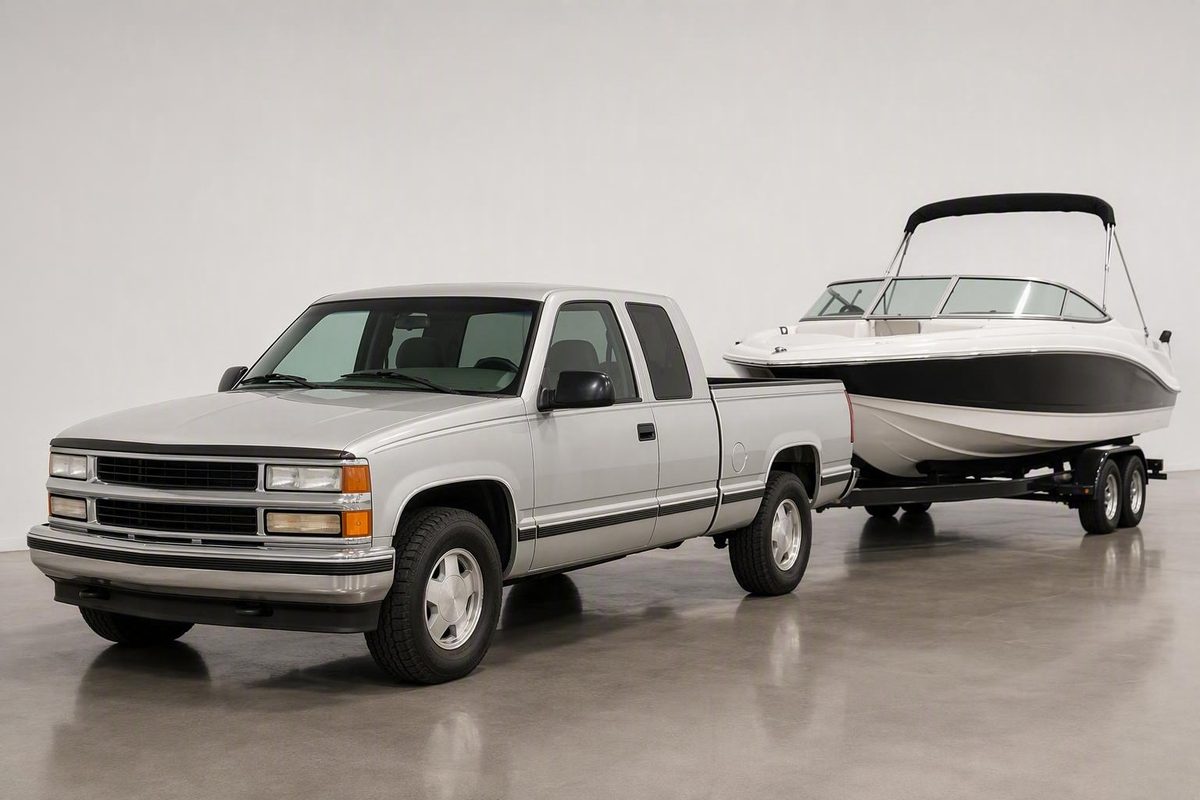
Some properly configured Silverado 1500s are reported to tow up to 9,500 pounds conventionally, but your truck-specific limit may be considerably lower.
The short answer: up to 9,500 pounds for some Silverado 1500 configurations
Secondary sources commonly report a maximum conventional towing capacity of 9,500 pounds for a properly configured 2000 Chevrolet Silverado 1500. That is a model-line maximum, not the rating of every 2000 Silverado. Some configurations have substantially lower reported ratings, so do not decide whether to tow a boat, camper, utility trailer, or equipment trailer from the headline number alone. Turan-Foley Chevrolet’s model-year guide presents 9,500 pounds as the highest reported figure rather than a universal rating for every truck (see its Silverado 1500 towing guide).
That answer also does not establish a universal towing range across every truck sold under related 1500, 2500 Light Duty, 2500 Heavy Duty, or 3500 designations. The supplied evidence does not verify the complete 2000 Chevrolet lineup, naming, or ratings for all those variants. Series, chassis, powertrain, weight ratings, and towing method can differ, so figures from one model must not be generalized to another.
Verify before towing: Identify the exact truck and find its rating in the original 2000 Chevrolet owner’s manual or Chevrolet trailering chart. Compare that rating with the truck’s certification labels, payload, axle ratings, combined-weight rating, tire capacities, installed hitch rating, and the trailer’s actual loaded weight.
If the question is simply “How much can a 2000 Silverado tow?”, the defensible short answer is: some properly configured Silverado 1500 trucks are reported to tow up to 9,500 pounds conventionally, but the truck-specific limit may be considerably lower.
Why the model year does not reveal your truck’s tow rating
“2000 Chevrolet Silverado” identifies a model year and nameplate, but it does not identify a complete towing configuration. The applicable rating may change with:
- Truck series or weight class
- Engine
- Transmission
- Two- or four-wheel drive
- Axle ratio
- Regular, extended, or crew cab
- Bed length and configuration
- Conventional, fifth-wheel, or gooseneck towing
- Hitch type and rating
- Factory trailering and cooling equipment
- Other installed options that change curb weight or available payload
A maximum advertised for one optimized configuration is therefore different from the rating assigned to a particular truck. Two 2000 Silverado 1500s can have the same engine yet differ in axle gearing, drivetrain, cab, bed, equipment, payload, and towing capacity.
Secondary sources also conflict on some combinations. One associates the reported 9,500-pound maximum with more than one engine and drivetrain combination, while another attributes it more narrowly to a 5.3-liter V8, four-wheel-drive truck with a 4.10 axle. None of the supplied sources reproduces a complete original Chevrolet towing chart that resolves every configuration-level question. Repetition of 9,500 pounds across several websites is repeated secondary reporting, not equivalent to confirmation from Chevrolet’s original model-year documentation.
The 2000 Silverado falls within the 1999–2006 period that an independent enthusiast bed guide identifies with the GMT800 generation. That source lists multiple bed arrangements for the generation, but it does not provide towing ratings. Cab and bed style can help identify a truck; bed dimensions alone cannot determine what it may tow (see the independent GMT800 bed overview).
It would therefore be misleading to merge 1500 and 2500 figures into a broad statement such as “a 2000 Silverado tows between X and Y pounds.” Such a range could imply that every truck falls within it despite incomplete evidence, differences among truck types, and conflicts in the secondary data.
A practical determination follows four steps:
- Identify the exact truck and its original equipment.
- Retrieve the matching Chevrolet chart entry.
- Establish the truck’s and trailer’s actual loaded weights.
- Compare the combination with every applicable vehicle, axle, tire, hitch, and trailer limit.
What the available figures say about 1500 and 2500 models
The available figures are best treated as clues for locating the correct factory specification, not as substitutes for it. Silverado 1500 and 2500 Light Duty figures are not interchangeable.
Silverado 1500: a reported ceiling, not a universal rating
For the 2000 Silverado 1500, 9,500 pounds is commonly reported as a maximum towing figure when properly equipped. Bomnin Chevrolet’s towing-by-year table reports that maximum but does not reproduce a complete original model-year configuration chart in the supplied material (review the dealership’s towing-by-year table).
Colman’s Country Campers publishes a separate dataset with the following 4WD Silverado 1500 examples:
| Reported configuration | Reported capacity |
|---|---|
| 4.3L V6, 4WD | 5,100 lb |
| 4.8L V8, 4WD | 7,500 lb |
| 5.3L V8, 4WD | 8,500 lb |
The same page’s FAQ separately claims 9,500 pounds for a 5.3L V8, 4WD truck with a 4.10 axle. Its table also contains concatenated axle entries such as “3.734.10,” making it unclear which axle ratio corresponds to each listed capacity. Those internal inconsistencies mean the numbers illustrate possible variation but should not be treated as definitive factory ratings (compare the conflicting configuration entries).
The practical takeaway is not that every 4.3-liter truck is rated at exactly 5,100 pounds or every 5.3-liter truck at exactly 8,500 or 9,500 pounds. It is that the engine alone does not settle the question and that some reported 1500 ratings are thousands of pounds below the model-line maximum.
Silverado 2500 Light Duty: owner-reported manual figures
A GM-Trucks forum discussion concerns an owner-described 2000 Silverado 2500 Light Duty with a 6.0-liter engine and 4L80E transmission. In that thread, a participant purported to quote the owner’s manual and reported these maximum trailer weights:
| Axle ratio | Participant-reported maximum trailer weight |
|---|---|
| 3.42 | 7,500 lb |
| 3.73 | 8,500 lb |
| 4.10 | 10,500 lb |
These are forum-attributed owner’s-manual figures, not Chevrolet specifications directly reproduced and independently verified in the supplied evidence. They concern the truck type discussed in that thread and must not be generalized to a Silverado 1500, 2500 Heavy Duty, 3500, or a truck with a different configuration. The discussion also illustrates why axle ratio, truck weight, GVWR, and trailer capacity must be distinguished (read the GM-Trucks owner discussion).
Colman’s dataset claims different 2500 values, including a larger 2500 Light Duty figure in its FAQ than in its summary table. That disagreement cannot responsibly be resolved by selecting the largest number. It reinforces the need to locate original Chevrolet documentation for the exact series, engine, transmission, drivetrain, axle ratio, cab, bed, equipment, and towing method.
No figure in this section establishes a complete towing range for every 2000 Chevrolet heavy-duty truck.
Identify your exact Silverado before looking up a capacity
Begin with the truck rather than a generic model-year search. Record each of the following:
- Series or weight class: Use the badges, certification label, VIN-related records, and original documentation rather than assuming the designation.
- Engine: Record displacement and engine code if available.
- Transmission: Identify the exact automatic or manual transmission.
- Drivetrain: Confirm 2WD or 4WD.
- Axle ratio: Identify the installed final-drive ratio.
- Cab: Record regular, extended, or crew cab.
- Bed: Record bed length and box configuration.
- Towing method: Specify conventional bumper-pull, fifth-wheel, or gooseneck.
- Hitch: Record the type, manufacturer, and weight-carrying or weight-distributing limits.
- Factory equipment: Identify trailering, cooling, electrical, suspension, and other relevant equipment.
Next, inspect the truck’s certification label. Record its gross vehicle weight rating (GVWR) and front and rear gross axle weight ratings (GAWRs). These are essential limits, but none is itself the truck’s trailer-weight rating.
Look for the glove-box RPO label and any original build or equipment records. In the GM-Trucks discussion, a participant identifies GT4 as a 3.73 axle ratio, but that remains an unverified forum statement in the available evidence. Confirm any code through authoritative GM or Chevrolet documentation before using it in a towing calculation.
Then locate the original 2000 Chevrolet owner’s manual or Chevrolet trailering chart. Match the complete combination rather than stopping when the engine or model name appears. A chart entry for a 5.3-liter 2WD regular-cab truck, for example, should not be assumed to cover a 5.3-liter 4WD extended-cab truck.
Inspect the installed hardware as well:
- Read the receiver or bed-mounted hitch label.
- Record both weight-carrying and weight-distributing limits if shown.
- Confirm that the hitch and mounting system are appropriate for the towing method.
- Read the truck-tire load and inflation markings.
- Confirm that the tires meet the truck’s required capacity.
- Verify that required wiring, cooling, brake-control, and other trailering equipment is actually installed.
Do not assume that a receiver means the truck retains every part of a factory tow package. On an older vehicle, original equipment may have been removed, replaced, damaged, or modified.
Use this worksheet while identifying the truck:
| Item | Your truck |
|---|---|
| Series or weight class | ____ |
| Engine | ____ |
| Transmission | ____ |
| Drivetrain | ____ |
| Axle ratio | ____ |
| Cab | ____ |
| Bed | ____ |
| Factory trailering equipment | ____ |
| GVWR | ____ |
| Front GAWR | ____ |
| Rear GAWR | ____ |
| GCWR | ____ |
| Actual truck weight before trailer load | ____ |
| Available capacity under GVWR | ____ |
| Receiver or hitch rating | ____ |
| Towing method | Conventional / Fifth-wheel / Gooseneck |
| Verified Chevrolet trailer rating | ____ |
If the axle ratio, GCWR, hitch rating, or matching Chevrolet trailer rating remains unknown, the investigation is not finished.
Know which weight rating controls the combination
Towing capacity is only one limit. A combination must remain within every applicable vehicle, axle, tire, hitch, combined-weight, and trailer rating.
Towing capacity is the applicable maximum loaded trailer weight for the truck’s exact configuration and towing method. It remains subject to the other limits below.
GVWR, or gross vehicle weight rating, is the maximum permitted loaded weight of the truck itself. The loaded truck includes occupants, cargo, accessories, hitch hardware, and trailer tongue or pin weight. GVWR is not towing capacity.
Tongue or pin weight adds load to the truck and can make the rear-axle rating especially important.
GCWR, or gross combined weight rating, is the maximum permitted combined weight of the loaded truck and loaded trailer. A trailer can appear to fit beneath a published trailer rating while still causing the combination to exceed GCWR once the truck is loaded.
Payload is the weight carried by the truck. It includes occupants, cargo, aftermarket accessories, tools, bed contents, hitch hardware, and trailer tongue or pin weight. Colman’s towing glossary likewise distinguishes GVWR, GCWR, payload, dry weight, and tongue weight as separate concepts (review the glossary and configuration guide).
For an older truck, do not automatically begin with a generic brochure payload figure. One operational approach is to weigh the truck in its trip-ready condition before applying trailer tongue or pin load:
Truck GVWR
− Actual loaded truck weight before trailer tongue or pin load
= Remaining capacity under GVWR
The actual truck weight should already include the driver, passengers, cargo, accessories, bed contents, and installed hitch hardware that will be present on the trip. This subtraction addresses GVWR only. Rear GAWR, front GAWR, tire capacity, hitch limits, GCWR, and the Chevrolet trailer rating still require separate checks.
The receiver, fifth-wheel hitch, mounting hardware, tires, payload, axle ratings, GCWR, and trailer ratings can each create a lower limit than the headline towing figure.
The lowest applicable vehicle, axle, tire, hitch, payload, combined-weight, or trailer limit controls.
The distinction matters because a driver may be below a reported trailer maximum yet over the truck’s GVWR or rear GAWR. Conversely, remaining payload does not automatically authorize towing up to a model-line maximum. Each rating answers a different question.
Calculate a realistic trailer limit with loaded weights
Use the trailer’s actual loaded weight, not its advertised dry or empty weight. Loaded weight includes cargo, fluids, batteries, propane, tools, spare parts, installed equipment, and anything else added to the trailer.
Published maximum trailer ratings may assume a properly equipped truck carrying only a 150-pound driver and no cargo. Additional occupants, options, accessories, bed cargo, and hitch hardware can reduce the capacity available for the trailer and its tongue weight. The 2000 GMC trailering guide describes these load assumptions and defines loaded trailer weight as the trailer plus equipment, fluids, and cargo. It covers GMC trucks rather than providing an exact Chevrolet Silverado chart, so it supports these general GM-era principles only (consult the 2000 GMC trailering guide).
For a conventional trailer, tongue weight is generally about 10% to 15% of actual loaded trailer weight. That downward force is carried by the truck, consumes payload, and affects axle loading. The percentage is a general guideline, not permission to exceed a vehicle, hitch, axle, tire, or trailer rating.
A basic payload worksheet is:
Capacity available under GVWR
− Occupants not included in the scale weight
− Cargo not included in the scale weight
− Accessories not included in the scale weight
− Hitch hardware not included in the scale weight
= Capacity remaining for trailer tongue weight
Do not subtract the same item twice. If the truck was weighed with its occupants, cargo, accessories, and hitch hardware already aboard, those items are already reflected in the scale weight.
Suppose an 8,000-pound loaded conventional trailer produces tongue weight within the general 10% to 15% range. The estimated tongue weight would be approximately 800 to 1,200 pounds:
8,000 lb × 10% = 800 lb
8,000 lb × 15% = 1,200 lb
Now assume, strictly for illustration, that a truck has 1,500 pounds of capacity available under GVWR before adding people and gear, and those people and items use 500 pounds:
1,500 lb available
− 500 lb people and gear
= 1,000 lb remaining
That 1,000 pounds must still accommodate any hitch hardware not already counted and the trailer’s actual tongue weight. If tongue weight is near the upper end of the illustrative range, the truck could reach GVWR before reaching its published trailer maximum. Rear GAWR, tire capacity, receiver limits, and GCWR could impose still lower limits.
This example does not establish that an 8,000-pound trailer is suitable for any particular 2000 Silverado. The answer still depends on the truck’s labels, configuration-specific Chevrolet rating, hitch, tires, loaded axle weights, and combined weight.
Scale measurements are more useful than brochure dry weights. Ideally, obtain enough measurements to determine:
- Loaded truck weight before connecting the trailer
- Loaded truck weight with the trailer connected
- Front- and rear-axle loads
- Loaded trailer weight
- Combined truck-and-trailer weight
- Actual tongue or pin weight, where the weighing method permits
Compare the measurements with GVWR, front and rear GAWR, GCWR, the Chevrolet trailer rating, hitch ratings, tire capacities, and the trailer’s ratings. Do not rely on subtraction from a single headline number while ignoring the other constraints.
Do not apply a conventional rating to a fifth-wheel or gooseneck
The reported 9,500-pound Silverado 1500 figure is described as a conventional maximum by one secondary source, while other supplied figures are not identified clearly enough to establish a different towing method. None of the available data provides a sound basis for converting these numbers into fifth-wheel or gooseneck ratings.
A conventional towing rating does not establish fifth-wheel capacity. A fifth-wheel places pin weight in the truck bed, and that load is carried by the truck. Payload, rear GAWR, GVWR, tire capacity, bed-mounted hitch limits, and GCWR can therefore constrain the combination even when the trailer’s total weight appears to fit below a reported maximum.
The 2500 Light Duty forum case illustrates the concern without resolving it. The owner was considering a fifth-wheel and questioned the truck’s GVWR, rear-axle loading, and estimated pin weight. The owner’s estimate that pin weight could equal 20% of trailer weight was part of an individual discussion, not a universal specification for all fifth-wheels or Silverados.
For fifth-wheel or gooseneck towing, locate the separately applicable Chevrolet rating and verify:
- The correct factory rating for that towing method
- Truck payload and loaded truck weight
- Truck GVWR
- Front and rear GAWR
- GCWR
- Truck-tire capacities
- Actual loaded pin weight
- Fifth-wheel or gooseneck hitch rating
- Mounting-system rating and installation
- Trailer GVWR, axle ratings, and tire capacities
- Bed, cab, trailer, and hitch clearances
Do not infer a heavy-duty or fifth-wheel rating from a Silverado 1500 conventional maximum. Likewise, a participant-reported 2500 Light Duty conventional figure cannot be assumed to authorize a fifth-wheel of the same weight.
Complete these checks before hitching up
Before towing with a 2000 Silverado, confirm every applicable item below.
Ratings and weights
- [ ] Exact Chevrolet trailer rating for the truck’s documented configuration
- [ ] Correct rating for conventional, fifth-wheel, or gooseneck towing
- [ ] Trailer’s actual loaded weight
- [ ] Expected and preferably measured tongue or pin weight
- [ ] Truck’s trip-ready weight and payload use
- [ ] Truck GVWR
- [ ] Front GAWR
- [ ] Rear GAWR
- [ ] GCWR
- [ ] Receiver, fifth-wheel, or gooseneck hitch rating
- [ ] Hitch-mounting and attachment ratings
- [ ] Truck-tire capacities
- [ ] Trailer GVWR, axle ratings, and tire capacities
Equipment and condition
- [ ] Truck and trailer tires are in suitable condition and inflated as required
- [ ] Hitch and mounting points are undamaged and secure
- [ ] Coupler or kingpin is correctly engaged
- [ ] Safety chains are attached as required for the setup
- [ ] Electrical connector is secure
- [ ] Running lights, brake lights, and turn signals operate
- [ ] Trailer breakaway equipment is connected and functioning where applicable
- [ ] Trailer cargo is positioned and secured
- [ ] Mirrors provide adequate rearward visibility
- [ ] Truck fluids, cooling system, brakes, suspension, and steering are serviceable
Verify that the trailer has adequate brakes for its loaded weight and that any required brake controller is properly installed, adjusted, maintained, and operating. The 2000 GMC guide discusses trailer brakes, brake-controller setup, suitable hitch equipment, weight-distributing hitches, and sway control, but its stated brake threshold should not be treated as a universal Chevrolet-specific legal rule. Follow the Silverado owner’s manual, equipment instructions, and applicable state or local law (review the guide’s safe-trailering instructions).
Whether a weight-distributing hitch or sway control is needed depends on the loaded trailer, the receiver’s weight-carrying and weight-distributing limits, the owner’s manual, and the hitch and trailer manufacturers’ instructions.
As practical considerations rather than additional manufacturer ratings, account for the condition of an older truck and the demands of the intended route. There is no supported universal margin percentage to apply; the first requirement is to identify and remain below every verified limit.
Final decision rule: If the truck’s exact configuration or any controlling rating remains unknown, do not rely on the 9,500-pound headline figure.
Frequently asked questions
Can every 2000 Silverado 1500 tow 9,500 pounds?
No. The 9,500-pound number is a commonly reported maximum for certain properly configured Silverado 1500 trucks, not the standard rating for every 2000 model. The applicable capacity can change with engine, transmission, drivetrain, axle ratio, cab, bed, hitch, equipment, payload, and other limits (see the model-year maximum and its qualifications).
Use original Chevrolet towing information for the exact truck. Do not assume that a particular engine automatically gives it the maximum rating.
Where can I find the axle ratio and towing information for my 2000 Silverado?
Start with the glove-box RPO label and any original build or equipment records. Decode axle-related RPO codes through authoritative GM or Chevrolet documentation rather than relying exclusively on a forum post or generic decoder.
For the tow rating, locate the original 2000 Chevrolet owner’s manual or trailering chart and match the series, engine, transmission, drivetrain, axle ratio, cab, bed, towing method, and equipment. Also read the certification and hitch labels. GVWR and GAWR are constraints on the combination, not substitutes for the trailer rating.
Is the 7,200-pound GVWR on my door label the truck’s towing capacity?
No. In the owner-forum example, the truck’s door label reportedly showed a 7,200-pound GVWR, but the discussion correctly treated that value as distinct from trailer capacity (see the reported label and ratings discussion).
A 7,200-pound GVWR means the loaded truck itself must not exceed 7,200 pounds. That truck weight includes occupants, cargo, accessories, hitch hardware, and trailer tongue or pin weight. Towing capacity and GCWR are separate figures, so GVWR alone cannot establish maximum trailer weight.
How much tongue weight should I expect from a conventional trailer?
A general estimate is 10% to 15% of the conventional trailer’s actual loaded weight. The loaded-weight section above shows how that guideline translates into an estimated range and why the result must be counted against the truck’s available capacity.
Treat the percentage as an initial estimate, not a final compliance measurement. Follow the trailer and hitch manufacturers’ instructions, observe the receiver’s limits, and weigh the loaded combination whenever practical.
Can I use the reported conventional tow rating for a fifth-wheel trailer?
No. A conventional rating does not establish fifth-wheel or gooseneck capacity. A fifth-wheel’s pin weight is carried by the truck and may consume a substantial part of its available capacity while increasing rear-axle and tire loads.
Find the Chevrolet rating applicable to the exact truck and fifth-wheel setup. Then verify payload, loaded truck weight, GVWR, rear GAWR, GCWR, tire capacity, actual pin weight, hitch rating, mounting system, and trailer ratings. If any controlling figure is unavailable, do not substitute the reported 9,500-pound conventional maximum.