
Which 2026 Silverado 1500 Fits the Way You Use a Truck?
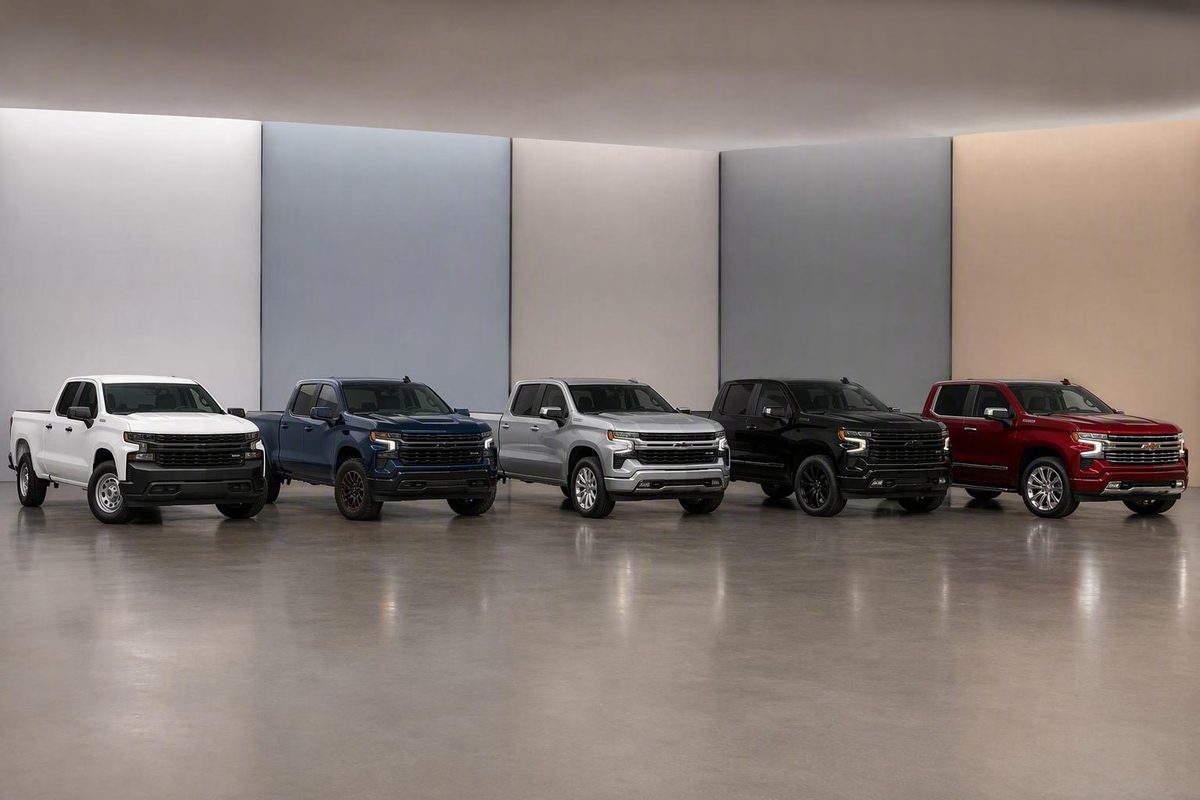
The 2026 Chevy Silverado trim levels are easier to understand as parallel paths than as one feature ladder. WT, Custom, and LT move from utility toward everyday comfort. RST branches toward street-oriented styling. Custom Trail Boss, LT Trail Boss, and ZR2 emphasize progressively more specialized off-road equipment. LTZ and High Country prioritize premium comfort and materials.
This is a provisional overview of the U.S.-market 2026 Chevrolet Silverado 1500 based primarily on third-party retailer and Chevrolet-dealer reporting available in July 2026. Chevrolet’s supplied pages confirm the model year, a lineup-level starting price, and access to Build & Price, but they do not verify the full trim-price matrix or every feature and configuration described here. This guide does not cover the separate Silverado HD or Silverado EV ranges, except for a brief HD clarification near the end.
A trim level is a manufacturer-selected equipment grouping that can affect design, cabin materials, convenience features, technology, powertrain availability, performance hardware, and price. A trim badge does not define the entire truck: engine, drivetrain, axle ratio, cab, bed, packages, options, and production availability remain important.
2026 Silverado 1500 trims at a glance
Multiple clearly dated 2026 retailer and dealer sources report nine Silverado 1500 trims: WT, Custom, Custom Trail Boss, LT, RST, LT Trail Boss, LTZ, High Country, and ZR2. The following matrix summarizes those third-party reports; it is not a substitute for Chevrolet’s complete order guide or the window sticker for an individual truck.
Quick-reference trim matrix
| Trim | Primary role | Defining third-party-reported equipment or availability | Third-party-reported starting price, July 2026 |
|---|---|---|---|
| WT | Utility-first work truck | Reported TurboMax engine, eight-speed automatic, 2WD, 17-inch steel wheels, durable flooring and seating, Chevy Safety Assist | $36,900 |
| Custom | Work and personal-use crossover | Reported 7-inch touchscreen, wireless Apple CarPlay and Android Auto, 20-inch aluminum wheels, Trailering Package, remote start, EZ Lift tailgate | $42,400 |
| Custom Trail Boss | Lower-price factory off-road entry | Reported 4WD, 2-inch lift, Z71 equipment, two-speed transfer case, automatic-locking rear differential, skid plates, off-road tires | $52,800–$52,900 |
| LT | Mainstream technology and comfort | Reported 13.4-inch touchscreen, 12.3-inch driver display, dual-zone climate control, chrome exterior treatment | $47,900 |
| RST | Street-oriented styling | Reported body-color exterior trim, darker or sport-oriented details, LT-like cabin technology, access to four engines | $51,300 |
| LT Trail Boss | Off-road focus with an upgraded cabin | Reported 4WD, 2-inch lift, Z71 hardware, skid plates, large digital displays, heated front seats and steering wheel | $59,600–$59,700 |
| LTZ | Conventional premium-value trim | Reported 5.3L V8 and 10-speed automatic, perforated leather-appointed seating, ventilated front seats, power tailgate, camera system | $58,000 |
| High Country | Luxury-focused endpoint | Reported premium leather, open-pore wood, heated front and rear seats, power-retractable running boards, wireless charging; Super Cruise available | $62,900 |
| ZR2 | Specialized factory off-road trim | Reported Multimatic DSSV dampers, front and rear electronic-locking differentials, 33-inch tires, off-road-cut bumpers, skid plates, 2-inch lift | $71,700–$71,800 |
RealTruck’s July 14, 2026 guide reports WT at $36,900, Custom at $42,400, LT at $47,900, RST at $51,300, LTZ at $58,000, and High Country at $62,900. It reports $52,900, $59,700, and $71,800 for Custom Trail Boss, LT Trail Boss, and ZR2 respectively; another 2026 dealer source reports those three at $52,800, $59,600, and $71,700, creating the $100 ranges shown above. RealTruck also supplies much of the reported equipment detail in its 2026 Silverado trim and pricing breakdown.
Every figure in the table should be treated as an unverified third-party starting price, not a configured or out-the-door amount. Depending on the source and build, the price may exclude destination, taxes, title and registration, options, accessories, dealer charges, and other costs. Cab, bed, engine, drivetrain, and package choices can also change the price.
Chevrolet itself displays a lineup-level starting price of $36,900 and provides a model-year-specific 2026 Silverado 1500 Build & Price tool. The supplied official page does not confirm every individual trim price, feature, or configuration restriction in this guide.
The table order is useful for reference, but it is not a strict hierarchy. ZR2 is not simply a High Country with more equipment, and RST is not necessarily an LT with a performance suspension. High Country is the luxury-focused endpoint; ZR2 is the specialized off-road endpoint.
WT, Custom, and LT: choosing the practical side of the lineup
WT, Custom, and LT are the clearest starting points for buyers who want a practical Silverado without immediately choosing a luxury or dedicated off-road model:
- WT prioritizes entry price and utility.
- Custom adds convenience, connectivity, and appearance features.
- LT makes the clearest reported move toward modern cabin technology and daily comfort.
Because Chevrolet’s captured 2026 pages do not provide a complete standard-equipment table, the details below remain third-party reported and may vary by configuration.
WT: the utility-first entry point
RealTruck reports a WT configuration with a 2.7L TurboMax engine, eight-speed automatic transmission, two-wheel drive, 17-inch steel wheels, vinyl seating and flooring, and Chevy Safety Assist. Another 2026 dealer source describes cloth rather than vinyl seating, so the seat material should be treated as configuration-sensitive rather than universal.
That conflict matters. A fleet-oriented WT, retail WT, or truck with a different cab and option package may not match a generic trim summary. Check the window sticker or build sheet for:
- Seating material and passenger capacity
- Cab and bed
- 2WD or 4WD
- Engine and transmission
- Safety and convenience equipment
- Fleet or retail options
WT makes the strongest case when the Silverado is primarily a tool. If larger wheels, remote start, smartphone integration, a more convenient tailgate, or bundled trailering equipment are not priorities, moving up may add expense without improving the parts of the truck that matter to the job.
Custom: convenience and visual polish
RealTruck’s 2026 guide reports the following Custom equipment:
- 7-inch touchscreen
- Wireless Apple CarPlay and Android Auto
- 20-inch aluminum wheels
- Trailering Package
- Remote start
- EZ Lift power-lock-and-release tailgate
These features should be verified on the individual truck because the supplied Chevrolet material does not establish their universal standard status across every Custom configuration.
The changes mainly affect everyday usability and appearance. Remote start and the upgraded tailgate can matter regularly, while the larger wheels and exterior treatment give Custom a more retail-oriented look than a basic work specification.
WT versus Custom
The two third-party starting figures imply a $5,500 difference, from $36,900 for WT to $42,400 for Custom. Those amounts may exclude destination and other charges, and they do not account for differences in cab, bed, drivetrain, or options.
Choose WT when minimizing entry cost and keeping the build simple matter most. Compare Custom when the truck will also serve as personal transportation and you would otherwise add several convenience, connectivity, appearance, or trailering features separately.
LT: the mainstream technology step
RealTruck reports LT with:
- 13.4-inch central touchscreen
- 12.3-inch driver display
- Dual-zone climate control
- Chrome exterior treatment
- Access to additional powertrains
The larger displays create a meaningfully different cabin interface from Custom’s reported 7-inch system. Dual-zone climate control may also make LT more appealing for drivers who regularly carry a front passenger.
Some dealer pages describe heated seats as an LT feature, but the supplied 2026 evidence does not establish them as standard across every LT configuration. Treat seat heating, camera systems, driver-assistance equipment, and similar comfort or technology features as items to confirm on the window sticker.
Custom versus LT
The reported prices—$42,400 for Custom and $47,900 for LT—produce another $5,500 difference before excluded charges or configuration changes.
The strongest documented reason to make that step is the larger digital interface and added cabin comfort, not a blanket increase in towing, payload, traction, or durability. LT is our editorial all-around choice for many daily drivers because its display package and climate-control upgrade create a more modern cabin without requiring a luxury trim. That is an equipment-balance judgment, not a claim that LT is objectively best or the most popular.
Choose this if
| Buyer need | Start with | Why |
|---|---|---|
| Work-only use | WT | Lowest third-party-reported entry price and utility-first positioning |
| Mixed work and personal use | Custom | Reported remote start, trailering equipment, smartphone integration, upgraded tailgate, and visual polish |
| Daily-driver comfort | LT | Reported larger touchscreen, digital driver display, and dual-zone climate control |
LT versus RST: technology value or street-oriented style?
RST is best understood as a street-styled branch near the LT level, not automatically as a performance trim.
LT emphasizes chrome exterior treatment, mainstream comfort, and a reported 13.4-inch touchscreen with a 12.3-inch driver display. Clearly dated 2026 dealer reporting describes RST with body-color grille elements, bumpers, and door handles, plus LT-like cabin technology. It also reports access to four engines, including an available 6.2L V8, although the exact cab, bed, and drivetrain restrictions still require verification.
The third-party-reported starting prices are $47,900 for LT and $51,300 for RST, a difference of about $3,400 before destination, options, or configuration effects. That step principally appears to buy styling differentiation and broader reported configuration possibilities.
What you gain with RST
Compared with LT, the clearest reported RST distinctions are:
- Body-color rather than chrome-forward exterior treatment
- Darker or sport-oriented visual details
- Access to RST-specific appearance packages
- Reported access to four engines, including an available 6.2L V8
What you do not automatically gain
The RST badge alone does not prove that a particular truck has:
- A sport suspension
- A lower ride height
- Better cornering
- A more powerful engine
- Greater towing or payload capacity
One dealer page makes broad claims about a sport suspension, lower stance, and improved cornering, but the stronger 2026 evidence does not establish those traits across every RST. A base RST and a heavily optioned RST can be substantially different trucks; the same is true of LT.
Decision rule: Choose LT when the large screens, dual-zone climate control, and lower reported entry price matter more than exterior treatment. Compare RST when body-color street styling, appearance packages, or access to a desired engine are priorities.
Before deciding, verify the exact engine, 2WD or 4WD system, package, cab, and bed combination in Chevrolet’s configurator. Do not use the RST name alone to infer mechanical equipment.
Custom Trail Boss, LT Trail Boss, and ZR2: the off-road ladder
The three off-road-oriented Silverado 1500 trims are best compared by mechanical hardware, cabin equipment, and reported starting price, not by generic labels such as “rugged” or “adventure-ready.”
Custom Trail Boss establishes the lifted Z71 formula. LT Trail Boss combines similar intent with a better-equipped cabin. ZR2 changes the hardware more substantially with specialized dampers and front and rear electronic-locking differentials.
Custom Trail Boss: foundational factory off-road hardware
RealTruck reports Custom Trail Boss with:
- Four-wheel drive
- 2-inch factory lift
- Z71 Off-Road Package
- Two-speed transfer case
- Automatic-locking rear differential
- Skid plates
- Off-road tires
Because the supplied official Chevrolet pages do not expose the full trim specifications, confirm these items—and their standard or package-dependent status—on the actual truck.
The third-party-reported starting-price range is $52,800–$52,900, reflecting a $100 disagreement between two 2026 sources. Custom Trail Boss is therefore the lower-price entry into the reported lifted Z71 branch.
Its case rests on more than appearance. The lift, 4WD system, two-speed transfer case, rear differential, skid plates, and off-road tires are the reported distinctions that matter.
LT Trail Boss: off-road intent with a more complete cabin
RealTruck’s July 2026 guide reports LT Trail Boss with:
- Four-wheel drive
- 2-inch lift
- Z71 equipment
- Skid plates
- 13.4-inch touchscreen
- 12.3-inch driver display
- Heated front seats
- Heated steering wheel
The reported starting-price range is $59,600–$59,700. Compared with the reported $52,800–$52,900 Custom Trail Boss range, the difference can run from roughly $6,700 to $6,900, depending on which source figures are paired.
The principal reason to pay that difference is the cabin. LT Trail Boss combines the lifted, off-road-oriented concept with the LT-style digital interface and reported heating features. Buyers should still verify that the heating equipment is present on the specific build.
ZR2: specialized suspension and differential hardware
ZR2 is the most specialized factory off-road trim in the reported 2026 Silverado 1500 range. A clearly dated 2026 dealer overview identifies:
- Four-wheel drive
- Multimatic DSSV dampers
- Front and rear electronic-locking differentials
- 33-inch tires
- Off-road-cut front bumper
- Aluminum skid plates
- 2-inch lift
Sources vary between “all-terrain” and “mud-terrain” terminology for the tires, so inspect the actual tire model rather than assuming one description applies to every ZR2. The electronic differentials should likewise be described only as front and rear lockers; the supplied evidence does not establish their exact control logic.
The reported starting-price range is $71,700–$71,800. Compared with LT Trail Boss at $59,600–$59,700, the difference is approximately $12,000–$12,200, depending on which endpoints are used.
That price step makes the clearest sense for a buyer who specifically wants the DSSV dampers and front and rear electronic-locking differentials. Those components are more useful for distinguishing ZR2 than broad claims about overall capability.
Off-road trims compared
| Trim | Mechanical focus | Cabin focus | Third-party-reported starting price |
|---|---|---|---|
| Custom Trail Boss | Reported lifted Z71 foundation, 4WD, two-speed transfer case, automatic-locking rear differential, skid plates | Custom-level cabin | $52,800–$52,900 |
| LT Trail Boss | Reported lifted Z71 concept with 4WD and skid plates | LT displays plus reported heated seats and steering wheel | $59,600–$59,700 |
| ZR2 | Reported DSSV dampers, front and rear electronic lockers, 33-inch tires, off-road-cut bumper, skid plates | Upper-level equipment varies by configuration | $71,700–$71,800 |
The buying logic is straightforward:
- Custom Trail Boss: Start here when foundational factory off-road hardware matters more than cabin upgrades.
- LT Trail Boss: Compare it when you want the lifted Z71 concept and LT-level technology in the same truck.
- ZR2: Choose it when DSSV dampers and front and rear electronic lockers are specific requirements rather than attractive extras.
The supplied evidence does not establish quantified differences in fuel economy, ride quality, road noise, replacement-tire cost, payload, or towing among these trims. Evaluate those tradeoffs through current specifications, a test drive, and vehicle-specific labels rather than assumptions.
ZR2 should not be called universally “the most capable Silverado” without qualification. It is the most specialized factory off-road trim in this reported Silverado 1500 lineup; another configuration may be preferable for towing, payload, commercial work, highway use, or luxury.
LTZ versus High Country: two approaches to a premium Silverado
LTZ and High Country both target premium-truck buyers, but they emphasize different levels of finish and equipment.
LTZ is the conventional premium-value step. It brings reported leather, ventilation, cameras, and tailgate convenience at the lower starting point.
High Country is the luxury-focused endpoint. It emphasizes richer materials, additional passenger and convenience features, and access to flagship driver-assistance technology.
LTZ: premium comfort without the High Country price
RealTruck’s 2026 guide reports LTZ with a 5.3L V8 and 10-speed automatic, although the exact engine and configuration rules still need to be checked. It also reports:
- Perforated leather-appointed upholstery
- Heated and ventilated front seats
- Power tailgate
- Eight-camera system
These features should not be assumed universal across every LTZ without checking the build sheet. Other dealer descriptions mention audio, charging, safety, and trailering technologies, but the supplied evidence does not reliably establish all of them as standard.
The third-party-reported starting price is $58,000. LTZ is therefore the logical premium starting point if leather-appointed seating, front-seat ventilation, camera coverage, and a power-operated tailgate are the equipment you value.
High Country: richer materials and flagship options
RealTruck reports High Country with:
- Premium leather
- Open-pore wood trim
- Heated front and second-row seats
- Power-retractable running boards
- Wireless charging
- Available Super Cruise
The word available matters. The supplied evidence does not establish Super Cruise as standard on every High Country. Package requirements, compatible equipment, and operating conditions must be checked for the individual truck.
The third-party-reported starting price is $62,900, approximately $4,900 above LTZ’s reported $58,000, before destination, options, or other costs. That step appears to buy richer materials, added rear-seat comfort, convenience features such as retractable running boards and wireless charging, and access to higher-end driver-assistance technology.
LTZ or High Country?
Choose LTZ if your premium checklist centers on leather-appointed seating, front-seat ventilation, camera coverage, and a power tailgate at the lower reported entry point.
Choose High Country if you place more value on upscale materials, heated second-row seating, power-retractable steps, wireless charging, and available Super Cruise.
High Country is the luxury flagship, but it is not the universal “top Silverado.” ZR2 follows a separate off-road path and carries a higher third-party-reported starting price.
Best Silverado trim by buyer mission
There is no universal winner. A less expensive trim can be better for a narrowly defined job, while a costlier model may direct money toward features you will not use. Use these as editorial shortlists, then verify the actual builds.
| Buyer mission | First trim to shortlist | Closest comparison |
|---|---|---|
| Lowest-cost utility | WT | Custom |
| Work and personal use | Custom | WT or LT |
| All-around daily use | LT | Custom or RST |
| Street-oriented style | RST | LT |
| Moderate factory off-road use | Custom Trail Boss | LT Trail Boss |
| Off-road hardware plus cabin comfort | LT Trail Boss | Custom Trail Boss or ZR2 |
| Specialized factory off-road use | ZR2 | LT Trail Boss |
| Premium value | LTZ | High Country |
| Luxury materials and flagship options | High Country | LTZ |
For WT, confirm cab, bed, drivetrain, seating, passenger capacity, storage, outlets, and trailering needs before assuming the lowest-price configuration can do the job.
Choose Custom when remote start, smartphone integration, bundled trailering equipment, an upgraded tailgate, and retail-oriented appearance matter. Choose LT when its larger displays and dual-zone climate control justify the price step; that is our editorial daily-use pick, not a factual declaration that it is best for everyone.
Shortlist RST for body-color styling, darker details, appearance packages, or access to a desired engine—not because the badge guarantees a performance suspension.
Among the off-road models, start with Custom Trail Boss when mechanical hardware matters more than cabin technology. Move to LT Trail Boss when the LT-style interface and reported heating features are important. Choose ZR2 when the DSSV dampers and front and rear electronic lockers are specific requirements.
For premium trucks, LTZ is the value-oriented shortlist; High Country is the luxury-materials and flagship-technology shortlist.
Compact decision tree
-
Is the truck primarily for basic work? - Compare WT and Custom. - WT favors entry price; Custom favors convenience and appearance.
-
Is it mainly a daily driver or mixed-use truck? - Compare Custom and LT. - Custom keeps the price lower; LT provides the stronger reported digital-cabin upgrade.
-
Is street appearance a major priority? - Compare LT and RST. - LT favors price and chrome; RST favors body-color styling and broader reported engine access.
-
Will it regularly leave pavement? - Compare Custom Trail Boss and LT Trail Boss first. - If DSSV dampers and front and rear electronic lockers are requirements, compare LT Trail Boss and ZR2.
-
Is premium comfort the priority? - Compare LTZ and High Country. - LTZ favors premium value; High Country favors richer materials and flagship options.
The objective is to reduce nine trims to two realistic candidates, not to declare one winner.
Trim is only one part of the configuration
Two Silverados with the same trim badge can have different prices, equipment, towing limits, payload limits, dimensions, and practical usefulness.
Variables include:
- Engine
- Transmission
- 2WD or 4WD
- Axle ratio
- Cab
- Bed
- Trailering equipment
- Off-road, safety, or technology packages
- Standalone options
- Market and production availability
Dealer reporting identifies four engines across the broader Silverado 1500 lineup: the 2.7L TurboMax, 5.3L V8, 6.2L V8, and 3.0L Duramax diesel. The supplied evidence does not establish a dependable, complete engine-by-trim matrix for every 2026 cab, bed, and drivetrain combination. Do not assume every engine is available on every trim.
Towing and payload are configuration-specific
Trim name alone does not establish how much a Silverado can tow or carry. Engine, transmission, drivetrain, axle ratio, cab, bed, trailering equipment, and the truck’s own weight all affect the result. Any published maximum applies only to a properly configured vehicle.
For a towing purchase:
- Identify the exact engine, transmission, drivetrain, axle, cab, and bed.
- Confirm the required trailering equipment.
- Consult Chevrolet’s current model-year trailering documentation.
- Read the vehicle-specific trailering information.
- Check the payload label on the individual truck.
- Account for passengers, cargo, accessories, hitch equipment, and trailer tongue weight.
A dealer capability overview likewise cautions that engine, drivetrain, cab, bed, axle ratio, and trailering equipment affect capability and recommends checking the vehicle-specific label and current documentation. Because the evidence pack does not include Chevrolet’s complete 2026 trailering guide, no exact towing or payload ratings are assigned here.
This is especially important when comparing a loaded luxury or off-road truck with a more basic build. Additional equipment can affect vehicle weight, and two trucks with the same trim name may not have identical certified limits.
Cab and bed affect practical fit
Cab and bed selection determine passenger room, cargo length, maneuverability, garage fit, and which configurations are possible. These choices can matter more than an appearance package.
For current-generation context, the Silverado bed-size chart lists short, standard, and long beds and explains common cab pairings. Use it for general dimensions and cab/bed context only; it does not establish that every pairing is available with every 2026 trim. Confirm the exact model-year combination in Chevrolet’s configurator.
Pre-purchase verification checklist
Put the following information on one page for every truck you compare:
- [ ] 2026 model year
- [ ] Exact trim
- [ ] Engine
- [ ] Transmission
- [ ] 2WD or 4WD
- [ ] Axle ratio
- [ ] Cab
- [ ] Bed
- [ ] Factory packages
- [ ] Standalone options
- [ ] Payload label
- [ ] Vehicle-specific trailering information
- [ ] Destination charge
- [ ] Dealer-installed accessories
- [ ] Taxes and registration
- [ ] Final configured or selling price
This prevents misleading comparisons between a lightly equipped LT and an option-heavy RST, or between two trucks with different cabs, beds, engines, and drivetrains.
Silverado 1500 versus Silverado HD trim names
Silverado HD is a separate heavy-duty product range covering the 2500 HD and 3500 HD. It should not be folded into a Silverado 1500 comparison because its engines, frames, configurations, capability, prices, and equipment rules differ.
The supplied 2026 reporting identifies these Silverado HD trims:
- WT
- Custom
- LT
- LTZ
- ZR2
- High Country
The supplied HD list does not include RST, Custom Trail Boss, or LT Trail Boss.
At a high level:
- WT targets basic work use.
- Custom and LT add convenience and technology.
- LTZ and High Country serve premium buyers.
- ZR2 adds off-road-oriented hardware.
Chevrolet displays separate lineup-level starting prices of $36,900 for Silverado and $45,900 for Silverado HD, reinforcing that they are distinct ranges rather than interchangeable versions of one trim ladder. These are not full configured prices.
This article does not attempt a complete Silverado HD comparison, and the supplied material does not support a full description of HD High Country equipment. HD shoppers should use Chevrolet’s model-year-specific Silverado HD Build & Price page and a dedicated HD guide rather than carrying 1500 prices, engines, or features across by name.
What are the nine 2026 Chevy Silverado 1500 trim levels in order?
The consistently reported display order is:
- WT
- Custom
- Custom Trail Boss
- LT
- RST
- LT Trail Boss
- LTZ
- High Country
- ZR2
Treat this as a lineup listing, not a strict hierarchy. RST is a street-style branch, High Country is the luxury endpoint, and ZR2 is the specialized off-road endpoint.
Is the Silverado High Country or ZR2 the top trim?
It depends on what “top” means. High Country is the luxury-focused flagship, while ZR2 is the specialized off-road flagship.
ZR2 has the higher third-party-reported starting price—$71,700–$71,800 versus $62,900 for High Country—but that does not make it universally better. The two trims prioritize different uses.
What is the difference between Custom Trail Boss and LT Trail Boss?
Both are reported with four-wheel drive, a 2-inch factory lift, Z71 off-road equipment, skid plates, and traction-oriented hardware. Custom Trail Boss is the lower-price, mechanically focused choice.
LT Trail Boss adds the LT-style 13.4-inch touchscreen and 12.3-inch driver display, plus reported heated front seats and a heated steering wheel. Its third-party-reported starting price is roughly $6,700–$6,900 higher, so the central question is whether the upgraded cabin justifies the step.
Which Silverado trim is best for towing?
No trim is automatically best for towing. The correct truck depends on the exact engine, drivetrain, axle ratio, cab, bed, trailering equipment, vehicle weight, payload allowance, and trailer.
Set the required towing target first, then identify configurations that meet it. Confirm the result through Chevrolet’s current trailering documentation, the individual truck’s vehicle-specific trailering information, and its payload label. Do not select a trim solely because it is more expensive or includes a Trailering Package.
Are Silverado 1500 and Silverado HD trim levels the same?
No. Some names overlap—including WT, Custom, LT, LTZ, ZR2, and High Country—but Silverado HD is a separate heavy-duty range. The supplied 2026 HD list does not include RST, Custom Trail Boss, or LT Trail Boss, and shared trim names do not imply shared engines, equipment, prices, or capability.
The simplest way to narrow the 2026 Silverado 1500 is to follow one of two paths. For utility, daily comfort, street styling, and luxury, compare WT, Custom, LT, RST, LTZ, and High Country. For factory off-road specialization, compare Custom Trail Boss, LT Trail Boss, and ZR2.
Shortlist two trims, then verify the exact engine, drivetrain, axle, cab, bed, packages, destination charge, payload label, trailering information, and final configured price before buying.