
Find the Factory Schedule for Your Exact Chevy
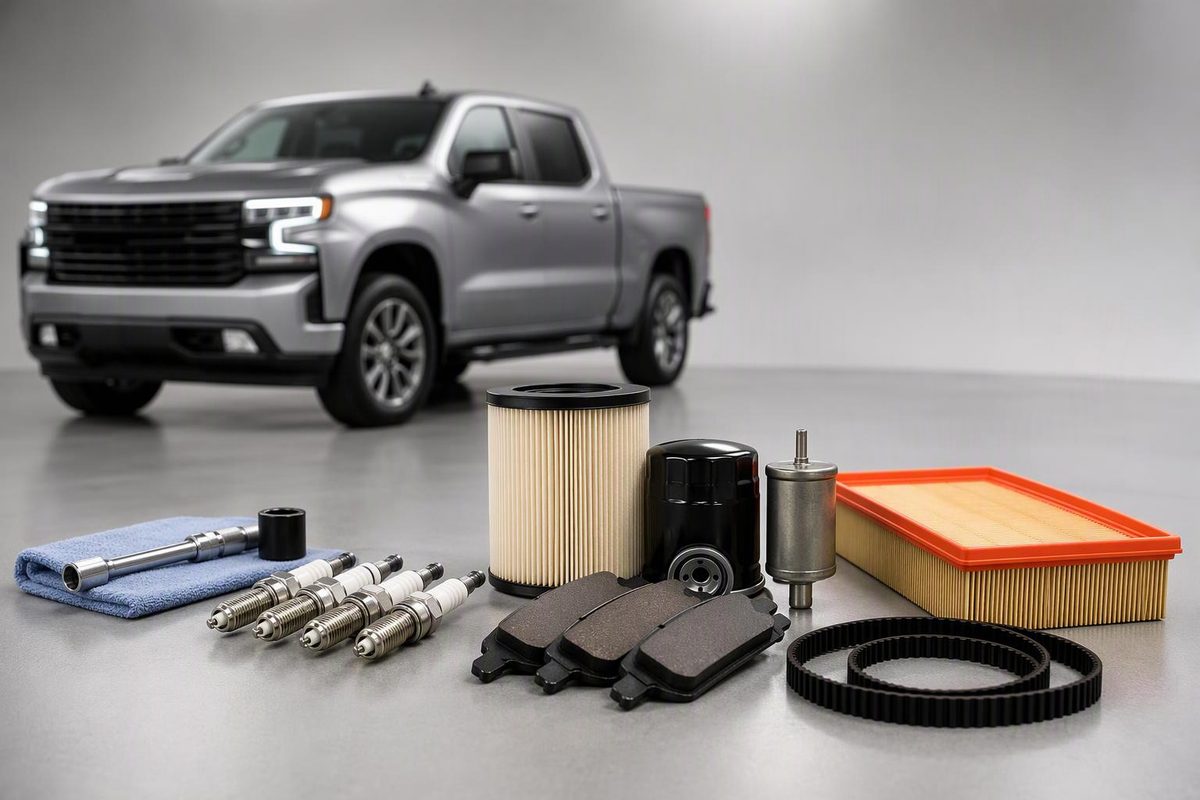
Use your Chevy’s exact manual, engine supplement and dashboard monitors to find due service and separate factory work from dealer add-ons at any mileage.
Factory scheduled maintenance for a Chevy truck or SUV is the work Chevrolet specifies for its exact model year, model, engine and operating conditions—not every service on a dealer’s menu. Check the matching owner’s manual, any Duramax supplement, vehicle-life monitors and the severe-service definitions before authorizing work.
Choose a 2025 Silverado 1500 configuration to see which factory entries in this example apply.
2025 Silverado 1500 Schedule Check
This checker covers the U.S. gasoline owner’s-manual example and the 2025 3.0L Duramax supplement, not other model years or engines.
Factory Entries to Check
- Every 7,500 mi (12,000 km): rotate tires, perform the multi-point inspection, lubricate body components, and check oil level and oil-life percentage.
- Change oil within 600 mi (1,000 km) of the message, or at least annually if no message appears.
- Replace the passenger-compartment air filter at 22,500 mi (36,000 km) or 24 months, whichever comes first.
- Replace spark plugs and inspect boots/wires at 60,000 mi (96,000 km).
- Service coolant at 150,000 mi (240,000 km) or six years; replace brake fluid every five years and A/C desiccant every seven years.
These are selected major entries, not the complete inspection schedule.
Sources: Chevrolet’s U.S. 2025 Silverado 1500 owner’s manual and 2025 3.0L Duramax supplement.
Start With the Manual for the Exact Truck
Use Chevrolet’s maintenance sources in this order:
- The owner’s manual for the exact model year and model.
- The diesel supplement if the truck or SUV has a Duramax engine.
- The oil-life, air-filter-life and fuel-filter-life messages, as equipped.
- The severe-service schedule if the vehicle’s actual use qualifies.
Chevrolet provides searchable or downloadable manuals through its official Manuals and Guides page. Manuals for 2008 and newer Chevrolets are also available through the myChevrolet app.
A generic Chevy maintenance chart can be wrong because requirements change by model year, powertrain, drivetrain and use. A Silverado 1500 with a gasoline V8 does not have the same service list as one with the 3.0L Duramax. Four-wheel drive adds transfer-case maintenance, while some towing and commercial operation can place a gasoline truck on a severe-service schedule.
The manual may use four kinds of service triggers:
| Trigger | What It Means |
|---|---|
| Mileage | Service is due at a stated odometer interval |
| Time | Service is due after a stated number of months or years |
| Vehicle monitor | An oil-, air-filter- or fuel-filter-life system calls for attention |
| Operating conditions | Towing, dust, short trips or commercial use may shorten an interval |
When the manual says “whichever comes first,” both mileage and elapsed time matter. A low-mileage truck can therefore need time-based brake-fluid, coolant or filter service before reaching the associated mileage.
The 2025 Gasoline Silverado Schedule Is One U.S. Example
The following entries come from Chevrolet’s U.S. 2025 Silverado 1500 owner’s manual. They illustrate how the schedule works for gasoline models; they are not a universal Silverado schedule.
| Interval or Message | Factory-Listed Work for Gasoline Models |
|---|---|
| Every 7,500 mi (12,000 km) | Rotate tires, perform the multi-point inspection, lubricate body components, and check oil level and oil-life percentage |
| “Change Engine Oil Soon” | Change oil and filter within 600 mi (1,000 km), then reset the oil-life system |
| At least annually | Change oil and filter if the oil-life system has not already called for service |
| 22,500 mi (36,000 km) or 24 months | Replace the passenger-compartment air filter, whichever comes first |
| 60,000 mi (96,000 km) | Replace spark plugs and inspect boots/wires on the 2.7L Turbo |
| 97,500 mi (156,000 km) | Replace spark plugs and inspect boots/wires on the 5.3L and 6.2L V8 engines |
| 100,000 mi (161,000 km) | Change transfer-case fluid on 4WD models |
| 100,000 mi (161,000 km) or 10 years | Replace hood and/or body lift-support struts, whichever comes first |
| 150,000 mi (240,000 km) or 6 years | Drain and fill the engine cooling system, whichever comes first |
| Every 5 years | Replace brake fluid |
| Every 7 years | Replace the air-conditioning desiccant |
Oil service is not simply “every 7,500 miles.” Chevrolet says to check the oil-life percentage at that interval, respond to the dashboard message and change the oil at least once each year. The oil-life monitor may call for service before 7,500 miles.
The manual also says one hour of extended idling counts as 33 mi (53 km) for maintenance purposes. That matters for trucks that spend substantial time idling at job sites, in traffic or while supporting equipment.
Severe Service Depends on How the Gasoline Truck Is Used
For the 2025 gasoline Silverado 1500, Chevrolet places the following uses under its severe schedule:
- Mainly driving in heavy hot-weather city traffic or hilly or mountainous terrain.
- Frequent trailer towing.
- High-speed or competitive driving.
- Taxi, police or delivery service.
Under that schedule, replace the automatic-transmission fluid and filter every 45,000 mi (72,000 km). On 4WD trucks, replace the transfer-case fluid every 50,000 mi (80,500 km) rather than the 100,000-mile gasoline-model interval shown for normal service.
The manual separately identifies conditions that can require more frequent maintenance. These include consistent trailer or load towing, tow-truck use, dusty commercial environments, 24-hour operation and regular trips of 4 mi (6 km) or less.
Owning a pickup, using the bed occasionally or towing once does not automatically make every mile severe. Compare the manual’s descriptions with the truck’s regular operation. Do not apply these 2025 gasoline-model intervals to another year or a diesel without checking its own documents.
Duramax Trucks Require the Matching Diesel Supplement
The gasoline-engine schedule is incomplete for a diesel. Chevrolet’s 2025 3.0L Duramax supplement adds these diesel-specific requirements:
- Replace the fuel filter at 30,000 mi (48,000 km), two years, or when the Change Fuel Filter message appears—whichever comes first.
- Service the cooling system at 150,000 mi (240,000 km) or six years, whichever comes first.
- Replace the timing/oil-pump belt at 200,000 mi (320,000 km) or 15 years, whichever comes first.
The supplement says biodiesel use, severe dust, off-road driving or extended trailer towing may shorten the fuel-filter interval. Reset the fuel-filter-life display only after replacing the filter.
For an older truck or another Duramax engine, verify the applicable supplement instead of copying these 2025 3.0L figures. Our guide to the fuel filter replacement interval explains why filter design and location also differ across Chevrolet generations.
Compare Dealer Packages Line by Line
Before authorizing a package labeled “30K service,” “factory service” or “recommended maintenance,” ask for an itemized estimate. Assign each line to one of four categories:
- Required now: Listed for the truck’s mileage, age, monitor message or applicable operating conditions.
- Inspection finding: Supported by wear, damage, contamination or a leak found on this vehicle.
- Preventive recommendation: Suggested by the shop but not currently due under Chevrolet’s schedule.
- Unrelated add-on: Not supported by the manual or a documented condition.
The name of a package does not establish that every item in it is factory scheduled. An inspection can also uncover legitimate work that is not scheduled by mileage, such as repairing a leak or replacing a damaged component. The shop should be able to distinguish that finding from scheduled service.
Confirm the required fluid specification as well as the interval. The 2025 gasoline Silverado manual, for example, specifies DEXRON-HP for its 8-speed automatic and DEXRON ULV for its 10-speed. It also warns against chemical flushes not approved by GM. A service can occur at the right mileage and still use the wrong product or procedure.
Keep an itemized record showing the date, mileage, work performed and products used. The manual says to retain maintenance receipts.
In the United States, the Federal Trade Commission says routine maintenance or repairs do not have to be performed by the dealer to keep a warranty in effect. Coverage can be denied for damage caused by a defective part or improper installation, but the manufacturer or dealer must show that the part caused the damage. Warranty companies may also request maintenance records.
The controlling schedule is the one published for the truck’s exact year, model, engine and operating conditions. Dashboard life monitors and time limits remain part of that schedule even when a dealer menu reduces maintenance to a single mileage number.