
How to Find the Right Fuel-Filter Schedule for Your Vehicle
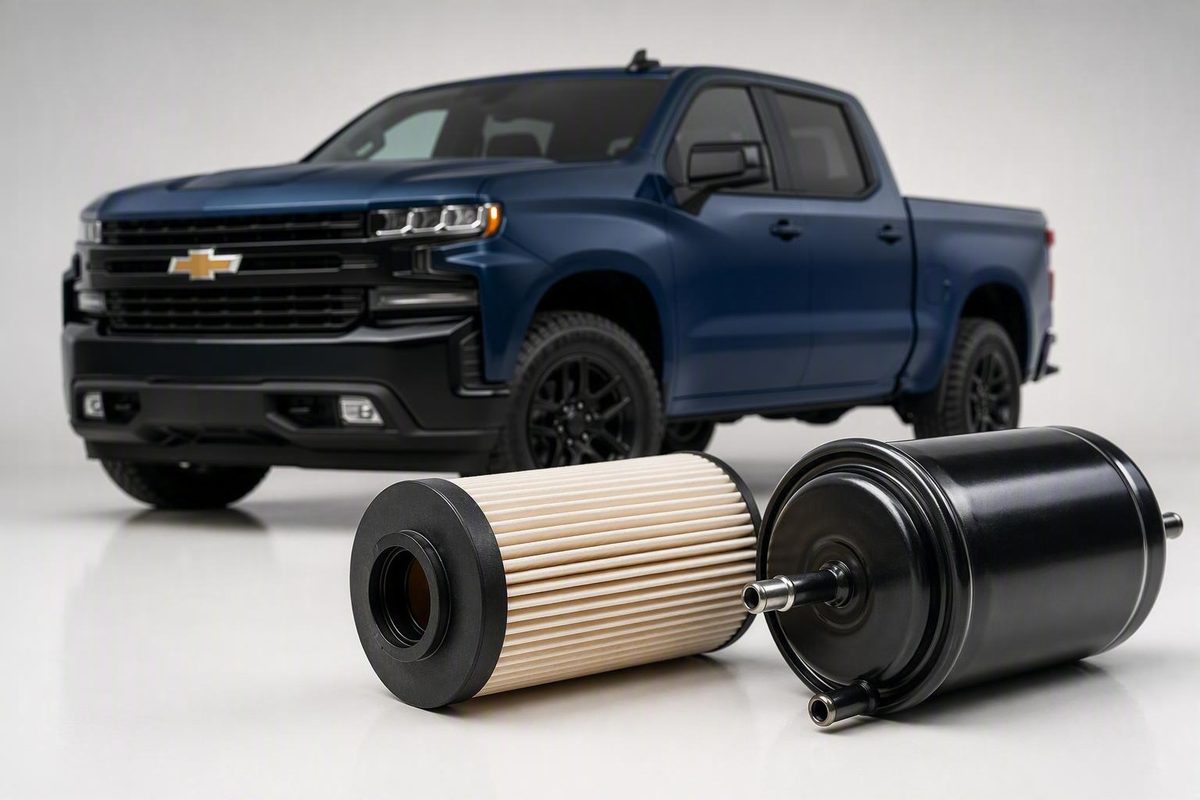
Your filter's location and design determine whether replacement is routine maintenance or part of a larger fuel-pump service.
The short answer: use the schedule for your exact vehicle
There is no dependable universal fuel filter replacement interval. The correct schedule depends on the vehicle’s:
- Model year
- Make and model
- Engine
- Fuel type—gasoline or diesel
- Fuel-filter monitor or warning status, if equipped
Start with the official owner’s manual, maintenance schedule, diesel supplement, or VIN-specific manufacturer information. Searching only for “Silverado fuel filter interval,” for example, can mix gasoline and diesel engines, light-duty and heavy-duty trucks, and model years with different filter designs.
Automotive service articles sometimes cite a general range of 20,000 to 150,000 miles, but that span is too broad to guide service on an individual vehicle. Kelley Blue Book recommends following the owner’s manual because some older vehicles have scheduled filters while some newer vehicles use filters integrated into the fuel-pump assembly in its fuel-filter service overview.
The decisive question is not simply, “How many miles are on the vehicle?” It is, “What filter design and maintenance rule apply to this exact vehicle?”
By contrast, many newer gasoline vehicles place the filter inside the fuel tank as part of the fuel-pump module. That arrangement may have no routine filter-replacement line in the maintenance schedule.
If the schedule does not list fuel-filter replacement, do not fill the gap with a generic recommendation such as 30,000 miles. First determine whether the filter is integrated, whether a separate service procedure exists, and whether the manufacturer treats it as a scheduled maintenance item.
It also helps to distinguish four events that are often confused:
- Scheduled replacement: The filter is due under a mileage, time, or monitor-based rule.
- Inspection: The fuel system or filter condition is checked, but replacement is not automatic.
- Monitor check: The fuel-filter-life display or warning status is reviewed.
- Diagnosis: A warning, suspected contamination, leak, starting problem, or drivability symptom is investigated.
Only scheduled replacement necessarily means installing a new filter. An inspection, monitor check, or diagnostic process may lead to replacement, but none is a replacement instruction by itself.
Why fuel-filter intervals vary so widely
A fuel filter captures impurities, sediment, contaminants, and rust before they reach the fuel-injection system and engine. As material accumulates, a serviceable filter can eventually restrict fuel delivery. The rate of accumulation—and how the filter is serviced—depends on its design and operating environment.
Three broad categories are useful when researching a vehicle.
Serviceable external or inline gasoline filter. If the manufacturer schedules replacement, it can usually be serviced independently of the fuel pump. Its location, fittings, and required procedure remain vehicle-specific.
Serviceable diesel fuel filter. The schedule can use mileage, elapsed time, a filter-life monitor, warning messages, or a combination of those criteria. An applicable diesel supplement can therefore be as important as the main owner’s manual.
Filter integrated with the in-tank fuel-pump assembly. Here, the filter is part of a module inside the tank rather than a normal standalone maintenance item. Depending on the vehicle, it may be serviced only when the pump assembly is removed or replaced. Routine service is therefore fundamentally different from changing an accessible inline filter.
Filter location and design determine whether replacement is ordinary scheduled maintenance or part of a larger fuel-pump service. They also affect access, labor, testing, and parts requirements.
The phrase “lifetime fuel filter” requires careful interpretation. It generally means routine filter replacement is not scheduled under normal maintenance.
Vehicle age can offer a clue, but it cannot establish an interval. There are exceptions in both directions. Engine choice can also change the answer within the same model year: a gasoline truck may have no scheduled filter replacement while its diesel counterpart has a serviceable filter and an onboard life system.
None of those variables supports assigning a mileage based only on whether a vehicle is old or new.
The reliable approach is to identify the design first and then apply the corresponding official schedule. Age, symptoms, and operating conditions provide context; they do not override vehicle-specific documentation.
A practical decision tree for finding your interval
Use the following process before buying a filter or booking routine service.
Step 1: Identify the complete vehicle configuration.
Record the model year, make, model, engine, and fuel type. If the model has multiple duty classes or generations, include those details. “2025 Silverado 1500 3.0L Duramax diesel” is useful; “Chevy truck” is not.
Do not assume that two vehicles with the same model badge use the same filter or schedule.
Step 2: Search the official maintenance material.
Look for terms such as:
- Fuel filter
- Diesel fuel filter
- Fuel-system inspection
- Fuel-filter life
- Water in fuel
- Severe service
- Special operating conditions
Check the normal maintenance schedule and any diesel or engine-specific supplement. If the manufacturer provides an electronic manual or owner portal, select the information tied to the correct model year and configuration rather than relying on a general search result.
Read the instruction carefully. “Inspect fuel system” does not mean “replace fuel filter.” “Check fuel-filter life” does not mean the filter is due. A warning-based instruction may also differ from a fixed mileage interval.
Step 3: Determine whether the filter is separately serviceable.
Confirm whether the vehicle has an external filter, an accessible diesel-filter housing, or an in-tank filter integrated with the pump assembly. Use vehicle-specific parts documentation or ask a qualified parts or service source to check by VIN.
Do not guess from the vehicle’s age or an online photograph.
Step 4: Apply only the due criteria specified for that vehicle.
Compare the documented rule with:
- Current mileage
- Elapsed time, if the schedule includes time
- Fuel-filter-life percentage, if equipped
- Active maintenance messages
- Fuel-system or water-in-fuel warnings
- Recorded date and mileage of the last replacement
Mileage and time are not automatically interchangeable. If the documentation gives both, determine whether it says “whichever comes first,” treats one as a planning estimate, or uses another rule. Do not invent a time limit when the schedule provides only mileage or monitor guidance.
Step 5: Review the duty cycle and fuel history.
Towing, prolonged idling, off-road work, snow plowing, commercial operation, dusty environments, repeated short trips, and inconsistent fuel quality can be reasons to check whether special-service guidance applies. Whether any condition formally shortens the interval depends on the exact vehicle and its official instructions.
Record how often those conditions occur. Occasional towing is not necessarily equivalent to daily commercial hauling, and one long highway trip is not the same duty cycle as repeated low-speed operation and idling.
Step 6: Treat symptoms as a diagnostic path.
If the vehicle is hard to start, loses power, stalls, leaks fuel, displays a warning, or behaves abnormally under load, do not simply wait for the next scheduled mileage. Equally, do not assume that replacing the filter will solve the complaint.
A filter can be one possible cause without being the confirmed cause.
The key distinction is simple: maintenance determines whether a known service item is due; diagnosis determines why the vehicle is malfunctioning.
Gasoline vehicles and integrated fuel filters
Many newer gasoline vehicles use a filter integrated into the in-tank fuel-pump assembly.
Depending on the vehicle, an integrated filter may be serviced only with the pump module. That does not mean the assembly should be replaced preventively at an interval borrowed from a vehicle with an external filter. It means the fuel-delivery system should be maintained and diagnosed according to its own design.
This distinction prevents three common mistakes:
- Applying a diesel fuel-filter interval to a gasoline engine in the same model
- Assuming every vehicle needs a filter at 30,000 miles
- Confusing a fuel-system inspection with replacement of a standalone filter
The supplied evidence does not establish a routine gasoline Silverado fuel-filter replacement interval. One dealership schedule separates gasoline and Duramax maintenance, listing diesel filter service but no corresponding gasoline filter replacement in its Silverado maintenance guide.
That omission does not prove that every gasoline Silverado uses the same integrated design or that no gasoline Silverado has ever had a replaceable filter. Silverado covers numerous model years, platforms, and engines. The narrower and supportable conclusion is that no universal gasoline Silverado interval can be drawn from the available guidance.
For a gasoline Silverado, confirm:
- The exact model year and engine
- Whether a separate fuel filter appears in the parts documentation
- Whether the maintenance schedule names fuel-filter replacement
- Whether a listed service is replacement, inspection, or diagnosis
- Whether a vehicle-specific warning or instruction applies
If the schedule lists only a fuel-system inspection, follow that instruction without converting it into an automatic filter change. If the filter is integrated and the vehicle has a drivability problem, diagnose the complete fuel-delivery system rather than treating the pump module as a routine maintenance part.
Silverado Duramax intervals: why the published numbers differ
Silverado Duramax owners will encounter several mileage figures online. The examples below come from Chevrolet dealership maintenance pages—not from an included GM owner’s manual or diesel supplement. They should therefore be treated as application-specific planning guidance, not verified factory requirements.
| Vehicle | Engine | Dealer planning guidance | Time guidance | Limitations |
|---|---|---|---|---|
| 2026 Silverado 2500 HD | 6.6L Duramax turbo-diesel | 15,000 miles | 12 months | The dealer qualifies applicability by use and directs owners to confirm the requirement for the specific configuration. House Chevrolet guide |
| 2025 Silverado 1500 | 3.0L Duramax diesel | About 22,500 miles | Roughly two years | Presented as a planning point; severe use or inconsistent fuel quality may justify earlier attention. Emich Chevrolet guide |
| Silverado Duramax; model year and engine not identified | Duramax diesel | Replacement at 22,500 miles; life-system check every 7,500 miles | None stated | The page does not identify model years, engine variants, or operating conditions. The shorter figure is a monitor check, not a replacement instruction. Balise Chevrolet schedule |
| 2020 Silverado diesel | Diesel engine | 22,500–30,000 miles | None stated | The source does not explain how to choose between the endpoints. Nimnicht Chevrolet guide |
| Silverado 1500; model year not identified | 3.0L Duramax diesel | 30,000 miles | None stated | A later table mentions the filter at another milestone, but the narrative is too ambiguous to establish a recurring replacement interval. Jimmy Britt Chevrolet guide |
These figures should not be averaged. Doing so would produce a seemingly precise number with no reliable application. The pages concern different model years, light-duty and heavy-duty trucks, different Duramax engines, and different operating contexts. Some include a time component, some use a mileage range, and others omit enough vehicle detail to make applicability uncertain.
They should not be ranked by assuming the shortest interval is always best. The objective is neither the earliest nor the latest number; it is the correct requirement for the truck.
Before acting on any benchmark, use the VIN to confirm:
- The applicable GM maintenance schedule and diesel supplement
- The exact engine and fuel-filter arrangement
- Whether mileage, time, filter-life status, or a warning controls service
- The severe-use provision, if any
- The required post-replacement procedure
When severe use or fuel quality may change the plan
Operating conditions can matter, but “severe use” is not a universal instruction to halve the normal interval.
Silverado dealership guidance identifies conditions that may justify earlier inspection, closer attention to filter-life status, or earlier service when supported by vehicle-specific instructions:
- Frequent or heavy towing
- Extended idling
- Off-road operation
- Snow plowing
- Commercial or jobsite use
- Dusty conditions
- Repeated short trips
- Humid operating environments
- Inconsistent or questionable fuel quality
For the named 2025 Silverado diesel application, dealership guidance specifically identifies towing, extended idling, off-road use, plowing, commercial use, dusty conditions, repeated short trips, and inconsistent fuel quality as reasons to review the service plan more closely in the Emich Chevrolet schedule.
The page calls for fuel-filter replacement at 30,000 miles and more frequently in humid climates or for extended idling Chevy Silverado 1500 Scheduled Maintenance by Mileage (30 K, 60 K, 90 K) with Gas vs. Diesel Guidance - Jimmy Britt Chevrolet. Treat humidity as context to discuss, not as evidence for a universal mileage.
Avoid rules such as “replace it at half the normal interval” unless the official documentation for the exact vehicle says so. A manufacturer may define severe operation narrowly, use a monitor to account for it, prescribe a separate schedule, or provide no altered fuel-filter mileage.
It is also important to separate gradual severe-duty exposure from a suspected contamination event.
Frequent towing or commercial idling may influence service planning over time. Suspected bad fuel, visible contamination, a water-in-fuel warning, an abrupt loss of power after refueling, or a new fuel-system warning calls for prompt, vehicle-specific diagnosis rather than waiting for scheduled maintenance. Changing only the filter should not be assumed to resolve a broader contamination problem.
When asking a technician, dealer, or manufacturer representative whether earlier service is appropriate, provide:
- Current mileage and date
- Date and mileage of the last filter replacement
- Fuel-filter-life reading and warning messages
- Where and when the vehicle was last refueled
- Any suspected contamination or water exposure
- Starting, idling, acceleration, or power symptoms
- Typical towing weight and frequency
- Time spent idling or operating at low speed
- Off-road, plowing, dusty, or commercial duty
- Whether the problem appeared suddenly or gradually
This record is more useful than simply describing the truck as having “severe use.” It lets the recommendation be tied to actual duty, service history, monitor status, and symptoms.
Symptoms that call for diagnosis before replacement
A restricted fuel filter can reduce fuel delivery, but its possible symptoms overlap with many other faults. They include:
- Difficult or extended starting
- Rough idle
- Sluggish acceleration
- Reduced power, especially under load
- Stumbling or hesitation
- Stalling
- Misfiring
These symptoms do not prove that the filter is clogged. Kelley Blue Book specifically cautions that even a no-start condition cannot be blamed on the filter alone because the pump may also be responsible in its diagnostic overview.
Use the symptom as the beginning of a diagnostic process:
| Symptom or observation | Appropriate next step |
|---|---|
| Hard or extended starting | Review warnings and service history, scan for relevant faults, and arrange engine-specific fuel-delivery testing |
| Rough idle or misfiring | Evaluate ignition, air, injector, sensor, and fuel-delivery possibilities rather than assuming the filter is responsible |
| Weak acceleration or reduced power | Note whether the problem occurs under load and compare tested fuel delivery with the exact engine specification |
| Stumbling or intermittent stalling | Arrange diagnosis of the fuel-delivery and engine-management systems |
| No-start condition | Check basic electrical and engine conditions, then evaluate pump operation, fuel delivery, and other plausible causes |
| Fuel odor or visible leakage | Treat it as a fuel-system concern requiring prompt inspection, not as proof that scheduled filter service is due |
| Check-engine light | Retrieve and interpret diagnostic information rather than replacing a filter solely to see whether the light clears |
| Low filter-life reading or filter warning | Consult the exact manual to determine whether the message calls for replacement, inspection, draining, or another procedure |
Fuel-pressure or delivery testing and inspection can help investigate a suspected restriction. A generic target or a reading taken at the wrong point can produce an unreliable conclusion.
The same restraint applies to visual inspection.
Do not replace the filter solely as an experiment for a check-engine light, hard start, misfire, or weak acceleration. If the filter is already due, replacement may be part of the maintenance plan, but the drivability complaint still requires diagnosis—particularly if it continues after service.
Service safety and what to confirm with the technician
Before approving service, ask the technician to confirm:
- Is the filter separately serviceable? An external filter and an integrated pump-module filter require different work.
- What makes it due? The basis should be the official schedule, elapsed time, mileage, monitor status, warning, contamination finding, or diagnosis.
- Does the recommendation match the VIN and engine? A diesel benchmark should not be transferred to a gasoline engine or another Duramax application.
- Were the symptoms diagnosed? Hard starting or reduced power should not be attributed to filter restriction without appropriate evaluation.
- Is the replacement part correct? The part and associated seals must match the application.
- Will the completed repair be checked for leakage? Post-service inspection should follow the vehicle-specific procedure.
Diesel owners should also ask whether the applicable procedure calls for priming, bleeding, separator service, or resetting a fuel-filter-life monitor. Not every truck requires every step, so the exact service documentation should control.
Replacing a separately serviceable filter is a different job from accessing an in-tank pump assembly. Obtain an estimate tied to the VIN, required part, labor procedure, diagnostic work, and related components rather than relying on a general national price.
The practical action sequence is:
- Identify the exact vehicle, engine, and fuel type.
- Check the official maintenance schedule and applicable supplements.
- Determine whether the filter is separately serviceable or integrated.
- Review mileage, elapsed time, monitor status, and warnings.
- Account for documented operating conditions and fuel concerns.
- Diagnose symptoms before replacing parts.
For a Silverado Duramax, the dealership benchmarks compared above—including the 15,000-, 22,500-, and 30,000-mile figures—are application-specific planning information only. Confirm the actual requirement and monitor procedure through VIN-specific GM documentation before scheduling service.
Chevy Truck Expert describes its editorial scope and hands-on background on its About page. It is an independent enthusiast publication with no affiliation with or endorsement by General Motors, not an official source for GM maintenance requirements.
Frequently asked questions
Is 30,000 miles a standard fuel filter replacement interval?
No. That mileage may be relevant to some serviceable filters and appears as a dealership planning point for one unspecified-year Silverado 1500 diesel application, but it is not a universal standard.
Some vehicles have shorter or longer schedules, while some newer gasoline vehicles have integrated filters with no routine replacement interval. Use the official maintenance information for the exact model year, engine, and fuel system. If no interval is listed, do not create one by defaulting to a generic mileage.
What does a lifetime or integrated fuel filter mean?
A lifetime or integrated filter generally is not listed as a normal, separately replaceable maintenance item. It may be installed inside the fuel tank as part of the fuel-pump assembly.
“Lifetime” does not mean the component is physically incapable of restriction, contamination, damage, or failure. It means routine replacement may not be scheduled under normal service. If fuel-delivery symptoms develop, diagnose the system rather than replacing the pump assembly solely because a generic mileage has been reached.
Should I replace a Silverado Duramax fuel filter at 15,000, 22,500, or 30,000 miles?
Use the figure that applies to the exact model year, Duramax engine, configuration, and official maintenance schedule—not whichever number appears most often online.
The comparison table above shows why the dealership benchmarks are not interchangeable: they concern different trucks, engines, model years, time guidance, and operating contexts. Check the VIN-specific GM schedule, diesel supplement, filter-life monitor, warnings, elapsed-time rule, and severe-use instructions before acting.
Does checking the fuel-filter life system mean the filter must be replaced?
No. Checking the system means reviewing its status, remaining-life indication, or warning messages. It is a monitoring event, not automatically a replacement event.
A schedule may call for monitor checks more frequently than filter replacement. Consult the official documentation for the particular truck to determine what the displayed status or warning requires.
Can hard starting or weak acceleration confirm a clogged fuel filter?
No. Hard starting, weak acceleration, rough idle, stumbling, reduced power, misfiring, and stalling can be consistent with restricted fuel delivery, but they do not identify the filter as the cause.
Review warnings and maintenance history, inspect the fuel system as appropriate, and have fuel delivery tested using specifications for the exact engine. Pump, injector, ignition, sensor, electrical, and other faults may create similar symptoms. Diagnose the complaint before authorizing filter or pump replacement.