
Choose the Silverado Cab That Fits Your Passengers, Cargo, and Garage
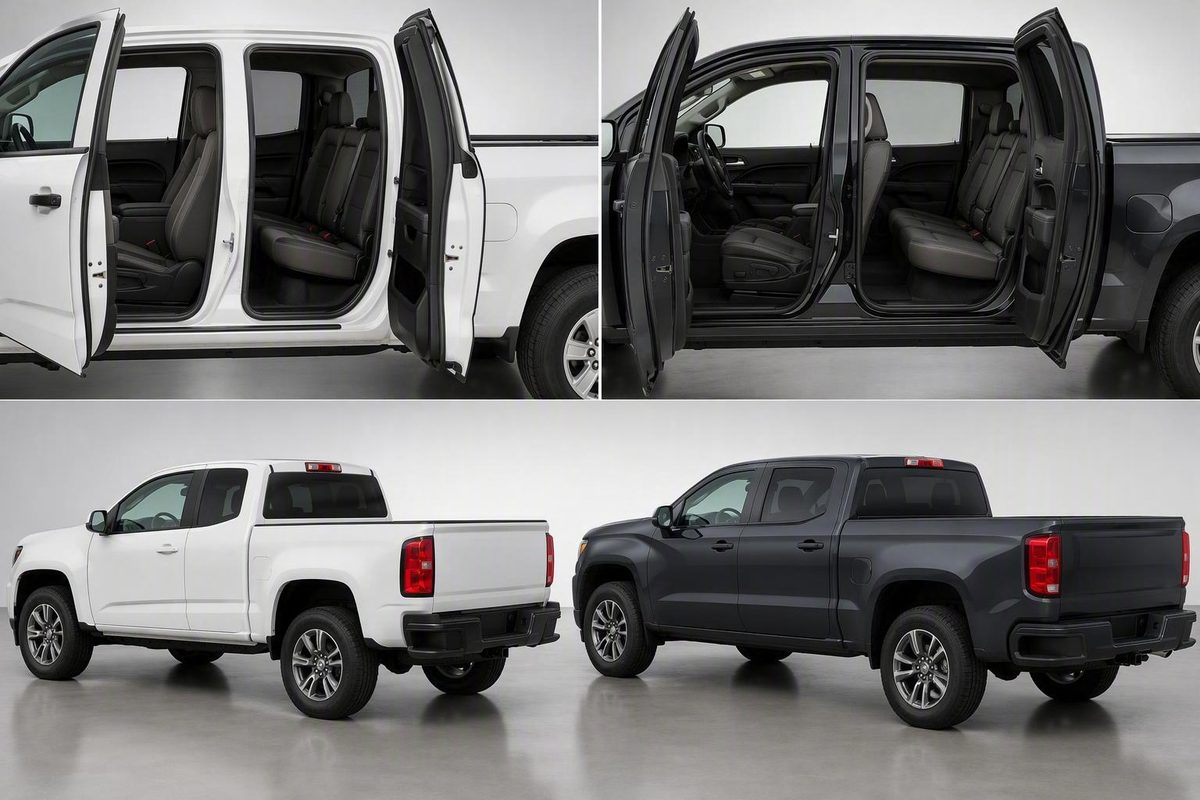
Crew Cab offers 43.40 inches of cited rear legroom versus 35.24 in the Double Cab; bed pairings and total length determine cargo and garage fit.
Quick verdict: Crew Cab for people, Double Cab for a shorter utility-focused package
The central difference in the Chevy Double Cab vs Crew Cab comparison is rear-passenger space. Both are four-door Silverado cab styles with a second row, but the Crew Cab devotes considerably more room to that row. In one dealership comparison, the Crew Cab is listed with 43.40 inches of rear legroom versus 35.24 inches in the Double Cab—an 8.16-inch advantage (Len Stoler Chevrolet).
Choose the Crew Cab as your starting point if adults, teenagers, growing children, or child seats will regularly occupy the rear. It is also the stronger candidate for long family drives, a four-person commute, or any routine involving frequent loading through the rear doors.
Consider the Double Cab when the rear row will mainly accommodate occasional passengers, pets, tools, groceries, or weather-sensitive equipment. It retains four-door access and rear seating while packaging those features into a shorter cab.
A Double Cab is not merely a smaller version of an otherwise identical truck. Cab choice also affects bed pairings, total vehicle length, trim availability, parking demands, and garage fit. In the dealership-published 2025 examples used below, a Double Cab is paired with a standard bed, while a Crew Cab is listed with either a short or standard bed. Those combinations produce three materially different trucks, not simply two different cabins.
Neither cab is universally better. The practical choice depends on four questions:
- How frequently will someone use the rear seat?
- How much bed length do you need with the tailgate closed?
- How much usable garage or parking space do you have?
- Which configurations exist for the specific model year and trim you want?
Accuracy and methodology note: Most measurements in this guide come from Chevrolet dealership comparison pages rather than Chevrolet specification documents. They are useful reference points for the cited Silverado 1500 configurations, but they are not universal Chevrolet specifications. Verify the exact year, series, trim, drivetrain, equipment, market, window sticker, and build sheet before buying.
2025 Silverado 1500 Double Cab vs Crew Cab specifications at a glance
The table consolidates figures published in a 2025 Silverado 1500 cab-style guide from Gordon Chevrolet. Treat it as a dealership-published 2025 Silverado 1500 reference, not independently Chevrolet-confirmed data or a specification chart for every Silverado.
| 2025 Silverado 1500 reference configuration | Double Cab, standard bed | Crew Cab, short bed | Crew Cab, standard bed |
|---|---|---|---|
| Doors | 4 | 4 | 4 |
| Rear seating | Yes | Yes | Yes |
| Reported second-row legroom | 35.24 in | 43.40 in | 43.40 in |
| Bed length | 79.44 in | 69.92 in | 79.44 in |
| Overall length | 231.88 in | 241.41 in | 250.08 in |
| Reported seating capacity | 5 with front buckets; up to 6 with front bench | 5 with front buckets; up to 6 with front bench | 5 with front buckets; up to 6 with front bench |
| Basic packaging priority | Standard-bed utility in the shortest listed package | Maximum rear room with a shorter bed | Maximum rear room while retaining the standard bed |
The Crew Cab’s listed rear-legroom advantage is 8.16 inches. That is the most consequential measured difference for passengers.
The dimensions also reveal a less intuitive tradeoff. The Crew Cab short-bed example has a bed that is 9.52 inches shorter than the Double Cab’s standard bed, yet the entire Crew Cab truck is approximately 9.53 inches longer. Moving to the Crew Cab short-bed configuration reallocates substantial length to passenger space without making the complete truck shorter.
When both trucks use the 79.44-inch standard bed, the listed Crew Cab is approximately 18.20 inches longer overall than the Double Cab. That difference can be decisive in a garage even though the cargo boxes are nominally the same size.
Both cab styles are reported to seat five with front bucket seats or as many as six with a front bench.
Before relying on this table for a purchase: Check the actual truck’s window sticker, build sheet, current Chevrolet materials, and physical dimensions. Confirm the model year, Silverado series, cab, bed, trim, drivetrain, and market rather than assuming a listing title is correct.
Passenger space: where the Crew Cab creates the biggest difference
Front-seat dimensions are not the main reason to select one cab over the other. Published Silverado 1500 comparison figures list effectively identical front measurements for the compared cab styles: approximately 43.0 inches of headroom and 44.5 inches of legroom (Andy Mohr Chevrolet).
The major change happens behind the front seats. The cited comparisons put second-row legroom at approximately 35.2 inches in the Double Cab and 43.4 inches in the Crew Cab. The roughly 8.2-inch difference can affect:
- Knee clearance behind a driver’s normally positioned seat
- Comfort for growing children as front-seat requirements change
- Space around a child-restraint installation
- The effort required to place bags or bulky equipment on the rear floor
- How constrained adults feel behind taller front occupants
Numbers do not tell the whole story. Crew Cab rear doors are generally visibly larger, but the supplied evidence does not establish verified opening-width measurements.
Owner experiences vary enough to rule out a universal comfort cutoff. In a discussion concerning 2014–2018 Silverado 1500 and Sierra 1500 trucks, some Double Cab owners considered the rear seat acceptable for adults or multi-hour travel, while others described it as cramped (GM-Trucks.com). These are anecdotes about an older generation, not controlled findings or evidence about every current truck.
A shorter adult behind a tall driver may have less usable room than a taller passenger behind a short driver. Seatback angle, front-seat track position, passenger proportions, child-seat design, and installation location can all change the result. There is no defensible universal rule such as “the Double Cab works below a certain height” or “it is comfortable for trips under a certain duration.”
Use this test instead:
- Have the primary driver adjust the seat, seatback, and steering wheel normally.
- Sit directly behind that position rather than behind a front seat moved artificially forward.
- Check knee, foot, and head clearance.
- Open and close the rear door from a realistic parking-space width.
- Install the actual child seat, if relevant, according to its instructions.
- Ask regular passengers to enter, sit, buckle, and exit.
If the rear seat will be used weekly, do not buy from a specification sheet alone. Test the hardest recurring seating arrangement the truck will need to handle.
Bed size and cargo volume: compare the cab-and-bed package, not the cab alone
Choosing a Crew Cab does not inherently mean accepting a short bed. In the cited 2025 Silverado 1500 reference, the Crew Cab appears with either a 69.92-inch short bed or a 79.44-inch standard bed. The cited Double Cab is paired with the 79.44-inch standard bed.
That creates three distinct packaging choices:
- Double Cab with standard bed: Less second-row space, full standard-bed length, and the shortest overall truck of the three cited configurations
- Crew Cab with short bed: More second-row space, 9.52 inches less bed length, and a longer overall truck than the cited Double Cab
- Crew Cab with standard bed: More second-row space and the same bed length as the Double Cab, but the longest overall package
Chevy Truck Expert, an independent enthusiast publication, compiles current-generation Silverado bed measurements. Its internally published figures list 62.9 cubic feet for the short bed and 71.7 cubic feet for the standard bed; the same figures also appear in an independent dealership comparison (Len Stoler Chevrolet).
Those volume figures describe cargo-box space, but they do not answer every hauling question. Start with the load itself:
- Must the tailgate close?
- Does the cargo need to lie flat on the bed floor?
- Can it sit above the wheelhouses?
- Will a cross-bed toolbox reduce usable floor length?
- Will a bed cover limit cargo height?
- Where are the usable tie-down points?
- Can the load be properly supported and secured?
- Will frequently carried items fit without contacting the cab or tailgate?
A Double Cab standard-bed truck can suit someone who frequently carries longer materials or equipment but uses the second row only occasionally. The Crew Cab short bed reverses that priority, favoring passenger accommodation while giving up bed-floor length. The Crew Cab standard bed avoids that cargo-length sacrifice but creates a substantially longer truck.
Cargo volume and payload are separate measures. Check the labels and documentation for the specific truck rather than inferring capacity from cab style or cubic feet.
For generation-specific research, consult the site’s Silverado bed-size chart, then verify the actual vehicle before buying a toolbox, tonneau cover, camper shell, liner, rack, or other fit-sensitive accessory. Similar marketing names can conceal dimensional changes between generations.
Overall length, parking, and garage fit
Cab size alone does not determine whether a Silverado will fit. The combined cab-and-bed configuration establishes the complete footprint.
As shown in the source-cited 2025 table above, the three reference packages are:
- Double Cab with standard bed: 231.88 inches
- Crew Cab with short bed: 241.41 inches
- Crew Cab with standard bed: 250.08 inches
The Crew Cab standard-bed figure converts to approximately 20 feet 10 inches. That conversion is useful when comparing the truck with garage depth, but the more precise 250.08-inch source figure should remain the basis for a close-clearance calculation.
The counterintuitive comparison is between the first two trucks. The Crew Cab short-bed truck has approximately 9.5 inches less cargo-box length than the Double Cab standard-bed truck, yet it is approximately 9.5 inches longer overall. The larger passenger compartment more than offsets the shorter box.
The Double Cab standard-bed configuration may therefore be easier to place in a limited-depth garage or crowded parking area. That does not establish a turning-circle advantage; the supplied evidence does not include verified, configuration-matched turning measurements. Parking ease also depends on sightlines, cameras, aisle width, surrounding vehicles, driver familiarity, and installed accessories.
Measure the space rather than relying on “short bed” or “standard bed” terminology. For a garage, record:
- Usable depth with the garage door fully closed
- The nearest obstruction at bumper height
- Clearance for a receiver hitch, ball mount, or hitch-mounted accessory
- Clearance for a front plate bracket, grille guard, plow hardware, or other front equipment
- Garage-door opening width and height
- Interior width at mirror and body level
- Space needed to walk around the truck
- Room to open doors without striking a wall, cabinet, or another vehicle
- The positions of steps, curbs, shelves, water heaters, and door tracks
Do not measure an empty garage wall to wall and call the result usable depth. Closed-door hardware, shelving, steps, and stored items can reduce the actual parking envelope. If clearance is tight, measure the individual truck from its foremost installed component to its rearmost installed component.
Nominal bed names describe the cargo box, not the complete vehicle. A Crew Cab with a short bed can still be longer than a Double Cab with a standard bed, so the word “short” is not evidence that the truck itself is short.
Which cab fits families, work crews, tools, pets, and mixed use?
The best starting point depends on what repeatedly occupies the truck, not on the rare trip that could be handled another way.
| Use case | Passenger frequency | Rear-seat need | Bed priority | Likely starting point |
|---|---|---|---|---|
| Family with a rear-facing child seat | Frequent | Maximum practical room and access | Secondary | Crew Cab |
| Adults or teenagers in back every week | Frequent | Meaningful knee room | Depends on cargo | Crew Cab |
| Long family trips | Frequent or periodic | Sustained rear comfort | Secondary unless carrying substantial gear | Crew Cab |
| Four-adult work commute | Frequent | Regular adult seating | Moderate to high | Crew Cab |
| Coworkers riding short distances occasionally | Occasional | Basic rear seating | High | Double Cab |
| Tools or groceries carried inside | Little passenger use | Enclosed, weather-protected area | Standard bed useful | Double Cab |
| Pet transport | Varies | Entry space and carrier fit | Depends on other cargo | Test both |
| Long cargo carried frequently | Low rear-passenger use | Secondary | Standard-bed length important | Double Cab |
| Standard bed plus regular family use | Frequent | High | High | Crew Cab standard bed, if it fits |
| Fixed-depth garage | Any | Depends on household | Must fit measured space | Compare exact overall lengths |
For families, the Crew Cab is the more passenger-oriented starting point—not a guarantee of fit, and not a comparative crash-safety claim. Its additional rear legroom and generally larger rear doors can make it more practical for regular passengers, teenagers, longer drives, and child-seat use. The actual restraint and seating position still need to be tested.
For work crews, distinguish between carrying coworkers occasionally and transporting a team every day. A Double Cab may be reasonable when coworkers ride short distances and bed utility matters more. If adults occupy the rear row daily, the Crew Cab’s passenger-oriented packaging is the more appropriate place to begin.
Either rear row can also provide enclosed space for tools, groceries, pets, electronics, or equipment that should not remain exposed in the bed. Do not assume either cab has a particular folded-seat or under-seat storage volume without inspecting the actual interior. Seat design and installed storage equipment can differ.
Six-person capability requires careful interpretation. In the cited 2025 configurations, reaching six designated seating positions requires a front bench; front bucket seats reduce the reported capacity to five. Even with six positions, practical comfort depends on occupant size, seating arrangement, and trip length.
Anecdotal reports reinforce the need to test. In a 2016 owner discussion focused primarily on 2014–2016 Silverado and Sierra trucks, participants reported substantially different experiences with Double Cab comfort and child-seat access (SilveradoSierra.com). Rather than selecting the anecdote that supports a preferred answer, treat the disagreement as evidence that fit is personal and generation-specific.
A useful decision rule is to choose around the hardest recurring requirement:
- A rear-facing child seat points toward Crew Cab.
- Four adult commuters point toward Crew Cab.
- A fixed garage depth may point toward Double Cab.
- Frequently carried long cargo may point toward a standard bed.
- Regular passengers plus a standard bed may require the longer Crew Cab standard-bed truck.
Optimize for what is difficult to improvise. It is often easier to plan occasional oversized cargo around an otherwise suitable truck than to create rear legroom that the cab does not have. That balance reverses if carrying long materials is the truck’s primary job.
Model years, cab names, doors, and trim availability
The numerical comparison in this article centers on a dealership-published 2025 Silverado 1500 example. Do not apply its dimensions or cab-and-bed combinations automatically to another Silverado generation, a Silverado HD, a Colorado, or every trim, drivetrain, and market.
Terminology becomes especially confusing in used-truck listings. Older Chevrolet trucks may use “Extended Cab,” and their rear-door design may differ from that of newer Double Cabs. Sellers sometimes use Double Cab and Extended Cab interchangeably even when the applicable generation distinguishes them.
In a 2017 owner discussion focused on trucks from the surrounding 2014–2018 period, participants identified Double Cabs by their smaller rear doors and reduced rear-passenger area relative to Crew Cabs. They also distinguished those Double Cabs from older Extended Cabs with different rear-door arrangements (SilveradoSierra.com). These are historical owner observations, not rules covering every Chevrolet truck.
Four doors alone do not establish the cab style because the compared Double Cab and Crew Cab examples both have four. A Crew Cab generally has larger rear doors and a longer passenger compartment, while a Double Cab generally has shorter rear doors. For a purchase, use the official build sheet, window sticker, model-year-specific vehicle record, or an official VIN lookup rather than appearance alone.
Do not rely on a forum-supplied rule involving a single VIN character. Decode the complete VIN through an official source or have a Chevrolet dealer retrieve the build information.
Trim choice can also narrow the decision. For 2025, the Gordon Chevrolet guide lists Double Cab on WT, Custom, and LT trims. It lists Crew Cab across WT, Custom, Custom Trail Boss, LT, RST, LT Trail Boss, LTZ, High Country, and ZR2 (Gordon Chevrolet). This is dated dealership guidance, not a permanent availability promise.
Trim access may depend on bed, drivetrain, market, inventory, and production decisions. Even if the Double Cab fits physically, it may not be offered with the equipment package you want. Conversely, a used-market search may reveal model-year combinations absent from a newer lineup. Set the model year first, then evaluate cab availability within that year.
A test-drive and buying checklist before choosing either cab
Begin with the exact vehicle rather than the generic question of Chevy Double Cab vs Crew Cab. Record:
- Model year
- Silverado series, such as 1500 or HD
- Trim
- Engine
- Drivetrain
- Cab configuration
- Bed configuration
- Installed packages and accessories
- Market of original sale, if relevant
Then work through the following checks.
1. Establish the driver’s real seating position. Have the primary driver adjust the seat, steering wheel, and seatback normally. Do not move the seat forward to make the rear row look better. Evaluate rear knee and foot room behind the true driving position.
2. Test actual rear-seat use. Bring the people and equipment the truck will carry. That may include adult passengers, children, a child restraint, a pet carrier, mobility aids, tool cases, or electronics. Check entry, buckling, sitting position, and exit—not simply whether an item can be pushed through the doorway.
3. Confirm the seating configuration. Check whether the truck has front buckets or a bench and whether its actual seating capacity is five or six. Inspect the installed seats, belts, and designated positions rather than relying on a generic listing.
4. Measure the cargo box. Measure the inside floor length and relevant width for your load. Account for a toolbox, liner, divider, tonneau hardware, or other accessory that reduces usable space. Determine whether regular cargo fits with the tailgate closed and whether appropriate securement points are available.
5. Measure the complete truck. Do not translate “short bed” into “short truck.” Measure or verify total length for that exact configuration, including equipment extending beyond the bumpers.
6. Recreate the garage or parking constraint. Measure usable garage depth with the door closed. Account for the hitch, front accessories, shelving, steps, door mechanisms, walking room, and space needed to open the doors. If workplace parking is the concern, evaluate the actual aisle width and stall length.
7. Match vehicles before comparing prices. Compare price only after matching model year, trim, engine, drivetrain, bed, equipment, condition, mileage, and incentives. Owner anecdotes about Crew Cab premiums reflect particular vehicles and markets; they do not establish a fixed price difference.
8. Verify weight and capability labels. Check the door-jamb labels, window sticker, build sheet, and current Chevrolet documentation for the individual truck’s payload, tire specifications, towing details, and configuration. Do not assume a universal towing or payload advantage from the cab name.
The available evidence does not support a reliable universal capability winner between Double Cab and Crew Cab.
The final decision path is straightforward:
- Frequent rear passengers or regular child-seat use: Start with Crew Cab.
- Infrequent rear passengers, standard-bed utility, and a shorter footprint: Start with Double Cab.
- Passenger room and full standard-bed length are both nonnegotiable: Evaluate a Crew Cab standard-bed truck and determine whether its added length fits.
- Priorities conflict: Sit in, load, and measure both actual trucks.
The Crew Cab is the better answer when recurring rear-seat access and passenger room cannot be compromised. The Double Cab is the practical answer when the rear row is secondary and a standard bed in a shorter overall package better suits the work or garage.
Remember that the cited dimensions are dealership-reported Silverado 1500 reference figures, not specifications for every Chevrolet truck. Base the purchase on the actual truck’s documentation, physical measurements, and an in-person passenger or child-seat test.
Frequently asked questions about Chevy Double Cab vs Crew Cab
How much more rear legroom does a Chevy Crew Cab have than a Double Cab?
One Silverado 1500 dealership comparison lists 43.40 inches of second-row legroom for the Crew Cab and 35.24 inches for the Double Cab. That gives the Crew Cab an 8.16-inch advantage (Andy Mohr Chevrolet).
Do not assume the same difference applies to every Silverado generation or Chevrolet truck. Verify the model-year-specific information for the vehicle under consideration.
Can a Chevy Crew Cab have a standard bed?
Yes. In the cited Silverado 1500 comparisons, the Crew Cab can be paired with a 79.44-inch standard bed as well as a 69.92-inch short bed. The Double Cab reference configuration uses the standard bed (McGavock Chevrolet).
Availability can vary by year, series, trim, drivetrain, and market. Confirm the combination on the actual truck’s build sheet or current configurator.
Is a Double Cab large enough for adults or child seats?
It can be, but suitability depends on the specific adults, front-seat positions, trip length, and child-restraint design. Owner reports are mixed: some found Double Cabs acceptable for adult travel, while others considered them cramped. Discussions involving older trucks also generally favored Crew Cabs for easier child-seat access.
Put the driver’s seat in its normal position, then test the rear with the actual adults or child restraint. If adults, growing children, or a rear-facing seat will be regular occupants, the Crew Cab is the more practical starting point.
Do Double Cab and Crew Cab Silverados both seat six people?
They can in the cited 2025 Silverado 1500 configurations, but six-person seating requires a front bench. With front bucket seats, the reported capacity is five.
Seating capacity does not establish comfort. Before planning to carry six people, inspect the specific truck’s seats and belts and have the intended occupants try the available space.
How can I tell a Double Cab from a Crew Cab on a used Silverado?
A Crew Cab generally has larger rear doors and a visibly longer passenger compartment. A Double Cab generally has smaller rear doors and less rear-seat space. Door count alone is not enough because both can have four doors.
Cab names and rear-door designs vary across generations, and used listings can be inaccurate. Confirm the cab through the build sheet, window sticker, model-year-specific vehicle record, or an official VIN decoder rather than relying on appearance or an unverified single-character VIN rule.