
How Long Is a Colorado’s Bed? Short- and Long-Box Sizes Explained
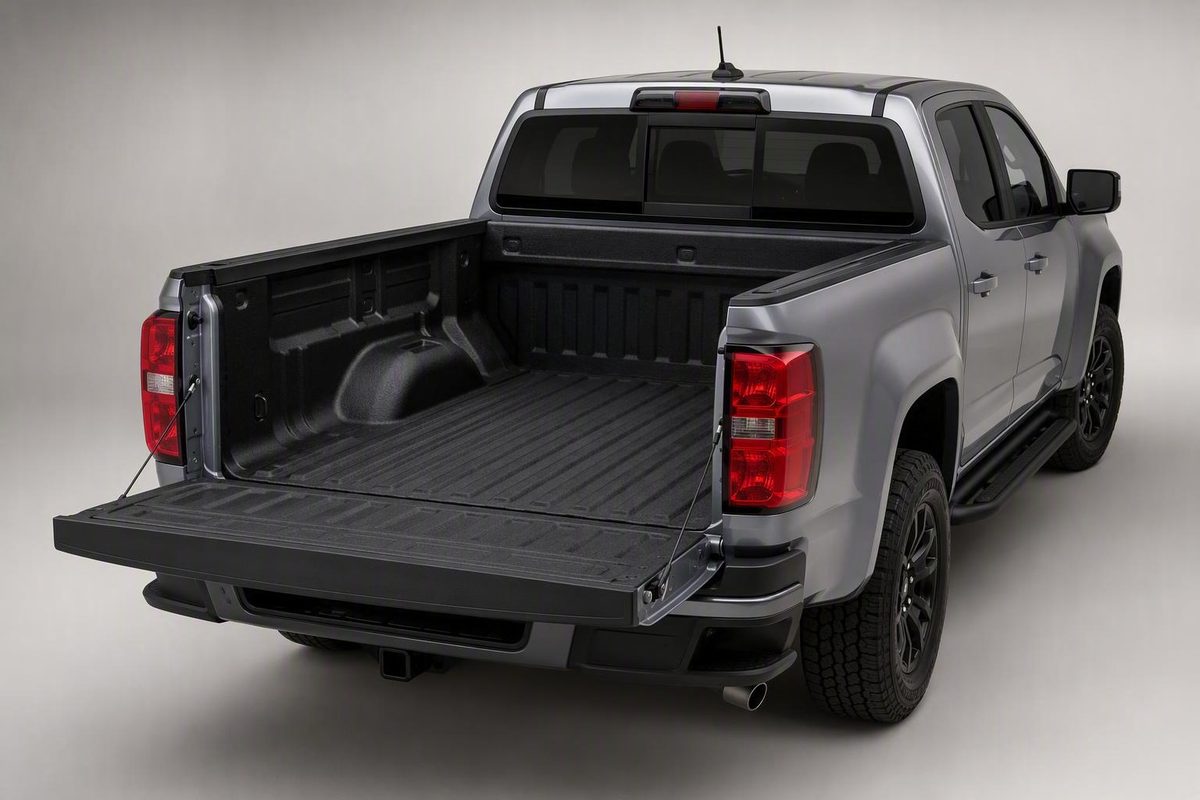
In 2019, the Extended Cab was reported with a 74-inch long box, while the Crew Cab was reported with either a 61.7-inch short box or a 74-inch long box.
Quick answer: How long is a Chevy Colorado bed?
For the supported recent examples, the Chevy Colorado bed length is 61.7 inches. That applies to the available evidence for the 2023 Colorado and 2024 Colorado, although those dealer pages do not document every possible ordering detail for each year.
Third-party sources also report a 61.7-inch bed for the 2025 Colorado and approximately the same measurement for the 2026 Colorado. These sources describe one Crew Cab short-bed configuration for those model years.
A 61.7-inch bed converts precisely to 5 feet 1.7 inches. Dealers and accessory sellers commonly round that measurement to about 5 feet 2 inches or call it a 5-foot-class bed.
That is not the answer for every Colorado ever built. Some older cab-and-bed combinations used a 74-inch long box, equal to 6 feet 2 inches.
Colorado bed lengths at a glance
Box Exact floor length Feet and inches Common description Short box 61.7 in. 5 ft. 1.7 in. About 5 ft. 2 in. Long box 74.0 in. 6 ft. 2 in. 6-ft.-class or 6-ft.-2-in. long box The difference between the two supported measurements is 12.3 inches.
The essential qualifier is supported examples. Bed availability changed with model year and cab configuration, and the available evidence does not document every Colorado year from the truck’s full production history. For that reason, identify a used truck by model year, cab, configuration, and physical bed measurement rather than relying on a generalized answer.
All Colorado measurements in this guide come from automotive publications, dealerships, retailers, accessory sellers, or owners. None of the available sources is a Chevrolet specification page, brochure, or order guide. Where the sources disagree or leave a configuration unclear, the limitation is disclosed rather than filled by inference.
Chevy Colorado bed-length chart by model year and cab
This chart covers only the years and configurations established by the available evidence. It is not a complete production-history chart.
Nominal bed names can also be misleading. “Five-foot bed,” “5-foot-class bed,” and “5-foot-2-inch bed” may all describe the same 61.7-inch box. Likewise, “six-foot bed” is sometimes used informally for the 74-inch, 6-foot-2-inch long box.
| Model year | Cab or configuration | Exact bed length | Practical label | Evidence limitation |
|---|---|---|---|---|
| 2019 | Extended Cab | 74.0 in. | 6 ft. 2 in. long box | The detailed dealer comparison says the Extended Cab used the long box. |
| 2019 | Crew Cab Short Box | 61.7 in. | About 5 ft. 2 in. | Detailed configuration text supports this option, although the simplified summary can make it look like the only Crew Cab bed. |
| 2019 | Crew Cab Long Box | 74.0 in. | 6 ft. 2 in. long box | Supported by the detailed text rather than clearly represented in the summary. 2019 cab-and-box comparison |
| 2020 | Extended Cab Long Box, 2WD Base | 74.0 in. | 6 ft. 2 in. long box | Applies only to this specifically identified configuration. 2020 configuration specification |
| 2021 | Not established | Not established | — | Do not infer a length from the supported 2020 or 2022 entries. |
| 2022 | Crew Cab entry | 61.7 in. advertised | About 5 ft. 2 in. | The chart supports the Crew Cab entry, not every possible 2022 configuration. |
| 2023 | Crew Cab entry | 61.7 in. advertised | About 5 ft. 2 in. | The 2022–2023 advertised-length chart covers Crew Cab trucks. Advertised bed-length chart |
| 2023 | Dealer-listed example | 61.7 in. | About 5 ft. 2 in. | A separate dealer page reinforces the length but does not establish every ordering combination. |
| 2024 | Configuration not identified | 61.7 in. | About 5 ft. 2 in. | The dealer page does not establish cab choices or alternative-bed availability. |
| 2025 | Crew Cab short bed | 61.7 in. | About 5 ft. 2 in. | The accessory guide lists a short bed and no standard- or long-bed alternative. 2025 bed-length guide |
| 2026 | Crew Cab, across listed lineup | 61.7 in. | About 5 ft. 2 in. | The dealer page lists one common bed for WT, LT, Trail Boss, Z71, and ZR2. 2026 Colorado dimensions |
| Other years or configurations | Not established | Not established | — | Measure the truck and consult model-specific documentation. |
2019: both short- and long-box Crew Cabs were reported
The detailed 2019 comparison says the Extended Cab came with the 74-inch long box, while the Crew Cab could be configured with either the 61.7-inch short box or the 74-inch long box.
The source’s summary is less precise because it presents the Crew Cab with a 5-foot-2-inch bed. Its detailed body-configuration text expressly describes both Crew Cab box choices. That more specific statement is useful for identifying the available combinations, but the inconsistency is a reason to measure a used 2019 Crew Cab rather than assume it has the short box.
This is an important used-truck distinction. Cab style can narrow the possibilities for a known model year, but “Crew Cab equals short bed” is not a dependable rule across the Colorado’s supported history.
2020: one specific long-box record
The supported 2020 example is narrowly defined: a Colorado Extended Cab Long Box, two-wheel drive, Base trim, with a 74-inch cargo-bed length. It does not establish the bed choices for every 2020 Colorado.
There is also a source-labeling trap. The supplied source title referred nominally to 2026, but the page URL, heading, year field, and configuration identify a 2020 truck. Its 74-inch measurement is evidence only for the displayed 2020 Extended Cab Long Box configuration—not for a 2026 long-bed Colorado.
2022 and 2023: supported Crew Cab entries
An aftermarket retailer’s advertised-length chart lists a 61.7-inch bed for the 2022–2023 Colorado Crew Cab. Because the entry is cab-specific, it should not be expanded into a claim about every configuration that might have existed in those model years.
For 2023, a separate dealer listing reports a 61.7-inch bed, a 58.2-inch floor width, 45.5 inches between the wheel housings, and 41.9 cubic feet of maximum cargo volume. Those figures reinforce the Crew Cab chart entry, but the dealer page does not provide a complete ordering guide for the model year.
2024: length supported, configuration details incomplete
The available 2024 dealer page gives the bed length as 61.7 inches. It does not clearly identify the cab configuration or document whether another bed choice was available. The source therefore supports the listed length without proving the model year’s complete cab-and-bed ordering structure.
The same page reports 49.9 cubic feet of cargo volume. That conflicts with the 41.9-cubic-foot figure reported for other recent 61.7-inch beds, so the 2024 volume should not be treated as definitive.
2025: one reported Crew Cab short-bed configuration
The supplied retailer and accessory material describes the 2025 Colorado as using one Crew Cab short-bed configuration, with a 61.7-inch floor length and no listed factory long-bed alternative.
That conclusion is limited to the model year covered by those sources. It does not imply that older Colorado Crew Cabs lacked a long-box choice.
2026: one reported bed across the lineup
Dealer sources describe the 2026 Colorado as a Crew Cab with the same 61.7-inch bed across the listed trims. The identified lineup includes WT, LT, Trail Boss, Z71, and ZR2.
These are dealer- and accessory-industry reports rather than a Chevrolet order guide. Anyone buying a fitted component should still confirm the individual truck and use the accessory manufacturer’s year-, cab-, and bed-specific application listing.
For years and configurations marked “not established,” the evidence gap is intentional. Adjacent model years should not be treated as interchangeable without model-specific documentation.
Bed width, wheelhouse clearance, depth, and cargo volume
Length answers only one part of a cargo-fit question. Whether an item fits also depends on:
- Floor width: the broader side-to-side measurement at the bed floor.
- Wheelhouse clearance: the narrowest floor-level width between the inward-projecting wheel wells.
- Bed depth: the vertical distance inside the cargo box.
- Rail-level dimensions: especially important for covers, toppers, racks, and cross-bed toolboxes.
- Cargo volume: useful for broad capacity comparisons but unable to describe the shape of that space.
- Installed equipment: liners, mats, rail caps, drawer systems, and storage compartments can reduce usable room.
For the supported recent examples, reported floor width ranges from approximately 58.2 to 58.8 inches, while the reported width between the wheel housings is approximately 45.5 inches. The 0.6-inch floor-width difference should not be averaged away. It may reflect a model-year difference, rounding, measurement location, or another methodological distinction that the sources do not explain.
Dimension comparison
| Supported example | Bed length | Floor width | Between wheel housings | Depth | Reported volume |
|---|---|---|---|---|---|
| 2020 Extended Cab Long Box 2WD Base | 74.0 in. | 57.8 in. | 44.4 in. | Not listed | 49.9 cu. ft. |
| 2023 dealer example | 61.7 in. | 58.2 in. | 45.5 in. | Not established | 41.9 cu. ft. |
| 2024 dealer listing | 61.7 in. | 58.2 in. | 45.5 in. | Not established | 49.9 cu. ft., disputed |
| 2025 Crew Cab short bed | 61.7 in. | 58.8 in. | 45.5 in. | 20.9 in. | 41.9 cu. ft. |
| 2026 Crew Cab bed | 61.7 in. | About 58.8 in. | About 45.5 in. | Not established here | About 41.9 cu. ft. |
For the specific 2020 Extended Cab Long Box, the reported combination is 74 inches long, 57.8 inches wide at the floor, 44.4 inches between the wheel housings, and 49.9 cubic feet in volume. Those measurements apply only to that identified 2020 configuration.
For 2025, the third-party measurements are 61.7 inches long, 58.8 inches at maximum width, 45.5 inches between the wheel housings, 20.9 inches deep, and 41.9 cubic feet in volume.
Mathematically, 41.9 cubic feet is approximately 1.55 cubic yards because a cubic yard contains 27 cubic feet. The source article also gives an inconsistent 2.8-cubic-yard conversion; that conversion should not be used.
For 2026, dealer-reported figures are approximately 58.8 inches of floor width, 45.5 inches between the wheel housings, and 41.9 cubic feet of cargo volume. Another 2026 dealer page describes the same common bed across the listed trims, reinforcing the configuration claim without turning it into a first-party Chevrolet specification.
Why the 2024 volume figure is unresolved
The 2024 dealer listing combines a 61.7-inch bed length, 58.2-inch floor width, 45.5-inch wheelhouse width, and 49.9-cubic-foot volume.
The volume is the unresolved part. It matches the figure reported for the older 74-inch long-box example, while the supported 2023, 2025, and 2026 short-bed examples are reported at 41.9 cubic feet. The available material does not explain whether the discrepancy comes from a different method, a configuration distinction, copied data, or another error.
Cargo volume also cannot prove that a particular object fits. A long, narrow item may occupy little total volume but still extend beyond the closed tailgate. A bulky item may appear acceptable by volume yet be blocked by the wheel wells, bed rails, tailgate opening, or an installed toolbox.
Keep bed dimensions separate from payload and towing ratings. Those ratings can vary with configuration and equipment, and the available evidence does not establish one universal rating for every Colorado. Use the documentation for the individual truck when evaluating load limits.
How to measure a Colorado bed correctly
Truck-bed length is generally the usable interior floor distance from the inside of the front bulkhead behind the cab to the inside edge of the closed tailgate.
That interior measurement is more useful for cargo planning and many accessories than an exterior body-panel measurement.
Use this procedure:
- Clear the measuring path. Remove loose cargo or anything that prevents the tape from lying straight.
- Close the tailgate. The listed bed length generally refers to enclosed interior space.
- Place the tape against the inside face of the front bulkhead. Do not start at the cab or exterior bed panel.
- Run the tape straight along the bed floor. Avoid measuring diagonally or holding the tape above the floor.
- Measure to the inside edge of the closed tailgate.
- Record the result in inches. Inches distinguish a 61.7-inch bed from a rounded “five-foot” label.
- Repeat the measurement. A second reading can reveal an incorrect starting point or a crooked tape.
Accessory guidance recommends measuring the actual vehicle because advertised names are rounded and liners, rail caps, cargo systems, and other equipment can alter usable dimensions. Accuracy to roughly one-quarter inch is appropriate for many fitted products. RealTruck’s measuring guide
Why “5-foot bed” does not mean exactly 60 inches
Truck-bed names are categories rather than guaranteed literal measurements:
- 60 inches equals exactly 5 feet.
- 61.7 inches equals 5 feet 1.7 inches.
- 62 inches equals 5 feet 2 inches.
Calling the Colorado box a “5-foot bed” identifies its general class. Calling it a “5-foot-2-inch bed” rounds the measurement to the nearest whole inch. For close cargo or accessory fit, use the actual 61.7-inch figure and then measure the individual truck.
Measure for the product, not just the truck
Different products mount to different parts of the bed, so one floor-length measurement cannot answer every fitment question.
For a bed mat or drop-in liner:
- Measure length at floor level.
- Record the floor width.
- Measure the narrow clearance between the wheel wells.
- Note floor contours, access panels, drains, coatings, and existing hardware.
For a tonneau cover or topper:
- Measure at the bed rails, not only at floor level.
- Use the product maker’s specified mounting points.
- Note rail caps, racks, stake-pocket accessories, and hardware that could interfere with clamps.
For a crossover toolbox or storage system:
- Record rail-to-rail width and bed depth.
- Locate the wheel wells and any other obstruction.
- Check the available space behind the cab.
- Account for the room needed to open a lid or access drawers.
For slide-in or highly fitted equipment:
- Measure the floor, rails, depth, tailgate opening, and wheelhouse positions.
- Record protrusions instead of treating the cargo box as a perfect rectangle.
- Account for liners, mats, electrical components, and installed storage systems.
An accessory guide defines usable length as the floor distance from the bulkhead to the inside of the tailgate and notes that width, depth, wheel-well position, and model-specific design also affect fit. Physical measurements should therefore be paired with the product maker’s vehicle-specific application listing.
What can fit in a 61.7-inch Colorado bed?
Cargo fit is best evaluated through measurable constraints rather than general promises. Start by asking:
- What are the load’s length, width, height, and shape?
- Must the tailgate close?
- Will the item sit on the floor, above the wheel wells, or on separate support equipment?
- Does the proposed arrangement comply with the limits and instructions in the truck’s documentation?
Plywood and other 4-by-8-foot sheet goods
A full 4-by-8-foot sheet measures 48 by 96 inches. Compared with a 61.7-inch bed, the sheet is 34.3 inches longer, so it cannot be enclosed lengthwise with the tailgate closed.
Width creates another constraint. The approximately 45.5-inch gap reported between the wheel housings is 2.5 inches narrower than a 48-inch sheet. A full-width sheet therefore cannot lie directly on the lowest part of the floor between those wheel wells.
Another arrangement may place sheet material above the wheel housings or extend it over an open tailgate. The dimensions alone do not establish whether a particular stack, support arrangement, or trip is appropriate. Consult the truck and equipment documentation and the rules that apply where the vehicle will be operated.
Measure the actual width at the height where the material will rest. A liner, bed wall, toolbox, rack, or other installed component may change the available space.
Lumber, pipe, trim, and ladders
Long, narrow material does not require the 48-inch width of sheet goods, but it can still exceed the enclosed bed length. Compare the material’s complete dimensions with:
- The enclosed bed-floor length.
- The available support points.
- The position of the wheel wells and tailgate.
- The space occupied by other cargo or accessories.
- The truck and equipment documentation applicable to the load.
Do not assume all 8-foot material presents the same fit problem. Light trim, dense lumber, pipe, and a large material stack can have very different dimensions and equipment requirements.
Bicycles and motorcycles
Bicycle and motorcycle fit depends on more than nominal bed length. Measure:
- Total vehicle length.
- Handlebar width.
- Front- and rear-tire positions.
- Height at the handlebars, mirrors, or windscreen.
- Space required by the selected rack or wheel chock.
- The locations needed by the chosen mounting or restraint system.
- Tailgate clearance in the intended orientation.
Dealer accessory lists include bicycle racks and tire-groove products, demonstrating that cargo-management accessories are marketed for these uses. They do not prove that every bicycle, motorcycle, rack, or setup fits every Colorado.
Removing a bicycle’s front wheel or changing its orientation may reduce the required length, but the outcome still depends on frame size, wheelbase, other cargo, and the mounting system. Use the accessory maker’s application data rather than relying on the bed’s nominal name.
Toolboxes, coolers, camping equipment, and work gear
Rectangular equipment can be difficult to fit because the Colorado bed is not a completely unobstructed rectangle. Check:
- Width between the wheel wells.
- Width available above the wheel wells.
- Clearance below and across the bed rails.
- Space required to close the tailgate.
- Lid-opening or drawer-extension clearance.
- The footprint of an existing liner or storage system.
- Whether installed equipment occupies the intended mounting area.
Cargo volume is useful for comparing overall capacity, but it does not show whether a wide cooler passes between the wheel housings or whether a toolbox clears the rails. Compare the item’s exterior measurements with the actual truck.
Pre-loading checklist
Before planning an unusual, long, or heavy load:
- Measure the cargo’s full length, width, height, and shape.
- Measure the truck at the points where the load will actually rest.
- Check the applicable limits in the vehicle documentation.
- Include installed accessories and other cargo in the plan.
- Identify the intended tailgate position.
- Follow the instructions supplied with any rack, support, or cargo-management product.
- Check the transportation requirements that apply to the route and jurisdiction.
The bed dimensions identify likely fit constraints. They do not certify a particular loading arrangement.
How to identify a short-bed or long-bed used Colorado
For the supported configurations, physical measurement is the most dependable practical identification method:
- A floor measurement near 61.7 inches corresponds to the supported short box.
- A floor measurement near 74 inches corresponds to the supported long box.
This is not presented as an exhaustive rule for every Colorado ever produced. It distinguishes the two box measurements documented in the available evidence.
Allow for small differences caused by tape placement, liners, bulkhead contours, or rounding. If the result is unclear, repeat the measurement with the tailgate closed and the tape lying flat along the bed floor.
Use the cab and model year as supporting evidence
Cab style can narrow the possibilities once the model year is known, but it cannot serve as a universal rule.
For 2019, the Extended Cab is reported with the 74-inch long box, while the Crew Cab could reportedly have either the 61.7-inch short box or the 74-inch long box. A used 2019 Crew Cab should therefore not automatically be advertised or ordered for as a short-bed truck.
The same caution applies when comparing different years or generations. A rule that works for one group of trucks may not apply to another, and sellers may use “short bed,” “standard bed,” and “long bed” inconsistently.
Treat visual clues as secondary
Owners discussing second-generation Colorado and Canyon trucks have suggested body proportions and fuel-door location as quick visual clues. Participants described the fuel door as being closer to the wheel-well area on the short bed and on a flatter panel ahead of the wheel well on the long bed. The original poster also reported that a generic VIN decoder did not provide the bed length. Second-generation owner discussion
These are unofficial, owner-reported observations about second-generation trucks. They should not be generalized to every Colorado generation or used instead of a tape measure. Photographs can distort proportions, and body repairs or replacement components can weaken visual clues.
Before ordering a used-truck accessory, confirm:
- Model year.
- Cab style.
- Physical floor length.
- Product-specific application listing.
- Any available vehicle build documentation.
Also inspect for liners, rail caps, racks, storage systems, replacement tailgates, or body work that could affect fit.
Choosing between a recent short bed and an older long box
Neither bed is universally better. The appropriate choice depends on recurring cargo, accessory requirements, passenger needs, and where the truck must be driven or stored.
The supported 74-inch box provides 12.3 inches more enclosed floor length than the 61.7-inch box. That can reduce overhang for long items or leave more space behind a cross-bed toolbox. It does not solve every cargo problem: the supported 2020 long-box example has a reported 44.4-inch wheelhouse gap, compared with approximately 45.5 inches in the supported recent short-bed examples.
Before choosing, list:
- Your longest recurring cargo.
- Required width at floor level.
- Required clearance above the wheel wells.
- Whether a closed tailgate matters.
- Rail-level dimensions required by a cover, topper, rack, or toolbox.
- Passenger and rear-seat requirements.
- Overall truck length and maneuvering needs.
- Garage, driveway, and parking constraints.
The available 2025 and 2026 evidence describes one Crew Cab short-bed configuration with a 61.7-inch floor. A shopper who needs a factory 74-inch Colorado box should therefore investigate older used configurations rather than assume that a 2025 or 2026 truck offers one.
Configuration-level checking remains necessary in the used market. The 2019 Crew Cab could reportedly have either box, while the supported 2020 long-bed record is specifically an Extended Cab Long Box 2WD Base. Neither example proves every possible configuration for surrounding model years.
If a 74-inch box is still substantially shorter than your recurring cargo requires, compare full-size trucks separately. Colorado and Silverado measurements are not interchangeable. Readers expanding their search can consult the site’s Chevy Silverado bed-size chart, but every measurement there is Silverado-specific.
Use this final buyer checklist:
- Verify the model year and cab.
- Measure the interior bed floor with the tailgate closed.
- Measure the wheelhouse gap and relevant rail dimensions.
- Inspect liners, caps, racks, and storage modifications.
- Confirm vehicle-specific accessory compatibility.
- Compare representative cargo dimensions where practical.
- Consult the truck’s documentation for applicable operating and load limits.
The useful answer is configuration-specific: supported recent Colorado examples use a 61.7-inch bed, while some older trucks used a 74-inch long box. Identify the year and cab, measure the actual bed, and verify product fitment before buying equipment.
Frequently asked questions
Is the Chevy Colorado bed 5 feet or 5 feet 2 inches long?
The supported recent bed measures 61.7 inches, equal to 5 feet 1.7 inches. Dealers and accessory sellers commonly round that to 5 feet 2 inches, while some call it a 5-foot or 5-foot-class bed. For cargo or accessory fit, use the exact measurement rather than the nominal label. 2026 measuring chart and dimensions
Does the Chevy Colorado have a 6-foot or long-bed option?
Some older Colorados did. The supported long box measures 74 inches, or 6 feet 2 inches. For 2019, the Extended Cab is reported with the long box and the Crew Cab with either the short or long box. A specific 2020 Extended Cab Long Box configuration is also documented at 74 inches. 2019 Colorado configuration comparison
The supplied 2025 and 2026 evidence describes a 61.7-inch Crew Cab short bed and does not support a factory long-bed option for those years.
How wide is a Chevy Colorado bed between the wheel wells?
Supported recent examples report approximately 45.5 inches between the wheel housings. The specific 2020 Extended Cab Long Box record reports 44.4 inches. Measure the individual truck before buying a fitted mat, storage bin, drawer system, or other floor-level product. 2020 long-box specification
Can a 4-by-8-foot sheet fit in a Chevy Colorado bed?
A full sheet cannot be enclosed lengthwise with the tailgate closed in the supported 61.7-inch bed. A 4-by-8 sheet is 48 inches wide and 96 inches long, while the reported recent wheelhouse gap is approximately 45.5 inches. It therefore cannot lie directly on the lowest part of the floor between the wheel wells.
Another arrangement may position the material above the wheel wells or extend it beyond the enclosed floor, but the dimensions alone do not validate a specific loading setup. Consult the applicable vehicle, equipment, and transportation requirements.
Do all 2026 Chevy Colorado trims have the same bed length?
The available dealer sources report one Crew Cab bed configuration measuring 61.7 inches across the listed 2026 WT, LT, Trail Boss, Z71, and ZR2 trims. These are dealer-reported specifications rather than a supplied Chevrolet order guide, so buyers should confirm the individual truck and the accessory maker’s vehicle-specific listing. 2026 Colorado cab-and-bed guide