
When Your Colorado Brake Warning Matches the eBoost Probe
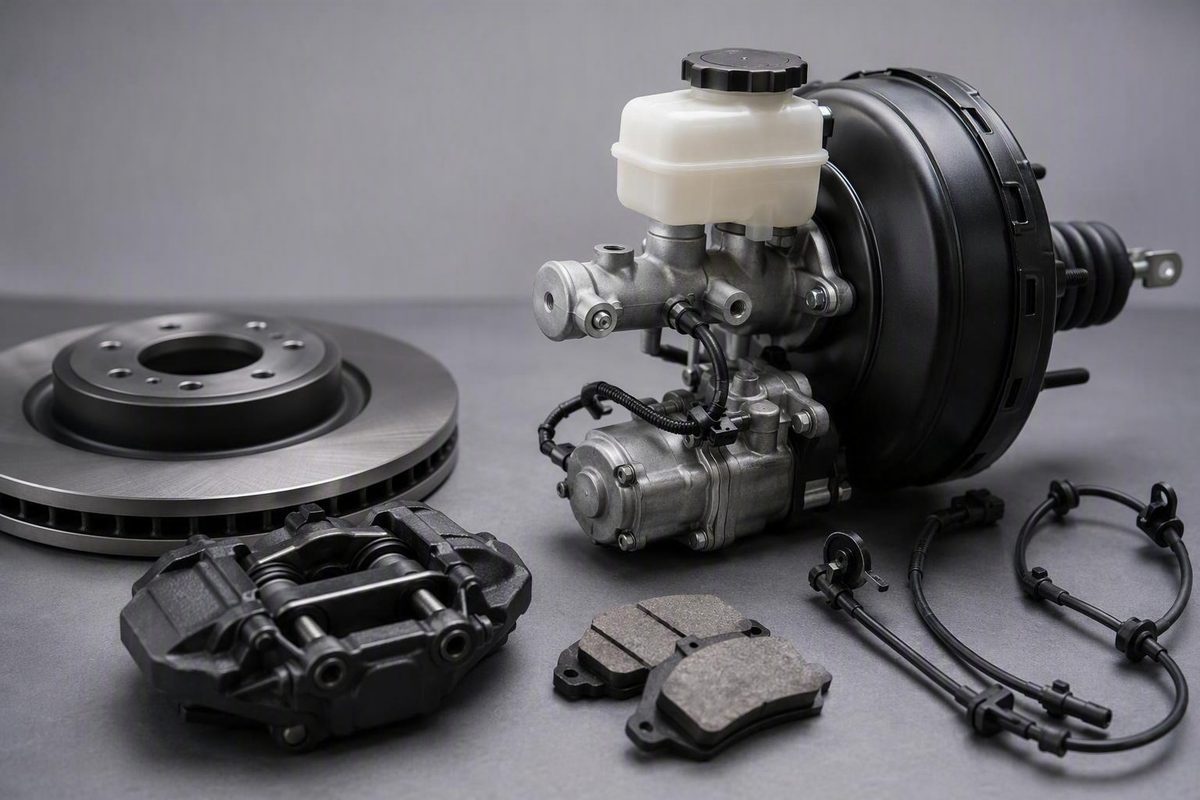
Learn when a Colorado brake warning, hard pedal, or 43 mph limit matches the eBoost investigation, when to stop driving, and what evidence to save.
A Service Brake System or Brake System Failure message accompanied by a hard pedal or a 43 mph speed limit on a 2023–2026 Chevy Colorado can match the eBoost brake-assist failure pattern under federal investigation. Stop driving if the pedal becomes hard or stopping performance changes; get the truck transported for diagnosis. NHTSA’s investigation covers every 2023–2026 Colorado and GMC Canyon, but it is not a recall and does not prove that every brake warning has the same cause.
Select what happened; the tool identifies the closest pattern and the appropriate next step.
This triage tool compares the warning sequence with the reported startup/spindle pattern and the immediate-loss pattern under investigation. It cannot diagnose the failed component.
A 2023 Colorado with a brake-system message, hard pedal and 43 mph cap at startup closely resembles the startup-detected eBoost pattern described in the investigation.
Photograph the display and preserve brake-module codes before anything is reset.
| Pattern | Timing | Key Evidence | Disposition |
|---|---|---|---|
| Startup/spindle pattern | Startup or before moving | Hard pedal with brake warning; 43 mph cap reported | Do not drive; transport |
| Immediate-loss pattern | While moving or braking | Pedal suddenly hard or assist disappears | Stop safely; do not resume trip |
| Warning without changed braking | Startup or intermittent | Pedal and stopping appear normal | Prompt module scan and inspection |
| Hydraulic/mechanical concern | Any time | Soft, low or sinking pedal; leak; changed stopping | Do not drive; transport |
| Trailer-brake message | Often with trailer connection | Message specifically names trailer brakes | Do not tow dependent trailer |
| Pad-monitor message | Any time | Message specifically names pad monitor | Measure inner and outer pads |
| Make | Model | Years | EA26006 Status |
|---|---|---|---|
| Chevrolet | Colorado | 2023–2026 | Included—all listed years |
| GMC | Canyon | 2023–2026 | Included—all listed years |
| GM | 12 additional nameplates | — | Included in total; names and year ranges not supplied here |
EA26006 covers 14 nameplates and 1,164,820 vehicles. The supplied evidence specifically establishes the complete 2023–2026 ranges for Colorado and Canyon; it does not provide a reliable model-year list for the other 12 nameplates.
A Hard Pedal Or Changed Braking Means Stop Driving
A warning without changed braking still needs prompt diagnosis, but a hard, soft, low, sinking, or inconsistent pedal changes the decision. Park in a safe location and arrange professional transport rather than trying to reproduce the fault.
Use the same stop-driving response if stopping distance increases, visible brake fluid appears, or a red brake warning remains illuminated with abnormal pedal behavior. A speed restriction does not make the truck safe to drive; it is a response to a detected fault, not assurance that adequate brake assist remains available.
If brake assist is lost, the foundation brakes may still respond when the driver pushes much harder. That distinction should not be treated as permission to continue driving. A suddenly hard pedal can increase the force and distance required to stop, particularly when the driver is not expecting it.
Normal pedal feel does not clear the truck either. A persistent message may indicate a stored or intermittent fault even when assist appears normal at that moment. Contact a Chevrolet dealer or qualified brake technician, give them the exact wording and accompanying lights, and ask whether the vehicle should be transported.
The eBoost Investigation Now Includes Every 2023–2026 Colorado
On August 21, 2026, NHTSA upgraded its eBoost inquiry to Engineering Analysis EA26006. The analysis covers 1,164,820 vehicles across 14 GM nameplates, including every 2023–2026 Chevrolet Colorado and GMC Canyon. The investigation record reports 21 crashes and six injuries. NHTSA provides the investigation files for EA26006, while contemporary reporting summarizes the expansion and affected population. Yahoo Autos reports the scope, crash count, and injury count.
An Engineering Analysis is a formal defect investigation, not a recall. It allows NHTSA to examine the alleged failure mechanism, incident data, warning behavior and the adequacy of any manufacturer response. There is no recall established by the supplied evidence for this condition.
The reported eBoost concern involves the electromechanical brake-assist unit. One pattern involves an internal spindle failure detected around startup, with a hard pedal, brake warnings and a 43 mph speed restriction. The expanded analysis is also examining allegations of a more immediate loss of assist while the vehicle is moving or braking.
That second pattern matters because a driver may have less time to react than someone who receives the warning when starting the truck. If the pedal becomes hard during a stop, concentrate on bringing the vehicle to a safe stop, activate the hazard lights when appropriate, and do not resume the trip.
The investigation’s inclusion of a truck does not diagnose an individual event. A Colorado can display a brake warning for a mechanical, hydraulic, electrical, software or monitored-circuit problem unrelated to the alleged eBoost spindle failure. The warning sequence, pedal behavior, speed restriction and stored brake-module data are needed to distinguish them.
Startup And Mid-Stop Failures Are Different Patterns
A warning that appears immediately after startup, followed by a hard pedal and a 43 mph cap, closely resembles the reported startup-detected eBoost pattern. Photograph the display, note whether the pedal was hard before the truck moved, and have the truck transported.
A pedal that becomes hard while driving or during an active stop resembles the immediate-loss pattern now receiving added scrutiny. A speed restriction may appear with the event, after it or not at all. The safety decision should follow the loss of assist, not the presence of the speed cap.
A message with normal pedal feel and no apparent change in stopping does not fit either pattern as strongly. It still warrants retrieval of codes from the brake and chassis modules. Intermittent faults can disappear after a restart while leaving history or event information that helps identify what happened.
Do not disconnect the battery or clear codes to see whether the message returns. Its disappearance does not establish that the truck has been repaired, and clearing information can remove evidence needed by the technician or a safety investigation.
Record The Exact Message Before Powering Down
“Service Brake System,” “Brake System Failure,” “Service Brake Assist,” “Service Trailer Brake System,” and “Service Brake Pad Monitor” are not interchangeable. Photograph every display page if messages cycle.
Record the following before codes are cleared:
- The exact message and every illuminated warning light.
- Whether it appeared at startup, while cruising or during a brake application.
- Whether the pedal was normal, hard, soft, low, sinking or inconsistent.
- Whether stopping response or required pedal force changed.
- Whether the display imposed a 43 mph limit or another restriction.
- The mileage, road conditions and sequence of events.
- Whether restarting changed the warning or pedal feel.
- Any recent brake, wheel, battery or electrical work.
- Whether a trailer was connected and depended on electric brakes.
Include the truck’s model year, trim, drivetrain and relevant towing configuration. Timing after recent work is a diagnostic lead, not proof that the work caused the failure.
For a suspected safety defect, retain repair orders, diagnostic reports and towing invoices. Ask the shop to put the driver’s description—including a hard pedal, sudden assist loss or speed cap—on the repair order rather than recording only “warning light on.”
Diagnosis Must Include The Brake Control Modules
A basic powertrain code scan is not enough. Ask the dealer or technician to retrieve current, history, pending and communication codes from the ABS, brake-system control and other relevant chassis modules before clearing anything.
Request the module that stored each code and any available freeze-frame, failure-record or event information. The shop should explain whether the fault was present at startup, returned during a commanded test or appears intermittently.
Mechanical and hydraulic inspection remains necessary even when the event resembles the eBoost pattern. It should cover inner and outer pad thickness at all four wheels, rotor condition, caliper and slide operation, fluid level and condition, and visible hoses, lines, fittings, reservoir and master-cylinder areas.
The electrical diagnosis should follow the stored codes. Depending on the results, that may include testing power supplies, grounds, connectors, wiring, communication circuits, wheel-speed sensors, charging voltage and the brake-assist assembly. Software or calibration status may also need verification.
Do not approve a control module, master cylinder or eBoost unit solely because the display contains the word “system.” The proposed part should follow a documented test result. If a dealer says the event does not match the investigation, ask what codes and tests support the alternate diagnosis.
After repair, the order should show what was corrected, which modules were rechecked and whether the warning or assist problem returned under an appropriate verification procedure. Deliberately road-testing an unrepaired truck with a hard pedal is not an appropriate owner check.
Trailer-Brake And Pad-Monitor Messages Follow Separate Paths
A Service Trailer Brake System message concerns the integrated electric trailer-brake path. If a connected trailer depends on electric brakes, do not tow it until the fault has been diagnosed and trailer braking restored.
Third-party guidance for 2015–2022 Colorados associates code C1114 plus “Service Trailer Brake System” with a short to power on the trailer-brake output circuit or a poor trailer ground. It interprets C1114 accompanied only by “Check Trailer Wiring” differently, as a short to ground on the output circuit. Those interpretations are limited to the cited trailer-specific path and should not be applied to a general brake-system warning or automatically extended to 2023–2026 trucks. The C1114 guidance explains the older Colorado trailer-brake path.
A Service Brake Pad Monitor message identifies a wear-monitoring concern rather than, by itself, an eBoost failure. Physical inspection should include both pads at each wheel because an outer pad visible through the wheel can retain material while the inner pad is badly worn.
One third-party example showed a 2024 Colorado with about 20,000 miles, a front-brake warning and 82% rear pad life. Inspection reportedly found a very thin inner front pad despite substantially more material on the outer pad. That example demonstrates why the display percentage and visible outer pad cannot replace measurement; it does not establish a widespread defect. The video documents the mileage, displayed percentage and uneven wear.
Resetting or disabling the pad monitor cannot add pad material, release a sticking caliper, repair a sensor or correct damaged wiring. Record the displayed front and rear values before any reset.
Some 2023 Trucks May Have A Separate Service Program
Third-party reporting says certain 2023 Chevrolet Colorados may qualify for GM Customer Satisfaction Program N252521980, concerning brake system control module software. The reported initial remedy is module reprogramming; if the problem persists, the reported instructions call for master-cylinder replacement and a brake-fluid change.
The same report says eligibility is VIN-specific and covered work is available without charge, regardless of vehicle age or mileage, through November 30, 2027. These details should be verified through a Chevrolet dealer because the underlying GM program document was not supplied. GM Authority reports the program number, remedy and VIN requirement.
That program is not evidence that every 2023 Colorado is included or that it explains every hard-pedal event. Ask the dealer to check the VIN in GM’s Investigate Vehicle History system and compare the program condition with the truck’s software status, codes and symptoms.
Check The VIN And Report A Suspected Defect
Run the VIN through NHTSA’s recall lookup, then ask a Chevrolet dealer to check the same VIN for open GM recalls, campaigns and customer-satisfaction programs. These are separate searches. An investigation may be open even when the VIN shows no recall.
An owner whose Colorado suffered a hard pedal, sudden loss of assist, crash or near miss can submit a safety complaint to NHTSA. Include the VIN, mileage, exact warning, 43 mph restriction if shown, pedal behavior, whether the event began at startup or during a stop, diagnostic codes, repair findings and whether it recurred.
The current practical answer is not to wait for a recall before acting. A hard pedal or changed braking requires safe parking and professional transport. A warning with normal braking still requires preserved codes, a complete brake-system diagnosis and VIN checks through both NHTSA and Chevrolet.