
Why Your Chevy’s Check-Engine Light Flashed—and What to Check Next
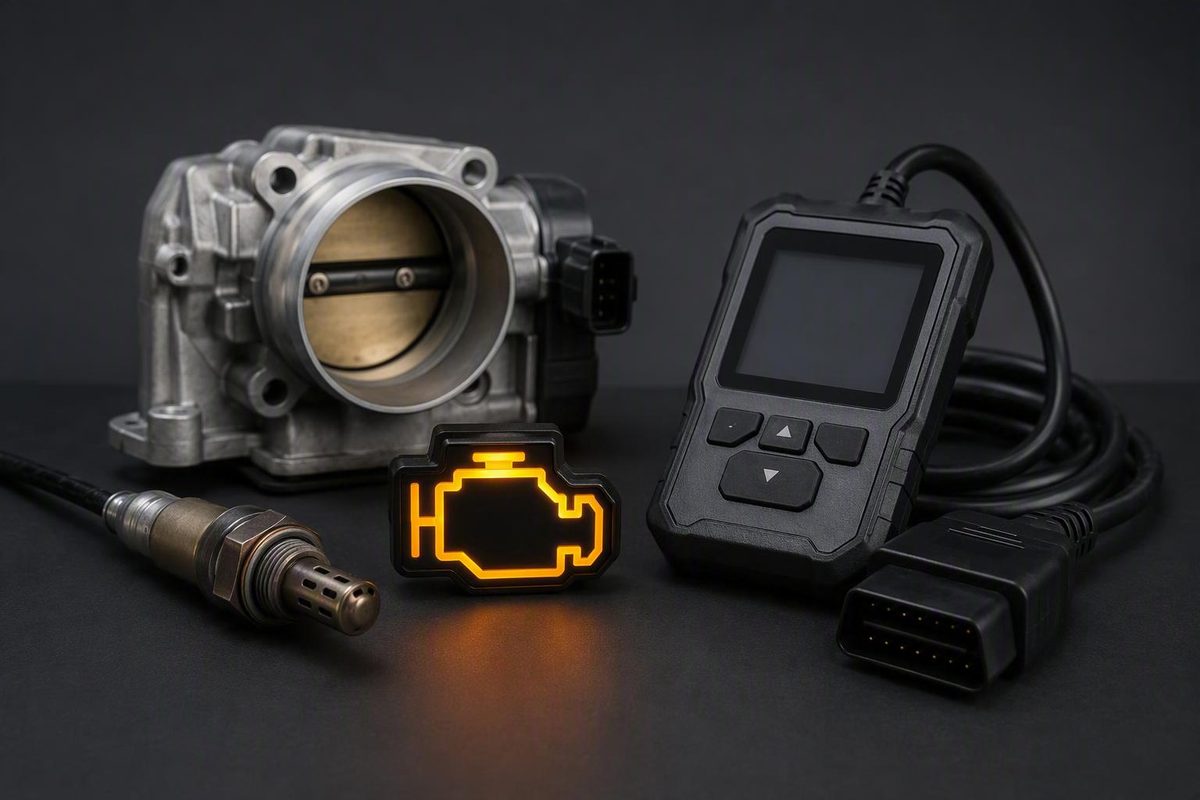
Prompt scanning still matters if the light stops. Record the event and exact codes so diagnosis can account for your Chevy’s model, engine and symptoms.
A flashing check-engine light can warn of a malfunction capable of damaging the emission-control system. Reduce the load on the vehicle and follow the exact model’s owner’s manual; do not keep accelerating to see whether the light returns. The light does not identify the failed part.
Start With Chevrolet’s Instructions
For a concrete manufacturer example, the 2016 Silverado owner’s manual, page 143 instructs drivers to lower speed and avoid hard acceleration and uphill grades. When towing, it also calls for reducing hauled cargo as soon as possible.
If flashing continues, that manual says to park safely, switch off, wait at least 10 seconds, and restart. If it still flashes, follow those precautions and obtain dealer service promptly. This is the 2016 Silverado procedure, not a replacement for the manual for every Chevy model or engine. If you cannot proceed safely, arrange roadside assistance.
Even if the light stops, record the event and arrange diagnosis. Chevrolet’s general warning-light guidance recommends service as soon as possible for the malfunction indicator, including when the driver has not yet noticed an engine problem.
What a Scan Can Tell You
The diagnosis should account for model, year, engine, warning behavior, operating conditions, symptoms and retrieved trouble codes. A code narrows the investigation; it does not by itself prove that a plug, wire, coil or injector needs replacing.
Why it may happen only during hard acceleration
Reddit user aksbug90 reported that a 2015 Silverado with the 5.3L engine began flashing its check-engine light during hard acceleration while passing. The owner said the light later went out, no trailer was attached, and no loss of power was perceived. See the original account in context.
It does not prove that the cause was a spark plug, ignition coil, injector, or another fuel-system component.
Record the conditions as accurately as possible:
- What the vehicle was doing when the light appeared
- Whether the event occurred during acceleration
- Whether the transmission had downshifted
- Whether the light flashed continuously or briefly
- Whether it became steady or turned off
- Whether the engine shook, stumbled, or sounded different
- Whether power appeared to change
- Whether any other warnings appeared
- Whether the event has happened again
The reported absence of perceived power loss did not establish that the warning was harmless. It was simply one detail from that owner’s account.
What P0300 and cylinder-specific misfire codes suggest
A commenter in the Silverado discussion described P0300 as a random-misfire code and P0301-style codes as identifying a particular cylinder associated with detected misfiring. These were forum explanations rather than definitions from Chevrolet service documentation, so they should be treated as starting points for qualified diagnosis.
| Scan result | Practical interpretation | What it does not prove |
|---|---|---|
| P0300 | The discussion’s explanation did not isolate the detected misfiring to one cylinder. | It does not establish that a particular plug, wire, coil, injector, or other component failed. |
| P0301-type code | The numbered cylinder can become an initial focus of diagnosis. | It does not explain why misfiring was detected on that cylinder. |
Record the complete result rather than summarizing it only as a “misfire code.” A cylinder-specific result points the investigation toward a location, but further testing is still required to determine the cause.
The relevant tests and components depend on the exact Chevrolet model, model year, engine, and ignition design. A code explanation taken from one Silverado discussion should not be applied automatically to every Chevy truck or SUV.
Possible causes are not the same as a diagnosis
Forum participants raised spark plugs, plug wires, ignition coils, injectors, and other fuel-system problems as possibilities. The thread did not establish which, if any, caused the original poster’s warning.
One participant described a separate cylinder 8 case in which a plug, coil, and wire were replaced. Another said that replacing plugs and wires resolved an individual load-related misfire. Both reports were personal repair anecdotes—not evidence that the same work would repair another Chevrolet displaying a similar warning.
Component arrangements and plausible causes vary among models, model years, engines, and ignition designs. Advice about one Silverado may not apply to another Silverado, much less to a Tahoe, Suburban, Colorado, or another Chevrolet.
Do not select replacement parts solely because:
- Another owner’s light flashed during acceleration
- A scan result identifies a cylinder
- A list of possible causes names a familiar component
- A forum repair appears inexpensive or straightforward
- Another vehicle had superficially similar symptoms
Vehicle-specific testing is what distinguishes a possible cause from a supported repair recommendation.
What to bring to a qualified diagnostic appointment
Bring or write down:
- Chevrolet model and model year
- Engine, if known
- Current mileage
- Whether the light flashed briefly or continuously
- Whether it later became steady or turned off
- Driving conditions when it appeared
- Any shaking, hesitation, power change, noise, odor, or other warning noticed at the time
- Whether the event has recurred
- Every retrieved code in its exact letter-and-number form
In the documented Silverado case, the owner reported attempting an auto-parts-store scan after the light was no longer active. That account does not prove that the scanner missed information, nor does it establish that no relevant information remained. Report exactly what the scan displayed instead of reducing the result to “nothing was wrong.”
A qualified diagnosis should consider the vehicle details, symptoms, warning behavior, and available codes before recommending a repair. Retain any scan receipt, written result, or photograph of the scanner display.
Follow the manufacturer warning-light precautions first, then obtain a diagnosis. A flashing light does not by itself prove that a particular part failed. Record the event, obtain the exact codes, and rely on vehicle-specific diagnosis rather than an extinguished light or a similar-sounding forum repair.