
What Your Chevy’s Charging-System Warning Is Telling You
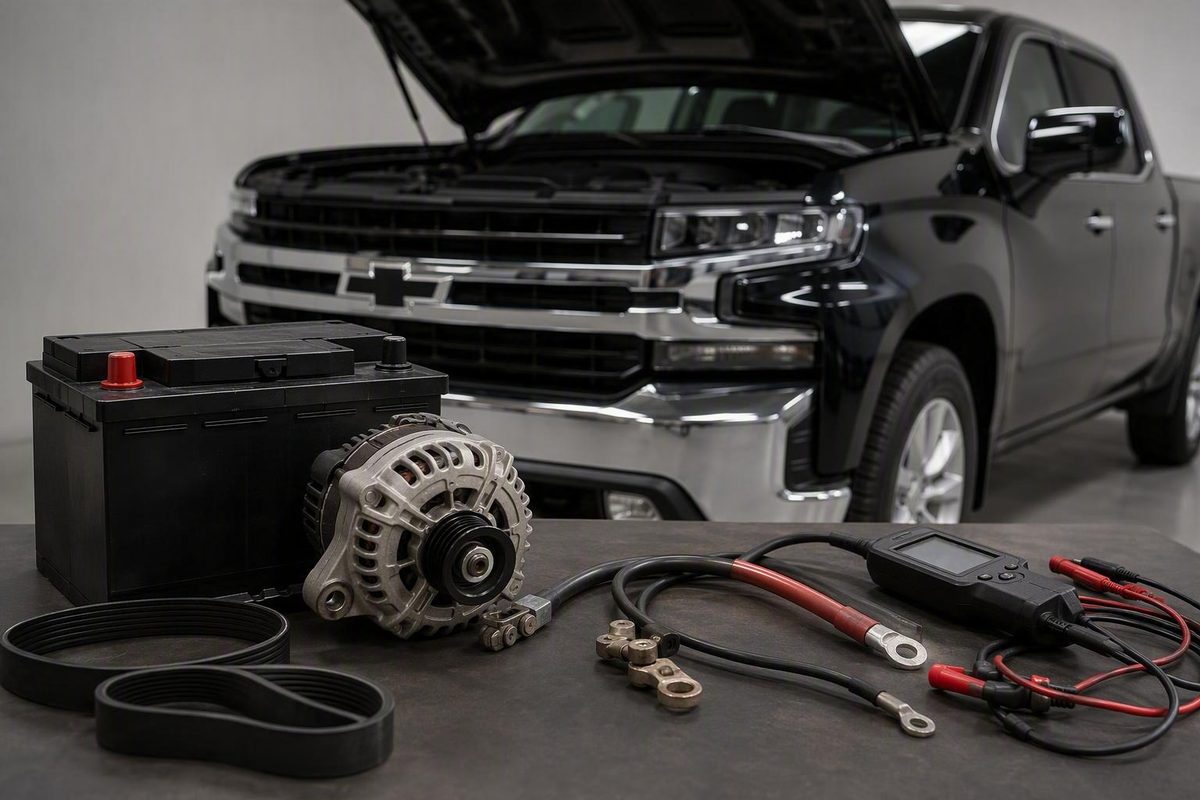
Learn when to stop driving and how battery-load, charging-output, code-scan, belt, cable, ground and voltage-drop checks isolate the fault.
The “Service Battery Charging System” message means your Chevrolet has detected abnormal performance in the system that maintains the 12-volt battery and supplies electrical power while the engine runs. It is a warning about the system, not proof that the battery, alternator, or another specific part has failed (AutoZone’s third-party Chevrolet charging-system overview).
That distinction matters. Battery condition, alternator output, belt drive, cables, grounds, wiring, protective devices, sensors, connectors, and electronic controls can produce overlapping symptoms. Replacing the part that sounds most closely related to the message can waste money while leaving the underlying fault unresolved.
The safest practical response is to assess how the vehicle is behaving, inspect only what is readily accessible with the engine off, document when the warning occurs, and arrange testing of the battery and complete charging circuit. This is general troubleshooting guidance, not Chevrolet or General Motors service information; Chevy Truck Expert is an independent enthusiast publication with no affiliation with or endorsement by General Motors (publication terms and independence disclosure).
What “Service Battery Charging System” Means on a Chevy
The charging system has two closely related jobs:
- Maintain the battery’s state of charge.
- Supply electrical power while the engine is operating.
The dashboard message indicates that the vehicle has detected charging-system behavior outside its expected range. It does not necessarily mean the battery is dead, and it does not automatically condemn the alternator. Third-party guidance identifies inadequate alternator output, corroded or loose connections, broken wiring, and a loose or broken drive belt among the possible causes.
Depending on the model, year, engine, and equipment, the relevant system may include:
- The 12-volt battery
- Battery terminals, cables, and grounds
- The alternator and voltage regulator
- The serpentine belt, tensioner, and pulleys
- Charging-system wiring and connectors
- Fuses, fusible links, or other protective devices
- Battery-current monitoring on some vehicles
- Electronic charging controls
These parts operate as a circuit. A functioning alternator cannot charge effectively through a high-resistance cable or poor ground. A sound battery can discharge if the belt does not drive the alternator properly. A replacement alternator cannot repair a damaged connector or an open circuit.
Chevrolet models do not all use identical components, sensor locations, fuse assignments, or diagnostic strategies. A procedure shown for one Cruze, Malibu, Silverado, Tahoe, Traverse, or Equinox should not automatically be applied to another model or year.
Treat the warning as the beginning of diagnosis:
The vehicle has detected a charging-system problem, but testing is required to determine whether the fault involves energy storage, power generation, mechanical drive, wiring, connections, monitoring, or control.
Can You Keep Driving, or Should the Chevy Be Towed?
A Chevy may continue running when the message first appears, but that does not establish how long it will continue to operate. If the battery is not being replenished adequately, the vehicle can consume its stored energy until it will not restart or can no longer remain running. General charging-system guidance therefore recommends prompt attention rather than extended driving (CarParts.com’s charging-system warning guide).
Stop safely and arrange assistance when severe symptoms appear
As a conservative response, stop in a safe location and arrange professional assistance if the warning is accompanied by:
- Stalling or repeated attempts to stall
- Rapidly dimming lights or weakening electrical equipment
- A significant change in steering assistance
- Smoke or a strong burning odor
- Abnormal engine temperature
- A visibly displaced, shredded, or missing belt
- Several electrical systems failing in quick succession
- A no-start or progressively slower cranking
- Failure to remain running after a jump-start
General maintenance guidance warns that an unresolved charging fault can exhaust the battery’s stored energy and advises against prolonged driving with the warning active (Panda Hub’s general charging-system overview).
Smoke, burning odors, or obvious heat damage call for particular caution. Shut the vehicle off once safely positioned and obtain roadside help rather than handling the affected electrical connection.
If the vehicle has already stalled in traffic, prioritize the safety of occupants. A jump-start that briefly restores operation does not establish that continued driving is safe when the vehicle dies again or its electrical power continues to decline.
Owner reports illustrate how severe low-voltage events can develop, although they cannot predict what every Chevrolet will do. In one Malibu discussion, owners reported clicking, stalling, very low indicated voltage, and loss of power-steering assistance during charging trouble (Malibu owner reports). These are anecdotes, not evidence of a model-wide defect, but they reinforce the need to take rapidly worsening symptoms seriously.
If the Chevy remains stable
That is not a guarantee that it is suitable for an extended trip.
Use conservative judgment:
- Avoid unnecessary driving.
- Arrange diagnosis promptly.
- Reduce optional electrical loads if doing so does not compromise visibility, comfort needed for safe control, or legally required equipment.
- Keep necessary lights, wipers, and window-clearing equipment in use.
- Do not assume that a stable dashboard gauge guarantees continued operation.
Operating time depends on battery charge, battery condition, electrical demand, and whether the charging system is producing reduced output or no useful output.
Do not attempt inspections or measurements near moving belts, pulleys, or energized high-current connections unless you have the appropriate equipment and training. The owner checks below are deliberately limited to observations made with the engine off.
Likely Causes, From Connections and Belts to Electronic Controls
The supplied evidence does not establish a Chevrolet-wide failure rate that makes one component the usual answer. It is more useful to divide the possible causes by function.
Connections and conductors
Current must travel from the alternator to the battery and electrical system and return through the ground side of the circuit. Faults along either path can interfere with charging.
Possible problems include:
- Loose battery clamps
- Corrosion at a terminal
- Damaged positive or negative battery cables
- Poor engine, body, or frame grounds
- A loose alternator output connection
- Broken wiring or damaged insulation
- Loose or heat-damaged connectors
- High-resistance junctions
- Open fuses, fusible links, or related protective devices
A cable can appear satisfactory at its exposed end while corrosion or damage remains hidden beneath the insulation. Likewise, clean battery terminals do not rule out resistance at the alternator, a ground connection, a fuse block, or another junction. Silverado forum discussions contain unresolved reports in which participants recommended deeper cable and ground checks despite normal-looking connections, but those reports are diagnostic clues rather than confirmed repairs (Silverado cable and ground discussion).
Mechanical drive
On a conventional engine-driven charging system, a belt transfers engine rotation to the alternator. If that drive is interrupted, alternator output can become inadequate even when the alternator itself is not the original fault.
Possible belt-drive problems include:
- A missing or broken serpentine belt
- A loose or slipping belt
- Cracking, fraying, glazing, or contamination
- A weak or damaged tensioner
- Pulley or accessory-drive trouble
Do not assume continued operation is acceptable simply because the engine still runs.
Battery condition
A weak, deeply discharged, or internally failing battery can contribute to abnormal system readings. It may crank slowly, fail to retain charge, or perform poorly when substantial current is required.
Battery voltage alone does not establish the battery’s full condition. A battery may display a plausible resting voltage yet fail under load. Conversely, a low reading may show that the battery has been discharged by another fault rather than identify the battery as the original cause.
Battery diagnosis should therefore consider both:
- State of charge: how much stored energy is presently available
- Performance under load: whether the battery can supply the required current
A discharged battery may need appropriate charging before its condition can be judged fairly.
Alternator, regulator, and diodes
Generation-side faults can include:
- Inadequate or intermittent alternator output
- Voltage-regulator trouble
- Internal connection faults
- Diode-related output problems
- Heat-sensitive failure
- Pulley or bearing problems that interfere with operation
A simple bench test can be useful, but it does not include the vehicle’s installed wiring, grounds, belt drive, connectors, or operating environment.
A useful follow-up to “the alternator tested good” is: What test was performed, and did it reproduce the load and temperature present when the warning appeared?
Monitoring and electronic control
Some vehicles use battery monitoring or electronic charging management. Depending on the exact configuration, possible issues can include:
- A battery-current sensor
- A loose or damaged sensor connector
- Sensor wiring
- A control or communication fault
- Charging-management software or calibration
The evidence available here is not sufficient to define Chevrolet control logic model by model. A third-party GMC and Buick dealership article includes battery monitoring and charging-management software among the possible system elements, but that should not be treated as official Chevrolet service information or applied universally (third-party dealership charging-system article).
Do not replace a current sensor or module merely because another vehicle’s repair video mentions one. First confirm that the exact Chevy uses the component in question, then inspect its connections and evaluate relevant diagnostic information.
Safe Checks You Can Make Before Buying Parts
Begin with the engine off, the vehicle secured against movement, and the keys removed. Allow hot components to cool. Limit your work to observation and safely accessible items; leave energized testing and work around moving components to a qualified person.
Inspect the battery area
If the battery is safely accessible, look for:
- A clamp that is visibly loose or displaced
- White or blue-green deposits
- Cracked or distorted terminals
- Frayed conductors
- Swollen or damaged insulation
- A cable rubbing against another part
- Melted plastic or other signs of overheating
- A battery case that appears swollen, cracked, or wet
Do not create sparks or allow a metal tool to bridge the positive terminal and grounded metal. If the battery is leaking, badly swollen, melted, or otherwise visibly damaged, stop the inspection and seek professional assistance.
Remember that appearance has limits. A clean terminal can still have a poor contact surface, and a cable can be damaged internally.
Follow accessible cables and grounds
Inspect visible portions of the positive and negative cables without dismantling the vehicle. Look for:
- Loose fasteners
- Corrosion
- Damaged insulation
- Chafing or rubbing
- Broken strands
- Heat discoloration
- Contaminated or visibly loose grounds
Do not copy a ground location from a different model or year. A point shown for one Silverado may not apply to another Silverado, much less a Malibu or Cruze. Use information matched to the exact model, year, engine, and configuration.
Look at the serpentine belt
With the engine off, inspect the visible belt path for:
- An absent or displaced belt
- Obvious looseness
- Cracks or missing sections
- Frayed edges
- A glazed surface
- Rubber debris around a pulley
- A belt that is not seated correctly
Do not place fingers between a belt and pulley, and do not reach into the belt path while the engine is operating.
Record the warning pattern
Intermittent faults are easier to investigate when the owner provides a clear timeline. Record:
- Whether the message is constant or temporary
- How long it remains visible
- Whether it appears immediately after startup
- Whether it occurs only at idle
- Whether headlights, climate control, or defogging were in use
- Whether the engine was cold or fully warm
- Whether vibration, rain, or outside temperature seems relevant
- What the dashboard voltage gauge showed, if equipped
- Whether the battery light or other warnings appeared
Also document associated symptoms:
- Slow cranking
- Clicking without cranking
- Dimming or flickering lights
- Changing blower speed
- Multiple warning lights
- Rough running or stalling
- Failure to restart
- Unusual belt noise
- Burning odors
- Recent jump-starts or battery disconnection
Photos or video of the message and gauge may help if captured by a passenger or while the vehicle is safely parked.
Preserve diagnostic information
Do not disconnect the negative battery cable merely to clear the message.
Do not replace a fuse based on a number shown for another Chevrolet. Fuse assignments and sensor locations vary. Confirm the correct protective device and rating for the exact vehicle. If a replacement fuse or link opens again, the underlying circuit fault must be identified rather than bypassed.
How Battery and Charging Tests Fit Together
No single voltage reading answers every charging-system question. A sound diagnosis combines several tests, each aimed at a different part of the problem.
1. Visual inspection
The first stage looks for obvious defects such as:
- A missing or damaged belt
- A loose battery clamp
- Terminal corrosion
- Damaged cables
- Overheated connections
- Disconnected wiring or sensors
A visual inspection is efficient, but it cannot establish battery capacity, alternator performance under load, low circuit resistance, or stable output.
2. Battery state-of-charge assessment
Resting voltage primarily helps estimate state of charge. Recent charging or electrical use can affect the reading, so the test conditions matter.
Third-party guides commonly present 12.4–12.7 volts after a rest period as a general reference for a charged 12-volt battery and 13.7–14.7 volts while running as a general charging range. These are not official Chevrolet pass-fail specifications and should not be applied universally.
A low resting reading shows that the battery is discharged, but not why. Possible explanations include:
- Battery deterioration
- Inadequate charging
- An electrical draw while parked
- Repeated short trips
- Recent or prolonged cranking
3. Battery load or conductance testing
A battery must supply current, not merely display voltage. A load or conductance test assesses its ability to perform that job.
The result should be interpreted in light of the battery’s charge level, rating, type, temperature, and installation. If the battery is discharged, charging may be necessary before a fair evaluation.
Even if the battery fails and is replaced, the charging system should still be checked. Otherwise, the unresolved fault may discharge or damage the replacement.
4. Scan relevant vehicle modules
Those records may help direct testing toward charging output, voltage feedback, sensing, wiring, or low-voltage events.
“No codes” from a simple reader therefore does not prove that the complete charging system is healthy.
Codes are clues, not automatic part-replacement instructions.
5. Test charging performance in the vehicle
Installed-system testing can compare charging behavior under relevant operating conditions, including different engine speeds, electrical loads, and temperatures.
Results should be evaluated for the exact:
- Chevrolet model and year
- Engine and alternator configuration
- Battery type or multiple-battery arrangement
- Temperature
- Electrical load
- Vehicle charging strategy
Some vehicles may vary charging output with operating conditions. The supplied evidence does not establish exact Chevrolet strategies or acceptable readings by model, so a lower or fluctuating gauge indication should not be treated as proof of failure without vehicle-specific information.
6. Check voltage drop on both sides of the circuit
Voltage-drop testing is used to identify excessive resistance while current is flowing.
The positive-side test examines the path between the alternator output and the battery or distribution point. The negative-side test examines the return path through battery cables and relevant engine or body grounds.
This testing may be useful when:
- Alternator output appears adequate at the alternator but not at the battery
- The battery repeatedly discharges
- Cables look clean but remain suspect
- The warning appears under heavier load
- A replacement alternator has not corrected the problem
Because these measurements involve energized, high-current circuits and may be made near moving components, they are best left to someone with suitable tools and training.
7. Evaluate ripple or diode behavior when indicated
A diode-related problem may affect output stability even when an average DC-voltage reading appears plausible. Third-party diagnostic guidance includes ripple testing among the checks that may be appropriate when an alternator remains suspect (LiTime’s commercial diagnostic overview).
Ripple analysis may be considered when there is unexplained flickering, electrical instability, or a warning that persists despite an apparently acceptable basic voltage check. Proper equipment and vehicle-specific interpretation are important.
| Test | What it helps establish | What it cannot prove alone |
|---|---|---|
| Visual inspection | Obvious damage, looseness, corrosion, or belt trouble | Electrical performance under load |
| Resting voltage | Approximate battery state of charge | Battery capacity or circuit integrity |
| Load or conductance test | Ability of the battery to supply current | Alternator, cable, or control-system health |
| Code scan | Fault records and diagnostic direction | Which part must be replaced |
| Installed charging test | System behavior under operating conditions | Low resistance in every cable path |
| Voltage-drop test | Excessive resistance in positive or ground paths | Battery capacity |
| Ripple evaluation | Output instability or possible diode trouble | Health of every charging-system component |
What Intermittent Warnings and Symptom Patterns Suggest
An intermittent warning is not automatically harmless. It may reflect a marginal fault that appears only with heat, vibration, electrical load, or a particular operating condition.
Possibilities include:
- A loose terminal or connector
- Corrosion hidden inside a cable
- Excessive resistance at a ground
- Wiring that opens when moved or heated
- A belt that slips under certain conditions
- A heat-sensitive alternator or regulator
- A sensor or sensor-connector issue
- An electronic control fault
Use the pattern as a diagnostic clue, not a conclusion. A warning accompanied by dimming lights, declining electrical power, hard starting, or stalling is more urgent than a brief message with no other visible effects. Both still merit investigation.
Why a brief test can miss the problem
A warning that appears only after a long drive with several electrical loads operating may not occur during a short, cold test at idle. Likewise, a marginal connection may behave normally while the vehicle is stationary and fail only during vibration or after heating.
Testing is more informative when it safely reproduces the reported conditions, such as:
- Cold startup
- Hot idle
- Higher electrical demand
- A longer drive
- The temperature or operating condition in which the message usually appears
Why a normal-looking gauge does not settle it
A dashboard gauge shows only what was displayed at that moment. It does not identify hidden cable resistance, an intermittent connection, or a fault that was inactive during the observation. A basic scanner may likewise miss records stored outside the modules it can access.
In one unresolved 2007 Silverado report, the owner described a daily warning lasting about two minutes despite battery replacement and several other checks (intermittent Silverado owner report).
A separate Silverado owner reported an increasingly persistent warning even though the battery and alternator had reportedly tested normally and the dashboard gauge remained near 14 volts. The available discussion proposed further cable, ground, connector, and code checks but documented no confirmed repair.
These anecdotes do not prove a universal Silverado defect. They show only that intermittent warnings may survive basic checks and that one gauge observation does not identify the failed circuit.
Keep a simple log containing:
- Date and time
- Outside temperature
- Length of drive
- Engine temperature, if known
- Driving condition
- Electrical accessories in use
- Warning duration
- Gauge reading
- Other warning lights
- Starting behavior before and after the event
Why the Warning Can Return After a New Battery or Alternator
A new component repairs only a fault that the component actually had. It cannot correct an unrelated problem elsewhere in the charging circuit.
After battery replacement
A new battery can discharge again if the vehicle still has:
- Inadequate alternator output
- A slipping or damaged belt
- Excessive resistance in a charging cable
- A poor ground
- Broken or intermittent wiring
- Failed fusible protection
- A sensor or connector fault
- A charging-control problem
Once that energy is consumed, the original symptoms can return.
After alternator replacement
A replacement alternator does not repair:
- Corrosion inside a cable
- A loose battery terminal
- A weak engine or body ground
- A damaged alternator connector
- A poor high-current junction
- A belt or tensioner problem
- A battery that cannot perform properly
The installation should also be verified. Confirm that the correct part was installed, the connections are secure, and the belt is properly routed and tensioned.
Why a passed test may not be conclusive
A parts-store or bench test may not reproduce faults caused by installed wiring, under-hood heat, vibration, belt operation, or the electrical load present when the warning appears.
One 2015 Silverado owner reported an intermittent warning despite replacement of the alternator, battery, and a voltage sensor. Disconnecting and reconnecting the negative terminal reportedly cleared the warning only temporarily, and the discussion ended without a verified repair (GM-Trucks owner discussion).
That case is anecdotal. It does not establish a common defect, but it demonstrates why repeatedly replacing parts is not a substitute for circuit testing.
Diagnosis-first checklist after parts have been replaced
Before authorizing another component:
- Confirm the current symptoms. Separate a warning-only condition from a discharged battery, no-start, stall, or visible loss of electrical power.
- Recover codes before clearing them. Include stored, pending, history, and relevant manufacturer-specific information.
- Verify terminals, cables, and grounds. Do not rely on appearance alone.
- Inspect the belt drive. Check belt condition, routing, tension, and associated pulleys.
- Test the battery under load. A new battery may still be discharged, unsuitable, damaged, or defective.
- Test charging performance in the vehicle. Reproduce the temperature, load, or operating condition associated with the warning.
- Check positive and negative circuit paths. Look for excessive resistance while current is flowing.
- Evaluate ripple when the evidence points toward unstable alternator output.
- Investigate sensors or controls only when codes and circuit tests justify it.
- Verify the repair under the original trigger conditions.
A message that disappears after battery disconnection has been reset, not necessarily repaired.
What to Ask for at the Repair Shop
A clear handoff can reduce diagnostic time. Give the technician:
- Chevrolet model and model year
- Engine and drivetrain, if known
- Battery age and type
- Whether the vehicle has more than one 12-volt battery
- Warning frequency and duration
- Whether it appears at startup, idle, highway speed, or when hot
- Electrical loads operating at the time
- Dashboard gauge readings or safely captured photos
- Slow-crank, clicking, dimming, stalling, or restart symptoms
- Recent jump-starts or battery disconnections
- All recently replaced parts
- Previous test results, invoices, or diagnostic codes
Ask that relevant codes be retrieved and documented before they are cleared or battery power is disconnected. A complete scan may need to include stored, pending, history, and manufacturer-specific information rather than only generic emissions codes.
A complete evaluation may include:
- Battery state of charge
- Battery performance under load
- Charging output under the conditions associated with the warning
- Belt, tensioner, and pulley inspection
- Positive-side voltage-drop testing
- Negative-side voltage-drop testing
- Cable, ground, connector, and protective-device inspection
- Ripple or diode evaluation when indicated
- Battery-current sensing and related wiring, where equipped
- Charging-control or software checks when supported by the vehicle and diagnostic evidence
Ask for actual findings instead of only “good” or “bad”:
- What caused the battery to fail its test?
- Where was excessive voltage drop measured?
- Was output inadequate at the alternator or only at the battery?
- Did the warning occur during testing?
- What code or circuit result supports replacing a sensor or module?
- Was the repair retested under the conditions that originally caused the message?
For recalls, check the exact VIN through the appropriate government recall lookup rather than assuming coverage from a model name. The supplied evidence does not establish a universal Chevrolet charging-system recall.
Discuss price only after the failed circuit or component has been identified. Cleaning a connection, replacing a cable, installing an alternator, and diagnosing an electronic-control problem involve substantially different parts and labor. Vehicle configuration, location, parts choice, access, and labor rates make a universal estimate unreliable.
The desired outcome is straightforward:
- Document the symptoms and codes.
- Confirm the failed circuit or component.
- Repair the verified fault.
- Clear codes only after preserving the original information.
- Verify battery and charging performance.
- Recreate the original trigger conditions.
- Confirm that the warning does not return.
Frequently Asked Questions
Does “Service Battery Charging System” mean I need a new battery?
No. The message identifies abnormal charging-system performance but does not identify the battery as the failed component.
The battery may be weak, discharged, internally damaged, or unable to perform under load. The same message can also result from alternator output, belt drive, cables, grounds, wiring, protective devices, sensing, or control problems.
Test the battery’s state of charge and load performance, then evaluate the charging circuit. If the battery was discharged because the vehicle was not charging correctly, installing another battery without repairing the original problem may only restart the cycle.
Can I drive my Chevy with the charging-system warning on?
Possibly far enough to reach a nearby safe location if the vehicle remains stable, but continued operation cannot be guaranteed. Avoid an extended trip and arrange prompt diagnosis.
Stop safely and seek professional assistance if the vehicle stalls, will not remain running, rapidly loses electrical power, develops a significant steering-assist change, overheats, has a visibly broken or displaced belt, or produces smoke or a burning odor. An unresolved charging fault can consume the battery’s stored energy and eventually cause a no-start or stall.
Why did the warning return after I replaced the battery or alternator?
The replacement may not have addressed the actual fault.
A new battery can discharge if the alternator, belt, cable, ground, wiring, protective device, sensor, or charging control remains defective. A new alternator cannot overcome excessive circuit resistance, poor grounding, a damaged connector, or an unrelated belt-drive problem.
Verify the replacement and installation, test the battery under load, scan the relevant modules, check installed charging performance under the conditions that trigger the warning, and assess both sides of the charging circuit before replacing another part.
Can the warning be intermittent even if no code appears on a basic scanner?
Yes. A loose connection, hidden cable corrosion, marginal ground, vibration-sensitive wire, heat-related component fault, sensor connector, or control issue may appear only under certain conditions.
A basic scanner may also lack access to manufacturer-specific, history, or module-level information. Record when the warning appears, which electrical loads are operating, whether the engine is hot or cold, how long the message lasts, and what other symptoms occur.
What voltage should a Chevy battery show with the engine off and running?
There is no single pass-fail number for every Chevrolet under every condition.
Third-party sources commonly describe a charged resting 12-volt battery as being in the mid-12-volt range and conventional running readings as being in the upper-13- to mid-14-volt range. These are broad reference values, not official Chevrolet specifications.
Resting voltage mainly reflects state of charge and cannot prove that the battery can supply adequate current. Running voltage must be interpreted for the exact model, year, engine, battery configuration, temperature, electrical load, and charging design.
Treat the Chevrolet charging-system message as a request to diagnose the complete system, not an instruction to replace the battery or alternator. Seek assistance when stalling, rapidly declining electrical power, belt failure, smoke, overheating, or a burning odor appears. Otherwise, arrange prompt testing that combines battery-load results, code information, installed charging behavior, and cable-circuit checks before authorizing additional parts.