
The Common Chevy Six-Lug Size—and Why It Does Not Guarantee Wheel Fit
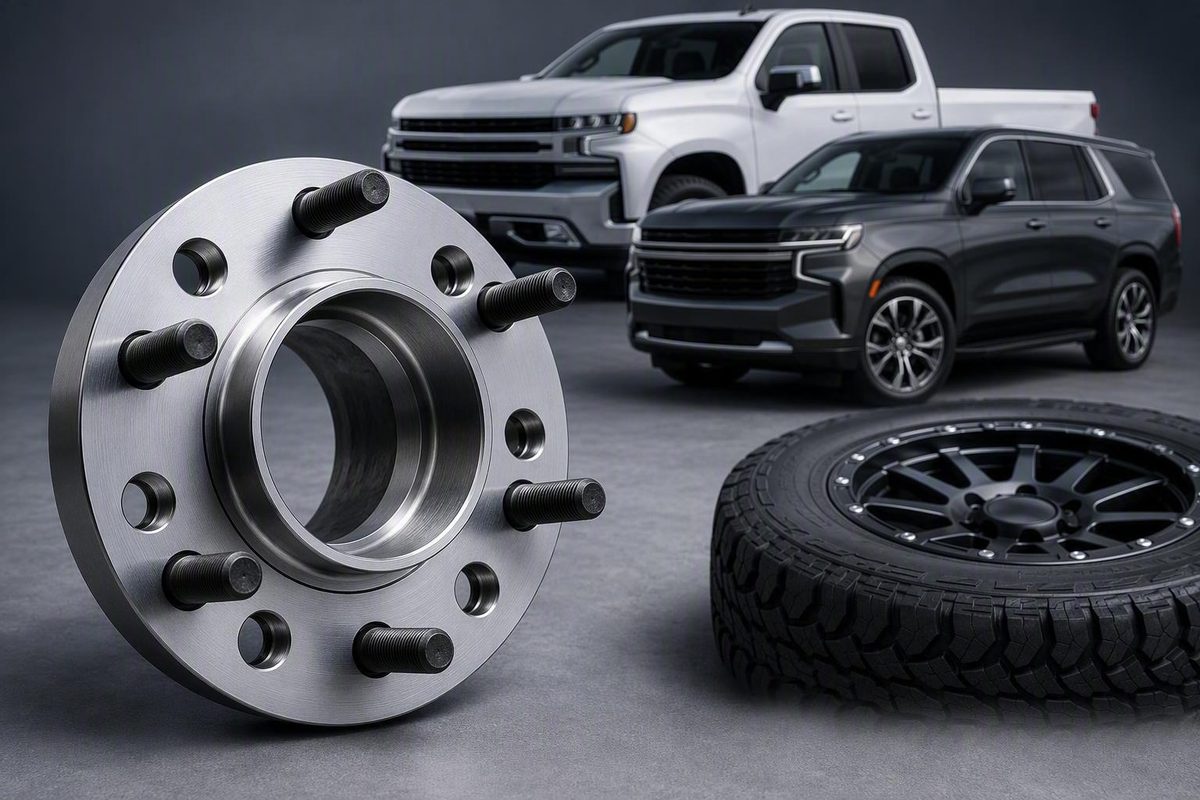
The common Chevrolet 6 bolt pattern is 6×5.5 inches, also written as 6×139.7 mm. Chevrolet dealership fitment guides commonly associate this pattern with many…
Quick answer: the common Chevrolet six-lug pattern
The common Chevrolet 6 bolt pattern is 6×5.5 inches, also written as 6×139.7 mm. Chevrolet dealership fitment guides commonly associate this pattern with many Chevrolet light-duty trucks and full-size SUVs, but those guides are secondary sources rather than official GM engineering specifications (Sawyer Chevrolet’s six-lug guide).
The notation describes two characteristics:
- 6 means the wheel has six lug holes.
- 5.5 inches, or 139.7 mm, is the nominal diameter of the circle passing through the centers of those holes.
Thus, 6×5.5 and 6×139.7 are inch and metric labels for the same nominal lug arrangement.
Important: This is a common Chevrolet pattern, not a universal specification. Do not buy a wheel merely because it has six holes or is advertised as a “Chevy wheel.” Verify the exact vehicle and the wheel’s complete specifications first.
A bolt-pattern match establishes only lug count and bolt-circle diameter. It does not establish compatibility for the center bore, offset, wheel dimensions, brakes, load rating, fasteners, or installation hardware. Record the vehicle’s complete year, model, trim, drivetrain, brake package, factory wheel option, and relevant suspension equipment before shopping.
Why not every six-lug Chevrolet is the same
Not every six-lug Chevrolet uses 6×139.7. Dealership guides usually describe that pattern as applying to “most,” “many,” or “typical” Chevrolet trucks and SUVs rather than every model and configuration.
The Colorado illustrates the problem. One broad dealership table lists Colorado at 6×120 without defining model-year boundaries, while other general guides refer to only “some” Colorado configurations. Neither statement is precise enough for purchasing a wheel.
A user-generated Colorado forum offers a possible generation distinction: contributors reported 6×120 for 2015–2022 Colorado trucks and said the change to 6×139.7 began with the 2023 model year (ColoradoFans owner discussion). That is an owner-forum report, not manufacturer-issued documentation. It should be used only as a lead for further research—not as proof that every Colorado from 2023 onward, including 2026 or future models, has that specification.
This distinction matters because 6×120 and 6×139.7 both describe six-lug wheels, but their bolt circles are different sizes. Similar appearance and matching lug count do not make them interchangeable.
Even when a broad model listing appears applicable, the exact configuration remains important. A complete Chevrolet model-year chart would imply a level of certainty that the available secondary evidence does not support.
What the evidence supports by Chevrolet model
The following table is a secondary-source starting point, not an official Chevrolet or GM fitment catalog. Every entry requires confirmation against vehicle-specific service information, parts data, applicable owner documentation, or a qualified wheel or parts professional.
| Vehicle | Secondary-source guidance | Evidence quality | Verification note |
|---|---|---|---|
| Silverado 1500, 1999–2025 | 6×139.7 mm | Bounded Chevrolet dealership guide; not a GM engineering specification (Mtn. View Chevrolet) | Confirm the exact truck and do not extend the range to 2026 or later. |
| Tahoe | Commonly associated with 6×139.7 mm | General dealership guidance without a complete year-by-year table (Frank Boucher Chevrolet) | Verify the specific year and configuration. A shared pattern does not prove Silverado wheel interchange. |
| Suburban | Commonly associated with 6×139.7 mm | General dealership guidance without a complete year-by-year table | Check the vehicle and proposed wheel independently. |
| Avalanche | Commonly associated with 6×139.7 mm | General dealership guidance without complete generation details | Do not infer direct fit from the model name or bolt pattern alone. |
| Colorado, 2015–2022 | Forum contributors report 6×120 | User-generated owner discussion; provisional (ColoradoFans) | Confirm through vehicle-specific Chevrolet or GM information before buying. |
| Colorado, beginning with 2023 | Forum contributors report a change to 6×139.7 mm | User-generated owner discussion; provisional | Verify each later model year separately; the report must not be projected indefinitely. |
| Silverado 2500 HD and 3500 HD, before 2011 | 8×165.1 mm | Bounded dealership guide; not a GM engineering specification (Mtn. View Chevrolet) | These are eight-lug applications, not direct substitutes for a six-lug Silverado 1500 wheel. |
| Silverado 2500 HD and 3500 HD, 2011–2025 | 8×180 mm | Bounded dealership guide; not a GM engineering specification | Confirm the exact truck and do not extrapolate beyond 2025. |
The Silverado ranges are unusually specific within the supplied evidence, but their source remains a dealership guide. They are suitable for narrowing a search, not for replacing vehicle-specific confirmation.
The Tahoe, Suburban, and Avalanche evidence is broader. It supports describing those models as commonly associated with 6×139.7, but not claiming that every model year uses it or that factory wheels can move directly among those vehicles.
Colorado deserves separate treatment because its generation-specific figures come from an owner forum and broad dealership tables conflict or omit year boundaries. The reported change beginning in 2023 is therefore a caution to investigate the exact truck.
Other vehicles—including the Express, Silverado EV, GMC products, and some Toyota or Nissan trucks—appear in broad secondary-source lists. Those mentions do not supply complete year, hub, offset, brake, load, or fastener specifications and should not be converted into direct-fit recommendations.
How to measure a six-lug bolt pattern
A six-lug pattern can be measured straight across because each lug has another directly opposite it. A retailer’s measurement guide identifies a ruler, tape measure, caliper, or dedicated bolt-pattern gauge as suitable tools and specifies a center-to-center measurement for six-lug wheels (Discounted Wheel Warehouse measurement guide).
Follow these steps:
- Count the holes or exposed studs. Confirm that there are six rather than relying on a seller’s description.
- Choose one hole or stud.
- Locate the hole or stud directly opposite it.
- Measure center to center. The line should pass through the center of the hub opening.
- Read the diameter. Approximately 5.5 inches or 139.7 mm indicates the nominal 6×5.5/6×139.7 pattern.
- Repeat the measurement. This helps catch an angled tool or incorrectly selected endpoints.
Measure opposite holes on an unmounted wheel.
Simple measurement diagram:
             ○
       ○           ○

       A-----------B
       ○           ○
             ○

A to B = center of one hole to center of the opposite hole
Approx. 5.5 in / 139.7 mm = nominal 6×139.7 pattern
The measurement line must terminate at the centers of the opposite holes or studs, not at their inner or outer edges.
Measurement can identify the likely lug count and bolt-circle diameter. It cannot establish center bore, offset, load rating, brake clearance, thread pitch, lug-seat design, or required hardware. If the reading is ambiguous, stop and compare the wheel and vehicle with reliable documentation or ask a qualified wheel or parts professional to identify them.
Why a matching bolt pattern does not mean a wheel fits
A 6×139.7 label confirms only that the wheel has six lug holes arranged on the stated nominal bolt circle. Dealership fitment guidance also identifies center bore, offset, load rating, and thread pitch as separate compatibility considerations (Beaty Chevrolet wheel-fitment guide).
Before purchasing or installing a wheel, verify every item below.
Center bore
The center bore is the opening in the middle of the wheel. Sharing a bolt circle does not show whether the proposed wheel has the correct hub interface for the vehicle.
Obtain the center-bore specification for both the wheel and the exact application. If compatibility is uncertain, do not infer it from the lug holes or attempt to settle the question merely by test-tightening the fasteners.
Wheel offset
Offset describes the position of the wheel’s mounting surface relative to its centerline.
The correct question is not only “Do the holes line up?” but also “Is this offset approved or specified for this wheel and vehicle combination?”
Wheel diameter and width
Diameter and width are independent of bolt pattern.
A shared bolt circle does not demonstrate that a wheel has appropriate dimensions for the vehicle. Compare both measurements with vehicle-specific fitment information.
Brake and suspension clearance
Advertised diameter alone does not establish brake clearance. Clearance must therefore be confirmed for the exact wheel design and vehicle configuration rather than inferred from the nominal bolt pattern.
Load rating
Bolt pattern does not state how much load a wheel is designed to support. Obtain the proposed wheel’s load rating and verify that it is appropriate for the specific vehicle and intended use.
This is particularly important when considering wheels from a vehicle of a different size or duty class. Physical alignment with the studs is not evidence of adequate load capacity.
Lug thread pitch
The vehicle’s studs and lug nuts must have compatible threads. A listing that says only “six-lug Chevy” does not identify the required thread specification for every Chevrolet application.
Verify the vehicle’s thread specification and the hardware required by the wheel rather than assuming that donor-vehicle hardware is suitable.
Lug-seat design
Ask the wheel manufacturer, seller, or qualified professional to identify the required seat design for the exact wheel.
Do not substitute hardware merely because its threads engage the vehicle’s studs.
Correct installation hardware
Confirm all required wheel hardware for the application, including the specified lug nuts and any wheel-manufacturer installation requirements. If the seller cannot identify the required hardware, treat the fitment as unresolved.
Use this pre-purchase checklist:
- [ ] Correct lug count
- [ ] Correct bolt-circle diameter
- [ ] Compatible center bore and hub interface
- [ ] Appropriate offset
- [ ] Suitable wheel diameter
- [ ] Suitable wheel width
- [ ] Confirmed brake clearance
- [ ] Confirmed suspension and body clearance
- [ ] Appropriate load rating
- [ ] Correct stud and lug-nut thread pitch
- [ ] Correct lug-seat design
- [ ] Correct installation hardware
If any item remains unknown, the wheel has not yet been shown to fit.
How to evaluate factory take-offs and cross-model swaps
Factory take-offs may offer an original-equipment appearance and can include tires, center caps, or sensors. Nevertheless, the donor vehicle’s badge is not a complete fitment specification.
Use a two-stage evaluation.
Stage one: Compare the bolt pattern
Confirm the lug count and bolt-circle diameter on both the receiving vehicle and the take-off wheel.
A 6×120 wheel is not a direct bolt-pattern match for a 6×139.7 vehicle. Likewise, a six-lug wheel is not a direct substitute for an eight-lug application. This rules out a direct six-lug Silverado 1500 wheel swap onto the Silverado 2500 HD and 3500 HD applications listed with eight-lug patterns in the dealership guide.
Stage two: Compare every remaining specification
If the patterns match, compare:
- Center bore and hub interface
- Offset
- Diameter and width
- Brake and suspension clearance
- Tire size and body clearance
- Wheel load rating
- Lug thread and seat design
- Required installation hardware
Consider two hypothetical wheels marked 6×139.7. Wheel A may be specified for a particular Silverado 1500, while Wheel B was designed for a different SUV or another manufacturer’s truck. The matching labels establish the same nominal lug arrangement, but they provide no answer about the wheels’ center bores, offsets, dimensions, brake clearance, load ratings, or required hardware.
The same restraint applies to swaps among the Silverado 1500, Tahoe, Suburban, and Avalanche. Secondary dealership guidance commonly associates some applications with 6×139.7, but the shared label does not prove direct interchange.
Cross-brand listings require the same analysis. Some Toyota and Nissan applications may carry a 6×139.7 label, but that identifies only the nominal bolt circle—not compatibility with a Chevrolet hub, brakes, fasteners, or load requirements.
Colorado is a useful visual warning. Forum contributors reported 6×120 for 2015–2022 trucks, so a wheel from that range could look like a conventional six-lug truck wheel yet fail the first-stage comparison with a 6×139.7 Silverado 1500. The reported Colorado change beginning in 2023 would merely allow the evaluation to proceed to stage two; it would not establish interchange.
Do not assume that adapters, spacers, machining, or hub rings solve an incompatible take-off wheel. The available evidence does not establish the suitability of any such approach for a specific wheel and vehicle combination.
A verification workflow before buying wheels
A structured process is more reliable than discovering a mismatch after tires have been mounted.
1. Identify the vehicle completely
Record:
- Model year
- Model
- Trim
- Two-wheel drive or four-wheel drive
- Engine and drivetrain where relevant
- Brake package
- Factory wheel option
- Suspension or off-road package
- Modifications affecting hubs, brakes, suspension, or wheel clearance
Do not reduce the description to “Chevy six-lug” or even “Silverado 1500.” Fitment information must correspond to the actual configuration.
2. Establish the likely bolt pattern
Use vehicle-specific Chevrolet or GM service information, parts data, applicable owner documentation, or a qualified wheel or parts professional.
For a Silverado 1500 within the secondary-source 1999–2025 range, 6×139.7 is a reasonable research starting point—not a substitute for checking the truck. Do not extrapolate the range to a 2026 or later model.
For a Colorado, particularly near the reported generation change, do not rely on an unbounded table or forum statement. Verify the exact model year independently.
3. Measure as a cross-check
Count the lugs and measure center to center across opposite holes on an unmounted wheel or across opposite exposed studs after removing the wheel. A reading near 5.5 inches or 139.7 mm supports identification as a nominal 6×139.7 pattern.
Treat the measurement as confirmation of the bolt circle only. It does not identify the wheel’s remaining specifications.
4. Obtain the proposed wheel’s complete specifications
Ask the seller to provide these details in writing:
- Bolt pattern
- Center-bore diameter
- Wheel diameter
- Wheel width
- Offset
- Load rating
- Lug-seat design
- Required lug hardware
- Manufacturer and model
- Part or casting number, if available
A listing that says only “fits Chevy six-lug” is incomplete.
5. Document the donor vehicle for used take-offs
Ask for the donor vehicle’s:
- Exact model year
- Model and trim
- Drivetrain
- Original wheel size
- Relevant brake or suspension package
- Wheel casting or part number
Descriptions such as “newer Tahoe” or “Silverado wheels” are too broad to resolve generation and configuration differences.
6. Compare the specifications line by line
Use a worksheet rather than relying on appearance:
| Fitment item | Vehicle requirement | Proposed wheel | Confirmed? |
|---|---|---|---|
| Lug count | |||
| Bolt circle | |||
| Center bore | |||
| Offset | |||
| Diameter | |||
| Width | |||
| Brake clearance | |||
| Load rating | |||
| Thread pitch | |||
| Lug-seat design | |||
| Required hardware |
Record a specification or a vehicle-specific fitment determination for each line. “Looks right” is not confirmation.
7. Resolve conflicts before purchase or installation
If the seller’s information conflicts with vehicle documentation, check the wheel markings, verify the part or casting number, and consult a qualified professional familiar with the vehicle and wheel.
Stop condition: If any required specification is unknown, unsupported, or conflicting, do not purchase or install the wheel until the discrepancy is resolved.
Frequently asked questions
Are 6×5.5 and 6×139.7 the same bolt pattern?
Yes. They are inch and metric labels for the same nominal pattern: six lug holes on a bolt circle approximately 5.5 inches, or 139.7 mm, in diameter.
That equivalence describes only the lug arrangement. It does not mean every wheel with either label fits every Chevrolet.
Are all Chevrolet six-lug patterns the same?
No. Although dealership guides describe 6×139.7 as common among many Chevrolet light-duty trucks and full-size SUVs, exceptions and reported generation changes exist.
For example, owner-forum contributors report 6×120 for 2015–2022 Colorado trucks and say a change to 6×139.7 began in 2023. Because that account is user-generated and broad dealership tables are inconsistent, verify each exact Colorado rather than treating the report as an official specification.
How do I measure a six-lug wheel bolt pattern?
On an unmounted wheel, measure from the center of one lug hole straight across to the center of the directly opposite hole. On the vehicle, remove the wheel and measure between the centers of two directly opposite exposed studs.
A reading of approximately 5.5 inches or 139.7 mm indicates a nominal 6×5.5/6×139.7 pattern. Repeat the measurement and remember that it confirms only the bolt circle.
Do Silverado 1500 wheels fit Silverado 2500 HD or 3500 HD trucks?
Not as a direct six-lug-to-eight-lug swap. A dealership guide lists the 1999–2025 Silverado 1500 at 6×139.7, pre-2011 Silverado 2500 HD and 3500 HD models at 8×165.1, and 2011–2025 HD models at 8×180. Those ranges are secondary dealership guidance, not official GM specifications, and vehicles outside them require separate verification.
Does a matching 6×139.7 pattern guarantee that a wheel will fit?
No. It confirms only six lug holes on the same nominal bolt circle. Center bore, offset, wheel diameter and width, brake and suspension clearance, load rating, thread pitch, lug-seat design, and installation hardware must also be verified for the exact vehicle and wheel.
The practical rule is simple: 6×5.5, or 6×139.7, is a common starting point for many Chevrolet light-duty trucks and full-size SUVs—not a universal answer. Confirm the exact vehicle, then match every relevant wheel and hardware specification before purchasing or installing anything.