
How Much Oil Your 3.0L Duramax Needs With A Filter
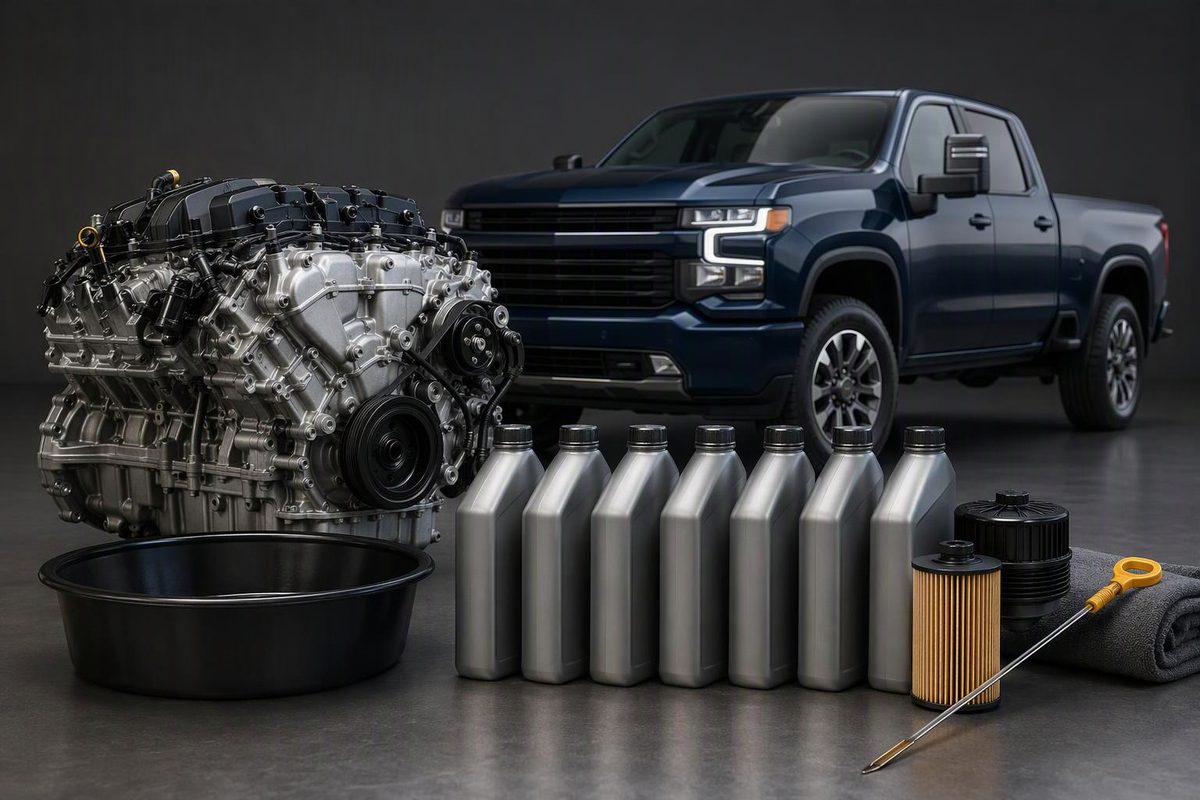
Find the LM2 and LZ0 oil-change capacity, documented Chevy applications, required 0W-20 dexosD oil, and GM’s dipstick timing before adding more oil.
The 3.0L Duramax oil capacity is approximately 7 US quarts (6.6 liters) with a filter change, for both the LM2 and LZ0 engines. That is 7 US quarts—not 7 liters. GM’s 2024 3.0L Duramax diesel supplement, pages 45–46, lists both engine versions with the same oil-with-filter capacity.
Use that figure to plan an oil-and-filter service, then verify the level on the dipstick. GM labels the capacity approximate and instructs owners to recheck after filling. It is not a fixed quantity to add to an engine that already contains oil.
Choose your service task; the tool separates an oil-change fill from a top-off or dry-engine fill.
3.0L Duramax Fill Reference
LM2 and LZ0: SAE 0W-20 meeting dexosD.
~7 US qt / 6.6 L
Approximate oil-with-filter capacity. Verify the dipstick level after filling; keep it within the cross-hatched range.
Top-off: Quantity —. The service-fill figure does not establish how much to add to existing oil.
Dry fill or unchanged filter: Quantity —. Separate figures are not provided by the references used here.
Dipstick check: level ground; engine off at least two hours. If that wait is not possible: at least 15 minutes warm, or 30 minutes not warm.
Source: GM 2024 diesel supplement, pp. 45–46; 2025 supplement, pp. 26–28 and 45–46. ~ = approximate; — = quantity not established here.
LM2 And LZ0 Have The Same Listed Capacity
The documented Chevrolet applications below show that the engine update did not change the listed oil-change quantity. Both versions take approximately 7 US quarts, or 6.6 liters, when the filter is changed.
| Engine | Documented Model-Year Examples | With Filter |
|---|---|---|
| 3.0L Duramax LM2 | 2020 Silverado 1500; 2024 Tahoe and Suburban | 7 US qt / 6.6 L |
| 3.0L Duramax LZ0 | 2024 Silverado 1500; 2025 Silverado 1500, Tahoe and Suburban | 7 US qt / 6.6 L |
Sources: GM’s 2020 supplement, page 65, 2024 supplement, pages 45–46, and 2025 supplement, pages 45–46.
These are model-year examples supported by the cited supplements, not a complete application chart for every Chevrolet diesel. Confirm your vehicle’s model year and engine in its own diesel supplement before buying supplies. A capacity entry for a Silverado 1500 should not be treated as proof of the specification for an unrelated engine or truck.
For the listed LM2 and LZ0 applications, however, the capacity answer is the same. You do not need a different oil quantity simply because the engine code changes from LM2 to LZ0. The distinction still matters when identifying the vehicle and looking up other service information; it just does not change this documented oil-with-filter figure.
If you have the larger diesel instead, use our separate 6.6L Duramax oil-capacity guide. The 3.0L specification here is not a specification for the 6.6L engine.
Seven Quarts Means An Oil-And-Filter Service Fill
The condition attached to the capacity matters as much as the number: GM lists oil capacity with the filter. That makes approximately 7 US quarts the reference for an oil change that also replaces the filter.
It does not mean the engine should receive that quantity whenever the dipstick reads low. During a top-off, oil is already present, so the amount needed depends on the existing level. Adding the full service-fill quantity on top of that oil would misuse the specification and could leave the engine overfilled.
The cited figure also is not identified as a dry-engine fill specification. If you are filling an engine after work that requires a dry-fill procedure, these capacity entries do not establish the quantity for that job. The draft sources provide no separate dry-engine figure or filter-unchanged service-fill figure; neither should be inferred from the oil-with-filter number.
| Service Situation | What The Cited Figure Establishes |
|---|---|
| Oil and filter change | Approximately 7 US qt / 6.6 L |
| Topping off existing oil | No fixed quantity; check the dipstick |
| Oil change without a filter change | Separate quantity not provided here |
| Dry-engine fill | Separate quantity not provided here |
Keeping those situations separate prevents the most consequential misunderstanding in a capacity lookup: confusing the engine’s listed service-fill amount with the amount it needs right now.
Buy 0W-20 Oil That Meets DexosD
The cited supplements specify SAE 0W-20 engine oil meeting GM’s dexosD specification. Both parts of that description matter. The viscosity is 0W-20, and the oil must meet dexosD; a bottle labeled only with the right viscosity does not establish that it meets the required specification.
Look for the dexosD-approved logo rather than treating every 0W-20 product as interchangeable. If you are comparing bottles on a shelf or listings online, check the approval information as well as the viscosity. The capacity tells you how much oil to have available; it does not tell you whether a particular product is suitable.
GM also advises against oil additives and engine-oil-system flushes. Those instructions and the oil requirement appear in the 2025 supplement, pages 27–28.
For a routine oil-and-filter change, plan on seven one-quart bottles—or another package combination totaling at least 7 US quarts. Package size and engine capacity are different quantities: buying enough oil for the job does not mean every container you purchase must be emptied into the engine.
No oil brand, product price, or filter part number is established by these capacity references. Use the vehicle-specific service information for parts selection rather than deriving a filter choice from the fact that LM2 and LZ0 share a fill quantity.
Keep US Quarts And Liters Separate
GM gives the same approximate capacity in two units: 7 US quarts and 6.6 liters. Choose the figure that matches the markings on your oil containers or measuring equipment. Do not carry the number seven from the quart specification into a liter measurement.
This distinction is especially relevant when purchasing oil sold in liter-sized containers. The listed metric service-fill reference remains 6.6 liters; “seven” belongs to the US-quart figure. The two labels describe the same approximate oil-with-filter capacity, not two different choices for how much to put in.
Likewise, “3.0L” identifies the engine in this discussion. It is not the engine’s oil capacity. A container marked 0W-20 describes viscosity, not volume. Keeping the engine designation, oil specification, and fill quantity separate makes a supply check straightforward: the right engine, the right oil, and enough oil for the documented service.
Check The Dipstick After The Correct Waiting Period
A dipstick reading taken immediately after shutdown can be misleading. GM’s procedure accounts for the engine’s temperature and the time it has been off, so an immediate reading should not be used as the reason to add more oil.
Park on level ground. GM specifies checking after the engine has been off for at least two hours, and says a cold-engine check before starting improves accuracy. If you cannot wait two hours, the shorter waiting period depends on whether the engine is warm.
| Check Condition | Minimum Wait After Shutdown |
|---|---|
| Preferred check | Two hours |
| Warm engine, if you cannot wait two hours | 15 minutes |
| Engine not warm, if you cannot wait two hours | 30 minutes |
After the appropriate wait, pull the dipstick and wipe it clean. Fully reinsert it, then remove it again with the tip down to read the level. Use a towel or glove if the handle is hot, and fully reinsert the dipstick when finished.
The wipe-and-reinsert step is part of the reading procedure, not an optional cleanup step. Use the reading obtained after fully reinserting the clean dipstick to judge where the oil sits in the operating range. These instructions, including the waiting periods and handling procedure, are in the 2025 supplement, pages 26–27.
For an oil change, this means the capacity figure is not the final check by itself. Even after measuring the service-fill quantity, verify the dipstick using the prescribed conditions rather than assuming the number poured establishes the finished level.
The Cross-Hatched Range Sets The Final Level
Keep the oil within the dipstick’s cross-hatched operating range. GM warns that both overfilling and underfilling can harm the engine. More oil is not a safety margin if it puts the reading above that range.
If the level is above the operating range, GM instructs owners to drain the excess or have a service professional remove it. Do not treat a high reading as acceptable merely because the amount added matched the approximate capacity. The capacity and the dipstick serve different purposes: one is a service-fill reference, while the other verifies the oil level in the vehicle.
A low reading also does not reveal a top-off quantity from the capacity figure alone. The cited material here does not establish a universal amount to add for a particular dipstick position. Without that information, assigning a precise dose would be a guess.
For a top-off, establish the reading under GM’s specified conditions and use the required oil. Do not substitute the full 7-quart oil-change quantity for an unknown top-off amount. If the reading is unclear, repeat the stated dipstick procedure rather than adding oil based on a reading taken immediately after shutdown or with the dipstick incompletely inserted.
“Approximately” Does Not Override The Dipstick
GM’s use of “approximately” is why the article gives both the listed quantity and the level-check procedure. The supplement supplies a service-fill reference; it also tells owners to recheck after filling. Those instructions work together.
There is no alternate exact fill quantity in the cited material that replaces the approximate 7 US quarts. Nor does the approximate label authorize filling above the operating range. The practical target is the documented oil-and-filter quantity followed by a properly taken dipstick reading within that range.
For the documented LM2 and LZ0 Chevrolet applications, the purchase specification is therefore straightforward: have approximately 7 US quarts (6.6 liters) of SAE 0W-20 dexosD-approved oil available for an oil-and-filter change. Keep a top-off, a filter-unchanged service, and a dry-engine fill separate from that reference, and use your vehicle’s diesel supplement and dipstick to verify the job.