
How Much Each 2027 Silverado 1500 Engine Can Tow
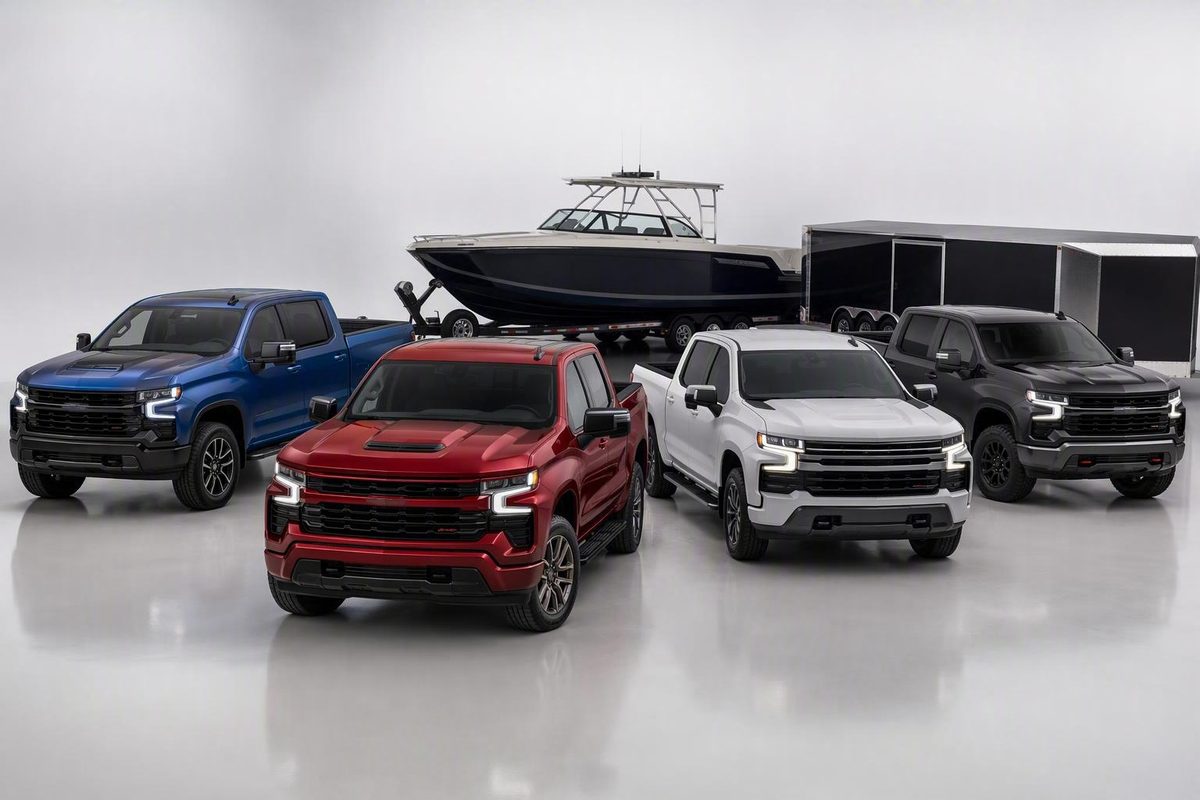
The 5.7L V8 leads at 13,700 pounds; compare TurboMax, Duramax and 6.6L V8 maximums, plus why a specific truck may rate lower.
The 5.7L L76 V8 has the highest stated 2027 Chevrolet Silverado 1500 towing capacity at 13,700 pounds. The 3.0L Duramax follows at 12,000 pounds, ahead of the 6.6L L78 V8 at 9,700 pounds and the Enhanced 2.7L TurboMax at 9,400 pounds. These are maximum ratings for properly equipped configurations, not ratings shared by every truck with the corresponding engine, according to GM’s 2027 Silverado 1500 powertrain figures.
Chevrolet separately advertises a 13,700-pound maximum available trailering rating for the truck as a whole. Buyers still need to verify the rating, payload allowance and equipment of the individual Silverado they intend to purchase or tow with.
2027 Silverado 1500 towing capacity by engine
| Engine | Output | Maximum towing | Maximum payload |
|---|---|---|---|
| Enhanced 2.7L TurboMax | 350 hp / 455 lb-ft | 9,400 lb | 2,340 lb |
| 3.0L Duramax diesel | 305 hp / 495 lb-ft | 12,000 lb | 1,870 lb |
| 5.7L L76 V8 | 402 hp / 428 lb-ft | 13,700 lb | 2,170 lb |
| 6.6L L78 V8 | 481 hp / 501 lb-ft | 9,700 lb | 1,510 lb |
The table shows GM’s stated maximum towing and payload figures. Ratings vary by configuration, trim and packages, and the published powertrain table does not identify the exact cab, bed, drivetrain, axle ratio or equipment required to reach each maximum. See GM’s complete engine comparison.
The 5.7L V8 leads for maximum towing, but it does not lead in maximum payload. That distinction belongs to the Enhanced 2.7L TurboMax, with a stated maximum payload of 2,340 pounds. The engine with the highest tow rating therefore is not automatically the engine attached to the truck with the greatest payload allowance.
Maximum towing and maximum payload may also be achieved by different configurations. A buyer should not combine the 13,700-pound tow maximum from one qualifying configuration with the 2,340-pound payload maximum from another and treat both figures as applying to the same truck.
All four announced engines use a 10-speed automatic transmission. Chevrolet identifies the powertrain families as the Enhanced 2.7L TurboMax, 3.0L Duramax Turbo-Diesel, 5.7L V8 and 6.6L V8. Its launch announcement also describes a multi-trim lineup, but it does not establish which exact combination qualifies for each engine-level maximum. Review Chevrolet’s 2027 Silverado 1500 announcement.
Scope: These capacities apply only to the 2027 Silverado 1500. Do not use them for the Silverado 2500HD or 3500HD, which are different trucks with separate ratings and trailering documentation.
The available 2027 figures are not consistently identified as conventional, fifth-wheel or gooseneck ratings. Until Chevrolet releases complete configuration-level trailering tables, use them as model-line comparison points rather than as permission to tow a particular trailer with a particular truck.
Why the 5.7L V8 outrates the more powerful 6.6L V8
The 5.7L L76 V8 has a stated maximum tow rating of 13,700 pounds, compared with 9,700 pounds for the 6.6L L78 V8. That is a 4,000-pound advantage for the smaller engine, calculated from the two published maximums.
The result appears counterintuitive if the engines are compared only by output:
- The 6.6L produces 481 horsepower, which is 79 more than the 5.7L’s 402 horsepower.
- The 6.6L produces 501 lb-ft of torque, which is 73 more than the 5.7L’s 428 lb-ft.
- Despite its greater displacement and output, the 6.6L does not receive the higher maximum tow rating.
Those figures and their corresponding Silverado towing maximums are reported in the published comparison of the 5.7L and 6.6L V8 specifications.
The qualifying truck must stay within its combined-weight, vehicle-weight, axle, payload and equipment limits—not merely produce enough engine power to move the trailer.
The available manufacturer material does not state why the 6.6L maximum is lower. It does not identify a configuration-specific engineering reason or provide enough detail to attribute the difference to vehicle weight, trim content, off-road hardware, cooling, gearing, axle ratio or another particular feature. Assigning any of those explanations would be speculation.
For a buyer who needs the highest advertised towing ceiling, the 5.7L V8 is the logical starting point. That does not mean every 5.7L Silverado can tow 13,700 pounds. The buyer must still find a configuration that qualifies and verify the individual truck’s rating before relying on that maximum.
The 6.6L may suit buyers who prioritize its higher stated horsepower or torque, but those output figures should not be substituted for a tow rating. When trailer capacity is the deciding requirement, compare certified ratings rather than ranking the engines by size or output.
Why your truck may tow less than the engine maximum
Engine-level capacities are model-line maxima, not guarantees. Two Silverado 1500s equipped with the same engine can have different tow ratings because the complete configurations are different.
- Cab and bed configuration
- Two-wheel drive or four-wheel drive
- Axle ratio
- Chassis configuration
- Trim
- Factory-installed trailering packages
- Wheels, tires and other equipment
- Dealer-installed or owner-added accessories
Occupants, bed cargo, tools, accessories and hitch equipment also add weight to the tow vehicle. That additional weight uses payload and can reduce the trailer-weight headroom available under the truck’s other ratings.
The cited 2027 information does not identify the exact cab, bed, drivetrain, axle ratio, trim, wheel, tire or trailering-package combination required to achieve any of the four engine maximums. A prior-model Silverado trailering table should not be used to fill those gaps. Equipment, packages and certified ratings can change between model years, even when an engine name or truck configuration appears similar.
Several limits must be considered together:
- GCWR: Maximum combined weight of the loaded truck and loaded trailer
- GVWR: Maximum permitted weight of the loaded truck
- Rear GAWR: Maximum permitted load on the rear axle
- Payload: Weight carried by the truck, including occupants, cargo, accessories and hitch load
- Tire limits: Load ratings of the tires installed on the truck
- Hitch limits: Ratings of the receiver, ball mount, hitch ball and related equipment
- Trailer limits: The trailer manufacturer’s GVWR, axle ratings and component limits
Chevrolet defines GCWR as the maximum combined weight of the loaded vehicle and loaded trailer. It also explains that trailer-weight rating is based on GCWR and tow-vehicle weight and that additional passengers, equipment and cargo reduce the available rating. Those definitions appear in Chevrolet’s official towing glossary and trailering-guide portal.
Staying under the advertised trailer-weight maximum does not compensate for exceeding another rating.
This is why an engine name cannot answer the complete towing question. It establishes a possible ceiling, while the truck’s configuration, labels, equipment and loaded condition determine what applies in practice.
Payload and tongue weight can become the practical limit
For an explicitly illustrative example, Chevrolet’s general guidance recommends conventional-trailer tongue weight equal to 10% to 15% of loaded trailer weight. A conventional trailer weighing 10,000 pounds when loaded could therefore place approximately 1,000 to 1,500 pounds on the hitch. That percentage comes from Chevrolet’s general 2025 Trailering Guide, not from a 2027 configuration-specific rating.
The example shows why payload can become the practical limit before trailer weight does.
Use a truck-specific payload worksheet:
Truck-specific payload allowance − occupants − bed and cabin cargo − accessories − hitch equipment − loaded trailer tongue weight = remaining payload margin
Start with the payload allowance for the individual truck, not the engine-level maximum in the comparison table. The 2,340-pound TurboMax figure, for example, is a maximum for a qualifying configuration; it is not the payload rating of every TurboMax truck.
Do not subtract the illustrative tongue weight from an engine’s maximum payload and assume the result certifies a combination. Maximum towing and maximum payload may come from different truck configurations. An estimated tongue-weight percentage also does not replace the truck’s labels, the trailer manufacturer’s requirements or actual loaded weights.
The trailer’s empty or advertised weight is not enough for this calculation. Tongue weight should reflect the trailer as it will actually travel.
Payload becomes especially important with several passengers, cargo in the bed or a trailer carrying substantial weight at the hitch. Even when the engine-level tow ceiling appears sufficient, the available payload margin may determine whether the configuration works.
How to verify a specific 2027 Silverado before towing
Before relying on an engine-level maximum, verify the individual truck and the loaded combination:
- Identify the complete configuration. Record the engine, cab, bed, drivetrain, trim, axle ratio, wheels, tires and installed trailering equipment.
- Inspect the truck’s labels. Check the Trailering Information Label and certification labels for vehicle-specific ratings and weight limits.
- Use the correct model-year documentation. Consult the 2027 Owner’s Manual and Chevrolet’s official 2027 configuration-level trailering material when available.
- Confirm the hitch and related equipment. Verify the ratings of the receiver, ball mount and hitch ball, along with any required trailering or weight-distributing equipment.
- Account for the loaded truck. Include every occupant, all cabin and bed cargo, installed accessories and hitch hardware.
- Determine loaded trailer and tongue weight. Use the trailer’s actual travel condition rather than its empty or advertised weight.
- Compare every applicable limit. Check GCWR, GVWR, rear GAWR, payload, tire ratings, hitch ratings and the trailer’s own limits.
- Weigh the complete combination. Measure the truck and trailer as they will travel, including passengers and cargo.
The resulting truck, trailer and axle weights should be checked against the applicable limits in the official Chevrolet trailering documentation.
The available 2027 evidence supplies engine-level maximums but not the configuration rows needed to determine the rating of a particular Silverado 1500. Until complete 2027 tables are published, a dealer quote or build description should not be treated as sufficient unless it is matched to the truck’s official labels and documentation.
Because manufacturer information can be expanded or revised, keep a visible last-checked date with any saved comparison, printed specification or dealer quote. Recheck Chevrolet’s current 2027 documentation before ordering the truck and again before relying on a maximum for towing.
The buying takeaway is straightforward: choose the engine according to the towing ceiling you need, but choose the actual truck according to its vehicle-specific rating and remaining payload. For the highest stated ceiling, start with the 5.7L V8. Before purchasing or towing, verify the selected Silverado’s configuration, labels, equipment and complete set of weight limits.