
Diagnose a 2013 Tahoe Service 4WD Warning Without Guessing
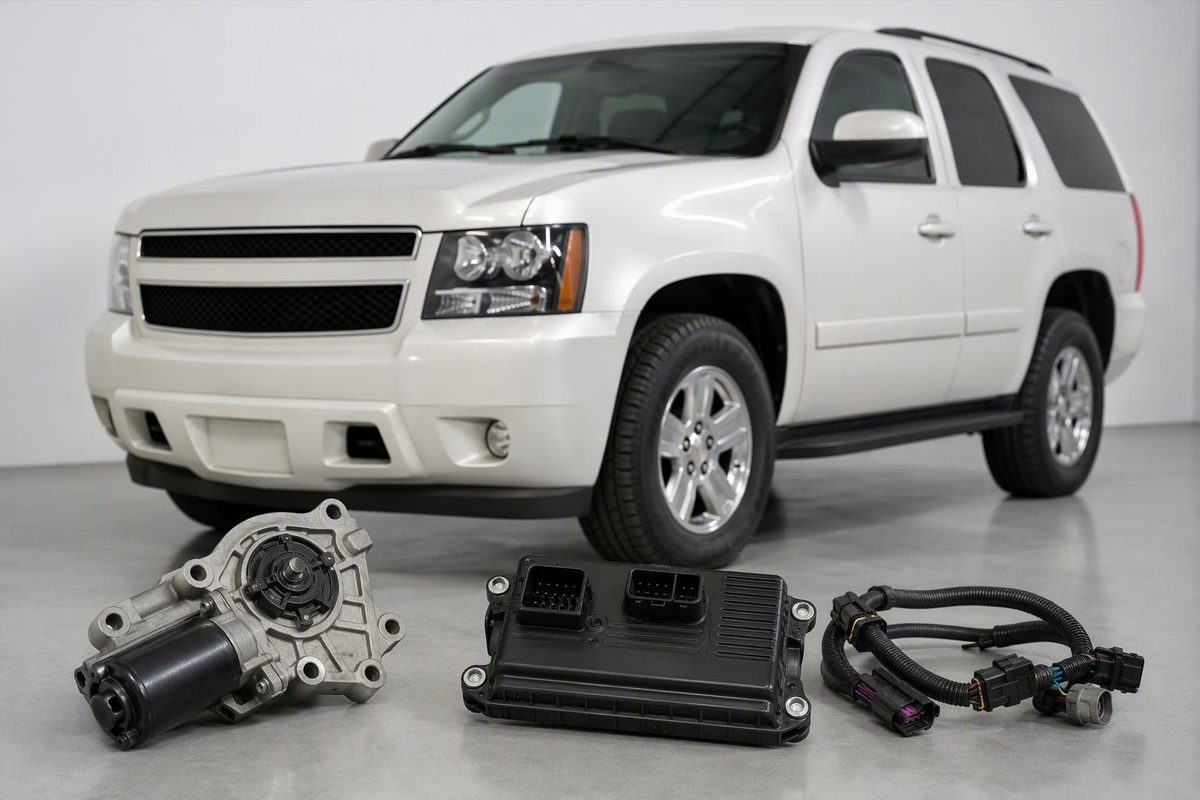
Find why a 2013 Tahoe can show Service 4WD with no code, which module to scan, and what GM says to inspect before replacing a motor or module.
A SERVICE 4 WHEEL DRIVE message with no code on a basic OBD-II reader does not mean your 2013 Tahoe has no stored fault. The reader may not communicate with the transfer case shift control module (TCCM). Use a scan tool that explicitly supports the 2013 Tahoe TCCM before replacing the transfer-case motor, selector switch or control module.
Although owners often call it “Service 4WD Soon,” the exact Driver Information Center message on a 2013 Tahoe is SERVICE 4 WHEEL DRIVE.
Select the scan result you have; the tool identifies the next diagnostic step.
TCCM Scan Result
PIP5080B applies only to listed vehicles with transfer-case RPO NP0, NQF or NQH.
Get a TCCM-Capable Scan
Use a tool that explicitly communicates with the 2013 Tahoe transfer case shift control module. Preserve current and history codes.
| Finding | Diagnostic Route |
|---|---|
| Basic reader: no codes | Scan the TCCM before replacing parts. |
| No TCCM communication | Verify power, ground and network circuits. |
| C0306 or C0569 | Inspect motor A/B circuits at X3 and X109. |
| C0321 | Inspect circuit 1342 at X109. |
| C0396 or C0398 | Use the chart; inspect X109/X3 terminals. |
| No TCCM DTC | Compare requested mode, inputs and feedback. |
Source: GM bulletin PIP5080B and the 2013 Tahoe/Suburban owner’s manual.
Start With the Owner-Manual Reset Procedure
Chevrolet specifies this initial response:
- Stop as soon as safely possible and turn off the Tahoe.
- Leave the key in LOCK/OFF for at least one minute.
- Restart the vehicle and check the Driver Information Center.
The 4WD system needs service if the message remains or returns after driving, according to the 2013 Tahoe/Suburban owner’s manual, p. 5-43. Do not depend on 4WD operation or an uncertain selector indication until the fault has been diagnosed.
Before cycling the ignition again, record what the selector is doing. Note which lamp is on, flashing or dark; whether the warning appears at startup or after requesting a mode; and whether you can hear a shift motor.
The manual says a lamp flashes while a transfer-case shift is underway and remains illuminated when the shift finishes. If the requested shift cannot be completed, the system should return to its previous setting (owner’s manual, pp. 9-33–9-40).
Stop operating the selector if the Tahoe grinds, will not move normally, binds severely during ordinary turns or appears stuck in transfer-case Neutral. Arrange transport rather than continuing to test it.
Transfer-case Neutral can let the Tahoe roll even with the transmission in Park. Set the parking brake if Neutral may be engaged (owner’s manual, p. 9-35).
A Basic OBD-II Reader May Miss the Stored Codes
A basic code reader reports only the controllers and code types it supports. A successful engine-code scan does not establish that the transfer-case module has no codes.
GM’s relevant bulletin identifies these chassis DTCs in the transfer-case system:
- C0306
- C0321
- C0396
- C0398
- C0569
The scan tool must explicitly support the TCCM on a 2013 Tahoe, not merely engine and emissions codes. Ask the technician to perform a full-vehicle module scan that includes the TCCM.
The scan report should show current and history DTCs without clearing them first. It should also establish whether the TCCM communicates. If the module communicates but has no current or history code, the technician should observe requested and actual transfer-case mode, selector-switch input, motor data and position feedback.
Avoid disconnecting the battery or clearing codes before this scan. Erasing stored evidence can make an intermittent warning harder to reproduce and trace.
GM Bulletin PIP5080B Points to Connector Inspections
GM bulletin PIP5080B applies to listed 2012–2013 Tahoe and related four-wheel-drive models equipped with transfer-case RPO NP0, NQF or NQH. It addresses an intermittent Service 4WD message accompanied by one or more of the five DTCs listed above (GM bulletin PIP5080B).
Check the Tahoe’s RPO information and scan results before applying the bulletin. The bulletin does not establish that every 2013 Tahoe with a warning has the same fault.
GM reported that many returned transfer-case control modules and actuator motors tested with no trouble found. Later warranty repairs involved wiring at connectors X109 and X3. The bulletin directs technicians to inspect terminal tension, crimps, terminal seating and general connector condition before replacing the TCCM or actuator motor.
| TCCM Scan Result | Bulletin-Directed Emphasis |
|---|---|
| C0306 or C0569 | Inspect the motor A/B circuits at TCCM connector X3 and connector X109 while following the DTC procedure. |
| C0321 | Inspect circuit 1342 at X109 closely while following the DTC procedure. |
| C0396 or C0398 | Follow the applicable diagnostic chart and inspect X109/X3 terminals before replacing the module or motor. |
| TCCM will not communicate | Verify module power, ground and network circuits before condemning the module. |
| No current or history DTC | Compare requested mode with switch, motor and position feedback while reproducing the warning. |
An earlier revision of the bulletin includes an image of an X109 motor-circuit terminal visibly backed out. It illustrates why terminal fit matters, but it is not proof that a particular Tahoe has that fault (GM bulletin PIP5080A).
No TCCM Communication Requires Circuit Testing
A TCCM that does not appear on a full-module scan is not automatically defective. The module cannot communicate if it lacks required power or ground, or if there is a fault in the communication network.
The diagnostic sequence should verify those circuits before authorizing a replacement module. If communication is restored, scan again for current and history transfer-case codes before clearing anything.
Likewise, communication without a stored DTC does not prove that every component is working. Live data can show whether the mode requested at the selector agrees with the switch input received by the TCCM and with the motor or position feedback reported by the transfer case. Bidirectional testing can help separate a command problem from a motor, feedback or wiring problem.
The Repair Estimate Should Identify the Failed Test
A selector switch, actuator or encoder assembly, TCCM, connector fault, or damaged wiring can produce overlapping symptoms. The warning alone does not identify which part has failed.
A defensible repair order should identify:
- The DTCs and the module that stored them
- The Tahoe’s transfer-case RPO
- Connector and terminal findings
- The failed circuit test, live-data result or bidirectional-command result supporting the repair
If an estimate says only “no code—replace motor,” ask whether the vehicle was scanned through the TCCM and request the test result that condemns the motor. A no-code result from an engine-only reader does not support that diagnosis.
Until the fault is diagnosed, avoid repeatedly requesting different transfer-case modes. Chevrolet says excessive shifting can trigger protection that allows only one response every 10 seconds for as long as three minutes. The owner’s manual also warns against extended use of 4HI or 4LO on clean, dry pavement because it can cause premature powertrain wear (owner’s manual, pp. 9-33–9-40).