
How to Choose a Low-Profile Truck Tool Box for a Chevrolet
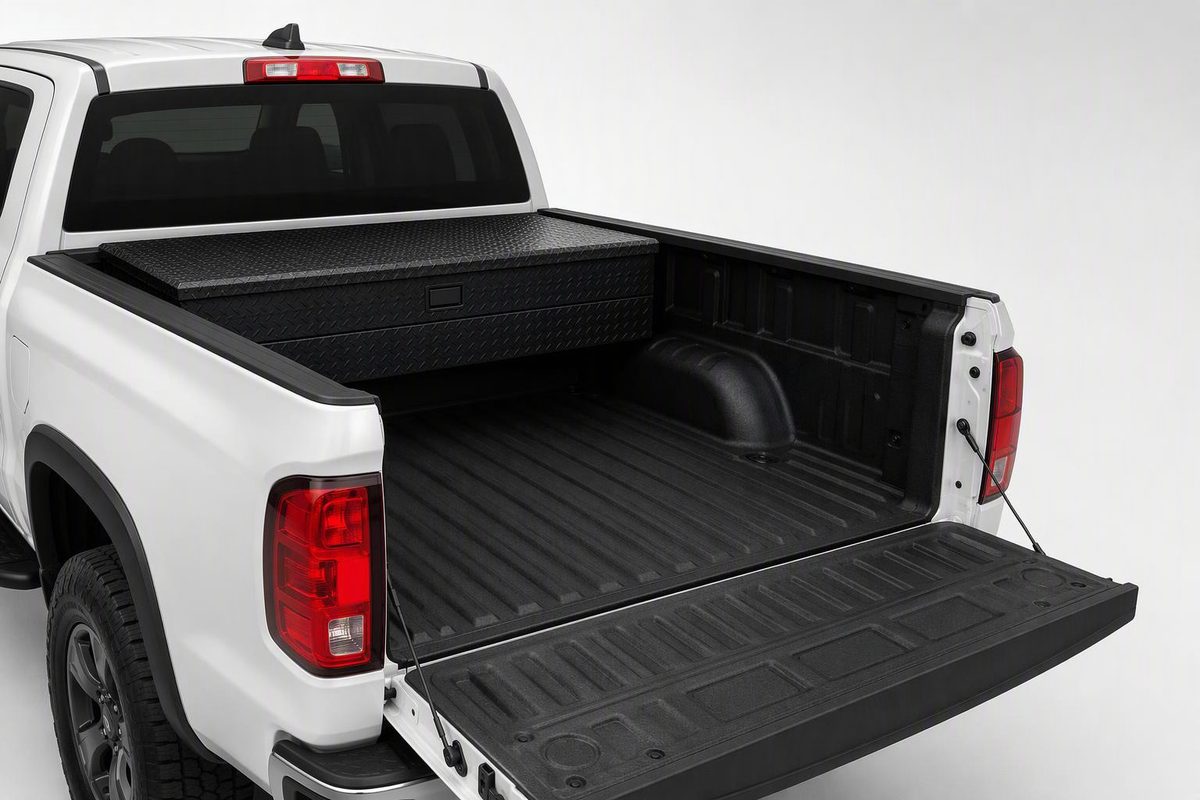
Measure bed rails, tonneau clearance and lost bed space before choosing a low-profile tool box for a Silverado or Colorado.
A low-profile truck tool box should fit the bed rails and tonneau cover as one system. Do not order from “full-size,” “mid-size” or “low-profile” wording alone. For a Silverado or Colorado, verify the box’s overall length, front-to-back depth, tub dimensions and open-lid clearance against the actual truck.
“Low profile” does not necessarily mean “fits under a tonneau.” It may mean only that the lid sits lower relative to the bed rails. UWS, for example, classifies both a 67 × 20 × 14.75-inch crossover box and a much shallower 64 × 12.75 × 10.5-inch slim box as low-profile models (UWS 66-inch crossover specifications; UWS 63-inch slim-box specifications).
Measure these points on the truck
Measure with any rail caps, bedliner, tonneau rails, headache rack or cab guard already installed.
| Measurement | Where to measure | What it decides |
|---|---|---|
| Inside rail span | Between the inner faces of the bed rails where the box will sit | Maximum tub length that can hang between the rails |
| Outside rail span | Across the outer edges of the rails | Whether the box spans both rails with adequate support |
| Flat rail width | Usable horizontal surface on each rail | Whether the box feet sit securely without resting on unsuitable trim |
| Rail to bed floor | Vertically from rail top to the floor | Whether the suspended tub clears the floor, liner and cargo below |
| Front-to-back space | Front bulkhead to the first obstruction | How much bed length the box consumes and whether it meets a wheelhouse or accessory |
| Cab and glass clearance | Proposed box position to the cab, rear glass and rack | Whether the lid can open fully without contact |
| Tonneau envelope | Between cover rails and from the mounting surface to the cover’s lowest component | Whether the box, handles and moving lid can coexist with the cover |
Check the exact Chevrolet series, cab and bed before ordering. Silverado bed names are not interchangeable across 1500 and HD models; the current 1500 standard bed, for example, is not the same length as the HD standard bed. The Silverado bed-dimensions guide separates those configurations.
A crossover-box listing may provide:
- Overall length: side to side across the truck
- Overall width: front to back
- Overall height: bottom to highest closed point
- Tub length: portion hanging between the bed rails
- Tub width: front-to-back space occupied below the rails
- Tub height: distance the tub hangs below its mounting surface
Confirm those conventions on the specific dimension drawing. Sellers do not always label dimensions consistently.
Let the tonneau cover determine the box style
No tonneau cover
A rail-mounted crossover box is the simplest arrangement. Select a lid height that preserves the rearward view, then test the open lid—not only the closed box—against the cab and any rack. UWS instructs installers to open and close the lid before final tightening and verify clearance from the cab and rear window (UWS installation guide).
Existing full-length tonneau
Treat the cover’s rails, clamps, hinges, latches and folded or rolled stack as obstructions. A crossover box can sit low relative to the cab yet still be too tall or too wide for the cover.
Calculate:
Available vertical clearance = distance from the bed-rail mounting surface to the tonneau’s lowest component
The installed box, handles and lid must remain within that envelope while allowing the clearance specified by both manufacturers for seals, flex and operation. Also measure the span between the tonneau rails. A box that clears vertically can still strike a side rail or clamp.
Practical options include:
- an under-cover box designed for the cover or rail system;
- a suspended box with a confirmed compatible position and opening method; or
- side or wheel-well storage that avoids the cover mechanism.
Dimensions alone may not establish compatibility. RealTruck notes that its BAKBox 2 requires BAKFlip tonneau rails, while other suspended boxes use different mounting arrangements (RealTruck tonneau-accessory compatibility guide).
Toolbox-compatible tonneau
A shortened “toolbox tonneau” closes against a crossover box instead of covering it. RealTruck describes this cover type as approximately 20 inches shorter than the bed and compatible with most 18- to 20-inch-deep crossover boxes, but the exact seal position and box profile still matter (RealTruck tonneau-cover guide). Use a documented box-and-cover compatibility chart when one is available.
Protect usable bed space
On a short-bed Silverado or Colorado, front-to-back depth can matter more than catalog capacity. The two UWS examples show the tradeoff: the 20-inch-deep standard box provides 7.5 cu. ft., while the 12.75-inch-deep slim model provides 5.7 cu. ft. The slim box gives up 1.8 cu. ft. of storage but occupies 7.25 fewer inches of upper-bed length.
That difference can determine whether bins, coolers or building materials fit ahead of the closed tailgate. A suspended crossover may preserve floor space under its tub, but tall cargo still cannot use that section. Before ordering, mark the proposed depth and tub drop in the bed with painter’s tape, then test the cargo normally carried.
Include the box, mounting hardware and contents in the truck’s load calculation. Chevrolet’s Silverado manual directs owners to the vehicle-specific Tire and Loading Information label for maximum occupant-and-cargo weight; an advertised maximum payload for another configuration is not the controlling number (2018 Silverado owner’s manual). Check the owner’s manual for the truck’s model year for any separate bed-rail or accessory-loading limits.
Finally, use only the hardware and tightening procedure specified for the box and truck. For its crossover boxes, UWS calls for protective rail pads and one J-hook assembly per side, and warns against overtightening because that can damage the bed rails (UWS installation guide).
Choose the box only after its dimension drawing passes all three checks: secure bed-rail mounting, unrestricted tonneau operation and enough remaining space for the cargo the truck actually carries.