
What Four-Wheel Drive Really Adds to Your Fuel Bill
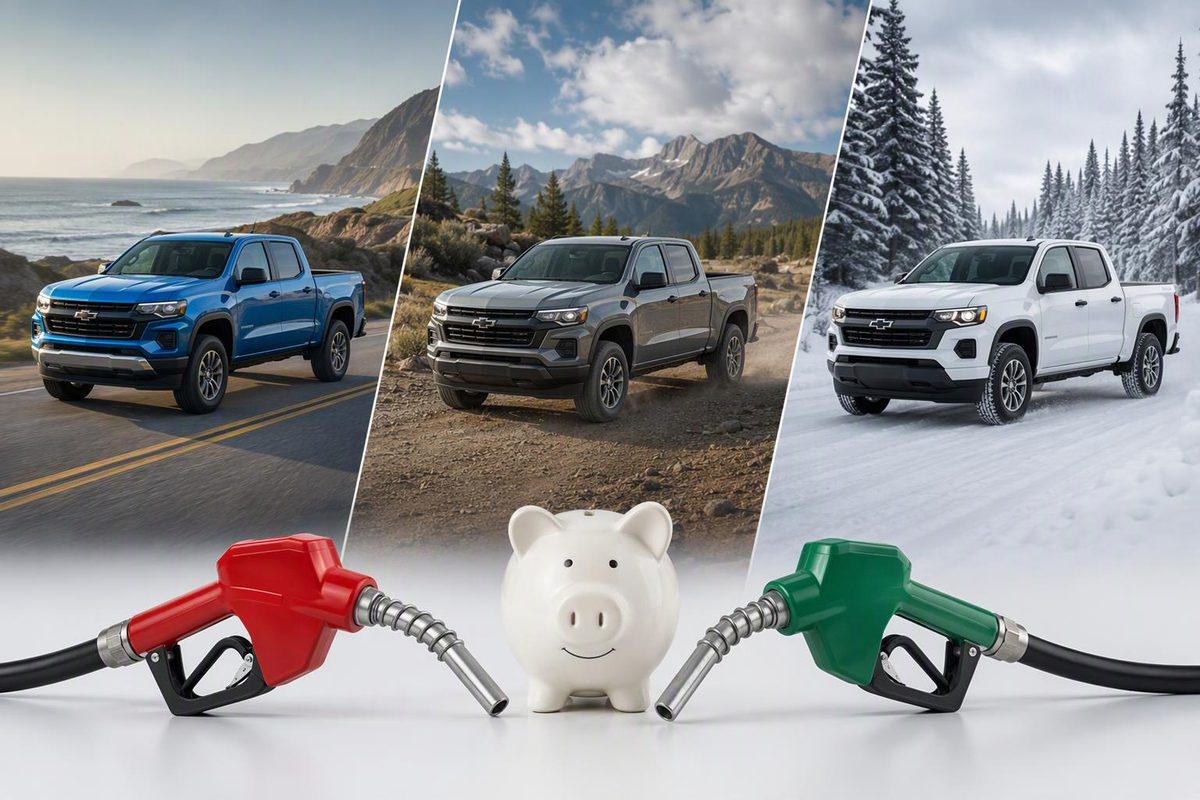
Compare Chevy Colorado 2WD and 4WD MPG ratings, calculate annual fuel costs, and see what Chevrolet says about using 2HI, AUTO, and 4HI on different roads.
Yes—four-wheel drive generally uses more gas. A 2026 Chevrolet Colorado rated at 19 MPG combined in 4WD uses about 10.5% more gasoline over the same distance than the comparable 2WD listing rated at 21 MPG. But buying a 4WD truck and engaging four-wheel drive in a truck you already own are different comparisons. DOE/EPA fuel-economy guidance says engaging all four wheels increases transfer-case and differential losses, reducing fuel economy; it does not provide one MPG penalty for every truck or driving mode.
At 12,000 miles per year and $3.50 per gallon, that Colorado ratings comparison works out to about $211 more per year for the regular 4WD configuration. Use your mileage and fuel price below to see whether the difference matters to your budget.
Enter your annual miles and gasoline price; choose the Colorado 4WD rating to compare costs.
Colorado Annual Fuel-Cost Comparison
Regular 4WD uses ~60 extra gallons per year compared with 2WD.
- 2WD fuel cost
- ~$2,000/year
- Selected 4WD fuel cost
- ~$2,211/year
Estimated gasoline spending only. Ratings compare configurations, not 2HI versus 4HI in one truck.
Source: DOE/EPA 2026 Colorado ratings, 2.7L gasoline engine and eight-speed automatic: 21, 19 and 18 MPG combined.
Colorado Ratings Show a 2 MPG Combined Difference
The 2026 Chevrolet Colorado provides a documented comparison. These EPA listings all have a 2.7L four-cylinder gasoline engine and eight-speed automatic transmission:
| Colorado Configuration | City MPG | Highway MPG | Combined MPG |
|---|---|---|---|
| 2WD | 19 | 24 | 21 |
| 4WD | 17 | 22 | 19 |
| 4WD With Mud-Terrain Tires | 17 | 20 | 18 |
Source: DOE/EPA 2026 Colorado ratings.
The regular 4WD listing is 2 MPG lower combined than the 2WD listing. It is also lower in both the city and highway columns. That makes this a useful shopping comparison, provided you are comparing the listed configurations rather than treating the figures as a guarantee for a particular trip.
The mud-terrain listing shows why equipment needs its own attention. Its combined rating is lower than the regular 4WD listing, even though both are four-wheel drive. You cannot assign the entire difference between the 2WD truck and the mud-terrain configuration to the drive system alone.
If you are choosing between a basic truck and an off-road configuration, compare the complete vehicles you would actually buy. Matching the engine and transmission is necessary, but it does not erase differences in tires or other equipment. Our Colorado MPG guide compares the additional configurations.
Lower MPG Means More Fuel Per Mile
MPG measures how far a vehicle travels on a gallon, not how many gallons a trip requires. To compare fuel use over the same distance, divide the mileage by each truck’s MPG rating. The lower-rated truck needs more gallons to cover those miles.
For the 21-versus-19-MPG Colorado comparison, that produces approximately 10.5% more gasoline for the regular 4WD configuration. That percentage belongs to these ratings. It is not a universal four-wheel-drive penalty, and it should not be carried over to a Silverado, Tahoe or Suburban without checking that vehicle’s figures.
This also explains why a difference stated only as “2 MPG” is incomplete. The annual cost depends on how far you drive and what you pay for gasoline. The same ratings gap matters more to a high-mileage owner than to someone who uses the truck occasionally. The calculator holds the EPA ratings constant and changes those ownership assumptions.
Selecting 2HI Does Not Give a 4WD Truck the 2WD Rating
The Colorado table compares different vehicle configurations, not one truck tested while switching between 2HI and 4HI. That distinction prevents a common mistake: assuming a 4WD Colorado rated at 19 MPG will become a 21-MPG truck whenever its driver selects 2HI.
DOE/EPA notes that four-wheel-drive vehicles are tested in two-wheel drive. The 4WD configuration’s published rating therefore is not evidence that it was driven continuously with four-wheel drive engaged during testing. Selecting 2HI does not turn it into the factory 2WD configuration or establish that configuration’s fuel economy.
Use the ratings comparison to answer a purchase question: what is the expected fuel-use difference between these listed trucks? Use the owner’s manual to answer an operating question: which transfer-case setting should you select for the surface you are driving on?
Those questions overlap, but their evidence is different. A window-sticker MPG rating does not tell you the exact cost of using AUTO during a wet commute. A manual’s statement that 2HI provides the best fuel economy does not establish the annual cost difference between two trucks on a dealer lot.
The available sources do not provide a controlled, numerical MPG comparison of 2HI, AUTO and 4HI in the same Chevy. Any claim that switching modes always costs a particular number of MPG would go beyond that evidence.
Chevrolet Specifies 2HI for the Best Fuel Economy
The 2021 Tahoe/Suburban owner’s manual, pages 236–239, gives a documented Chevrolet example of how the settings differ. The descriptions below apply to that manual; check your own model-year manual and transfer-case equipment before applying them to another Chevy.
| Setting | Manual’s Description | Fuel-Economy Guidance |
|---|---|---|
| 2HI | Front axle not engaged | Best fuel economy |
| AUTO | Front axle engaged; power distributed as needed | Slightly lower than 2HI |
| 4HI | For conditions needing extra traction | No numerical penalty given |
| 4LO, If Equipped | Extra torque for demanding off-road conditions | No numerical penalty given |
Source: 2021 Chevrolet Tahoe/Suburban owner’s manual.
2HI Is the Normal Street-and-Highway Choice in This Manual
In 2HI, the front axle is not engaged. Chevrolet specifies this setting for most streets and highways and says it provides the best fuel economy.
For an owner asking whether to leave this particular vehicle in AUTO all the time to avoid changing settings, the manual supplies a direct trade-off: AUTO offers automatic distribution of power as conditions require, but fuel economy is slightly lower than in 2HI. It does not put a number on “slightly.”
You therefore cannot use the Colorado’s 2-MPG ratings gap as the AUTO penalty for a Tahoe or Suburban. The vehicles, comparison and operating conditions are different. Even within the documented Tahoe/Suburban example, the manual’s guidance is qualitative rather than a fuel-cost estimate.
AUTO Is Not the Same as 4HI
In AUTO, the front axle is engaged, and power goes to the front and rear wheels automatically as conditions require. The manual describes AUTO as a separate setting for variable road surfaces.
In 4HI, the intended use is conditions requiring extra traction, including snowy or icy roads and off-road driving. The fact that both settings can send power to four wheels does not make them interchangeable. Choose by the manual’s description of the road conditions, not by the number of wheels implied by the setting’s name.
If your Chevy does not have an AUTO setting, this manual’s AUTO guidance does not create one or establish how a different transfer case operates. Confirm the settings actually fitted to your truck before deciding which description applies.
4LO Is for Demanding Off-Road Conditions
Where equipped, 4LO provides extra torque for conditions such as deep mud, sand or snow and steep hills. It is not the routine-commuting setting described by this manual.
Do not leave 4HI or 4LO selected for routine dry-pavement driving. The manual warns that extended use on clean, dry pavement can cause premature powertrain wear, steering vibration and faster tire wear. That warning is a stronger reason to avoid inappropriate use than an unverified MPG estimate.
Fuel economy should not override the need for traction, either. If conditions call for a setting your manual recommends, use it. The sensible fuel-saving choice is the appropriate mode for the surface—not keeping 2HI selected regardless of conditions.
The Colorado Example Adds About $211 a Year
Annual fuel cost = annual miles ÷ MPG × price per gallon.
Using 12,000 miles per year and gasoline at $3.50 per gallon, the regular Colorado comparison is:
| Configuration | Combined MPG | Annual Gallons | Annual Fuel Cost |
|---|---|---|---|
| 2WD | 21 | About 571 | About $2,000 |
| 4WD | 19 | About 632 | About $2,211 |
| Difference | — | About 60 More | About $211 More |
These are calculated estimates, not promised real-world results. The gallons and dollars are rounded independently, so subtracting the displayed rounded gallon totals may not match the rounded difference exactly.
The calculator uses the same method. Its regular 4WD choice compares 19 MPG with 21 MPG. Its mud-terrain choice compares 18 MPG with 21 MPG, which represents the listed configuration difference—not an isolated measurement of what the tires or four-wheel-drive system cost separately.
Your annual mileage and gasoline price are assumptions, not vehicle specifications. Replacing them with your own figures makes the estimate more useful without making the EPA ratings a prediction of every drive. The tool estimates gasoline spending only; it does not calculate purchase-price differences, maintenance costs or the value of extra traction.
When deciding whether the fuel premium is acceptable, keep the dollar result tied to the comparison you selected. The regular 4WD result belongs to the regular listing. It should not stand in for an off-road configuration with a different rating, or for another Chevrolet model whose MPG is not supplied here.
Match the Actual Trucks Before Comparing Fuel Bills
For a purchase decision, match model year, engine, transmission, cab, bed and tire/off-road equipment as closely as possible, then check each truck’s window sticker. Comparing only “2WD” and “4WD” can hide the configuration differences that matter to the final rating.
The Colorado table controls the listed engine and transmission, but its mud-terrain row deliberately represents different equipment. That row is useful if it matches the truck you want. It is less useful if your goal is to isolate four-wheel drive from every other change.
For a Silverado, Tahoe or Suburban purchase, use the ratings for those exact candidates rather than borrowing the Colorado’s 10.5% figure. This comparison supplies no matching ratings for those vehicles, so it cannot establish their fuel premium.
For the truck already in your driveway, a change in observed MPG does not by itself identify the drive-mode penalty. DOE/EPA explains that towing, heavy loads, cold weather, speed and tire condition also affect consumption. A winter tank driven in four-wheel drive and a mild-weather tank driven in 2HI may differ for several reasons at once.
That makes it worth separating what you know from what you are estimating. The window sticker supplies a configuration rating. The manual supplies operating guidance. Your fuel records show what the truck used under your actual conditions, but they do not automatically isolate the effect of one setting.
For most buyers, the useful answer is therefore two-part: budget for the rated fuel difference between the actual trucks, then operate the chosen truck in the mode its manual recommends. In the documented Colorado example, regular 4WD carries a measurable fuel premium. In the documented Tahoe/Suburban manual, 2HI is the best-economy setting, AUTO is slightly lower, and no numerical mode-by-mode penalty is provided.