
The Avalanche’s 50-Inch Bed Width Explained for Cargo Fit
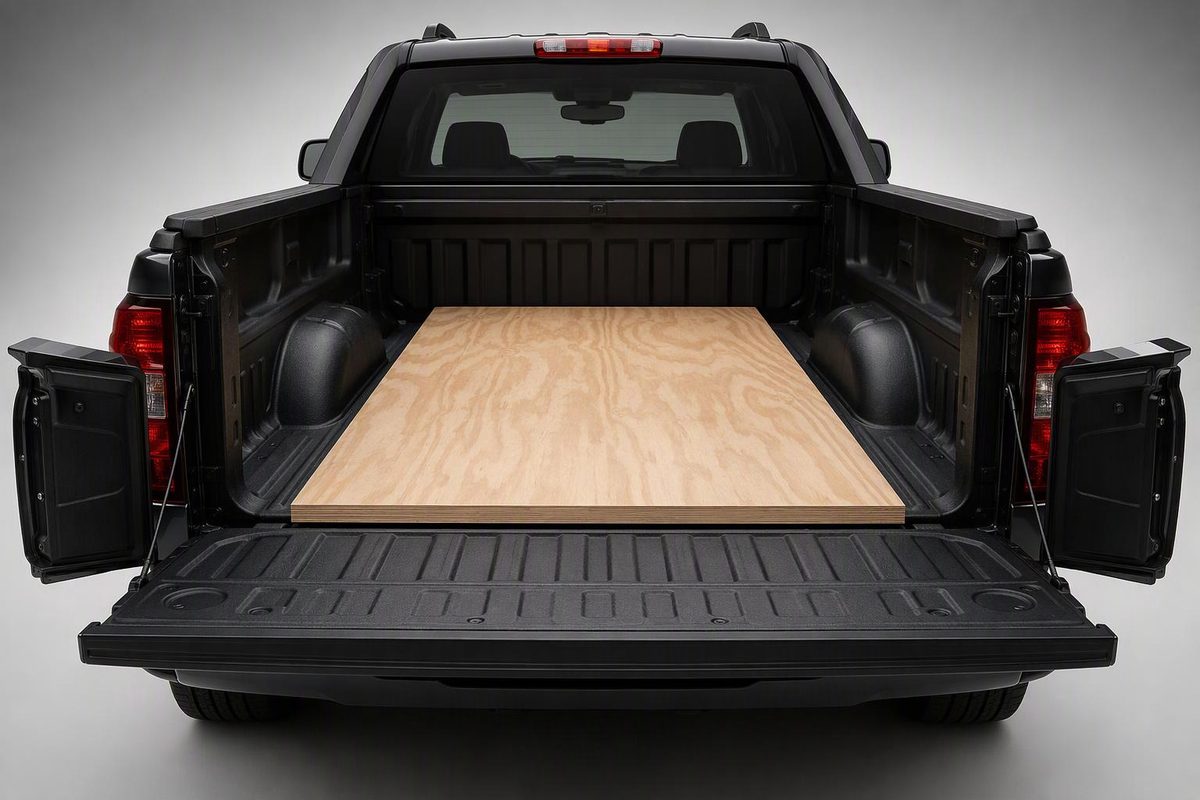
Compare documented Avalanche bed dimensions, check 4×8 plywood clearance with the Midgate down, and see which measurements matter before buying accessories.
The Chevy Avalanche’s published cargo-bed width is 50 inches (1,270 mm) at the floor and between the wheel housings—not the truck’s outside body width. That measurement appears in both 2002 Avalanche specifications and Chevrolet’s 2013 Canadian brochure. A 48-inch-wide plywood sheet is therefore narrower than the published cargo floor, but its length requires the Midgate to be lowered for containment within the listed cargo length.
Lowering the Midgate extends the cargo area into the cab; it does not make the bed wider. Use 50 inches for a first dimensional check, then measure the actual truck if the cargo or accessory comes close to that limit.
Choose a documented model-year example and enter your cargo width and length in inches to check nominal clearance.
Check Nominal Cargo Fit
Change Midgate Configuration
Fits Within Published Width And Length
Width Clearance2 in.
Length Clearance2.2 in.
2013 example, Midgate down: 50 × 98.2 inches.
Total clearance, not clearance per side. Dimensions stay in the orientation entered. Opening, height, installed accessories and load capacity are not checked.
Published Dimensions And Limits
| Example | Width | Up Length | Down Length |
|---|---|---|---|
| 2002 / 2006* | 50 in. | 63.0 in. | 97.6 in. |
| 2013† | 50 in. | 63.3 in. | 98.2 in. |
*2002 1500 2WD and 2006 1500 LS 2WD specifications. †2013 Canadian brochure. These are examples, not a complete model-year chart. Zero clearance is an exact nominal match, not a verified loading fit. Blank dimensions are unknown.
Sources: 2002 Cars.com, 2006 Cars.com, and 2013 Chevrolet Canadian brochure; clearances are calculated.
Published Bed Width Is 50 Inches In These Examples
The documented early and late examples below share the same published width. Their listed cargo lengths differ slightly. These are specific model-year and specification examples, not a year-by-year chart establishing every Avalanche configuration.
| Specification Example | Floor Width | Midgate Up Length | Midgate Down Length |
|---|---|---|---|
| 2002 1500 2WD | 50 in. | 63.0 in. | 97.6 in. |
| 2006 1500 LS 2WD | 50 in. | 63.0 in. | 97.6 in. |
| 2013 Canadian brochure | 50 in. | 63.3 in. | 98.2 in. |
The 2002 and 2006 specifications list 50 inches both at the cargo floor and between the wheel housings. Chevrolet’s Canadian brochure identifies the 2013 figure as cargo-floor width between the wheel housings. Separately, 2013 Cars.com specifications for the LS 2WD list 50 inches at the floor and at the top rear of the box.
Those measurement descriptions matter. Cargo-floor width answers whether an object is nominally narrow enough to occupy the floor. Width between the wheel housings addresses a common restriction for a load sitting low in the bed. Neither measurement is the outside width of the truck, nor does it establish the spacing of accessory brackets or mounting surfaces.
For the examples shown, the equal floor and wheel-housing figures mean you should not subtract another wheel-housing allowance from the published 50 inches. But you also should not assume there is extra usable width somewhere else simply because the body is wider. The cited dimensions give you a specific cargo-space reference, not a complete cross-section of every surface and opening.
If you are checking another model year or configuration, confirm its specification rather than treating these three examples as an exhaustive chart. For a purchase that depends on a close fit, the truck’s current usable space is the final measurement.
The Midgate Adds Length, Not Width
The Midgate is the folding partition behind the rear seats, not the tailgate. With it upright, the documented cargo lengths are 63.0 inches in the 2002 and 2006 examples and 63.3 inches in the 2013 brochure. Lowering it gives the longer cargo area listed in the table.
Chevrolet’s 2012 owner’s manual, pages 2-14–2-15, says to fold the rear seats before lowering the Midgate. It also states that the rear glass can remain installed when the Midgate is lowered. Those are instructions for the 2012 Avalanche; use the manual for your truck when setting up its cargo area.
The distinction between the Midgate and tailgate is essential when reading a bed-size listing. “Midgate down” describes an extension into the rear-seat area. It is not another name for carrying cargo over an open tailgate, and the listed extended length should not be treated as an open-tailgate measurement.
For a long, narrow item, the extended length may resolve the fit problem. For an item wider than the published floor, lowering the Midgate does not resolve the width problem. Check width and length separately rather than relying on a single description such as “extended bed.”
Also distinguish floor space from the route into that space. An object can be narrower and shorter than the published cargo area yet still require a separate check of the opening it must pass through. The cited bed dimensions do not supply every opening’s usable width or height.
A 4×8 Plywood Sheet Fits Nominally With The Midgate Down
Yes, a 48-by-96-inch sheet fits dimensionally within the published floor width and extended cargo lengths. It is 2 inches narrower than the 50-inch floor. If centered, that leaves about 1 inch on each side.
The length margin is smaller than the phrase “extended cargo area” might suggest. Subtracting the sheet’s 96-inch length from the documented Midgate-down lengths gives the following total clearances:
| Example | Width Clearance | Length Clearance |
|---|---|---|
| 2002 / 2006 | 2 in. | 1.6 in. |
| 2013 brochure | 2 in. | 2.2 in. |
These are calculated clearances from published dimensions, not results from a loading test. The length figure is the total difference between cargo length and sheet length; it is not that much clearance at each end. Likewise, the 2-inch width difference is shared between the sides when the sheet is centered.
With the Midgate up, the roughly 63-inch cargo area is too short to contain a 96-inch sheet with the tailgate closed. The fact that the sheet is narrower than the floor does not change that length restriction. A width-only answer to plywood fit would leave out the limiting dimension in the standard configuration.
A bed mat, liner or installed accessory can affect the usable space you are checking. Because the published margins are small, measure your truck with those items installed rather than assuming the nominal calculation guarantees loading clearance. The sources cited here do not provide a universal allowance to subtract for every liner or accessory.
The calculator uses the sheet’s stated width and length in the orientation you enter. It does not prove that the sheet can be maneuvered through an opening, fit beneath the cargo covers or be carried safely at a particular weight. Its “fits” result means only that the entered dimensions do not exceed the selected published width and length.
Cargo Dimensions Equal To The Bed Leave No Allowance
Nominal clearance is calculated as the published cargo dimension minus the corresponding cargo dimension. A positive result means the item is smaller along that axis; zero means it matches the published dimension exactly; a negative result means it exceeds that dimension.
An exact-width object is therefore a different proposition from a plywood sheet. At 50 inches wide, it has no nominal width clearance against a 50-inch floor specification. That is a dimensional match, not evidence of an easy fit. Any difference between the published space and the truck’s usable space becomes relevant.
Treat width and length as a pair. A shorter item can still be too wide, and a narrower item can still be too long. Averaging the dimensions or comparing only the larger number will not answer whether a rectangular footprint fits in the selected orientation.
Use the calculator’s Midgate-up option if the rear-seat arrangement needs to remain in its normal cargo configuration. Do not accept a Midgate-down result as proof that the same item fits with the partition upright. The selected configuration determines which published length is used; the 50-inch width stays the same.
The tool deliberately does not apply a guessed installation allowance. There is no sourced universal figure here for lost width from mats, liners, brackets or other equipment. If your measurements show less usable room, compare the item against those measurements before relying on the nominal result.
Toolboxes Need Mounting Measurements, Not Just Floor Width
Use 50 inches as the cargo-floor reference, not as an accessory mounting dimension. A toolbox that sits on the floor presents a different measurement problem from one whose fit depends on rails, brackets or another mounting surface.
For a floor-mounted box, measure the narrowest usable width at the height the box will occupy. Then check its length against the cargo configuration you intend to use. A product’s overall dimensions are useful only when compared with the actual space and installation position, including any parts that project beyond the main box.
For an accessory that mounts above the floor, obtain the rail or mounting span required by its manufacturer and measure that span on the truck. The published floor width does not establish it. The cited 2013 LS 2WD top-rear width also does not, by itself, establish a compatible bracket layout or mounting arrangement.
Clearance beneath the cargo covers and around their latches needs a separate check. The cited figures do not provide a universal height limit for an installed toolbox. A box can pass the width-and-length calculation while its lid, body or mounting hardware conflicts with something above or beside it.
Do not assume a Silverado accessory fits because its advertised bed size sounds similar. For the dimensional comparison, use our Silverado bed dimensions guide, then verify the accessory manufacturer’s Avalanche fitment and required mounting measurements. Similar floor dimensions alone are not a compatibility statement.
Mattresses And Platforms Need Their Full Footprint Checked
For a mattress, compare its actual width and length with the usable space in the configuration you plan to use. A product name or size category is not a substitute for its dimensions. The published Avalanche width gives the floor reference, but it does not tell you how a particular mattress behaves around trim or installed equipment.
A rigid cargo platform needs an equally specific check. Measure where the platform will sit, not just the exposed floor beneath it. If it is supported above floor level, the required width and support locations may differ from the floor measurement. The sources here do not document a universal platform mounting span.
For either item, check the opening through which it must pass, including the Midgate opening if the installation uses the extended cargo area. An assembled platform may have a different loading requirement from separate pieces even when the finished footprint is the same. Published floor dimensions cannot establish that loading path.
Use the nominal dimensions to rule out an obviously oversized footprint before buying. Use measurements of your truck to settle a close-fit decision. That division keeps the 50-inch specification useful without asking it to answer questions about openings, height or hardware that it does not cover.
Dimensional Fit Does Not Establish Payload Capacity
A load that fits within the floor dimensions is not automatically within the truck’s weight limit. This matters for sheet goods and other dense cargo: the fit calculation contains no weight information and cannot approve a load on that basis.
Chevrolet explains the vehicle-specific occupant-and-cargo label and warns about unsecured bed cargo in the 2012 Avalanche manual, pages 9-17–9-20. Check your own truck’s occupant-and-cargo limit and secure the load. A capacity figure for another vehicle should not replace the limit applicable to yours.
For the width question, the answer remains 50 inches at the published cargo floor in the documented examples. For a real loading or accessory decision, combine that figure with the correct Midgate configuration, the truck’s measured usable space and its vehicle-specific load limit.