
Find Your Silverado’s Plant Before Tariff Panic
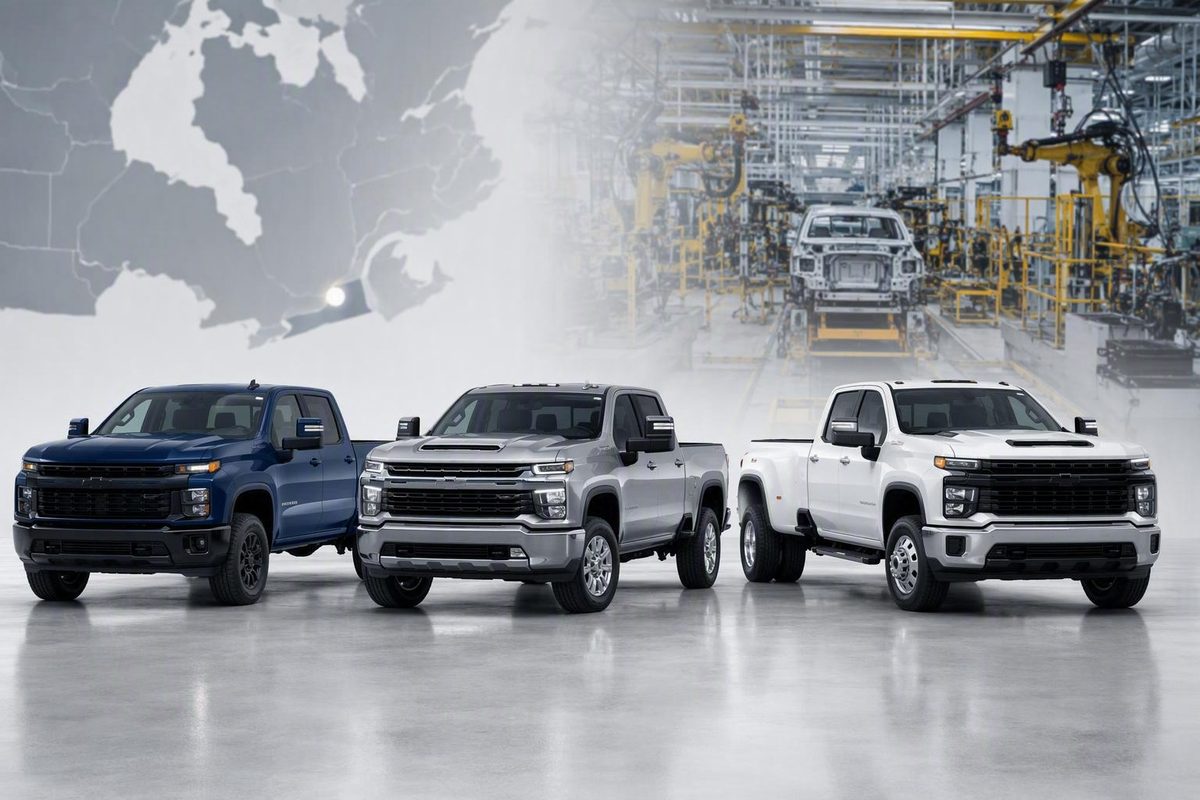
Check whether your Silverado 1500, 2500HD, or 3500HD came from Oshawa, then see whether the threatened 2027 Canada tariff changes your timing.
The threatened 50% tariff on Canadian-built vehicles is mainly a concern for Silverado 2500HD and 3500HD buyers—not a blanket reason to rush out and buy any Silverado. The increase is threatened for January 1, 2027, while industry reporting says Silverado 1500 production could leave Oshawa by late 2026. GM has not confirmed that production change, and any tariff effect still depends on the individual truck’s assembly plant and how much cost reaches its price (GM-Trucks.com, GM Authority).
A Silverado can be Canadian-built. Oshawa Assembly in Ontario produces—or has recently produced—both Silverado light-duty and heavy-duty trucks. But the model name, trim, engine, cab, bed and drivetrain cannot identify the factory. Check the driver-side certification label or original window sticker before treating tariff coverage as relevant to a particular truck.
The Blanket Buy-Now Warning Has a Real Basis
The received wisdom is understandable. A threatened increase from the existing 25% tariff to 50% sounds like a direct warning to buy any Canadian-associated Silverado before January 1, 2027. Oshawa is a documented Silverado plant, so broad coverage can easily turn into “buy your Silverado now before prices jump.”
That warning is directionally reasonable for a Canadian-built vehicle purchased after an enacted increase. Silverado HD buyers deserve particular attention because recent reporting associates 2500HD and 3500HD production with both Oshawa and Flint, Michigan. An Oshawa-built HD could face a different tariff situation from an otherwise similar Flint-built truck.
The warning becomes misleading when applied to every Silverado. Reporting published in June 2026 said AutoForecast Solutions expected Oshawa’s Silverado 1500 assignment to end before the close of 2026 as the next generation entered production. That would put the reported light-duty exit before the threatened January 1 effective date. GM Canada disputed the idea of a planned production scaleback and said next-generation Silverado 1500 production locations had not been disclosed (GM Authority).
The proper verdict is therefore narrower than either headline: there is no plant-blind reason for every Silverado buyer to rush. The strongest potential exposure is a Canadian-built HD purchased after a tariff increase actually takes effect. A 1500 buyer should verify the truck’s plant rather than assume the Oshawa story applies.
Choose your Silverado series and purchase window; the result shows whether tariff-driven urgency fits your truck.
Silverado Canada Tariff Timing Checker
This separates the Silverado 1500 forecast from the continuing HD question. It cannot identify your truck’s plant; use the label or window sticker for that.
The reported Oshawa 1500 exit falls before the threatened tariff date. Verify the individual truck because GM has not confirmed the move and Canadian-built carryover inventory may remain.
All Six Timing Outcomes
| Series | Purchase Window | Oshawa Connection | Timing Verdict |
|---|---|---|---|
| 1500 | Before late 2026 | Oshawa is a reported source alongside Fort Wayne and Silao. | No 2027 deadline yet; check the truck’s plant. |
| 1500 | Late 2026–Dec. 31 | Reported Oshawa exit window; GM has not confirmed it. | No blanket rush; transition details remain unresolved. |
| 1500 | Jan. 1, 2027 or later | Reported exit precedes the threatened tariff date. | No blanket rush; verify carryover inventory. |
| 2500/3500 HD | Before late 2026 | HD is reported at Oshawa and Flint. | No 2027 deadline yet; assembly plant still matters. |
| 2500/3500 HD | Late 2026–Dec. 31 | An HD may be Canadian-built or U.S.-built. | Verify before assigning tariff urgency. |
| 2500/3500 HD | Jan. 1, 2027 or later | Oshawa remains a reported HD source. | Potential exposure only if Canadian-built and the threat takes effect. |
Evidence Needed Before Acting
- Door-area certification label: Look for Canada or Oshawa and match its VIN to the truck.
- Original window sticker: Read the final-assembly entry, not engine or transmission origin.
- VIN: A leading
2supports Canadian origin; decode character 11 for the exact model year and line. - Actual transaction price: A 50% tariff rate is not proof of a 50% retail-price increase.
Current limitation: GM has not confirmed the reported Oshawa 1500 exit, and the threatened tariff’s configuration-specific retail effect is not supplied.
Sources: GM Canada facility information; June 2026 production reporting cited in the article; tariff reporting from August 24–28, 2026. Forecasts are marked as unconfirmed; no retail-price increase is assumed.
Your Truck’s Label Settles What Plant Lists Cannot
Open the driver’s door and inspect the certification label in the driver-side door area. If it identifies Canada or Oshawa, Ontario, that is vehicle-specific evidence of Canadian assembly. Label wording and layout vary by model year, so look for the country or location of manufacture rather than expecting one standard phrase.
Compare the label VIN with the VIN visible through the windshield and the number on the title, registration, insurance record and original window sticker. Resolve a mismatch before buying a used truck. Do not rely on assembly information from a label that belongs to a different VIN.
If the label is missing, damaged, painted over or unreadable, check the original window sticker. Its “final assembly point,” “final assembly plant” or similarly named entry answers where the completed truck was assembled. Consumer Reports likewise recommends using the label and window sticker rather than depending only on a VIN prefix or general factory list (Consumer Reports).
A documented comparison of three selected 2025 Silverado 1500 window stickers shows why trim is not a plant code. The RST shown listed Oshawa, Ontario; the Trail Boss listed Mexico; and the Custom listed Roanoke, Indiana (window-sticker comparison). Those examples identify three individual trucks, not every truck wearing those trims.
Read final assembly separately from engine origin, transmission origin and parts content. A truck finally assembled in Oshawa can contain major components from another country. A Canadian engine or transmission does not make a vehicle Canadian-assembled when final assembly occurred elsewhere.
If the truck’s records are unavailable or contradictory, ask GM or a Chevrolet dealer whether a vehicle-specific build record is available. Avoid posting a complete VIN or an unedited label photograph publicly. A shortened format such as 2G…[redacted] preserves useful context without exposing the full identifier.
The VIN Supports the Answer but Needs Proper Decoding
Modern Silverados use a standardized 17-character VIN. That format generally applies to 1981-and-newer GM trucks; earlier Chevrolet trucks require year-specific identification references.
Characters 1–3 form the World Manufacturer Identifier. Character 11 is the assembly-plant field. The two fields are related but not interchangeable, and the plant character must be interpreted for the correct manufacturer, model year and vehicle line (GM truck VIN guide).
| First Character | Country Generally Indicated |
|---|---|
2 |
Canada |
1, 4 or 5 |
United States |
3 |
Mexico |
A Silverado VIN beginning with 2 is strong supporting evidence of Canadian origin. It is not infallible standalone proof of the exact final assembly plant. The certification label and original window sticker are more direct because they can name the manufacture or final-assembly location for that vehicle.
Do not carry an old Oshawa plant code into a modern Silverado decoder without evidence that it applies to the exact model year and line. Plant characters are not universal geographic codes. The same character can mean something different in another manufacturer’s or vehicle line’s coding system.
The free NHTSA VIN Decoder provides a useful secondary check using information manufacturers submit to NHTSA. Its assembly-plant field can be blank or incomplete, so it does not replace an intact label or original window sticker.
Silverado 1500 and HD Have Different Plant Exposure
Recent production reporting associated Silverado 1500 assembly with Oshawa, Fort Wayne and Silao. It associated Silverado HD production with Oshawa and Flint.
| Plant | Location | Reported Silverado Line |
|---|---|---|
| Oshawa Assembly | Ontario, Canada | 1500 and HD |
| Fort Wayne Assembly | Roanoke, Indiana | 1500 |
| Silao Assembly | Silao, Mexico | 1500 |
| Flint Assembly | Flint, Michigan | HD |
These plant associations narrow the possibilities but cannot identify a truck in a driveway or on a dealer’s lot. They also do not prove that every trim, cab, bed, engine or drivetrain was produced at every listed factory.
Oshawa’s recent Silverado history explains why both lines appear in Canadian-production coverage. Silverado HD production restarted there on November 10, 2021. Silverado 1500 production began in May 2022. A historical account listed both lines as Oshawa products as of September 2022 (Oshawa Assembly history).
Those dates establish past and recent plant assignments, not permanent ones. They also explain the difference between the two tariff stories. The 1500 assignment has a reported late-2026 endpoint, although GM has not confirmed it. No comparable HD exit appears in the supplied reporting, leaving Canadian-built HD trucks more directly connected to the threatened 2027 date.
A 1500 assembled earlier in Oshawa does not become American-built if its production line later moves. Likewise, a future production forecast cannot determine the origin of a truck merely because its model year is near the transition. The truck’s production record still controls.
A 50% Tariff Would Not Equal a 50% Price Increase
The reported policy is a threatened increase in the tariff rate from 25% to 50%, not a documented 50% increase in Silverado window stickers. The draft evidence does not provide a configuration-specific retail price effect.
GM may absorb part of a tariff, change sourcing or production, adjust incentives, raise prices, or use some combination of responses. During the 2025 tariff round, the forecast cost to GM was as high as $5 billion, while the reported result was $3.1 billion. That gap shows why applying the headline tariff percentage directly to a buyer’s price is not sound (GM-Trucks.com).
This does not make the threat irrelevant. It means the sequence matters:
- Confirm that the policy takes effect.
- Confirm that the individual truck was assembled in Canada.
- Determine whether the seller’s actual price reflects additional cost.
- Compare that price with equivalent trucks from another plant.
For an HD buyer, that plant check can separate an Oshawa truck from a Flint truck. For a 1500 buyer shopping after the reported late-2026 transition, it can establish whether a truck is Canadian-built carryover inventory or a vehicle from Fort Wayne, Silao or another disclosed assignment.
Canadian Assembly Does Not Establish Quality or Parts Origin
Final assembly identifies where the completed vehicle was put together. It does not identify the origin of every engine, transmission, electronic module, interior component or piece of steel.
Assembly location alone also supplies no evidence that Canadian-, American- or Mexican-built Silverados are inherently better or worse in quality, reliability, craftsmanship, resale value or long-term durability. A used-truck evaluation should turn on condition, service history, inspection results, configuration, title history and vehicle-specific records.
Treat the Silverado EV separately. It is built in Detroit, while Oshawa coverage concerns combustion-powered Silverado production (Car and Driver).
The Answer Depends on Series, Date and the Individual VIN
For a Silverado 1500, the late-2026 Oshawa forecast undercuts a blanket claim that buyers must purchase before the threatened January 1, 2027 tariff increase. The forecast remains unconfirmed, and Canadian-built inventory could remain available after production changes, so the label still matters.
For a Silverado 2500HD or 3500HD, the tariff issue is more plausible because Oshawa remains one of the reported HD sources. It is still conditional: the truck must be Canadian-built, the threatened policy must take effect, and some of the cost must reach the transaction price.
Check the door-area certification label first, then the original window sticker. Use a properly decoded VIN as confirmation. Without one of those vehicle-specific records, the accurate answer is simply that your Silverado may have been built in Canada, but Canadian assembly has not been confirmed.