
Match Your Silverado 2500HD to Its Actual Tow Rating
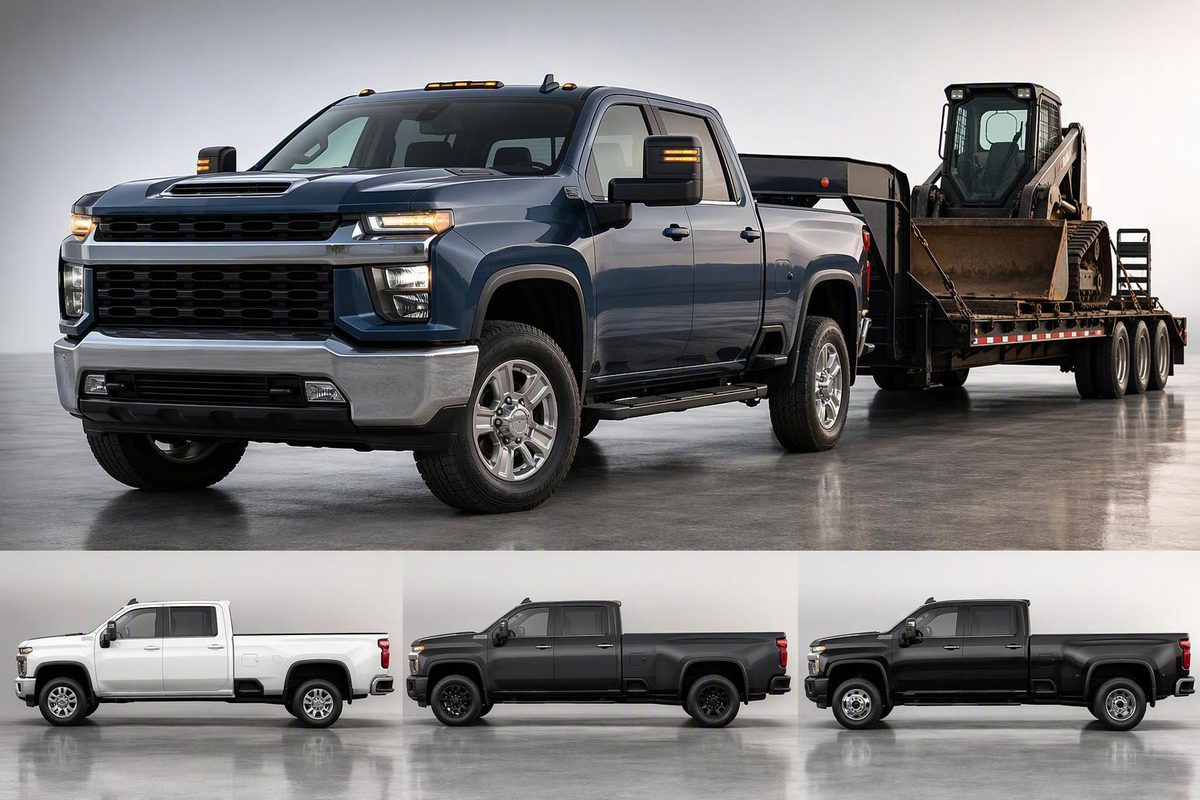
Compare 2026 Silverado 2500HD gas and diesel tow ratings by cab, bed and package, then check the payload limits that can rule out a loaded trailer.
The 2026 Chevrolet Silverado 2500HD tows up to 22,050 lb with a gooseneck or fifth-wheel hitch, or 20,000 lb conventionally, according to Chevrolet’s U.S. 2026 Trailering Guide. Those diesel maximums require specific configurations with the Max Trailering Package; they are not ratings for every 2500HD. The gas-engine maximums are 18,700 lb in-bed and 16,000 lb conventionally, also across different configurations. Source: Chevrolet, pages 31–36.
Choose a listed configuration to see both tow ratings and the wheel/GVWR requirements.
Match A Listed 2500HD Setup
Max = Max Trailering Package. Selected configurations only; an unlisted truck needs its own guide entry and labels.
Diesel Crew Cab 4x4, Standard Bed, Max Trailering; listed 18- or 20-inch wheels; 11,750-lb GVWR. General row, not High Country, ZR2 or ZR2 Bison.
Trailer rating only—not a payload or hitch-load approval. Match the truck’s labels and check loaded weights.
View All Listed Configurations
| Setup And Requirements | Conv. lb | In-Bed lb |
|---|---|---|
| Gas Crew 4x4, Standard18/20/22 in.; GVWR 10,850 lb | 16,000 | 18,380 |
| Gas Crew 4x4, Long18/20/22 in.; GVWR 11,050 lb | 16,000 | 18,280 |
| Diesel Crew 4x4, Standard, no Max18/20/22 in.; GVWR 11,350 lb | 18,500 | 19,200 |
| Diesel Crew 4x4, Long, no Max18/20/22 in.; GVWR 11,550 lb | 18,500 | 19,000 |
| Diesel Crew 4x4, Standard, Max18/20 in.; GVWR 11,750 lb | 20,000 | 21,600 |
| Diesel Crew 4x4, Long, Max18/20 in.; GVWR 11,900 lb | 20,000 | 21,490 |
| Diesel High Country Crew 4x4, Standard, Max20 in.; GVWR 11,750 lb | 20,000 | 20,800 |
| Diesel Regular 4x4, Long, Max18/20 in.; GVWR 11,450 lb | 14,500 | 22,050 |
| Gas Regular 2WD, Long18/20/22 in.; GVWR 10,350 lb | 14,500 | 18,700 |
General Crew Cab rows do not establish ratings for High Country, ZR2 or ZR2 Bison. Only the specific High Country setup shown is covered.
The selector covers the configurations discussed below, not the complete 2500HD lineup. If your truck does not match a listed row, that row cannot establish its capacity. Its Trailering Information Label and the corresponding Chevrolet configuration entry are the starting points for an exact match.
Gas And Diesel Maximums Belong To Different Trucks
| 2026 2500HD Engine | Conventional Maximum | Gooseneck/Fifth-Wheel Maximum |
|---|---|---|
| 6.6L gasoline V8 | 16,000 lb | 18,700 lb |
| Duramax 6.6L Turbo-Diesel V8 | 20,000 lb | 22,050 lb |
These are separate maximums across configurations, not two ratings for one universal truck. Reading across either row tells you what that engine can achieve somewhere in the 2500HD range. It does not identify a truck that achieves both figures.
The gas engine’s 18,700-lb rating applies to a Regular Cab Long Bed 2WD with the listed 18-, 20- or 22-inch wheel configuration and 10,350-lb gross vehicle weight rating (GVWR). That truck’s conventional limit is 14,500 lb. Choosing it for the highest gas in-bed rating therefore does not also deliver the 16,000-lb gas conventional maximum.
A diesel Regular Cab Long Bed 4x4 with the Max Trailering Package, listed 18- or 20-inch wheels and 11,450-lb GVWR reaches 22,050 lb in-bed towing—but also remains limited to 14,500 lb conventionally. Properly configured diesel Crew Cabs with Max Trailering reach the 20,000-lb conventional maximum. Source: Chevrolet’s configuration tables.
That distinction changes the shopping decision. For a conventional trailer, the 22,050-lb headline is not the figure to compare with loaded trailer weight. For a fifth-wheel or gooseneck, the conventional rating is not a substitute for the in-bed rating. Start with the hitch type, then match the truck configuration within that category.
Do not use the Silverado HD family’s advertised 36,000-lb diesel or 19,080-lb gas maximum for a 2500HD. Chevrolet’s Silverado HD model page covers both series; those figures belong to specific 3500HD configurations in the guide’s tables on page 37. A family-level advertisement is not a capacity label for an individual 2500HD.
Selected Crew Cab 4x4 Ratings Show The Package Difference
The following are selected higher-capacity rows from Chevrolet’s guide, not every available Crew Cab configuration. All trucks in this table are Crew Cab 4x4 models. Match the engine, bed, package, factory wheel configuration and GVWR before using a row.
| Crew Cab 4x4 Setup | GVWR | Conventional | In-Bed |
|---|---|---|---|
| Gas, Standard Bed | 10,850 lb | 16,000 lb | 18,380 lb |
| Gas, Long Bed | 11,050 lb | 16,000 lb | 18,280 lb |
| Diesel, Standard Bed, no Max | 11,350 lb | 18,500 lb | 19,200 lb |
| Diesel, Long Bed, no Max | 11,550 lb | 18,500 lb | 19,000 lb |
| Diesel, Standard Bed, Max | 11,750 lb | 20,000 lb | 21,600 lb |
| Diesel, Long Bed, Max | 11,900 lb | 20,000 lb | 21,490 lb |
| Diesel High Country, Standard Bed, Max | 11,750 lb | 20,000 lb | 20,800 lb |
“In-Bed” means gooseneck/fifth-wheel towing; “Max” means the Max Trailering Package. The gas rows and diesel rows without Max Trailering list 18-, 20- or 22-inch wheels. The general diesel Max Trailering rows list 18- or 20-inch wheels. The High Country row lists 20-inch wheels only. Source: Chevrolet 2026 Trailering Guide, pages 34–36.
For the listed general diesel Standard Bed 4x4 rows, Max Trailering raises the conventional rating by 1,500 lb and the in-bed rating by 2,400 lb. That comparison applies to those two matched rows. It is not a universal amount to add to another truck’s existing tow rating.
Bed length also needs an exact match. In the selected gas rows, both beds have a 16,000-lb conventional rating, but their in-bed ratings differ. The selected diesel rows likewise share conventional ratings within each package group while listing different in-bed capacities. Neither “Long Bed” nor “Standard Bed” alone establishes which truck can tow more in every hitch category.
High Country And ZR2 Need Their Own Entries
ZR2, ZR2 Bison and High Country have separate entries; do not apply the general rows to those trims or editions. The table includes one specific High Country configuration, not a blanket High Country rating.
The listed diesel High Country Standard Bed with Max Trailering reaches the same 20,000-lb conventional rating as the general diesel Standard Bed Max Trailering row, but its in-bed rating is 20,800 lb rather than 21,600 lb. Both list an 11,750-lb GVWR. This is why matching only the engine, bed and GVWR can still leave you with the wrong number.
Changing wheels does not, by itself, establish a higher rating. The wheel sizes in Chevrolet’s table describe the rated factory configurations. They are not instructions for converting an otherwise different truck into one of those configurations.
Fifth-Wheel Payload Can Limit An Otherwise Suitable Truck
Chevrolet recommends conventional tongue weight of 10–15% of loaded trailer weight and gooseneck/fifth-wheel pin weight of 15–25%. For some conventional trailer types, it directs owners to follow the trailer manufacturer’s recommended tongue weight instead. Hitch load must stay within the truck’s applicable vehicle, rear-axle and hitch-load limits.
The guide also specifies that at the maximum trailer weight, maximum tongue/pin weight is 10% conventionally or 15% for gooseneck/fifth-wheel towing. A trailer with a higher percentage may therefore require a lower trailer weight. Source: Chevrolet’s trailering notes, pages 8 and 31.
The recommended loading range and the maximum-rating condition serve different purposes. Do not assume that a truck advertised to tow its maximum can also accept a pin load at the top of the recommended percentage range. The trailer-weight rating and the load placed on the truck must both work for the actual combination.
For example, an 18,000-lb loaded fifth-wheel at 20% pin weight puts 3,600 lb on the truck. Add an illustrative 700 lb for occupants, cargo and hitch equipment, and the payload requirement becomes 4,300 lb. Those are example loads, not a published payload allowance for a particular Silverado.
The calculation is loaded trailer weight multiplied by pin-weight percentage, plus occupants, truck cargo and hitch equipment, to estimate the payload required.
A tow rating above 18,000 lb does not settle whether that example fits. Even when the trailer is below the truck’s in-bed tow rating, the truck must have enough occupant/cargo allowance for the resulting load. Its rear-axle and hitch limits must also accommodate the loaded combination.
The figures here do not provide a VIN-specific payload allowance or hitch-load limit. Use the actual truck’s labels and equipment ratings rather than filling those gaps with a model-wide estimate. A sales listing that gives only “maximum towing” leaves this part of the decision unanswered.
The Truck’s Labels Set The Final Configuration Check
Match The Trailering Label Before Using A Guide Row
Read the truck’s Trailering Information Label on the driver-side doorframe for its trailer ratings and gross combination weight rating (GCWR). Compare those ratings with the hitch type you plan to use. A conventional rating and a gooseneck/fifth-wheel rating are separate limits, even when both appear in the same configuration entry.
Next, check the certification label for GVWR and rear-axle rating, and verify the occupant/cargo allowance using the truck’s labels and owner’s manual. GVWR is not a tow rating or an available payload figure. In the comparison table, it helps identify the correct configuration; on the truck, it remains a limit that the loaded vehicle must respect.
If a listing says only “diesel Crew Cab 4x4,” it is missing information needed to choose among the rows above. Confirm bed length, Max Trailering equipment, wheel configuration, GVWR and any trim-specific entry. Do not select the highest diesel Crew Cab number simply because the truck shares the engine and cab.
Keep Hitch Preparation Separate From Max Trailering
The Gooseneck/5th Wheel Prep Package supplies mounting provisions. It is not interchangeable with the Max Trailering Package and does not, by itself, establish a higher tow rating.
For a truck advertised as “fifth-wheel ready,” verify both the applicable in-bed rating and the ratings of the hitch equipment that will actually carry the load. Mounting provisions answer where compatible equipment can attach; the vehicle and hitch ratings answer how much the combination can carry and tow.
Chevrolet describes trailering labels, loading limits and prep-package contents in its 2026 Trailering Guide. Use the specific truck’s labels and owner’s manual for the final hauling decision.
Verify The Loaded Combination, Not Just The Trailer Listing
Weigh the loaded combination with trailer supplies, passengers and truck cargo included. Confirm trailer weight, axle loads and combined weight against every applicable limit. Verify the hitch equipment’s ratings as part of that same check, rather than treating the truck’s trailer rating as permission to exceed a lower equipment limit.
For shopping, the configuration tables narrow the candidates. For hauling, the loaded weights determine whether the truck, trailer and hitch remain within their respective limits. The 2026 Silverado 2500HD’s 22,050-lb maximum is useful only for the specific diesel Regular Cab in-bed configuration that earns it; the right number for your truck is the matched rating supported by its labels, with enough capacity left for the actual hitch load and everything carried aboard.